SMEs are facing a hiring crunch in 2026. With only 12% of small businesses fully staffed, unfilled roles are stalling growth, delaying projects, and increasing costs. The labor market is tight, with unemployment for key roles like payroll professionals at just 0.9%, and inflation is pushing wages higher while squeezing budgets.
Key trends shaping SME hiring this year include:
- AI reshaping recruitment: 78% of SME leaders plan to increase AI investments, but AI-generated resumes are complicating candidate evaluation.
- Sector-specific challenges: Retail job openings are surging (up 58% year-over-year), while tech roles are contracting (-33%).
- Remote work opportunities: 94% of SMEs now offer hybrid work, expanding access to talent but adding complexity to verification processes.
- Skill gaps worsening: 45% of SME leaders say skill shortages are their top challenge, with many turning to reskilling initiatives.
What’s the solution? Scalable recruitment models like embedded recruitment are helping SMEs fill roles faster while cutting hiring costs by up to 70%. By embedding experienced recruiters directly into your team, you gain flexibility without overburdening internal staff, saving time and money.
Don’t let hiring bottlenecks hold your business back. The companies that succeed in 2026 will treat recruitment as a growth driver, not just an admin task. Learn how Rent a Recruiter can help you stay ahead.
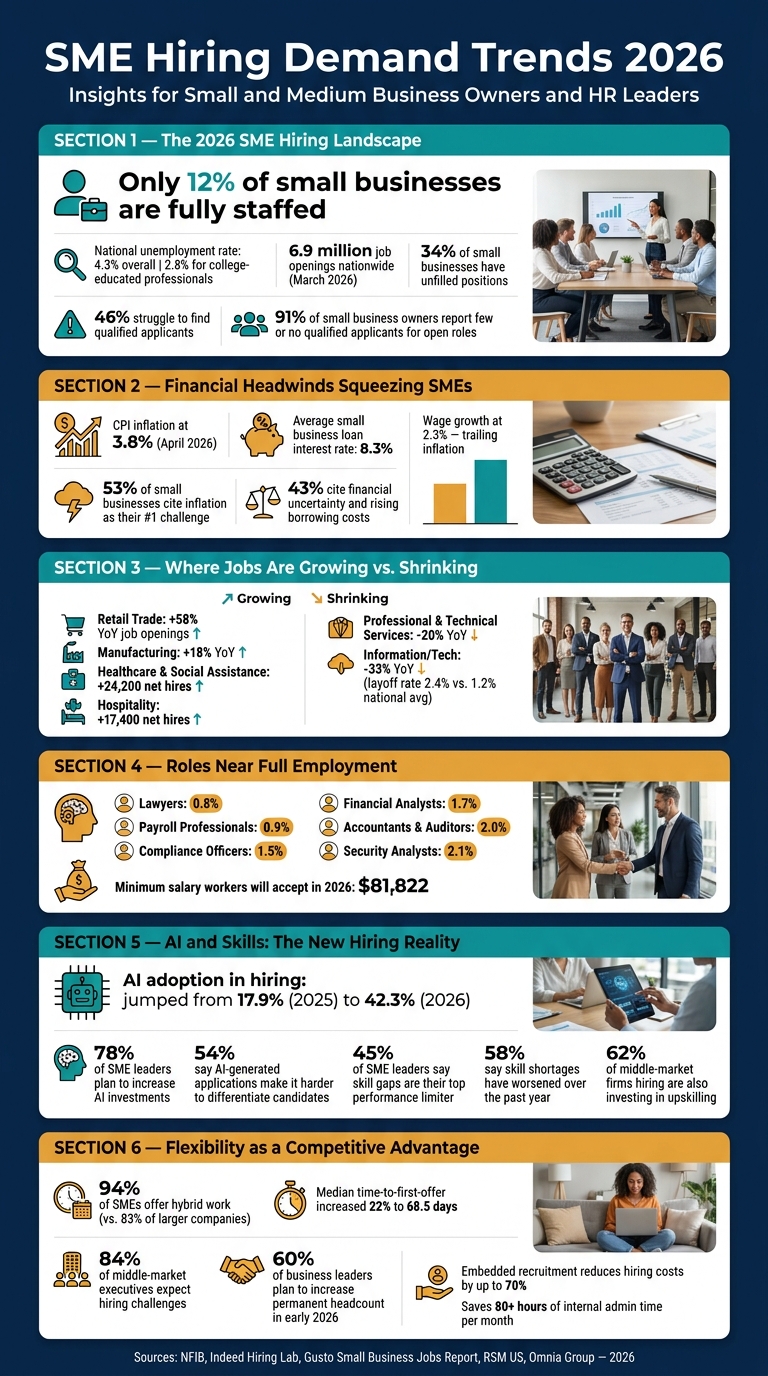
SME Hiring Trends 2026: Key Stats at a Glance
Macroeconomic and Labor Market Trends Affecting SME Hiring
Economic Conditions and Their Effect on Hiring
As of 2026, half of small business leaders have a positive outlook on the U.S. economy. However, 43% identify financial uncertainty and increasing borrowing costs as significant challenges, leading many to adopt a more cautious approach to hiring and favor flexible staffing models [9]. Chris Barber, a member of the U.S. Chamber’s Small Business Council, summed up the situation:
"The biggest challenge facing our business right now is financial uncertainty in the economy which is causing tightening on discretionary spending." [9]
With the U.S. Consumer Price Index (CPI) at 3.8% in April 2026 and short-term small business loan interest rates averaging 8.3%, inflation remains a dominant concern. In fact, 53% of small businesses cite inflation as their top challenge – a trend that has persisted for over four years [9]. These financial pressures are reshaping hiring strategies, making recruitment more complex.
Labor Market Data and Talent Supply
Economic pressures aside, the labor market itself presents ongoing challenges for SMEs. The national unemployment rate sits at 4.3%, dropping to just 2.8% for college-educated professionals [8]. Job openings nationwide remain high at 6.9 million as of March 2026, with a vacancy-to-unemployment ratio of 0.9 [10].
For small business owners, these numbers translate into real hurdles. In April 2026, 34% of small businesses reported having unfilled positions, while 46% said they struggle to find qualified applicants for open roles [6]. Bill Dunkelberg, Chief Economist at NFIB, highlighted the issue:
"A lack of qualified applicants has been a major hurdle for Main Street, and employers are struggling to fill open positions." [6]
Adding to the challenge, wage growth has slowed to 2.3%, trailing behind inflation. This makes it increasingly difficult for SMEs to compete for talent on compensation alone [11]. These dynamics underscore the need for talent acquisition strategies that address both economic and sector-specific realities.
How Hiring Demand Differs by Sector
Hiring trends vary significantly by sector, revealing opportunities and challenges that differ across industries:
| Sector | Net Job Gains (March 2026) | YoY Opening Change |
|---|---|---|
| Healthcare & Social Assistance | +24,200 | – |
| Hospitality (Accommodation/Food) | +17,400 | – |
| Retail Trade | +12,800 | +58% |
| Professional & Technical Services | +9,700 | -20% |
| Manufacturing | +8,400 | +18% |
| Information (Tech) | Net Loss | -33% |
Sources: Gusto Small Business Jobs Report [5]; Indeed Hiring Lab [10]
Healthcare, hospitality, and retail are showing strong hiring momentum, with retail job openings surging 58% year-over-year. In contrast, the tech sector is experiencing a contraction, with job openings down 33% and a layoff rate of 2.4% – double the national average of 1.2%. AI-driven restructuring is a key factor behind these losses [10].
Regionally, the South leads small business hiring with 41,400 net hires in March 2026, followed by the Northeast with 30,600 [5]. For SMEs, this data highlights where talent pools are growing and where expansion efforts might be most effective. Adapting to these sector and regional trends is critical for addressing talent gaps efficiently and staying competitive in a tightening labor market.
sbb-itb-a23bd6a
Shifts in Talent Availability for SMEs
These shifts highlight the urgency for recruitment models that can scale and adapt to fast-changing market conditions.
How Remote and Hybrid Work Changes Talent Access
Remote and hybrid work have dramatically expanded where SMEs can find talent. Instead of being limited to local candidates, small businesses can now tap into national and even international talent pools. Nearshore markets like Latin America, for example, offer access to highly educated, English-speaking professionals who work in time zones that align well with U.S. businesses [12].
Flexibility has become a critical advantage. 94% of SMEs offer hybrid work arrangements, compared to just 83% of larger companies [2]. This agility allows smaller firms to make quick decisions on flexible arrangements, often securing top candidates faster than bigger competitors. However, with remote hiring comes new challenges, particularly around candidate verification. Structured behavioral interviews and practical assessments have become essential tools for ensuring candidates meet the mark.
As SMEs broaden their reach, addressing the skills gap becomes even more pressing. This expanded access demands a sharper focus on refining job criteria and building diverse skill sets.
Closing Skill Gaps Through Reskilling
Skill gaps are now one of the biggest barriers to SME growth. 45% of small business leaders cite these gaps as the top factor limiting performance in 2026 [1], and 58% report that the problem has worsened over the past year [4]. Ana Minter, Principal at RSM US LLP, captured the shift in expectations, saying:
"Companies are no longer searching for people who can just do things. They are searching for people who can transform how things are done." [13]
Rather than waiting for the perfect hire, many SMEs are focusing on their current workforce. 62% of middle-market firms planning to hire are also investing in upskilling their teams [13][14]. Initiatives like mentorship programs, certification reimbursements, and allocating time for learning not only build skills but also improve employee retention.
Another key insight: many skill shortages are actually role clarity issues. Clearly defining what success looks like in the first 6–12 months and separating essential skills from "nice-to-haves" can significantly expand the talent pool without compromising on quality [7].
These internal efforts are essential as demographic changes further influence hiring dynamics.
Demographic Shifts and Their Effect on Hiring
The talent market isn’t evolving uniformly. Certain professional roles are nearing full employment, making traditional recruitment methods less effective.
| Role | Unemployment Rate |
|---|---|
| Lawyers | 0.8% |
| Payroll Professionals | 0.9% |
| Compliance Officers | 1.5% |
| Financial Analysts | 1.7% |
| Accountants & Auditors | 2.0% |
| Security Analysts | 2.1% |
Source: Indeed Hiring Lab [3]
At the same time, the Class of 2026, representing early-career professionals, is entering the workforce with new priorities. They value AI skills, meaningful work, and clear career advancement opportunities over traditional markers like employer brand [8][15]. Given that the average minimum salary workers will accept has risen to $81,822 in 2026, SMEs need to offer more than just competitive pay [12]. Companies that emphasize mentorship and structured career development are better positioned to attract this group.
Tuan Nguyen, Economist at RSM US LLP, described the broader landscape as a K-shaped labor market:
"The labor market has slowed down materially compared to previous years, and that slowdown is not the same for everybody. We are seeing that K-shaped economy evolving even more; you have bigger firms still in good shape, but smaller firms struggling a little bit more." [13]
For SMEs, standing out in the talent market requires more than just job postings. Success depends on a thoughtful approach – one that blends flexibility, targeted reskilling, and a clear value proposition tailored to candidates at every stage of their careers.
Hiring Trends SMEs Should Plan for in 2026
Staying ahead of hiring trends is crucial for SMEs looking to build strong, future-ready teams. By focusing on emerging demands and adjusting strategies accordingly, businesses can prioritize the right roles and set themselves up for success. Here are three key trends shaping SME hiring strategies in 2026.
Growing Demand for AI and Automation Skills
The impact of AI on recruitment strategies has seen a massive leap, rising from 17.9% to 42.3% between 2025 and 2026. This rapid growth means SMEs must rethink what they’re looking for in new hires. It’s not just about finding people who can operate AI tools. Instead, the focus is shifting to candidates who know when and how to use AI effectively, ensuring it delivers measurable results.
Hybrid roles are at the forefront – candidates who combine technical AI expertise with business insight are in high demand. As highlighted in the Omnia Group Talent Trends Report:
"AI is creating new opportunities, but without prepared people, those opportunities are difficult to translate into consistent outcomes." [16]
However, with 54% of small business leaders reporting that AI-generated applications make it harder to differentiate candidates [4], the hiring process is evolving. Role-specific screening questions and practical tests are now essential to identify the right talent.
This shift also impacts Marketing and Sales, where the integration of AI and data-driven tools is redefining job requirements.
Changing Role Profiles in Marketing and Sales
Marketing and Sales teams are transforming, with small businesses (under 100 employees) accounting for 63% of job openings in these areas [4]. Gone are the days when these roles were solely about campaign execution. Today’s hires must be comfortable working with data analytics, automation platforms, and AI-driven content tools.
To attract the right talent, SMEs need to clearly define their expectations. By distinguishing between essential skills and those that are merely nice-to-have, businesses can find specialists who can reshape how their marketing and sales functions operate. This approach ensures SMEs hire individuals who can drive strategy and innovation, rather than generalists focused only on day-to-day tasks.
Rising Need for HR and Operations Talent
Hiring timelines are stretching longer, with the median time to first offer increasing by 22% to 68.5 days [17]. This, combined with 84% of middle-market executives expecting hiring challenges [14], is putting pressure on HR and operations teams.
For SMEs, HR is no longer just a support function. It’s becoming a strategic partner in aligning workforce planning with broader business goals. As Mark Loughnane, Lead of Rent a Recruiter, explains:
"Workforce planning for SMEs only works when HR is aligned with commercial decision-making." [7]
Additionally, small businesses hold the largest share of Administrative and Customer Support job openings, at 64% [4]. Investing in HR and operations talent now will help SMEs scale effectively while maintaining momentum. By addressing these evolving demands, businesses can create a recruitment strategy that supports growth and keeps them competitive in 2026.
Building a Scalable Recruitment Strategy for 2026
With hiring timelines growing longer and skills gaps becoming more pronounced, SMEs can’t afford to rely on guesswork when planning their workforce. A scalable recruitment strategy ensures your hiring process evolves with your business – maintaining both speed and quality as you grow.
Using Data to Forecast Hiring Needs
One practical way SMEs can stay ahead is by shifting from annual headcount planning to quarterly hiring reviews. Labor markets move quickly, and a plan drafted in January might be outdated by spring. Quarterly reviews keep hiring strategies aligned with changing market conditions, allowing businesses to adapt rather than fall behind.
"The 2026 labor market is actually hundreds of distinct markets operating under different rules. Your hiring strategy needs to reflect the reality on the ground." [19]
With labor force participation at 61.9% in March 2026 [18], businesses face a 20% drop in applicants per role due to declining local participation. Setting internal thresholds – such as flagging a 25% drop in applicants per posting – can prompt immediate action, whether by expanding sourcing efforts or revisiting compensation packages. These early adjustments are crucial for a recruitment process that stays responsive.
Before opening a new role, ask yourself: what happens if this hire is delayed by three months? If the answer impacts revenue or compliance, that role becomes a top priority [7].
By leveraging data-driven insights, SMEs can build scalable hiring processes that adapt to fluctuating demands.
Embedded Recruitment for Flexibility and Cost Control
For SMEs, creating a recruitment function that can scale with demand – without the cost of a full internal team – is often a top priority.
An embedded recruitment model places a skilled recruiter directly within your business. They manage the entire hiring process while ensuring consistency and structure. This approach is particularly effective during periods of rapid growth, product launches, or post-funding surges when internal resources are stretched thin.
The results speak for themselves. MasterTech partnered with Rent a Recruiter for 27 months, embedding a Talent Partner who delivered 29 placements with a 4:1 CV-to-interview ratio, saving the company $123,000 compared to traditional agency fees [7]. Similarly, Unique used an embedded model to manage 291 interviews across global offices in Berlin, Zurich, New York, London, and Singapore – resulting in 10 hires in just a few months [7].
Rent a Recruiter supports high-growth SMEs in sectors like technology, SaaS, fintech, engineering, and professional services. Their embedded recruitment approach typically reduces hiring costs by up to 70% compared to commission-based models, while saving over 80 hours of internal admin time each month.
Measuring Recruitment Performance Over Time
Once your recruitment strategy is in place, tracking performance is essential to ensure it continues to deliver results. Monitoring key metrics transforms recruitment from a reactive process into a proactive, predictable function. Here are the most critical indicators to watch:
| Metric | What It Measures |
|---|---|
| Time-to-Fill / Time-to-Offer | Speed of your hiring pipeline |
| Cost-per-Hire | Efficiency of recruitment spending |
| Quality-of-Hire / First-30-Day Churn | Fit and retention of new hires |
| Applicants per Posting | Strength of sourcing channels and market supply |
| Offer Acceptance Rate | Competitiveness of your compensation and employer brand |
| Time-to-Productivity | How quickly new hires contribute to business goals |
Tracking time-to-fill in real time, rather than waiting for quarterly reviews, allows you to address delays before they escalate. For high-value roles, aim for a 48- to 72-hour window from posting to conditional offer [18]. Achieving this requires pre-approved offer bands, standardized interview templates, and regular benchmarking against local competitors. Even a small salary difference – just 2% to 5% – can sway candidates in a tight market [18].
Conclusion: Getting SME Hiring Ready for 2026
By 2026, SMEs will grapple with tighter talent pools, longer time-to-fill metrics, and a surge of AI-generated applications that complicate identifying quality candidates. With 91% of small business owners reporting few or no qualified applicants for open positions by the end of 2025 [3], the urgency to adopt smarter recruitment strategies is undeniable.
The businesses that thrive will be those treating recruitment as a proactive, strategic function. This means shifting to skills-based evaluations, incorporating flexibility into workforce planning, and being upfront about total compensation from the outset.
With 60% of business leaders planning to increase permanent headcount in early 2026 [3], the competition for top talent – especially in finance, legal, and tech sectors with unemployment rates below 2% – will only heat up. Slow or fragmented hiring processes simply won’t cut it.
Embedded recruitment provides a practical solution to these challenges. Rent a Recruiter places experienced recruiters directly within your team in a matter of days. This approach streamlines hiring, ensures consistency, and cuts hiring costs by up to 70% compared to traditional commission-based recruitment models – all while saving over 80 hours of internal admin each month.
The formula for success is straightforward: forecast quarterly hiring needs, focus on roles that directly impact revenue, thoroughly assess candidates, and establish a recruitment function built to scale. SMEs that take these steps now will be far better equipped to navigate the challenges of 2026 and achieve sustainable growth.
FAQs
Which roles should my SME prioritize hiring for in 2026?
In 2026, SMEs should zero in on roles that directly impact revenue, efficiency, and growth. Key areas include sales, customer support, and technical expertise – all crucial for driving income and maintaining strong client relationships.
With ongoing talent shortages in fields like finance, legal, and IT, it’s essential to focus on critical skills like AI proficiency and the ability to adapt to change. To bridge skill gaps while managing budgets, consider upskilling your current team or leveraging flexible talent solutions, such as freelancers, for a cost-effective approach.
How can I spot real skills when candidates use AI-generated resumes?
To spot real skills in AI-generated resumes, focus on structured interviews that include live demonstrations, problem-solving tasks, and behavioral questions. Dive into specific projects and ask candidates to explain their decision-making processes in detail. Cross-check for consistency between the resume, interview responses, and online profiles to ensure authenticity. Use work simulations and behavioral assessments to gauge performance in real-time. Additionally, AI screening tools can help flag issues like overly polished job description matches or rehearsed answers.
When does embedded recruitment make sense for an SME?
Embedded recruitment works well for SMEs when their internal teams are overwhelmed, hiring needs to move quickly, and aligning new hires with the company’s culture and goals is non-negotiable. It’s especially effective over a set period, typically 6 to 12 weeks, providing focused, efficient support tailored to your specific recruitment challenges.