
When hiring at scale, you’re caught between two critical priorities: speed and compliance. Move too fast, and you risk costly legal mistakes. Slow down, and you lose candidates to competitors. The real challenge? Building a process that does both without breaking under pressure.
Key insights:
- 42% of staffing teams struggle with compliance during high-volume hiring.
- Missing I-9 deadlines or background checks can result in fines of $281–$2,789 per violation.
- Delays lead to 46% of hires not showing up on Day 1, creating operational chaos.
The solution: Standardizing workflows, automating compliance tasks, and embedding experienced recruiters into your team. This approach ensures every hire meets legal requirements while keeping up with hiring demand. Providers like Rent a Recruiter help scaling companies reduce hiring costs by up to 70% and reclaim over 80 hours monthly.
Let’s explore how to balance speed and compliance, avoid risks, and build a scalable hiring process.
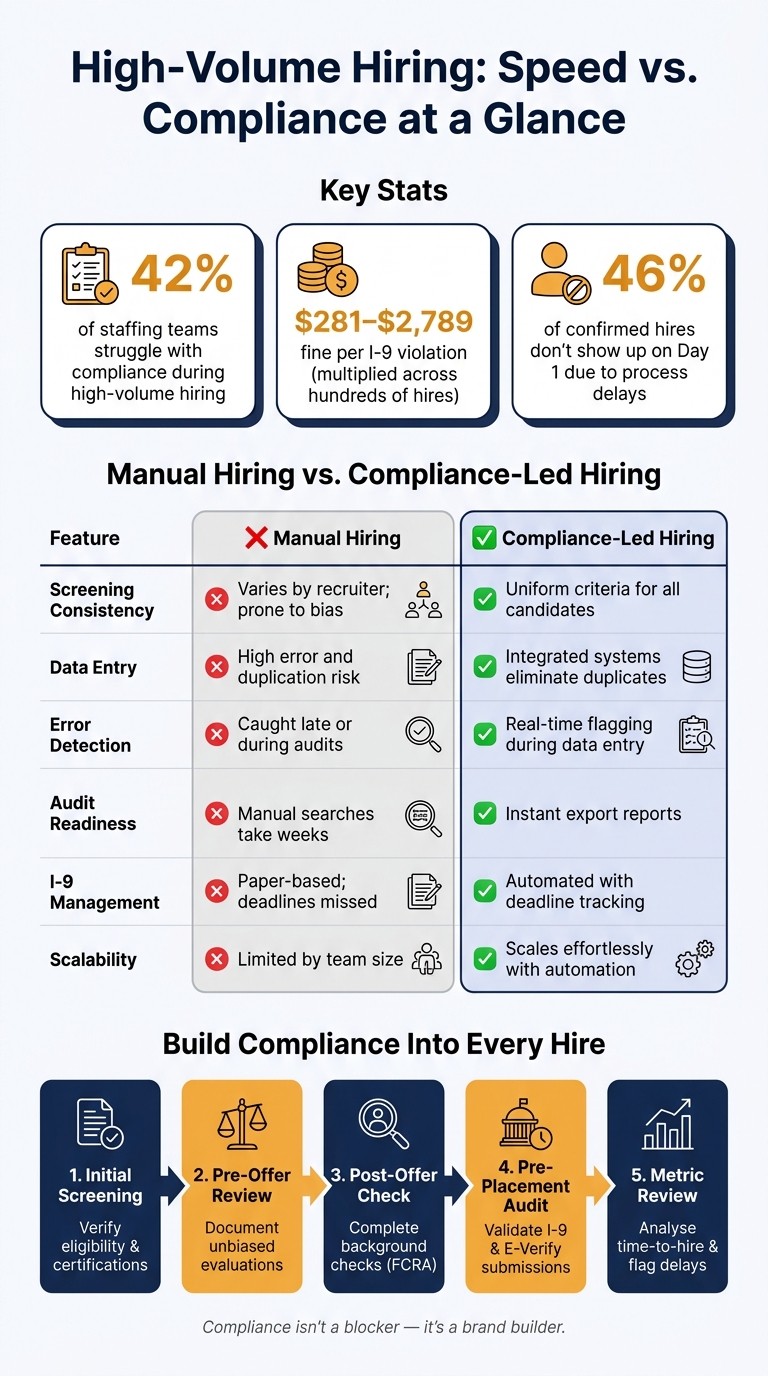
High-Volume Hiring: Speed vs. Compliance at a Glance
High-Volume Hiring and Compliance: The Core Concepts
What is High-Volume Hiring?
High-volume hiring involves filling a large number of similar roles within a tight timeframe. This approach is common in industries like retail, logistics, call centers, customer service, and others where workforce needs can surge quickly. A prime example is Amazon’s annual drive to onboard 150,000 seasonal workers ahead of the holidays, with candidates moving from application to start date in just a matter of days [7].
What makes high-volume hiring distinct isn’t just the scale – it’s the way the process is structured. Sourcing happens at lightning speed, screening is uniform across candidate groups instead of being tailored, and technology takes on much of the heavy lifting. The focus shifts from prioritizing "quality of hire" to achieving "throughput with a minimum quality threshold." Without this shift, the process simply can’t handle the demand.
What Does Compliance Mean in Hiring?
Compliance in hiring refers to meeting all legal and procedural requirements employers are obligated to follow, regardless of hiring volume. In the U.S., this includes tasks like completing Form I-9 (with Section 1 required on the candidate’s first day and Section 2 within three business days), conducting E-Verify checks where mandated (states like Florida, Tennessee, and North Carolina are expanding these requirements), and adhering to the Fair Credit Reporting Act (FCRA) when performing background checks.
Compliance also covers anti-discrimination laws under Title VII, EEOC guidelines, "ban-the-box" legislation, proper classification of workers, and data privacy rules such as the CCPA. Additionally, employers must follow record retention rules, such as keeping I-9 forms for three years after the hire date or one year after termination, whichever comes later.
In high-volume hiring, the fast-paced nature of recruitment creates a stark contrast to these detailed compliance requirements, leading to significant challenges.
Why Speed and Compliance Pull in Opposite Directions
The inherent tension between speed and compliance becomes clear when examining their underlying priorities. High-volume hiring thrives on rapid execution, while compliance demands precision and thoroughness – processes that can’t be rushed.
Every candidate must still undergo the same documentation, verification, and audit steps, even as hiring volume increases. When speed takes precedence, small errors – like missing I-9 deadlines or skipping a background check – can quickly escalate into larger, systemic risks. As Newbury Partners points out:
"When teams are under pressure to deliver candidates fast, certain critical checks and balances can become vulnerable to oversight." [3]
This is not a rare issue. 42% of staffing firms admit to struggling with compliance during high-volume hiring periods [3]. It’s a widespread challenge for teams operating without robust systems in place.
Understanding these dynamics is key to creating hiring processes that can handle rapid onboarding without compromising legal requirements.
The Pressure to Hire Fast
What Drives the Need for Speed
In high-volume hiring, speed isn’t just a preference – it’s a necessity. Seasonal demand is one of the clearest examples. Take retail as a case study: each Q4, the industry scrambles to fill over 500,000 temporary roles [7]. But it’s not just about holiday surges. Funding milestones and aggressive growth targets also create intense pressure. If leadership commits to a product launch or investors set headcount goals, the hiring team is expected to meet those deadlines, not negotiate them.
And then there’s the competitive job market. Frontline candidates, especially, don’t wait around. They often apply to multiple roles and accept the first solid offer they receive [6].
To make matters more challenging, recruiters are often stretched thin, juggling 20+ roles at once. This forces hiring teams to focus on immediate needs, often at the expense of scalable hiring processes [8]. The result? A race against time, with significant risks when things slow down.
What Happens When Hiring Slows Down
The fallout from a slow hiring process is both immediate and measurable. One of the most obvious issues is candidate drop-off. In many cases, applicants simply lose interest if the process drags on too long. Even when hires are confirmed, delays in onboarding can lead to shocking numbers: 46% of high-volume hiring teams report Day 1 no-shows [6]. In some scenarios, nearly one-third of confirmed hires fail to show up at all [6].
Operationally, the effects are crippling. Understaffed warehouses mean delayed shipments, unhappy customers, and lost revenue. Recruiters, bogged down by manual paperwork, face burnout [8]. Many organizations are turning to Recruitment as a Service to alleviate this administrative burden and stabilize costs. And in the rush to fill roles, shortcuts in compliance can lead to long-term risks that far outweigh the initial urgency.
"We lost candidates overnight because we couldn’t schedule fast enough." – Recruiter, via Mitratech [6]
Speed Drivers vs. Consequences: A Comparison
The table below highlights how the drivers of speed in hiring directly correlate with operational challenges when the pace falters:
| Speed Driver | Consequence of Falling Behind |
|---|---|
| Funding/growth goals: Pressure to scale to meet investor or leadership targets [8][9] | Missed targets: Failure to meet growth milestones or launch deadlines [9] |
| Seasonal peaks: Immediate need for staff during holidays or summer rushes [5][6] | Operational disruption: Delayed orders, half-staffed floors, lost revenue [6] |
| Competitive market: Candidates accept the first offer they receive [6] | Candidate drop-off: High ghosting rates and Day 1 no-shows [6] |
| Productivity gaps: Vacancies strain existing teams and reduce output [1][8] | Team burnout: Decreased morale and increased attrition among overstretched staff [8] |
Scale High Volume Recruiting Processes with Pendo: Improve Compliance and Efficiency
To see how your current processes measure up, take our recruitment health check.
Why Compliance Cannot Be Skipped at Scale
In the rush to meet high-volume hiring demands, compliance often takes a backseat. But skipping it isn’t just risky – it can lead to mounting legal and financial consequences as hiring scales up.
Key Compliance Requirements in Hiring
When hiring ramps up, even small compliance errors can snowball into costly penalties. Legal obligations tied to high-volume hiring don’t loosen under time pressure. For instance, mistakes in Form I-9 documentation can result in fines ranging from $281 to $2,789 per violation. Multiply that by hundreds of hires, and the numbers become staggering [10].
And it’s not just about I-9s. Employers must navigate a web of evolving regulations, such as:
- State-specific E-Verify mandates: States like Florida, Tennessee, and North Carolina have expanded requirements to ensure eligibility verification [6].
- FCRA-compliant background checks: Ensuring checks align with federal guidelines to avoid lawsuits or hiring risks [4].
- Worker classification: Properly identifying employees versus contractors to avoid tax liabilities [3].
- Pay transparency laws: Certain states now mandate salary ranges in job postings, with non-compliance leading to fines [5].
"Compliance should never be compromised for speed." – Beth Montgomery, Senior Director of Operations, OutSolve [5]
Why Compliance Gets Harder as Hiring Volume Grows
Most companies know the rules. The real challenge? Managing compliance at scale. Manual processes that might work for smaller teams often crumble under the weight of hundreds of hires. Errors like missing signatures or incorrect dates become harder to catch and fix when processing candidates in bulk [2].
The problem compounds when hires don’t stick. With 46% of high-volume hiring teams reporting Day 1 no-shows [6], recruiters often find themselves redoing compliance paperwork for replacement hires. This effectively doubles their workload. Add multi-state hiring into the mix – where each state may have unique rules for "ban-the-box" laws, disclosure timelines, or E-Verify requirements – and the complexity grows exponentially [4][6].
"High-volume hiring escalates compliance risk. Organizations that address these risks proactively will operate more confidently in 2026." – Canary AI [2]
Compliance Requirements vs. Risks: A Comparison
Here’s a breakdown of how compliance missteps can lead to serious consequences as hiring scales:
| Requirement | Risk |
|---|---|
| Form I-9 Verification | Fines ranging from $281 to $2,789 per form; legal action during ICE audits [6][10] |
| E-Verify Submission | State-level penalties, loss of business licenses, and reputational damage [6] |
| Background Screening (FCRA) | Lawsuits, financial penalties, and hiring individuals with disqualifying histories [4] |
| Worker Classification | Legal disputes over employee vs. contractor status and tax liabilities [3] |
| Pay Transparency | Fines from state/local labour departments and deterred candidates [5] |
| Document Retention | Failure to produce records during audits resulting in significant penalties [6] |
| EEO Consistency | Discrimination claims due to inconsistent evaluation criteria across candidates [3] |
The risks grow in proportion to your hiring volume. For example, overlooking just one I-9 form in a small team might seem minor. But apply that same error rate to 500 hires, and you’re looking at a major compliance crisis. Skipping the details isn’t just a gamble – it’s a liability.
sbb-itb-a23bd6a
How to Balance Speed and Compliance in Hiring
Balancing the need for speed with the demand for compliance in hiring can feel like walking a tightrope. But with efficient systems and processes, it’s possible to move quickly while staying legally protected.
The key? Building workflows that integrate compliance into every step, rather than treating it as an afterthought.
Standardization and Automation
One of the biggest risks to compliance is inconsistency. When every recruiter follows a different process, mistakes are inevitable. Standardized workflows – like documented screening criteria and mandatory compliance checkpoints – ensure every candidate is vetted the same way, no matter who handles their file.
Automation can take this consistency to the next level. 61% of staffing agencies and in-house teams already use AI-powered recruitment tools for tasks like resume parsing and screening [6]. But automation isn’t just for sourcing. It shines in compliance-heavy tasks:
- Digital I-9 management flags missing signatures or incorrect dates instantly.
- Automated reminders keep track of Section 1 and 2 deadlines.
- Integrated systems sync data between ATS and HRIS, cutting down on duplicate entry errors.
"Automation isn’t about replacing human oversight; it’s about empowering your team to maintain thorough compliance checks while meeting tight deadlines." – Newbury Partners [3]
Of course, automation isn’t infallible. That’s where human oversight comes in, ensuring any gaps are caught before they become problems.
Quality Checks and Escalation Paths
Automation handles routine tasks, but some compliance challenges need a human touch. Without a clear escalation path, issues like classification ambiguities or state-specific E-Verify requirements can grind hiring to a halt.
The solution? Build multi-stage quality checkpoints into your process. Instead of treating compliance as a final hurdle, address it at every stage. Catching issues early – like during initial screening – saves time and money compared to fixing them after an offer is made or, worse, after a candidate starts.
| Checkpoint Stage | Purpose |
|---|---|
| Initial Screening | Verify eligibility and required certifications. |
| Pre-Offer Review | Ensure unbiased evaluations are documented. |
| Post-Offer Check | Complete background checks and screenings. |
| Pre-Placement Audit | Validate I-9 completion and E-Verify submissions. |
| Metric Review | Analyse time-to-hire and pinpoint process delays. |
A rapid response team, trained in areas like I-9 audits and state-specific rules, can step in to resolve complex issues quickly, keeping the hiring process on track [3].
Manual Hiring vs. Compliance-Led Hiring: A Comparison
The cracks in manual hiring processes become painfully obvious when hiring volumes spike. Files go missing, deadlines are missed, and audit readiness becomes a scramble. For example, during an ICE audit, all I-9 documentation must be provided within three business days – a daunting task if your system relies on paper files [6].
Compliance-led hiring, on the other hand, is built for scale. Here’s how the two approaches stack up:
| Feature | Manual Hiring | Compliance-Led Hiring |
|---|---|---|
| Screening Consistency | Varies by recruiter; prone to bias [1][4] | Uniform criteria applied to all candidates [1][4] |
| Data Entry | High risk of errors and duplication [5] | Integrated systems eliminate duplicate entries [5] |
| Error Detection | Errors caught late or during audits [2] | Real-time flagging during data entry [2] |
| Audit Readiness | Manual file searches take weeks [6] | Instant reports with a single export [6] |
| I-9 Management | Paper-based; deadlines often missed | Automated with deadline tracking [5][6] |
| Scalability | Limited by team size | Scales effortlessly with automation |
The takeaway? A structured, compliance-led approach doesn’t just keep you audit-ready – it actually speeds up hiring. By embedding compliance into your workflows, you eliminate bottlenecks and avoid costly last-minute fixes.
Scalable Hiring Models for Growing Companies
Even the best recruitment tools won’t deliver results if your hiring team can’t keep up with compliance demands. That’s why your hiring model is just as critical as your workflows. A well-structured model transitions seamlessly into a scalable recruitment process, ensuring your hiring efforts stay on track as you grow.
Why Embedded Recruitment Works
When hiring volumes increase, many in-house teams struggle to keep up. Processes that handle 10 hires a month often buckle under the pressure of higher demands. This can lead to rushed documentation, inconsistent candidate screening, and compliance oversights.
Embedded recruitment solves these issues by embedding experienced recruiters directly into your team. These professionals oversee every step of the hiring process – from sourcing candidates to conducting compliance audits – ensuring accuracy and consistency even during hiring surges. Because they work as part of your team, they apply the same standards across every hire, keeping your processes audit-ready no matter how fast you’re scaling.
"In high-volume hiring, consistency is your strongest ally. A standardized screening process is your foundation for maintaining compliance while moving quickly." – Newbury Partners [3]
Embedded recruiters also act as a first line of defense for compliance challenges. They can quickly address state-specific requirements, flag misclassification risks, and resolve documentation issues before they derail the hiring process.
How Rent a Recruiter Supports High-Volume Hiring
Taking embedded recruitment to the next level, Rent a Recruiter provides a tailored solution for businesses experiencing rapid growth. Rent a Recruiter partners with high-growth companies in sectors like technology, SaaS, fintech, engineering, and professional services – companies that often face sudden hiring spikes without the systems to manage them effectively.
With Rent a Recruiter, experienced recruiters join your team within days, bringing structure, visibility, and consistency to the hiring process. This approach doesn’t just streamline hiring; it also delivers measurable results. Companies typically reduce hiring costs by up to 70% and reclaim over 80 hours each month that would otherwise be spent on administrative tasks. That extra time allows your HR team to focus on critical areas like compliance, onboarding, and retention.
Whether you’re scaling after securing funding, preparing for a product launch, or navigating seasonal hiring spikes, the embedded recruitment model ensures you have the capacity to meet demand. And most importantly, it does so without compromising the compliance standards that safeguard your business.
Conclusion and Next Steps
Managing high-volume hiring while staying compliant doesn’t have to feel like a constant tug-of-war. While the challenges are real, they become manageable with the right systems and mindset in place.
Key Takeaways
Here’s the bottom line: compliance should be woven into your hiring process, not tacked on at the end. By using standardized screening criteria, automating I-9 and E-Verify workflows, and validating documentation in real time, you can reduce risks without slowing down hiring. This matters even more when you consider that 42% of staffing firms face compliance issues during high-demand periods [3]. A proactive approach to compliance isn’t just about avoiding penalties – it’s a competitive advantage.
"Compliance isn’t a blocker, it’s a brand builder. Companies that take it seriously aren’t slower. They’re safer, more scalable, and more appealing to the talent you actually want to keep." – RemoFirst [9]
By embedding compliance into every stage of hiring, you create a process that balances speed with security, ensuring you’re ready to scale without sacrificing standards.
Call to Action
When hiring demand surges, your current process might not keep up. That’s where Rent a Recruiter comes in. Within days, an experienced recruiter can be embedded directly into your team, bringing the structure and consistency you need to hire at scale while maintaining compliance. Companies partnering with Rent a Recruiter often cut hiring costs by up to 70% and reclaim over 80 hours a month previously spent on admin tasks. This allows your HR team to focus on what truly matters – strategic growth.
Book a call with Rent a Recruiter to see how embedded recruitment can streamline your hiring and compliance efforts.
FAQs
What should I automate first to stay compliant during high-volume hiring?
To stay compliant during periods of high-volume hiring, begin by automating the collection and storage of critical documents like Form I-9s and employment eligibility verifications. Leveraging an Applicant Tracking System (ATS) can help you standardize workflows, maintain clear audit trails, and track document retention deadlines with ease. Additionally, automating tasks like background checks and pre-employment assessments ensures consistent evaluations, reduces bias, and eliminates unnecessary delays, keeping your hiring process both efficient and audit-ready.
How can I cut Day 1 no-shows without slowing the hiring process?
To cut down on Day 1 no-shows without slowing down the process, prioritize an efficient and automated candidate experience. Set up automated reminders for key onboarding steps, like completing Form I-9, to keep candidates engaged and informed. Streamline workflows by ensuring job descriptions are clear and training sessions are pre-scheduled, reducing unnecessary back-and-forth. By automating admin-heavy tasks, you eliminate bottlenecks, helping candidates stay on track and show up ready for their first day.
When does it make sense to embed a recruiter with Rent a Recruiter?
Embedding a recruiter through Rent a Recruiter makes perfect sense for businesses scaling quickly and juggling increased hiring needs. It’s a smart way to tackle hiring capacity while staying compliant with regulations. This approach not only cuts recruitment costs but also simplifies the entire hiring process, making it easier to handle sudden surges in demand. Whether you’re aiming to hit short-term hiring targets or looking to establish a scalable recruitment framework, this solution ensures compliance and significantly reduces the administrative burden that comes with growth.