
If your offer does not show flexibility, clear pay, and a clear path for growth, you will lose more hires, and pay for it in delay, lost output, and extra hiring spend.
I see the pattern clearly in scaling SaaS, Technology, IT, Fintech, Engineering, Security, Insurance, and Professional Services teams. High-demand candidates now judge offers on three things first: how they will work, what they will earn, and where the role leads. That matters because offer acceptance fell to 51% in Q2 2025, down from 74% in 2023. Lower acceptance means more back-and-forth, more stalled roles, and more cost per hire.
If you want better hiring outcomes, focus your offers on:
- Flexibility first, because remote, hybrid, and flexible hours now shape whether people stay in process
- Clear total pay, because candidates compare base salary, bonus, health cover, retirement match, PTO, and sign-on cash line by line
- Growth and manager quality, because when pay is close, the hiring manager, career path, and company stability often decide the outcome
- Fast offer process, because slow approvals and vague terms give other employers time to win the hire
A few numbers make the point fast:
- 85% of AI job listings offered remote or hybrid work
- Candidates may trade about 25% of total compensation for partial or full remote work
- 75% of tech workers rank base salary above equity in negotiation
- 67% of 2026 graduates say they would trade pay for more job security
- Teams that move from first contact to interview within five business days see 2.1 times higher acceptance
For you, the message is simple. The best offers are not just higher. They are clearer, faster, and easier to judge. That is what helps you cut late-stage drop-off, shorten time to fill, and make hiring plans more reliable.
The rest of the article breaks down what to put into those offers, and how to turn those points into a repeatable hiring process.
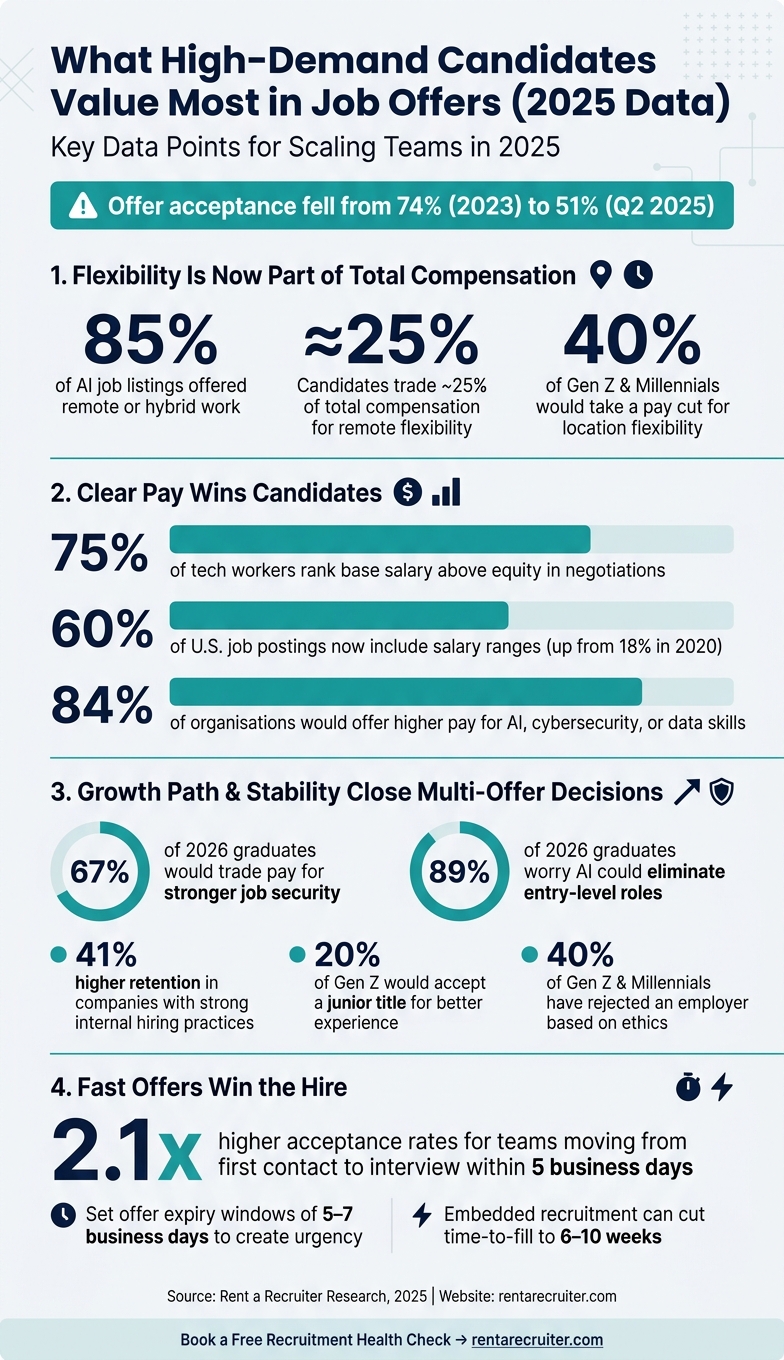
What High-Demand Candidates Value Most in Job Offers (2025 Data)
Flexibility and Work-Life Balance Are Now Primary Offer Drivers
You see this most clearly at offer stage. Flexibility now sits inside total compensation. In scarce-skill roles, it can make up for a lower salary.
Remote, Hybrid, and Schedule Flexibility as Standard Offer Terms
In 2025, 85% of AI job listings offered remote or hybrid arrangements [7]. For people in these roles, location flexibility is no longer a nice extra. It is close to standard.
It helps to split location flexibility from time flexibility.
- Location flexibility means where work happens, remote, hybrid, or on-site.
- Time flexibility means when work happens, staggered start times or flexible hours around core team windows.
That second point matters more than many hiring teams think. If a role needs people on-site, time flexibility can still protect offer acceptance.
Candidates also weigh the hidden cost of office-based work. That includes commuting time, commuting spend, childcare logistics, and the mental load that comes with organising all of it. If you ask for full on-site attendance and offer nothing in return, many people read that as a pay cut. A commuter stipend or childcare support can help close the gap without pushing up base salary [8][2]. For scaling SMEs, the commercial point is simple: put these terms in the offer. Do not leave them assumed.
When Candidates Accept Lower Pay in Exchange for Flexibility
This tradeoff is measurable. On average, candidates are willing to give up about 25% of total compensation for a role that is partially or fully remote instead of fully in person [2]. Among Gen Z and millennial workers, 40% say they would take a pay cut for more location flexibility [2].
That only works when the flexibility offer is clear and believable. Vague talk about work-life balance does not shift decisions. What does? Specific detail. Spell out schedule norms. Explain how the team handles high-intensity periods. Show what recovery looks like after a push.
If you cannot meet a candidate’s salary target, flexibility is one of the strongest levers you have to optimise your talent strategy. But it has to feel real. The candidate needs to picture it, test it, and trust it.
Comparison Table: Flexibility Elements and Their Effect on Offer Acceptance
| Flexibility Element | Candidate Appeal | Employer Burden | Offer Impact |
|---|---|---|---|
| Fully Remote | Very high, especially for AI roles [7] | High, requires async infrastructure and distributed culture | Strong; can offset up to ~25% lower pay [2] |
| Hybrid (2–3 days on-site) | High, preferred by many for collaboration [8] | Moderate, requires scheduling and office space | Moderate to high; often the baseline expectation [8] |
| Flexible Hours | High, especially for parents and caregivers [8] | Low to moderate, requires clear output expectations | High for roles that cannot be fully remote [8] |
| Expanded PTO | High | Moderate | High; signals long-term investment in employee wellbeing [7] |
| Parental Leave (20+ weeks) | Very high for mid-career and senior candidates [7] | High, requires temporary coverage planning | High; 24 weeks is the current benchmark among leading AI employers [7] |
When flexibility is not enough to close the gap, candidates move to a more direct comparison of pay and benefits.
sbb-itb-a23bd6a
Compensation, Benefits, and Pay Transparency Still Drive Offer Decisions
If flexibility gets you into the final round, compensation is what gets the deal done. Once flexibility is clear, candidates start comparing the offer line by line. If the package feels off, the process can fall apart fast.
Why Total Rewards Matter More Than Base Salary Alone
Base salary still leads the decision. 75% of tech professionals rank it ahead of equity during negotiations [5]. That matters because many hiring teams still lean too hard on stock or future upside when candidates are focused on cash, benefits, and what the offer means for their day-to-day life.
That said, strong candidates do not look at salary in isolation. They look at the full package: health cover, 401(k) match, PTO, and professional development budgets. In other words, they are not just judging what you pay. They are judging how the whole offer adds up.
Equity has less pull than many employers expect. A lot of candidates now treat it as a secondary extra, not the main reason to say yes [5].
For scaling SMEs, this is where offer design starts to matter. If you are hiring in SaaS, IT, Fintech, Engineering, Security, Insurance, or Professional Services, specialist talent often has options. Utilizing embedded IT recruitment can help secure these high-demand professionals before they accept competing offers. And employers know it. 84% of organisations say they would offer higher compensation for skills in areas like AI, cybersecurity, or data analysis [8].
If you cannot compete at the top of the salary range, you still have room to strengthen the offer. A better 401(k) match, stronger health cover, more generous PTO, or a serious learning budget can help close the gap [8].
Think of it like this: when base pay is close, the rest of the package often becomes the tie-breaker.
How Pay Transparency Affects Candidate Trust and Conversion
Once price enters the conversation, trust follows close behind. Sixty percent of U.S. job postings now include salary ranges, up from 18% in 2020 [4]. By the time many candidates reach offer stage, they already have a number in mind.
That changes the risk for employers. A low offer does not just lose the hire. It can make your business look out of touch with the market.
The fix is simple, but many teams still get it wrong. Share salary ranges early. Use current market data to set them. Do not wait until the offer letter to show the number [4].
For hiring leaders, this is not just about candidate experience. It is about conversion rate. If your pay band is unclear, or worse, far below market, you waste interview time, slow hiring, and lose candidates late in the process.
Comparison Table: Total Rewards Components and Their Influence on Offers
| Component | Candidate Interest | Negotiation Sensitivity | Effect on Acceptance |
|---|---|---|---|
| Base Salary | Very high; primary anchor [4] | Very high | Dominant factor for 75% of tech workers [5] |
| Bonus | High; valued for liquidity | High | Strengthens offer when base is below target |
| Equity/Stock Options | Moderate; skepticism rising [5] | High for executives | Usually secondary to cash for most individual contributors [5] |
| Health Insurance | High; expected as standard [8] | Low | Baseline requirement; gaps here hurt acceptance |
| 401(k) Match | Moderate to high | Low | Meaningful differentiator for SMEs |
| PTO | High; signals well-being investment | Low to moderate | Supports acceptance, especially alongside flexibility |
| Sign-on Bonus | Moderate | High; used to offset equity buyouts | Useful for closing final candidates [7] |
Career Growth, Leadership Quality, and Employer Reputation Shape Final Offer Decisions
When pay is close, candidates stop looking at compensation alone. They start asking a tougher question: what does this role do for my future?
In multi-offer situations, growth potential, manager quality, and employer reputation often decide where high-demand talent signs. For scaling companies, that matters because these are areas where you can win without stretching salary beyond budget.
Growth Paths and Learning Opportunities as Signals of Long-Term Value
Generic promises don’t carry much weight. Proof does. Show how people in the same role moved forward within 18 months [6].
That proof can include promotion timelines, cross-functional moves, and clear skill-building outcomes. It gives candidates something concrete to assess, instead of asking them to take your word for it [6].
This matters even more with younger talent. Gen Z is more open to nonlinear growth paths, and 20% would accept a more junior title for stronger experience [3]. Companies with strong internal hiring practices also see 41% higher retention [3].
For you, the business case is clear. If you can show that a role leads somewhere, you make the offer stronger and improve your chances of keeping that hire longer.
Once growth feels real, attention shifts fast. Candidates look at who they’ll work for, what the company stands for, and whether the business feels steady.
Manager Quality, Mission Clarity, and Reputation in Multi-Offer Situations
When two offers are close on pay, the hiring manager often tips the decision. Leadership credibility can decide a close call [6].
That puts pressure on scaling companies to make managers part of the offer story, not just part of the interview process. Candidates want to know who they’ll learn from, how decisions are made, and whether leadership looks steady under pressure.
Stability has also moved much higher up the list. In 2026, 89% of college graduates worry that AI could eliminate entry-level roles, a 25-percentage-point jump from 2025 [1]. As a result, 67% of 2026 graduates say they would accept lower pay in exchange for stronger long-term security [1].
For scaling SMEs, this creates a clear opening. If you can show financial health, steady growth, and resilience through disruption, that can set your offer apart [1]. You don’t need vague claims. You need signals people can see and trust, like tenure, growth trends, and a clear hiring plan.
Ethics and mission also matter, especially for younger talent. Around 40% of Gen Z and Millennials have rejected a potential employer based on personal ethics or beliefs [3]. That’s a big number, and it means mission can’t live only on the careers page.
There’s another point here that often gets missed. Naming trade-offs can make your offer more believable. If every company says it’s perfect, nothing stands out. Being direct about the role, the stage of the business, and the opportunity ahead can make the upside feel more real [6].
These factors only help if they show up clearly in the offer itself. For scaling SMEs, that means building a repeatable process that makes growth, leadership, stability, and mission visible every time.
Comparison Table: Non-Monetary Factors That Strengthen Offer Attractiveness
| Non-Monetary Factor | Effect on Acceptance | Retention Potential | Employer Differentiation |
|---|---|---|---|
| Career Progression (Nonlinear) | High; 20% will take a junior title for the right experience [3] | High; 41% higher retention with strong internal hiring [3] | Strong; shifts focus from title to skill-building [3] |
| Manager Quality | Critical in multi-offer situations [6] | High; reduces manager-driven churn [6] | High; SMEs can offer more direct access to leadership [6] |
| Job Security / Stability | Very high; 67% would trade pay for security [1] | High; appeals to AI-anxious talent [1] | Moderate; requires proof of company health and tenure [1] |
| Employer Reputation / Ethics | Moderate; 40% have rejected offers on beliefs [3] | High; builds values alignment [3] | Strong; connects the role to a concrete mission [3] |
| Structured Learning Paths | High; skills are a primary engagement driver for Gen Z and Millennials [3] | High; structured development signals long-term investment [1] | Strong; clear paths differentiate SMEs from larger employers [3] |
How Scaling SMEs Can Turn These Findings Into Better Offers and Faster Hiring
The research points to one practical conclusion: package flexibility, total rewards, and growth in a way candidates can judge fast. The issue is not what candidates care about. It is how you turn those priorities into an offer that gets to a decision, fast.
Build a Consistent Offer Framework for Scarce-Skill Roles
For scarce-skill roles, speed starts with a standard offer template. Slow offer turnaround costs hires.
Create a role-by-role offer template that covers flexibility, pay band, growth proof, and approval steps. Build a proof bank of promotions, lateral moves, and internal progression examples so non-cash claims feel credible [6]. If onsite time is part of the role, say why.
Two moves tend to have the biggest impact:
- Capture candidate priorities early, so the offer reflects what matters most to that person
- Set every offer to expire within 5 to 7 business days [4]
That creates clear urgency without turning the process into a hard sell. It also stops offers from drifting while other employers move in.
Teams that move from first contact to interview within five business days see a 2.1x higher acceptance rate [9]. In a tight hiring market, speed is commercial leverage. It saves time, cuts drop-off, and gives you a better shot at landing scarce talent before someone else does.
Use Embedded Recruitment to Improve Offer Visibility and Hiring Capacity
Offer quality matters less if your hiring team loses sight of candidate priorities before the final conversation. This is where embedded recruitment helps. Embedded recruiters keep candidate priorities visible and keep the process steady from first screen to offer.
For hard-to-fill roles, this model can cut time-to-fill to six to ten weeks by keeping passive outreach active and managing high-touch candidate relationships [9].
Rent a Recruiter places experienced recruiters directly into scaling teams within days, managing hiring end-to-end with a clear process and steady communication.
Conclusion: Build Offers Around What Research Shows Candidates Actually Value
Once offers are clear, credible, and fast, acceptance rates improve. For scaling SMEs, a better offer framework means more accepted offers and fewer late-stage losses. If you want to review where your hiring process stands today, book a free Recruitment Health Check.
FAQs
How can employers balance flexibility with business needs?
Employers can balance flexibility with business needs when the approach is clear, specific, and workable.
Spell out what flexibility actually means in your business. That may include hybrid or remote work, flexible start times, or compressed workweeks. Then connect those options to day-to-day hiring and team output, especially when peak periods demand stronger coverage or shift workloads across the team.
Just as important, be upfront about any in-office expectations. Set clear guardrails so managers and employees know what applies, when it applies, and why. That cuts confusion, saves management time, and helps teams stay aligned.
Support matters too. Flexibility falls flat if people are stretched too thin. Show that support through manageable stress levels, proper recovery time, and a clear 6-, 12-, and 18-month development path. For scaling companies, that doesn’t just help retention. It helps you protect output, cut friction, and keep hiring plans on track.
What should a clear total compensation offer include?
A clear total compensation offer should show more than base salary.
Spell out the full package. Include a specific breakdown of:
- Base pay
- Target bonus
- Equity scenarios
- Learning or professional development budget
This matters because hiring leaders don’t just lose people on salary. They lose them when the offer feels vague, thin, or hard to compare.
Benefits should be listed with real dollar value, not vague labels. If you offer tuition reimbursement, student debt support, housing assistance, mental health resources, or flexible scheduling, put numbers beside them.
For example, show:
- Tuition reimbursement: $5,000 per year
- Student debt support: $200 per month
- Professional development budget: $2,500 per year
- Housing assistance: $10,000 one-time support
That does two things. It makes the offer easier to understand, and it helps the candidate see the full financial value of joining your business.
Flexible scheduling may not always carry a direct dollar figure, but it still has weight. If it’s part of the package, explain what it means in practice, such as core hours, remote days, or compressed workweeks. Clear detail beats broad promises every time.
How can companies show growth and stability in an offer?
Companies need to back up claims with clear proof.
For stability, that means showing concrete signals, not making broad statements. Share things like customer retention, long-term contracts, investment plans, market position, operational maturity, and benefits such as 401(k) matching. If you want senior hires to trust the business, give them facts they can point to.
For growth, vague promises don’t cut it. Show a 6, 12, and 18-month learning roadmap. Share examples of internal mobility. Explain how much autonomy the role has and where that person will make an impact. That turns "there’s room to grow" into something people can assess.
Consistency matters too. When the hiring team tells the same story, with the same proof points, trust goes up. And when trust goes up, your hiring process moves with less friction.