
Building a strong Employer Value Proposition (EVP) is critical for SaaS startups trying to attract and retain top talent in competitive markets. Without one, you risk higher hiring costs, lower candidate interest, and higher employee turnover. A clear EVP can cut costs by up to 50%, double applicant numbers, and reduce turnover by nearly 70%.
Here’s a quick summary of the 5 steps:
- Define Your Talent Focus and Core Values: Identify key roles, align with your mission, and clarify what makes your company appealing to the talent you need.
- Research What Employees and Candidates Value: Use internal surveys, exit interviews, and market insights to understand what matters most to your team and potential hires.
- Analyze Competitors and the SaaS Talent Market: Benchmark pay, benefits, and messaging to identify gaps and opportunities to stand out.
- Build EVP Pillars and Proof Points: Develop 3–5 core pillars backed by measurable evidence, like promotion rates or learning budgets, to make your EVP credible.
- Embed and Refine Your EVP: Integrate your EVP into hiring processes, track its performance, and adjust as your company scales. Many startups use embedded recruitment services to manage this integration seamlessly.
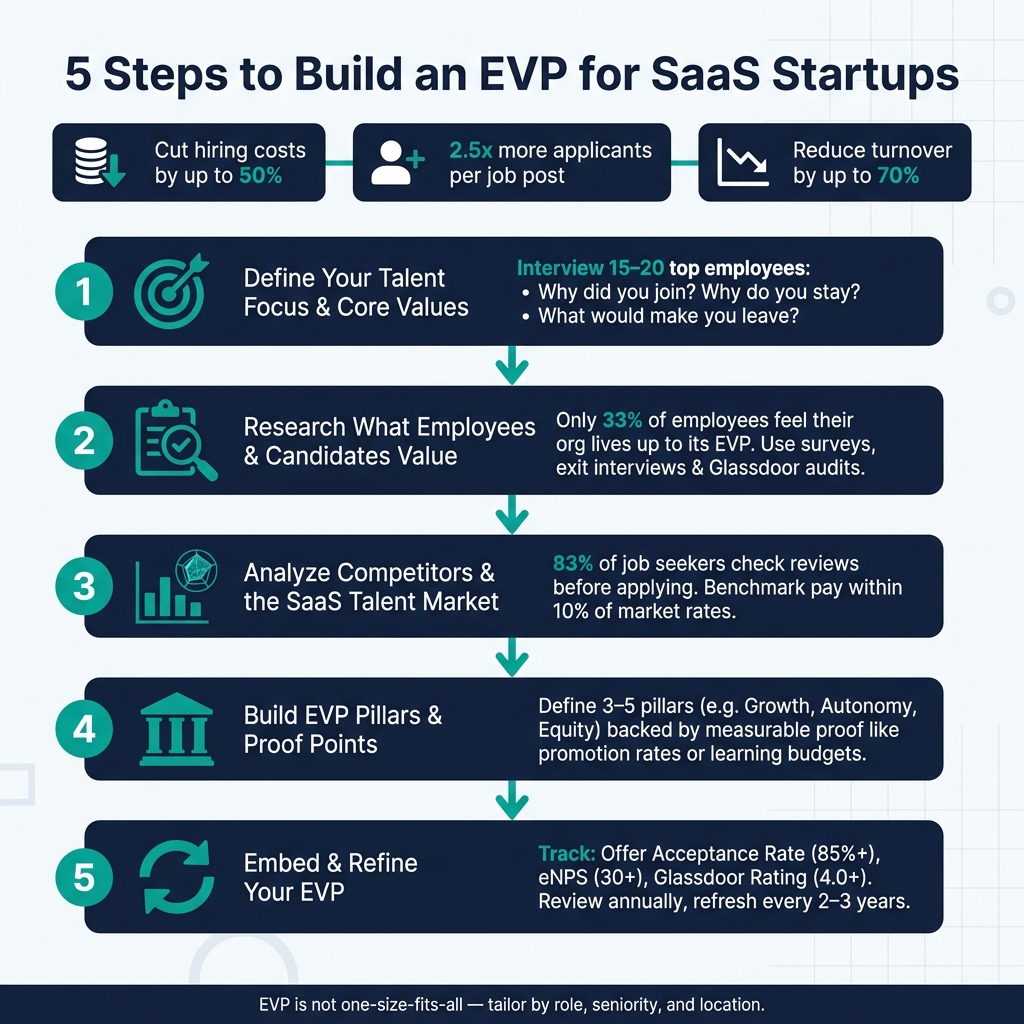
5 Steps to Build an EVP for SaaS Startups
Step 1: Define Your Talent Focus and Core Values
Identify Key Roles and Talent Segments
Start by pinpointing the roles and talent segments that are most critical for your company’s growth over the next 12–24 months. For many SaaS startups, this often includes engineers, product managers, and sales professionals, broken down further by seniority and location. A one-size-fits-all EVP won’t cut it. Each group values different things, so tailoring your approach is key [1][2].
To uncover what truly resonates with your team, interview 15–20 of your top employees. Ask three direct questions: Why did you join? Why do you stay? What would make you leave? The insights you gather will reveal more about your real EVP than any brainstorming session ever could [6].
"EVP is not one size fits all. It should adapt based on role (e.g., engineering vs sales), seniority (IC vs leadership), and location or market." – Metaview [1]
Once you’ve defined your target segments, align this with your company’s mission, vision, and values to sharpen your EVP even further.
Clarify Mission, Vision, and Core Values
Your core values need to reflect how your company actually operates, not just what sounds good on paper. Candidates, especially those with experience, will quickly notice if there’s a gap between what you claim and what you practice.
Define 4–6 core values that feel authentic. Your mission should clearly explain why your company exists, while your vision should articulate where you’re heading. Together, these provide candidates with something to believe in beyond just a paycheck. This is especially important for Millennial and Gen Z talent, who often prioritise purpose and direction when evaluating potential employers [3][2].
Use these values to help build a profile of your ideal candidate – someone who not only fits the role but also aligns with your culture.
Define Your Ideal Employee Profile
With your talent segments identified and your values clarified, you can now outline the profile of your ideal candidate. For SaaS startups, this often means prioritising traits like an entrepreneurial mindset, the ability to learn quickly, and comfort with uncertainty – qualities that are particularly important during the seed-to-Series B stages.
It’s also crucial to recognise that different roles and levels of experience come with different motivators. For example, senior software engineers are often drawn to technical ownership and autonomy, while junior sales hires may value structured mentorship and opportunities for rapid skill development [1][2].
Here’s a quick breakdown of how key traits align with various growth stages and candidate types:
| Trait | Key Characteristics | Growth Stage |
|---|---|---|
| Entrepreneurial | Self-starter, ownership-driven, thrives in ambiguity | Seed to Series B |
| Adaptive | Fast learner, flexible, ready for AI-driven tools | High-growth / Scaling |
| Mission-Driven | Purpose-focused, resilient, aligned with values | Impact-driven verticals |
| Technical | Curious, problem-solver, technically skilled | Deep-tech / Infrastructure |
Avoid overloading your job descriptions with exhaustive skills lists. Highlight the must-have traits and motivations that align with your culture, rather than relying on arbitrary credentials. For instance, requiring 10+ years of experience for a mid-level role can discourage qualified candidates from applying [2]. Focus instead on the qualities that predict success in your environment, not just the bullet points on a CV.
Step 2: Research What Employees and Candidates Value
Run Internal Surveys and Interviews
Once you’ve identified your target audience, the next step is understanding what truly drives them. The best way to do this? Start by consulting your current employees.
Approach this as a fact-finding mission, not a branding exercise. As one EVP framework explains:
"Most EVP projects fail when treated as communications documents instead of truth-finding exercises." [4]
Conduct confidential surveys and small focus groups across different teams and levels of seniority. Go beyond surface-level questions about pay – dig into "experience drivers" like decision-making processes, team dynamics during high-pressure situations, and management practices. These insights often reveal more about employee satisfaction than compensation alone [1].
Exit interviews are another goldmine of information. They highlight the gaps between what your EVP promises and what it actually delivers. Alarmingly, only 33% of employees feel their organization consistently lives up to its EVP promises [4].
Once you’ve gathered internal feedback, balance it with external data to get a broader perspective.
Review Candidate and Market Feedback
Internal insights only tell part of the story. Job seekers form opinions about your company long before they even apply – 75% of candidates decide whether they’re interested based on your external reputation [6]. That makes your public image a critical part of your EVP.
Start with a digital reputation audit. Review your Glassdoor ratings and employee reviews for recurring themes, whether positive or negative. Survey candidates who declined offers or rate your recruitment process to identify specific "brand friction" points that might not be obvious to your team [6]. Small improvements here can yield big results: a 0.5-point increase in your Glassdoor rating can lead to 20% more job clicks and 16% more application starts [6].
"Marketing fiction – an EVP that employees don’t recognize – collapses quickly when candidates experience the reality." – Pin [6]
Use these insights to refine your EVP so it resonates with both current and potential employees.
Break Down Findings by Role and Location
With both internal and external data in hand, segment your findings to address the unique needs of different roles and locations. A one-size-fits-all EVP won’t work – what appeals to a senior engineer might not matter to a junior sales rep.
"A junior developer and a senior sales director might value completely different aspects of working at your company, and your EVP needs to resonate with both." – Taleva [3]
For example, US-based SaaS startups often find that North American candidates prioritize career growth and are willing to take on heavier workloads for faster advancement [7]. Breaking insights down by role and region helps you create targeted messaging that speaks directly to what each talent segment values most.
| Segment | Key Value Drivers |
|---|---|
| Senior Engineering | Technical ownership, autonomy, complex problem-solving [1] |
| Junior Talent | Mentorship, learning opportunities, career progression [1][3] |
| Sales Roles | Compensation/bonuses, product sellability, market reach [1] |
| North American Candidates | Rapid career progression, performance-based rewards [7] |
Step 3: Analyze Competitors and the SaaS Talent Market
Review Competitor EVPs and Offerings
Once you’ve gathered internal insights, it’s time to look outward. Understanding what your competitors offer can help you identify gaps – and opportunities to stand out in the talent market.
Start with a digital audit of competitor career pages, job ads, LinkedIn posts, and Glassdoor profiles. Pay close attention to how they describe their culture, the benefits they highlight, and the tone they use to attract candidates. 83% of job seekers check company reviews and ratings before applying [6], so this public-facing content plays a crucial role in shaping perceptions.
Also, compare their claims to employee feedback. For example, if a competitor promotes "radical transparency" but their Glassdoor reviews mention micromanagement, that inconsistency could be an opening for you to differentiate. This kind of analysis helps you benchmark effectively and uncover what genuinely sets your offering apart.
"75% of candidates judge you before applying. They form an opinion from your Glassdoor page, career site, and LinkedIn long before they click ‘apply.’" – Pin [6]
Benchmark Pay, Benefits, and Culture Claims
Once you’ve reviewed competitors’ messaging, dig deeper into their actual offerings. Compare compensation packages to ensure your salaries are within 10% of market rates – falling short here can lose you candidates before they even look at the rest of your Employee Value Proposition (EVP) [3]. Beyond base pay, assess equity options, bonuses, parental leave, health benefits, and standout perks like home-office stipends or professional development budgets.
Workplace flexibility is another area to evaluate. By 2026, 91% of workers rank flexible work options as a top priority [5]. In SaaS, remote and hybrid work policies have become standard, so simply offering flexibility won’t help you stand out. If every competitor has similar policies, you’ll need to highlight other elements of your EVP.
Once you’ve established where you align with market standards, shift your focus to what makes your offerings unique.
Find Your Point of Difference
This is where you define what sets you apart. After benchmarking, you might notice that many competitors lean on generic promises like "collaborative culture", "unlimited PTO", or "we support your growth." While these sound appealing, they’re often overused and not distinctive.
"If any competitor could copy your EVP word-for-word, it’s not a differentiator." – Metaview [1]
Instead, focus on specific, tangible elements of your EVP that reflect your company’s true identity and are hard for competitors to replicate. The table below highlights the difference between generic claims and meaningful differentiators:
| EVP Element | Generic Claim | Distinctive Differentiator |
|---|---|---|
| Work Design | "Flexible/hybrid work" | "Async-first with quarterly offsites" [3][9] |
| Career Growth | "We support your growth" | "$3,000 annual learning budget + 1 learning day/month" [3] |
| Culture | "Collaborative environment" | "Open RFC process" or "No-blame postmortems" [9] |
| Impact | "Change the world" | "Direct contribution to a product serving 12M daily users" [9] |
Focus on 3–5 key differentiators that are authentic to your employee experience, align with the roles you’re hiring for, and are difficult for competitors to imitate. These specific elements are what make your EVP stand out and resonate with candidates.
sbb-itb-a23bd6a
Step 4: Build Your EVP Pillars and Proof Points
Define Your Core EVP Pillars
Now that you’ve wrapped up your competitive research, it’s time to shape your findings into 3–5 core EVP (Employee Value Proposition) pillars. These pillars should reflect what matters most to your target talent. To make them work, they need to be true (validated by your team), relevant (aligned with what candidates value), and differentiated (not something your competitors can easily claim) [3][6].
A helpful starting point is the "Stay vs. Join" analysis. Talk to your high performers and ask not just why they joined, but why they’ve stayed. The answers are often more honest and insightful, giving you a solid foundation for building meaningful pillars.
For SaaS startups, common pillars include Growth & Learning, Autonomy & Ownership, Compensation & Equity, Mission & Impact, and Technical Innovation. You don’t need all of them – focus on the ones that truly represent your company. Looking ahead, AI-readiness is gaining traction as a new EVP focus. By 2025–2026, over 70% of workers say they’ll prefer companies that actively prepare them for an AI-driven workplace [6].
"An EVP that lacks originality offers no competitive edge." – Taleva [3]
Back Each Pillar with Proof
A great EVP is more than just words. Every pillar needs to be backed by real, measurable evidence. For instance, if you claim a Growth & Learning focus, don’t just say “we invest in development.” Add specifics like a learning budget (e.g., $1,500–$3,000 per employee), internal promotion rates (e.g., "80% of managers promoted from within"), or onboarding milestones such as "engineers ship code in their first week" [1][3][9].
Here’s how to pair pillars with proof:
| EVP Pillar | Proof Point Examples |
|---|---|
| Growth & Learning | Annual learning budget (e.g., $2,000), promotion rates, mentorship programs [3][9] |
| Compensation & Equity | Salary bands at the 75th percentile, equity vesting schedules, 401(k) match% [9][2] |
| Work-Life Balance | Remote/hybrid policies, "no-meeting Fridays", parental leave duration [9][2] |
| Autonomy & Ownership | Clear job scopes (e.g., "own the onboarding roadmap end-to-end") [2] |
| Technical Innovation | Tech stack details, shipping frequency, open-source contributions [6][9] |
HubSpot is a standout example of a proof-driven EVP. With a 4.5+ Glassdoor rating across over 4,000 reviews, it backs its flexibility pillar with tangible initiatives like its 128-slide Culture Code, remote-optional policies, and quarterly team retreats [3].
"Specificity is credibility: claims that are testable are claims that stick." – Pin [6]
Once your pillars are backed by hard evidence, it’s time to get leadership on board and ensure compliance. For more tools to help with this process, explore our recruitment resources.
Secure Leadership Approval and Legal Compliance
Before rolling out your EVP, secure leadership buy-in and conduct a compliance review.
Leadership approval is critical. Only 33% of employees feel their company delivers on EVP promises [4]. Without a C-suite sponsor championing the EVP – through town halls, performance reviews, and internal messaging – it risks being dismissed as empty marketing. Test each pillar with your top performers by asking, “Is this actually true?” If there’s any hesitation, revise it before moving forward.
On the compliance side, have Finance and Legal review claims tied to compensation, equity, or work flexibility. This is especially important for companies hiring across multiple U.S. states, where labor laws and tax rules can vary widely [3][9]. For example, a promise of "full remote flexibility" may need clarification depending on state-specific regulations, ensuring both candidates and the company are protected.
Step 5: Embed and Refine Your EVP Across the Hiring Journey
Bring Your EVP into Recruitment Processes
Once leadership has given the green light, your EVP (Employee Value Proposition) needs to shine through every step of the hiring process. Why? Because 75% of job seekers research an employer’s brand before even applying [6].
Start with job descriptions. These should go beyond listing expectations and instead focus on what candidates gain. Avoid vague phrases like "collaborative culture." Instead, provide concrete examples tied to your EVP pillars. For instance, say, "Our engineers deploy to production within their first month" [6]. On your careers page, ditch the stock images. Instead, use 60–90 second video clips featuring real employees. Within the first 30 seconds of a visit, your EVP message should be clear [6].
Consistency is key during interviews. Recruiters and hiring managers must present a unified narrative to avoid confusing candidates. Equip interviewers with training to ensure they can effectively communicate your EVP. This consistency also extends to onboarding – new hires should see your EVP in action from day one [3][10].
Once your EVP is embedded in the recruitment process, the next step is measuring its effectiveness.
Track and Measure EVP Performance
To understand how well your EVP is working, track metrics that reveal its impact on candidates and employees. These metrics provide insight into whether your EVP resonates and delivers on its promises.
| Metric | What It Measures | Target |
|---|---|---|
| Offer Acceptance Rate | Whether candidates are convinced by your EVP | 85%+ |
| First-Year Retention | Whether the experience aligns with the EVP | 85%+ |
| Sourcing Response Rate | How well your outreach connects with passive talent | 25%+ |
| Glassdoor Rating | External perception of your brand | 4.0+ |
| Employee Net Promoter Score (eNPS) | Whether employees would recommend your company | 30+ |
| Cost-Per-Hire | Efficiency of brand-driven hiring | Trending down |
Regular "say-do" audits are essential. Compare your EVP claims with feedback from Glassdoor reviews and internal surveys. If employees flag issues like micromanagement, address these before touting "autonomy" in job ads [3]. Plan to review your EVP annually and refresh it every two to three years to keep pace with your company’s growth [3].
Scaling your hiring efforts while maintaining this level of consistency requires more than just metrics – it demands the right recruitment support.
Scale Hiring with Embedded Recruitment Support
As your business grows, scaling recruitment without diluting your EVP can be challenging. This is where embedded recruitment makes a difference.
Embedded recruiters work as part of your team. Unlike external agencies that might tweak messaging to close candidates, embedded recruiters fully immerse themselves in your culture. They align with hiring managers and ensure your EVP is communicated consistently across every touchpoint. This approach significantly reduces turnover – 29% fewer new hires leave when their recruitment expectations match the reality [8].
Rent a Recruiter offers embedded recruitment support that integrates seamlessly into your team in just days. These experienced recruiters manage the entire hiring process while ensuring your EVP stays intact. The result? Up to 70% lower hiring costs compared to commission-based agencies and a savings of 80+ hours per month on internal hiring admin.
"The companies that win don’t just define their EVP. They operationalize it – so every candidate hears the same, believable story, every time." – Metaview [1]
Conclusion: Build a Scalable EVP for Long-Term Growth
Key Takeaways from the 5 Steps
Creating a strong EVP isn’t something you do once and forget. It’s an ongoing effort to show why your company is a place where the right people want to work – and stay.
The process is step-by-step. Start by defining your core values and identifying your ideal employee profile. Then, dig into what candidates and employees actually value. Next, analyze the SaaS talent market to find what sets you apart. Use those insights to develop EVP pillars supported by proof, and finally, integrate your EVP into every stage of the hiring process. When done right, these steps can reduce hiring costs by 50%, attract 2.5x more applicants per job post, and cut employee turnover by as much as 70% [6][4].
Candidates want specifics, not generic claims. For example, saying "engineers ship to production in their first week" resonates far more than vague promises. Treat your EVP as a living, evolving asset – review and update it regularly to stay aligned with your company’s growth [3].
With these steps outlined, you’re ready to bring your EVP to life. For more insights on optimizing your hiring strategy, explore our recruitment blog.
Take the Next Step with Rent a Recruiter
Defining your EVP is one thing. Scaling it is another. If your SaaS startup is expanding quickly and you need recruiters who can seamlessly embed your EVP into the hiring process, Rent a Recruiter has you covered. Their embedded recruiters join your team in days, managing the entire hiring process while ensuring your EVP stays consistent across every candidate interaction. Schedule a call today to see how they can help you build a cost-efficient, scalable hiring strategy around your EVP.
FAQs
What makes an EVP different from employer branding?
An Employee Value Proposition (EVP) outlines the key benefits, values, and experiences a company provides to its employees in return for their work. It includes concrete factors like pay, opportunities for career advancement, and workplace culture. Meanwhile, employer branding is about how the company presents itself to the outside world as an employer. Think of it this way: the EVP is the foundation, while employer branding is the polished image that helps draw in top talent.
How do I pick 3–5 EVP pillars without sounding generic?
To stand out, focus on what genuinely makes your company different and matters to your employees. Start by digging into your internal data and gathering feedback from your team to uncover your real strengths. Then, zero in on specific, measurable pillars – things like clear promotion paths or a leadership style that inspires – rather than leaning on generic phrases like "great culture."
If you do mention culture, back it up with real examples that demonstrate what makes it special. The key is to ensure your Employee Value Proposition (EVP) aligns with what your target talent values most while showcasing the unique qualities of your organization. This approach not only builds credibility but also makes your EVP stand out in a crowded market.
What proof points should a SaaS startup use if it’s still early-stage?
For early-stage SaaS startups, highlighting proof points that demonstrate tangible results and reflect your company’s identity is key to attracting top talent. Think metrics like "80% of managers promoted internally" or "engineers ship to production within their first month." These kinds of data points make your Employee Value Proposition (EVP) more compelling.
Go a step further by sharing specific employee success stories or key achievements. For example, showcase how your team delivers features quickly or how your onboarding process sets new hires up for success. These validated examples not only resonate with driven candidates but also reinforce your company’s credibility and ambition.