Hiring top talent doesn’t have to break the bank. SMEs often struggle with recruitment costs, limited reach, and building trust with candidates. Employee advocacy offers a solution by turning your team into a powerful recruitment engine.
Here’s why it works:
- Cost savings: Avoid hefty recruiter fees (15–25% of a hire’s first-year salary) by leveraging employee networks. Referral programs can save $3,000+ per hire.
- Better hires: Employee-shared content reaches 561% further than corporate posts and connects with passive candidates who often stay longer.
- Stronger brand: Peer recommendations are trusted 93% more than corporate messaging, attracting candidates aligned with your company values.
The result? Faster hires, lower costs, and a recruitment process that scales with your business. To maximize impact, combine employee advocacy with embedded recruitment for end-to-end hiring support.
Ready to transform hiring? Start small by identifying internal advocates, providing shareable content, and tracking results with clear metrics. For more details on how this model works, see our recruitment model FAQs.
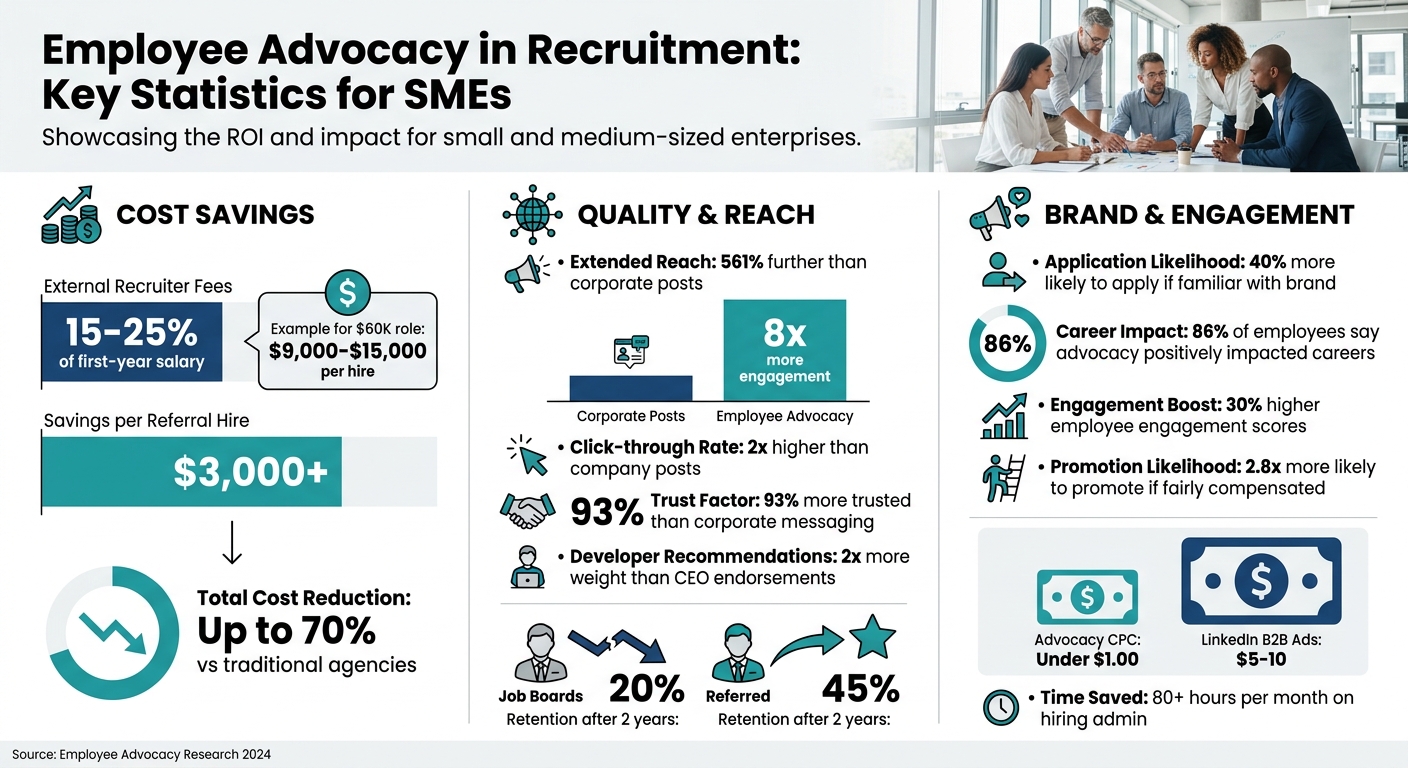
Employee Advocacy ROI: Key Statistics for SME Recruitment Success
What Employee Advocacy Means for Recruitment
Defining Employee Advocacy
Employee advocacy is all about empowering your team to share their real experiences at work, along with any open roles, turning recruitment into a company-wide effort. It’s not about flooding LinkedIn with generic updates – it’s about creating a workplace where employees naturally want to share their stories. For instance, when a software developer talks about solving an exciting technical problem or a customer success manager celebrates a team win, these moments give potential candidates a genuine look at what it’s like to work at your company [2][4].
"At its core, employee advocacy is the promotion of your company by the people who know it best: your team members." – Jen Dewar, JobScore [2]
While corporate career pages often showcase a polished version of company life, employee-shared content offers a more realistic and relatable perspective. This transparency helps candidates decide if they’re a good fit before even applying, which can make a big difference in attracting the right talent.
Why Peer Recommendations Work Better
Content shared by employees is far more trusted – 93% more, to be exact. A developer’s recommendation carries twice the weight of a CEO’s endorsement [1][3]. And the numbers back it up: posts shared by employees generate eight times more engagement than when the same content comes from official company accounts [3].
Why does this work? Employees speak the same language as their peers. Their posts resonate within technical circles and niche communities, reaching passive candidates who might not engage with a corporate post. These authentic stories not only build trust but also expand your talent pool and lower hiring costs. For SMEs, this approach directly tackles recruitment hurdles by connecting with candidates who reflect the strengths of your top-performing team members.
sbb-itb-a23bd6a
How to Build an Employee Advocacy Program from the Ground Up
Main Benefits of Employee Advocacy for SMEs
Employee advocacy tackles some of the biggest recruitment hurdles SMEs face – cutting costs, improving the quality of candidates, and boosting your employer brand. All of this is achieved by tapping into the networks your team already has.
Lower Costs Through Employee Networks
Recruiting through employee advocacy can save your business a significant amount of money. External recruiters often charge hefty fees, usually between 15% and 25% of a new hire’s first-year salary. For a $60,000 role, that’s $9,000 to $15,000 per hire [2]. By encouraging your team to share job openings within their own networks, you avoid these fees while reaching highly engaged audiences. Plus, you’ll rely less on expensive job boards and social media ads. Referral programs alone can save companies $3,000 or more per hire and deliver better returns than other recruitment methods [6].
The savings don’t stop there. Referred employees tend to stay longer. After two years, 45% of referred hires are still with the company, compared to just 20% of hires from job boards [6]. Since replacing an employee can cost anywhere from 50% to 200% of their annual salary [5], better retention translates into meaningful savings. For example, Digital Ocean’s referral program, which offered a $3,500 employee bonus and a $1,500 charitable donation per successful hire, led to 40% of new hires coming from referrals within its first year [6].
But it’s not just about saving money. Employee networks also open doors to a richer and more diverse talent pool.
Better Candidates and Wider Talent Pools
Your employees’ networks are a goldmine of talent that traditional recruitment methods can’t reach. In fact, when employees share your job openings, your brand message can travel 561% further than through official channels alone [7]. This extended reach is especially valuable for connecting with passive candidates – those who aren’t actively job hunting but could be a perfect fit.
"Your team members bring something invaluable to your recruitment efforts: access to their personal and professional networks. These connections represent a treasure trove of potential candidates that you couldn’t reach through job boards or corporate social media alone."
– Jen Dewar, JobScore [2]
Referred candidates often stand out because employees can communicate in ways that truly resonate. For instance, a software developer discussing your tech stack or upcoming projects can engage other developers far better than a generic corporate job ad. This peer-to-peer connection gives candidates a realistic view of the role, helping them decide whether it’s the right fit. The result? Referred candidates are 55% faster to hire than those from career sites [6] and are 2.6% to 6.6% more likely to accept job offers [6]. On top of that, referred hires contribute 25% more profit to their companies compared to hires from other sources [6].
Stronger Employer Brand and Employee Engagement
When employees share their experiences and workplace stories, it paints a genuine picture of your company that corporate messaging just can’t match. This personal touch not only attracts better candidates but also strengthens your brand identity. Posts shared by employees typically achieve double the click-through rate of company posts [7], and candidates familiar with your brand are 40% more likely to apply [7].
Employee advocacy doesn’t just benefit your recruitment efforts; it also boosts internal engagement. A staggering 86% of employees involved in formal advocacy programs say it has positively impacted their careers [7]. When employees feel fairly compensated, they’re 2.8 times more likely to promote your company’s talent brand [2]. This creates a positive cycle where a strong workplace culture inspires advocacy, which in turn attracts talent that aligns with your values.
Take Electronic Arts (EA) as an example. In 2014, they launched "EA Insiders", a program connecting over 20,000 employees across 30 offices. This initiative generated massive social engagement, reaching an audience of over 1.1 million people [6]. As Lorrie Sole, Senior Marketing Manager at Kelly Services, noted:
"We have a large employee base, many of whom are active on social media. And it quickly became clear that if we could harness the power of our employees, we could outpace our corporate marketing channels 10x."
[6]
Building an Employee Advocacy Program
Creating an employee advocacy program doesn’t require a huge budget. Start small with enthusiastic team members and easily shareable content. Here’s how to build a program that delivers results.
Finding and Supporting Employee Advocates
Your best advocates are already on your team – you just need to identify them. Look for employees who naturally share company updates, post office photos, or recommend your workplace to friends. These informal advocates are your starting point [8].
Focus on what some experts call "Patriots" – employees who genuinely believe in your company’s mission and goals [10]. High performers are especially valuable here. According to Price’s Law, in a 25-person SME, about five people (the square root of your workforce) produce half of the company’s value [10].
Different departments bring unique perspectives to the table. Sales teams can highlight customer success stories, Engineering can share technical insights, and People teams can showcase your company culture. Reviewing your referral history can also help identify employees who already understand what attracts top talent [2].
Start small with a pilot group of 10–30 ambassadors from various departments [4]. This allows you to test content, address potential challenges, and refine your approach before expanding company-wide. Hosting a LinkedIn workshop for these ambassadors can help them polish their profiles with professional headshots and updated company information. A strong personal profile amplifies their impact [2]. Provide them with easy-to-use content and clear guidelines to ensure their advocacy is both effective and consistent.
Providing Content and Clear Guidelines
One of the biggest hurdles for employees is not knowing what to share or how to share it. Make this easy by creating a central content hub on platforms like Slack or Microsoft Teams. This hub can house the latest job openings, company updates, and other shareable content [1][11].
Provide pre-written templates for social media posts and emails. These templates save time while keeping your messaging consistent. Include high-quality photos, videos, and branded assets to make posts more engaging [2][11].
Set clear but simple boundaries with a social media policy. This should act as a "runway" for employees, giving them confidence to share without fear of missteps. A short list of dos and don’ts is often enough to guide employees without overwhelming them [1].
Vary the types of content you provide to keep posts authentic and engaging. Blend branded company updates with industry news and prompts for employee-generated content. With 79% of job seekers using social media during their search [9], these authentic posts can help you connect with candidates where they are already looking.
Motivating Employee Participation
Once you’ve set up compelling content and clear guidelines, the next step is encouraging employees to participate. Highlight the personal benefits of advocacy, such as career growth and building a professional brand, alongside financial rewards [8].
Introduce a tiered reward system. Offer standard bonuses for most referrals and premium rewards for hard-to-fill roles. Stagger these payments at 90 and 180 days to ensure quality hires [4]. Since one in seven employee referrals leads to a hire [11], this approach is a smart investment. Non-monetary incentives like learning credits, charitable donations, or extra time off can also motivate employees [4][9].
Gamify the process with leaderboards and monthly ambassador spotlights to keep engagement high [4][9]. Companies with active advocacy programs often see 30% higher employee engagement scores [8].
Leadership involvement is key. When executives actively participate, it reinforces that advocacy is a valued part of the company culture. Introduce the program during new hire onboarding to normalize participation from the start [8]. Limit requests to share content to 2–3 times per month to avoid overwhelming employees. Overloading them with quotas can feel inauthentic and lead to disengagement [8][4].
Ultimately, the success of any advocacy program depends on creating a workplace where employees feel valued. Employees who believe their pay is fair are 2.8 times more likely to promote the company’s talent brand [2]. Advocacy can’t be forced – it’s a natural outcome of fair compensation, work-life balance, and real opportunities for growth.
Tracking Results and Scaling Your Hiring
Measuring Program Performance
Once your advocacy program is in motion, success hinges on tracking the right metrics. This is where UTM parameters come into play. For example, using tags like utm_source=employee_share helps you trace applications and hires back to employee-shared content. By integrating these insights into your ATS, you can ensure advocates receive proper credit for successful hires [4][13].
Focus on metrics that directly impact recruitment outcomes:
- Referral funnel: Track how many referred applicants progress from interview to offer.
- Quality of hire: Compare retention rates at 90 days and 1 year for advocacy-sourced hires versus job-board hires.
- Cost-per-advocacy-hire: Use this formula: (Platform Fees + Program Management + Referral Bonuses) / Total Advocacy Hires [4].
Here’s a breakdown of key performance indicators across five vital areas:
| KPI Category | Key Metrics | What It Tells You |
|---|---|---|
| Referral Funnel | Referred applicants, Referral-to-hire rate | Direct recruitment impact |
| Quality of Hire | 90-day/1-year retention, Performance tier | Long-term value of candidates |
| Reach & Engagement | Unique impressions, Clicks (UTM), CTR | Brand amplification |
| Conversion & Cost | Cost-per-advocacy-hire, Time-to-fill | Financial efficiency |
| Employee Activation | % of active advocates, Shares per advocate | Internal program health |
Pay close attention to your activation rate – the percentage of employees sharing content at least once a month. A healthy activation rate signals program momentum, while a decline may indicate waning interest [4]. Advocacy programs can deliver exceptional value, often achieving a cost-per-click under $1.00, compared to the $5.00–$10.00 average for B2B paid social campaigns on LinkedIn [12].
Once you’ve established a solid framework for tracking metrics, the next step is turning these insights into scalable hiring outcomes.
Adding Embedded Recruitment Support
To transform advocacy efforts into consistent hiring success, consider integrating embedded recruiters. These professionals take charge of the entire referral funnel, from the initial contact to the final offer, while closely monitoring conversion rates at each stage. They also develop a content engine – providing pre-made, on-brand content for employees to share, ensuring consistency and reducing effort [13][2].
Beyond managing the funnel, embedded recruiters offer practical tools to make advocacy seamless. Think short, 15-minute training sessions on authentic posting or simple one-page cheat sheets that guide employees on how to participate effectively [2][4].
Rent a Recruiter provides embedded recruitment support that slots directly into your team in just days. These recruiters handle the entire hiring process, bringing structure and clarity while reducing costs. Companies using this model often cut hiring expenses by up to 70% compared to traditional commission-based agencies (which typically charge 15–25% of a new hire’s first-year salary [2]). Plus, they save over 80 hours each month on internal hiring and admin tasks.
This approach is particularly effective when paired with employee advocacy. An embedded recruiter ensures that advocacy becomes a repeatable, efficient hiring channel, while your team focuses on amplifying your brand through authentic, network-driven engagement. Together, these strategies create a recruitment process that’s both cost-effective and scalable.
Conclusion
Main Points for SMEs
Employee advocacy turns recruitment into a team-driven effort with measurable outcomes. By tapping into your employees’ networks, you can access passive talent pools that traditional job boards simply can’t reach – those candidates who aren’t actively job hunting but would consider the right opportunity if it came from someone they trust. In fact, employee-shared content increases your reach by 561% and doubles click-through rates [7].
The financial advantages are just as striking. Advocacy reduces the need for expensive external recruiters while building more than just a hiring pipeline. It strengthens your employer brand and creates a workforce of advocates who feel deeply connected to your company’s mission. As Jen Dewar from JobScore aptly explains:
"The foundation of successful employee advocacy is an authentic, positive workplace experience" [2].
With these benefits in mind, the next step is to start putting this strategy into action.
Next Steps for Your Recruitment Strategy
Begin by launching a pilot advocacy program. Provide pre-approved content, simple UTM tracking, and focus on making participation easy and rewarding. Employees who feel fairly compensated are 2.8 times more likely to promote your talent brand [2]. By taking these steps, you’ll create a scalable, cost-efficient hiring process that supports your growth ambitions.
To take this even further, combine employee advocacy with embedded recruitment. Rent a Recruiter offers embedded recruiters who integrate seamlessly into your team in just days, taking over your recruitment process while your employees amplify your brand. Companies using this approach cut hiring costs by up to 70% compared to traditional agency fees and reclaim over 80 hours per month previously lost to hiring admin.
Book a call today to see how embedded recruitment can work alongside employee advocacy to transform your hiring strategy.
FAQs
How do I start employee advocacy with a small team?
Encourage your team to post genuine content about their work and the company culture on their personal social media profiles. To make it simple, provide easy-to-use templates or key messages they can adapt. Educate them on how employee advocacy boosts both recruitment efforts and brand visibility. Build trust by keeping participation voluntary, and acknowledge those who actively engage to inspire others. Focus on authentic, relatable stories that are easy to share – this approach will resonate with your team and help them feel confident about participating.
How do I track hires from employee-shared posts?
To measure hires generated from employee-shared posts, consider using employee advocacy platforms or social media tools with built-in analytics. These tools track metrics like engagement, leads, and identify top-performing employees contributing to your recruitment efforts.
Another option is to use unique URLs or UTM parameters in the posts your employees share. By tracking these through web analytics tools, you can pinpoint which posts drive traffic and conversions.
Combining these approaches gives you a clear picture of how employee advocacy directly impacts your hiring results.
What makes an embedded recruiter worth it for SMEs?
Embedded recruiters provide small and medium-sized businesses (SMEs) with a budget-friendly way to expand their hiring efforts without leaning too much on external agencies. By becoming part of your team, they handle the recruitment process from start to finish, ensuring it’s structured, transparent, and consistent. This approach can cut hiring costs by as much as 70% and free up over 80 hours each month from time-consuming admin work. On top of that, it delivers better-quality candidates and adjusts seamlessly to your growth milestones, whether you’re launching a new product or scaling after a funding round.