Bad hiring decisions can cost you 30% of first-year salary, and in many cases far more once lost output, backfilling, and manager time are added.
If you are scaling in SaaS, Technology, IT, Fintech, Engineering, Security, Insurance, or Professional Services, the point is simple: candidate quality is a business number. The hiring methods you use affect ramp time, retention, team output, and hiring spend. The article shows that structured interviews, work samples, and tight scoring tend to predict stronger hires than gut feel alone. It also shows how to tie pre-hire data to post-hire results, so you can see what is paying off and what is wasting time and money.
What you need to know up front:
- Candidate quality is about whether your selection process spots people likely to perform and stay
- Quality of hire is about post-hire results, usually performance, retention, ramp speed, and manager rating
- Structured interviews tend to predict job performance better than unstructured interviews
- Work samples and cognitive tests can improve prediction when used with care
- AI screening can cut admin, but you still need audits and human review
- ATS plus HRIS data lets you connect hiring activity to business output
- Start small, track outcomes, and keep only the methods that lead to better hires
In short, if you want better hiring outcomes, lower waste, and more control as you grow, this is about building a hiring process you can measure, test, and improve.
Change Your Hiring Process with Data Driven Decisions – Cadient
sbb-itb-a23bd6a
What Research Says About Predicting Better Hires
The goal is not more testing. It is better hiring decisions that lead to stronger performance and retention. The research is pretty clear on this point: a small number of structured methods predict job performance better than most hiring tools.
Structured interviews, cognitive measures, and work samples
Structured interviews are near the top of the list. When every candidate gets the same questions and each answer is scored against the same rubric, validity coefficients reach 0.42 to 0.51 for job performance. Unstructured interviews tend to lag behind, with validity in the 0.19 to 0.38 range. [3][5][12]
That gap matters. If you are hiring at pace across SaaS, Technology, IT, Fintech, Engineering, Security, Insurance, or Professional Services, a more structured interview process gives you a better shot at picking people who will perform well, not just interview well.
General cognitive ability (GMA) tests are also strong predictors, especially for roles where people need to learn fast or solve more complex problems. Work sample tests, where candidates complete tasks close to the job itself, show predictive validity around 0.33 to 0.54 and come with high job relevance. [1][12] When you combine a cognitive test with a structured interview or work sample, validity can rise to 0.60 to 0.65. [12][13]
| Method | Validity (alone) | Validity (combined with cognitive test) |
|---|---|---|
| Structured interview | .51 | .63 |
| Work sample test | .54 | .63 |
| Job knowledge test | .48 | .58 |
| Unstructured interview | .38 | .55 |
Source: U.S. Office of Personnel Management [17]
That is the commercial point in plain English: better prediction means fewer hiring misses. Fewer misses mean less time spent backfilling roles, less manager drag, and lower avoidable hiring cost.
These higher-validity methods still depend on one thing, though. Scoring has to stay consistent.
Situational judgment tests and combined assessment models
Situational judgment tests (SJTs) give candidates realistic workplace scenarios and ask them to choose or rate the best response. They are a good fit for roles where judgment matters and there is no neat black-and-white answer, like management, support, and compliance.
Research across 102 validity coefficients and 10,640 participants found that SJTs predict job performance at about rho = 0.34. [15] They also show a moderate correlation with cognitive ability, around 0.46 in some studies. That tells you they measure both knowledge and reasoning, but still add extra signal because they focus on applied judgment rather than raw problem-solving speed alone. [11]
For scaling teams, the message is simple. Start with a structured interview, then add one role-linked tool only if it improves prediction. A short cognitive screen for analytical hires, or an SJT for leadership roles, can lift hiring quality without turning the process into a slog for hiring managers or candidates. [11][12]
That only works if the scoring model is tight.
Why standardized scoring improves consistency
Method choice matters. Scoring discipline matters just as much. Standardized scoring turns gut feel into data you can compare across candidates.
When interviewers rate people against the same competency definitions and the same behavioural anchors, you cut down on the subjective bias that often chips away at hiring consistency. [12][14] Research backs this up. As interview structure goes up, interrater reliability goes up too. The estimated validity ceiling for highly structured interviews reaches .67, compared with just .34 for low-structured formats. [16]
A strong scorecard usually includes:
- 4 to 6 competencies linked to the role
- Behavioural anchors that show what weak, acceptable, and strong answers look like
- Space for interviewers to record specific examples [13][14]
This does more than tidy up the interview. It gives you a more defensible decision process and builds data you can compare later against performance, retention, and attrition.
Those scores then become the baseline for measuring quality of hire after the hire is made.
How AI and Recruitment Analytics Affect Candidate Quality
Once interview scoring is standardised, AI can sharpen the signal before candidates ever reach interview. If structured interviews improve selection, AI and analytics improve the steps that lead into it.
AI-assisted screening and candidate prioritisation
AI-assisted CV screening works best as a support tool, not a substitute for human judgement. Used against clear role criteria, it can cut manual triage and free up recruiter time for interviews and decision-making.
Organisations using AI recruiting tools have reported 25% faster hiring cycles and 20% higher quality-of-hire scores.[31]
That said, the risk is real and well documented. AI screeners can repeat racial, gender, and disability bias, so outputs need regular audits and job-related scoring rules.[19][22][23][25][26]
The safest approach is simple:
- Use transparent scoring rules
- Treat AI scores as one input, not the whole decision
- Configure models around job-related signals like skills, measurable achievements, and work sample results
- Avoid prestige proxies such as university name or unexplained gaps[20][21][24][25]
That matters for one reason above all: better screening only helps the business if it improves hiring outcomes without adding legal or reputational risk.
Funnel analytics, candidate experience, and conversion quality
Hiring quality is not only about who you choose. It is also about who stays in your process long enough to be chosen.
Strong candidates usually have options. If your application process drags on, communication is patchy, or scheduling feels like hard work, they drop out. In many cases, you will not even know who you lost.
Funnel analytics show where qualified candidates leave the process, and faster applications and scheduling improve completion and response rates.[28][32] When fewer strong candidates fall away mid-process, more of them reach the final stages. That gives you a deeper final pool and a better shot at making a strong hire.
These signals become even more useful when you compare them later with post-hire performance and retention. That is where recruitment data starts to move from admin reporting into commercial decision-making.
What this means for high-growth SMEs with lean teams
If your internal team is lean and you are dealing with a hiring spike, start small with talent acquisition strategies focused on high-volume roles and track a tight set of metrics: time-to-screen, time-to-fill, stage conversion rates, offer acceptance rate, and 90-day retention, before you expand scope.[28][29][30]
For scaling companies, this is often the point where process discipline pays off. You do not need a huge internal talent function to get better data. You need a hiring process that is consistent enough to measure.
For lean teams, embedded recruiters can help put structured screening, consistent data capture, and end-to-end hiring in place without adding permanent headcount.
Use these pre-hire signals as inputs into quality-of-hire analysis, not as stand-alone proof that hiring has improved.
How to Measure Quality of Hire in a Scaling Company
Once your selection process is standardised, the next step is proving it improves results after the hire. Quality of hire is not one metric on its own. It is a combined view of post-hire performance, retention, ramp speed, and manager satisfaction, showing whether your hiring decisions are paying off in practice.[2][33][34]
For scaling companies, that matters because better hiring should lead to stronger output, lower attrition, and less wasted spend. If you cannot measure that, you are still hiring on gut feel—consider a recruitment health check to identify where your strategy is falling short.
The metrics that matter most
Start with four indicators:
Normalise each one, then combine them into a single index. Track it by role, department, and sourcing channel. That gives you a clearer view of where hiring is working, and where it is quietly breaking down.
Source quality is often the best place to start. It links straight back to funnel and conversion data from the earlier stages of hiring, so you can see which channels bring in people who not only accept offers, but also stay and perform.[4][6][35] In other words, it helps you test whether tighter screening is leading to better hires, not just more hires.
According to SHRM‘s 2025 benchmarking data, only 20% of organizations track quality of hire,[37] which suggests most companies still lack a clear view of whether hiring is improving or eroding over time.
The data sources behind reliable hiring analysis
To measure these outcomes properly, connect your ATS data with your HRIS records. Your ATS contains pre-hire signals. Your HRIS contains post-hire outcomes. Put them together and you move from isolated hiring data to a fuller picture of hiring impact.
Use one consistent identifier, usually employee ID or email, to join the records. The minimum fields to collect are candidate source, interview scores, assessment results, hire date, performance rating at 6 and 12 months, employment status at 90, 180, and 365 days, and manager satisfaction score.[7][36]
Without that link, you may know where hires came from, but not whether they worked out. That makes it hard to tie hiring effort back to business results.
A simple analytics path for SMEs
Start with dashboards. Then test which pre-hire signals point to stronger outcomes.
Stage 1: Descriptive dashboards
Track time-to-fill, stage conversion rates, offer acceptance, first-year retention by source, and average performance ratings for new hires. View the data by quarter and department so you can spot which roles, teams, or sourcing channels need attention.[35][36]
This gives you a practical baseline. You can see where delays, drop-offs, or weaker hire quality are showing up first.
Stage 2: Cohort and correlation analysis
Group hires by start quarter, role family, or source. Then track retention, performance, and ramp speed over 6 to 12 months. Run simple correlations between pre-hire signals, such as interview ratings and assessment scores, and outcomes like 12-month performance or early attrition.[29][7]
This is where the process starts to get useful. You begin to see which parts of your selection process are linked to success, and which ones may add effort without improving hiring outcomes.
Stage 3: Predictive models
Once you have enough historical data, simple models can flag early attrition risk or estimate time to productivity.[29][34]
At that point, hiring analysis stops being just a reporting exercise. It starts helping you make better calls earlier, which can save time, cut hiring waste, and protect team performance.
What Employers Should Do Next
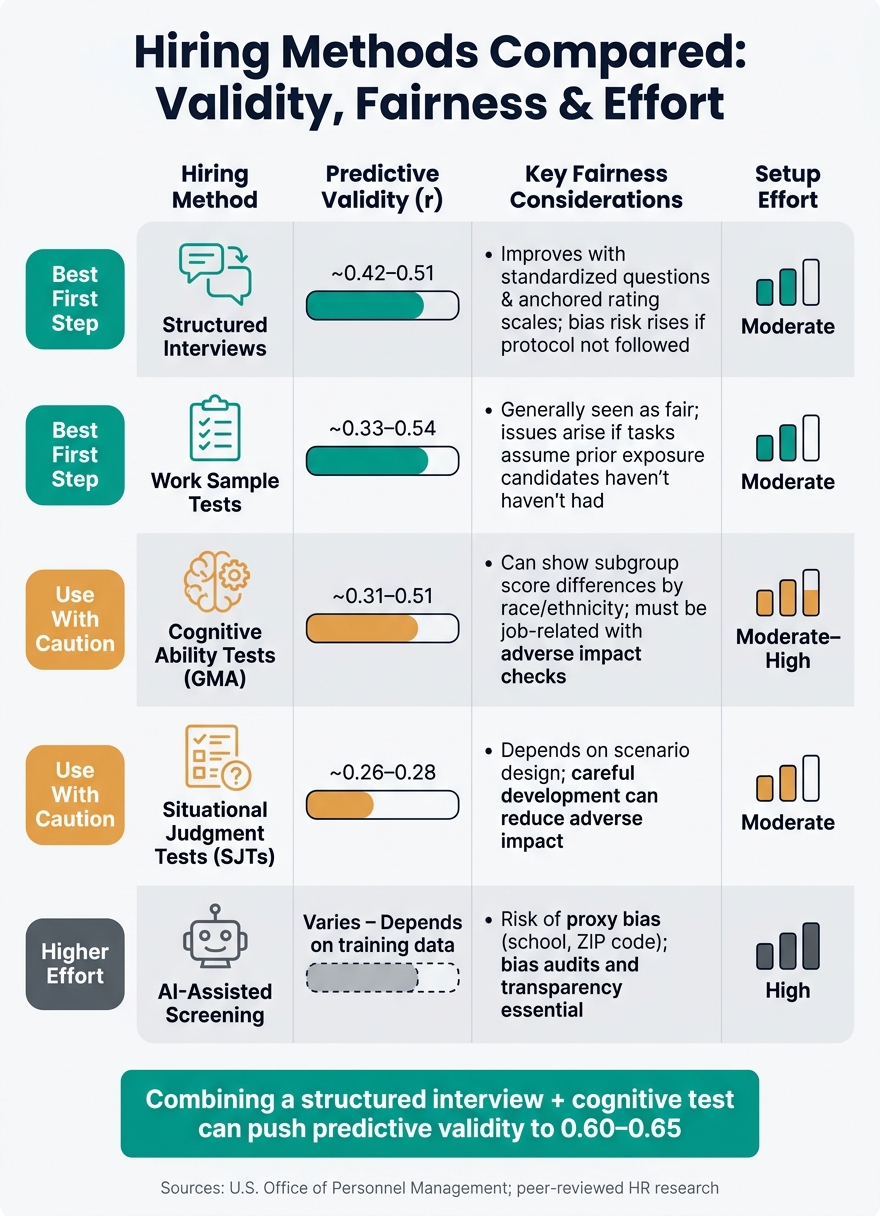
Hiring Method Comparison: Predictive Validity, Fairness & Setup Effort
Start with high-validity methods before adding complexity
Start with the simplest hiring stack that you can use well.
The aim is not to add more steps for the sake of it. The aim is better hires, stronger retention, and people getting productive faster. That is why structured interviews and work samples should come first, before you layer in more tools.
Build structured interview guides around 5 to 8 core competencies for each role. Add a job-relevant task, such as a coding challenge, a writing sample, or a case study, and score it with a clear rubric. Then track your funnel in your ATS: applications, screens, interviews, offers, and hires, split by role, source, and recruiter.[18][10][5]
This gives you a hiring process that is easier to run, easier to review, and easier to improve. For scaling teams, that matters. If you cannot see where hiring slows down or breaks, you cannot fix it.
Balance predictive accuracy with fairness and ease of use
Every hiring method comes with trade-offs across three areas: predictive validity, fairness, and setup effort. The smart move is to use the fewest tools needed to improve decision-making without adding drag to the process.
| Method | Approx. Predictive Validity (r) | Key Fairness Considerations | Setup Effort |
|---|---|---|---|
| Structured interviews (best first step) | ~0.42, with earlier estimates near 0.51[10][44] | Fairness improves with standardized questions and anchored rating scales; bias risk goes up if the protocol is not followed[18][10][41] | Moderate: templates scale across roles once built |
| Work samples (best first step) | ~0.33, higher in job-specific studies[18][5][10] | Often seen as fair; issues can come up if tasks assume prior exposure that some candidates have not had[18][5] | Moderate: design takes time but is practical to pilot for priority roles |
| Cognitive measures (GMA tests) (use with caution) | ~0.31, higher historical estimates for complex jobs[9][8][10] | Can show subgroup score differences by race and ethnicity; must be job-related and checked for adverse impact[9][10] | Moderate to high: requires vendor, validation, and legal review |
| Situational judgment tests (SJTs) (use with caution) | ~0.26 to 0.28[5][41] | Fairness depends on content and scenario design; careful development can reduce adverse impact[5][41] | Moderate: off-the-shelf options exist; custom versions need psychometric expertise |
| AI-assisted screening (higher-effort option) | Varies; depends on training data quality and target criteria[27][38][39][40] | Risk of stand-in bias using proxies like school or ZIP code; bias audits and transparency are essential[38][24][39][40][45] | High: requires technical infrastructure, governance, and continuous monitoring |
One point matters more than many teams expect: you still own the outcome. Even if a third party provides the tool, employers remain responsible for adverse impact.[42][43][46]
That makes the business case pretty clear. Start with methods that are easier to defend, easier to train on, and easier to roll out across teams. Add heavier tools only if the data show they improve hiring results enough to justify the cost, time, and risk.
Conclusion: Use data to improve hiring quality, control costs, and scale
Use structured, data-backed hiring first. Measure post-hire outcomes. Expand only when the data justify it.
Start small. Track what happens after hire. Scale only the methods that improve quality of hire.
Rent a Recruiter can help scaling teams embed structure and visibility directly into hiring.
FAQs
How do I measure quality of hire?
Measure quality of hire against role-based outcomes that tie back to business performance, not gut feel.
That usually includes:
- 90-day retention
- Time to productivity
- Hiring manager satisfaction at 30, 60, and 90 days
- First-quarter KPI performance
You can also track interview quality scores, offer acceptance rate, and 12-month performance ratings.
The key is consistency. Use the same scorecard and the same hiring funnel across roles where it makes sense, so you can compare results properly and spot problems early.
Review these metrics weekly or monthly for early warning signs, then look at them quarterly for a deeper view of hiring output and team impact.
Which hiring methods should I use first?
Start with a data-led foundation. Build a clear hiring process that begins with role intake, then sets 4 to 7 competencies, scorecards, standardised questions, and trained interviewers. From there, standardise screening and interviews at each stage so every hire is measured the same way.
This matters because loose hiring processes cost time, slow down decisions, and make it harder to spot what’s working. If each interviewer uses a different yardstick, your hiring data is weak from day one.
Use a hybrid approach first. Apply predictive analytics to repeatable tasks like screening and scheduling, then leave final decisions to recruiter or hiring manager judgement. That gives you speed where automation helps, without handing over the calls that shape team quality and retention.
Start small. Track cost per hire, time to fill, offer acceptance rate, and 90-day retention. Once you can see what’s improving, scale with more confidence and less waste.
How can I use AI in hiring safely?
Use AI as a support tool, not the final decision-maker.
That means using it for low-judgment work that eats up time but doesn’t need human judgement at every step. Think initial screening, interview scheduling, and status updates. Those tasks can move faster without pulling your hiring team into admin all day.
But when the stakes are higher, people should stay in charge. Cultural fit, role fit, and final hiring decisions need human input. That’s where context matters. That’s where nuance matters. And that’s where poor calls get expensive.
If you want fairer and more accurate hiring, a few things matter:
- Use diverse datasets
- Focus on job-relevant skills instead of keyword frequency
- Audit outcomes on a regular basis for bias
- Keep clear, consistent documentation for compliance
This is the balance most scaling teams need. Let AI handle repetitive tasks. Keep humans responsible for the calls that affect hiring quality, risk, and long-term team performance.