
Cross-functional onboarding isn’t just about getting new hires up to speed – it’s about preparing them to contribute effectively across your entire business. For SMEs, where every hire has an outsized impact, poor onboarding can lead to high turnover, wasted time, and operational bottlenecks. 33% of new hires look for another job within six months due to bad onboarding, and replacing them can cost up to 60% of their annual salary.
Here’s why cross-functional onboarding works better:
- Retention: Companies with structured onboarding retain 82% of new hires, compared to 46% with disjointed processes.
- Productivity: New hires reach full productivity up to 50% faster with clear workflows and interdepartmental context.
- Collaboration: Breaking down silos early reduces misalignment, improves decision-making, and avoids costly mistakes.
For growing SMEs, this approach provides a scalable way to align teams, reduce turnover, and maximize the ROI of every new hire by optimising your hiring strategy. If building this structure feels overwhelming, Rent a Recruiter can help you create a process that works without the high costs of traditional agencies.
Reshaping Your Onboarding Process to Make New Hires Successful
sbb-itb-a23bd6a
What Cross-Functional Onboarding Means for SMEs
Most traditional onboarding processes focus narrowly on a single team. A new hire gets their tools, meets their manager, and learns the essentials of their role. But what’s often missing is the bigger picture – how the organization operates as a whole. Cross-functional onboarding flips this approach. It emphasizes the interconnectedness of departments, showing how work flows across teams and how decisions in one area impact others [1].
Rather than just teaching a new hire what they need to do, this method provides insight into how their role fits into the larger system. It highlights dependencies, handoffs, and the ripple effects of their actions. As Alex from Orichi puts it:
"Most productivity breakdowns aren’t caused by a lack of talent or effort. They’re caused by missing context, unclear expectations, and misaligned systems – exactly the problems that structured onboarding solves." – Alex, Orichi [1]
This approach becomes increasingly important as companies grow. When there are only 10 employees, informal knowledge-sharing fills the gaps. But as headcount climbs to 50 or 100, that informal system collapses. Without a structured, cross-departmental onboarding process, new hires are left to navigate the complexities of the business through trial and error – a costly and inefficient learning curve [1].
Core Components of Cross-Functional Onboarding
To make cross-functional onboarding work, SMEs need four key elements:
- Visible workflows: Map out how tasks move between departments so new hires can see how their role fits into the broader process [1].
- Communication norms: Establish clear guidelines for communication tools – for instance, using Slack for urgent issues and email for less pressing matters. This helps eliminate early miscommunications [1][2].
- Cross-functional mentorship: Pair new hires with a buddy from another department to foster interdepartmental relationships and build a broader network quickly [2].
- A unified onboarding plan: Create a single roadmap that integrates input from HR, IT, Finance, and team leads. This ensures a consistent experience rather than leaving each team to manage onboarding independently [2].
These components transform onboarding from a simple checklist into a structured workflow. It’s a process that’s coordinated, sequenced, and shared across the business [6]. This approach not only streamlines onboarding but also addresses the most common challenges SMEs face.
Common Onboarding Challenges in SMEs
For SMEs, the biggest challenge isn’t a lack of motivation – it’s a lack of time. without a dedicated HR team or flexible hiring model, onboarding often falls to whoever can spare a moment. The result? Inconsistent and fragmented experiences that vary wildly depending on who’s managing the process.
Another issue is siloed teams. When departments don’t collaborate during onboarding, new hires are set up to inherit those silos. They focus on their team’s priorities without understanding how their work affects others. For example, a sales rep might close deals that the customer success team isn’t equipped to handle, creating unnecessary friction [1].
On top of this, critical knowledge often resides in the heads of long-tenured employees. New hires are left to interrupt senior staff repeatedly for answers, slowing everyone down. This lack of documentation exposes a major weakness in many SMEs. It’s no wonder that only 12% of employees feel their organization excels at onboarding [7][8]. That number underscores just how widespread these challenges are, even in businesses of all sizes.
What the Research Shows About Performance and Collaboration
Studies reveal that cross-functional onboarding plays a critical role in improving both performance and retention. Annabell Mitschelen and Simone Kauffeld from Technische Universität Braunschweig emphasize this point:
"Onboarding is not merely a process of knowledge transfer, but a dynamic interaction between organizational structures and newcomer engagement." [9]
This means onboarding goes beyond handing out manuals or policies. It’s about helping new hires understand the real workings of the company – the processes, the informal networks, and the unspoken norms. This dynamic approach leads to two major benefits: quicker problem-solving and stronger knowledge-sharing practices.
Faster Problem-Solving and Better Coordination
Research consistently shows that informal, problem-based learning speeds up team coordination across departments [9]. When a new hire gains cross-functional exposure right from the start, they quickly learn who to approach when issues arise. They also understand which teams handle which decisions, cutting down resolution times significantly.
That said, onboarding isn’t about overwhelming new hires with every detail. A study on private manufacturing firms highlighted the risks of "extensive involvement." In this case, every new management hire who was deeply immersed in all business and social activities left the company within 18 months [5]. Why? Being pushed too quickly into tightly bonded teams made them feel like outsiders rather than collaborators.
Henning Piezunka, a management professor at Wharton, explains this dynamic:
"Managers underestimate how special these relationships are and believe they can just onboard someone… The top management team isn’t geared toward having another equivalent member in there." [5]
A better approach is selective involvement, where new hires begin with independent tasks, allowing trust and collaboration to develop naturally. This method not only improves coordination but also strengthens knowledge-sharing practices, which are essential for small and medium enterprises (SMEs) as they scale.
Knowledge Sharing and Workforce Resilience
Cross-functional onboarding directly improves how knowledge flows within an SME. Research shows that effective sharing of both tacit and explicit knowledge enhances operational performance, with innovation acting as a key driver [10]. When employees across departments share insights, the business becomes more adept at tackling new challenges.
Resilience is another critical factor. Onboarding programs that encourage self-directed learning empower new hires to seek out information and build connections across teams [9]. This independence reduces reliance on a single manager or team for guidance, a benefit often realized through an embedded recruitment service – a significant advantage in SMEs, where employees often juggle multiple responsibilities.
Business Benefits of Cross-Functional Onboarding for SME Growth
Cross-functional onboarding isn’t just a buzzword; it delivers clear, measurable advantages for growing SMEs. By fostering collaboration and knowledge-sharing across departments, the results translate directly into better business outcomes.
Getting New Hires Up to Speed Faster
Research shows that structured onboarding can boost new hire productivity by over 70% [11]. For SMEs, this means faster ramp-up times and fewer delays. Imagine outsourcing recruitment when hiring 10 employees annually and shaving two weeks off their onboarding process – that’s nearly five months of additional productive capacity recovered in a year [1].
One effective approach is using 30/60/90-day roadmaps. In the first 30 days, new hires focus on mastering tools and systems. By 60 days, they’re building relationships with key stakeholders, and by 90 days, they’re operating independently and aligning with company goals [3]. This structure not only provides clarity but also helps managers oversee progress without hovering.
Breaking Down Silos and Reducing Redundant Work
Faster onboarding also tackles inefficiencies caused by silos. When roles and responsibilities aren’t clear, new hires might either duplicate efforts or leave tasks undone. Cross-functional onboarding addresses this early, ensuring clear departmental boundaries and smoother collaboration [1].
Silos can also lead to misaligned priorities. For example, a sales team might focus on closing deals without considering whether customer success can handle the workload [1]. Breaking down these barriers ensures teams work toward shared goals rather than competing metrics.
Improving Knowledge Retention and Communication
Turnover is a costly problem, especially during the early stages of employment. Around 20% of employees leave within the first 45 days [8]. Structured onboarding, however, increases the likelihood of employees staying for at least three years by 58%, significantly cutting hiring costs [11][8].
A well-designed onboarding process ensures that institutional knowledge – like unspoken rules, communication norms, and preferred tools – is passed down effectively. This prevents new hires from having to "reinvent the wheel" and reduces the frustration of figuring things out on their own. Better internal communication and knowledge-sharing ultimately create a more cohesive and productive team.
How to Build a Cross-Functional Onboarding Program in Your SME
Creating a cross-functional onboarding program doesn’t have to be resource-heavy. The key is a clear structure and shared responsibility across departments. As monday.com explains:
"Onboarding is a team sport. Using a RACI matrix ensures that no activity falls through the cracks between departments." [13]
Start by assigning clear roles: HR oversees culture and compliance, IT manages hardware and system access, managers focus on role-specific performance, and a designated "buddy" helps with social integration. This approach ensures no task is left undone – a common challenge in SMEs where onboarding responsibilities often fall through the cracks, requiring a more modern approach to recruitment services. From there, focus on fostering collaboration across departments to broaden the new hire’s exposure.
Setting Up Cross-Functional Touchpoints
During the first three days, introduce new hires to team tools, workflows, and key colleagues. In the second and third weeks, schedule short, informal chats – about 15 minutes – with team members from other departments such as finance, product, or sales. These interactions help break down silos and build an internal network early on.
Another valuable addition is a Week 2 "Ask Me Anything" session. This 30-minute open Q&A with the full team encourages curiosity and gives new hires a safe space to ask about cross-department dynamics they might not feel comfortable discussing with their manager. [12] To prevent burnout during shadowing or mentoring, rotate responsibilities among team members so no one feels overburdened.
Documenting Processes and Knowledge
One of the most common mistakes SMEs make during onboarding is failing to document processes. A "How We Work" document – covering communication channels, response time expectations, meeting schedules, and decision-making processes – removes much of the guesswork for new hires. [12] Pair this with a searchable internal wiki that consolidates standard operating procedures and answers to FAQs, so new hires can find what they need without constantly interrupting senior staff.
Structured onboarding programs can help employees reach full productivity 50% faster than informal ones. [12] A well-maintained knowledge base not only supports this acceleration but also allows for continuous improvement over time.
Using Feedback to Improve Onboarding Over Time
To keep improving your onboarding program, gather structured feedback at regular intervals. Schedule check-ins during weeks 1, 3, and 6, and use standardized surveys at the 30-, 60-, and 90-day marks. This helps identify potential confusion and track how confident new hires feel. Interviewing your last five hires can also reveal gaps in your documentation – these are the areas to address next. As Trainual puts it:
"The onboarding system gets better as you measure it." [7]
Make sure all feedback sessions are scheduled during the hiring process to ensure they take place, even when workloads ramp up. This proactive approach ensures your program evolves alongside your team’s needs.
How to Measure the Impact of Cross-Functional Onboarding
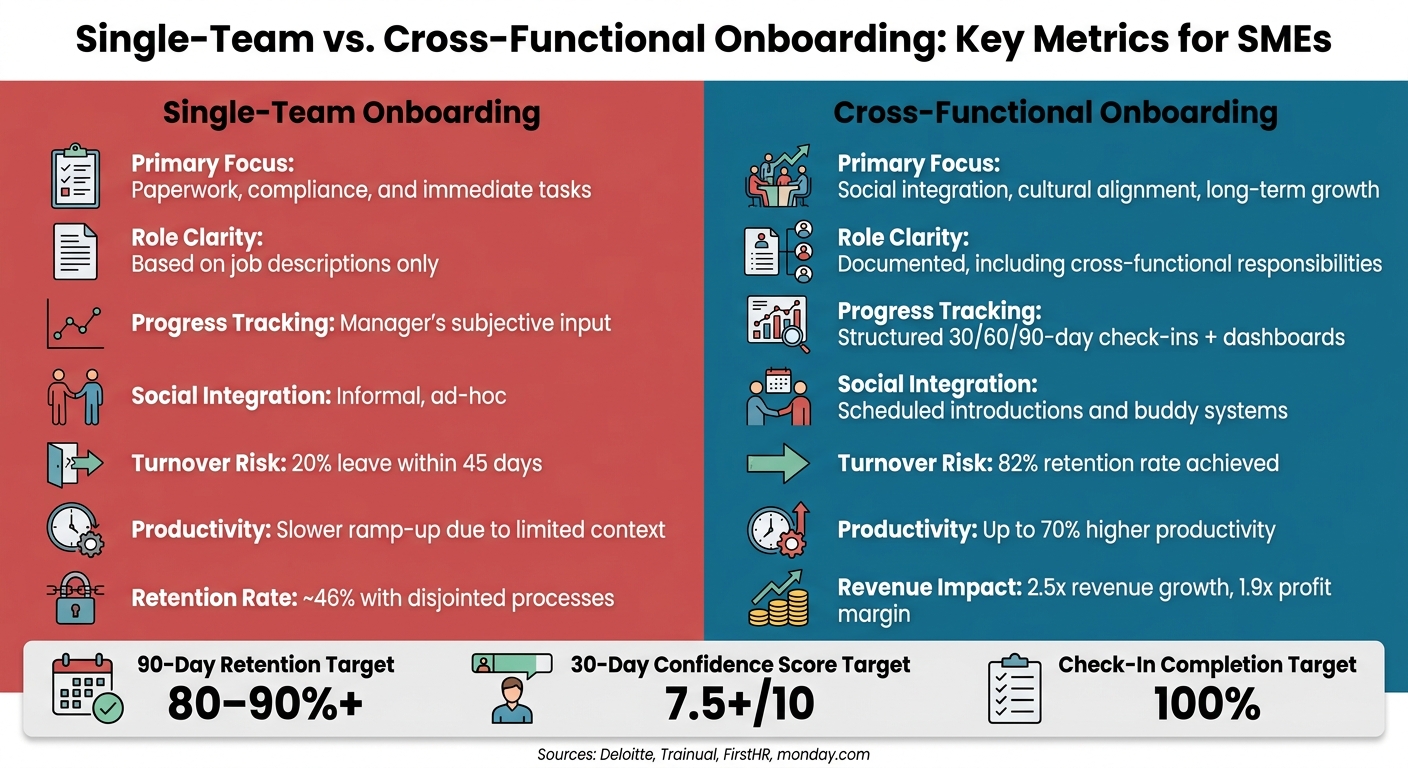
Single-Team vs Cross-Functional Onboarding: SME Impact Stats
Assessing the success of your onboarding program boils down to tracking specific metrics. These benchmarks provide clarity on what’s working and where adjustments are needed.
Key Metrics to Track
Start with your 90-day retention rate. Statistics reveal that one in three new hires leaves within the first 90 days, often pointing to poor cultural fit (19.5%) or an underwhelming onboarding experience (17.4%) [7]. If early attrition is high, it’s a red flag that your onboarding process may need a rethink, perhaps by integrating fractional recruitment services to ensure better cultural alignment from the start.
Next, measure Time to Productivity – how quickly a new hire completes their first independent task without requiring corrections. To make this meaningful, define what "productive" means for each role before onboarding begins. Pair this with a 30-Day Confidence Score, where new hires rate their readiness on a scale of 1 to 10. Scores below 7 should trigger immediate follow-ups [15].
"The first 90 days of employment are when new hires decide whether to stay or leave, and most of that decision is made in the first 30 days based on information you could have collected with a three-question Google Form." – FirstHR [15]
Another critical metric is the check-in completion rate. Regular one-on-ones with managers and cross-functional interactions are vital. A completion rate below 80% indicates the process isn’t being consistently followed [15].
Here are some benchmarks to guide your evaluation:
| Metric | SME Standard | Warning Sign | Critical Failure |
|---|---|---|---|
| 90-Day Retention | 80–90%+ | 70–79% | Below 70% |
| 30-Day Confidence | 7.5+/10 | 6–7 | Below 6 |
| Day 7 Satisfaction | 7+/10 | 6–7 | Below 6 |
| Check-In Completion | 100% | Below 90% | Below 80% |
| Training Completion | 100% (Compliance) | Below 80% | Any compliance gap |
(Source: [15])
These benchmarks allow you to compare the outcomes of single-team onboarding against cross-functional approaches.
Single-Team Onboarding vs. Cross-Functional Onboarding: A Comparison
Studies highlight that effective onboarding correlates with 2.5 times higher revenue growth and a 1.9 times greater profit margin [14]. The key difference lies in whether onboarding focuses narrowly on role-specific tasks or builds a broader understanding of the organization.
| Feature | Single-Team Onboarding | Cross-Functional Onboarding |
|---|---|---|
| Primary Focus | Paperwork, compliance, and immediate tasks | Social integration, cultural alignment, and long-term growth |
| Role Clarity | Based on job descriptions | Clearly documented, including cross-functional responsibilities |
| Progress Tracking | Relies on manager’s subjective input | Structured check-ins (30/60/90 days) and real-time dashboards |
| Social Integration | Informal, ad-hoc interactions | Scheduled introductions and buddy systems |
| Retention Impact | Higher risk of early exits (20% turnover within 45 days) | Retention improves significantly, with an 82% boost and a 58% higher long-term stay rate |
| Productivity | Slower ramp-up due to limited context | Up to 70% higher productivity with faster contributions |
This comparison underscores the advantages of a broader onboarding strategy. Implementing such a strategy often requires structured talent acquisition services to bridge the gap between hiring and long-term integration. Cross-functional onboarding not only enhances retention but also accelerates productivity and contributes to overall business growth.
Conclusion: How Cross-Functional Onboarding Supports SME Growth
Onboarding isn’t just an HR task; it’s a growth lever. For SMEs, where every employee plays a critical role, losing even one hire can disrupt operations. Cross-functional onboarding addresses this by aligning efforts across departments from day one, creating a unified approach that drives both individual and company success. The data backs this up.
When employees understand their role in the bigger picture from the start, they perform better, make fewer mistakes, and stay longer. Companies with strong onboarding processes achieve 2.5x revenue growth and 1.9x profit margins compared to those without [16]. These figures reflect the compound impact of clear communication, structured processes, and collaborative touchpoints.
"Scalable onboarding infrastructure – not individual manager effort – is a core capability distinguishing high-growth companies that sustain performance during rapid hiring." – Deloitte Global Human Capital Trends [4]
The takeaway? A unified onboarding strategy is essential, especially for SMEs navigating rapid growth. This means structured preboarding, coordinated introductions, defined milestones, and ongoing feedback – all done consistently. Yet, consistency is where many SMEs falter when scaling quickly.
If building this structure feels overwhelming, there’s help. Rent a Recruiter offers embedded recruiters who integrate directly into your team. They bring the expertise and systems needed to create a scalable hiring process, without the high costs or delays of traditional agencies. Companies partnering with Rent a Recruiter typically cut hiring expenses by 70% and save over 80 hours per month in internal admin, giving your team the time and resources to onboard effectively.
FAQs
What’s the simplest way to start cross-functional onboarding?
The simplest way to kick off cross-functional onboarding is by assigning new hires a buddy or mentor from a different department. This straightforward approach not only helps them form connections but also gives them a wider view of how the company operates. Another effective tactic is organizing interdepartmental meet-and-greet sessions or team-building activities. These events encourage collaboration and help employees understand how their roles fit into the bigger picture, all without needing complicated tools or intensive HR efforts.
How do you avoid overwhelming new hires with too much exposure?
Onboarding doesn’t need to overwhelm new hires. A structured approach like the 3-3-3 rule can make their transition smoother and more effective. Here’s how it works:
- In the first week, focus on three key people they should meet, three clear goals they can achieve, and three essential tools they’ll need to get started.
Kick off their first day with a later start and an earlier finish, giving them time to absorb everything. Pair them with a peer buddy to answer questions and guide them through the initial phase. Use a 30-60-90 day plan to provide a clear roadmap for their progress.
Finally, let connections form naturally. Avoid pressuring them to dive into every activity or relationship immediately – building familiarity takes time. This approach ensures they feel supported without being overwhelmed.
Which onboarding metrics should SMEs track first?
Small and medium-sized enterprises (SMEs) should prioritize tracking retention rates and time-to-productivity to gauge the success of their onboarding efforts. Metrics such as compliance completion rates, readiness scores, and performance against 30-, 60-, and 90-day goals provide valuable insights into how well new hires are settling in. Tools like the employee Net Promoter Score (eNPS) can be used to assess engagement levels. Together, these measurements ensure new employees are smoothly integrated into the team while identifying areas where the onboarding process can be refined.