
If you wait until a role opens to start passive talent outreach, you are already behind.
I’d boil this down to four things: build a tagged pipeline, start low-pressure outreach, keep a light follow-up rhythm, and track who is warming up. That gives you a better shot at cutting hiring delays, lowering wasted screening time, and filling specialist roles without starting from zero each time.
For scaling teams in SaaS, IT recruitment, Fintech, Engineering, Security, Insurance, and Professional Services, the business case is simple:
- Active applicant pools are often weak, with 42% lacking the basic skills listed
- Unfilled specialist roles can cost $1,700 to $5,000 per day
- A warm passive pipeline can cut time-to-fill from 60 days to 10 to 15 days
- Personalised outreach can lift response rates to around 40%
If you want passive talent to turn into hires later, you need a system now, not when hiring pressure hits.
I see this as a pipeline discipline issue, not just a sourcing issue.
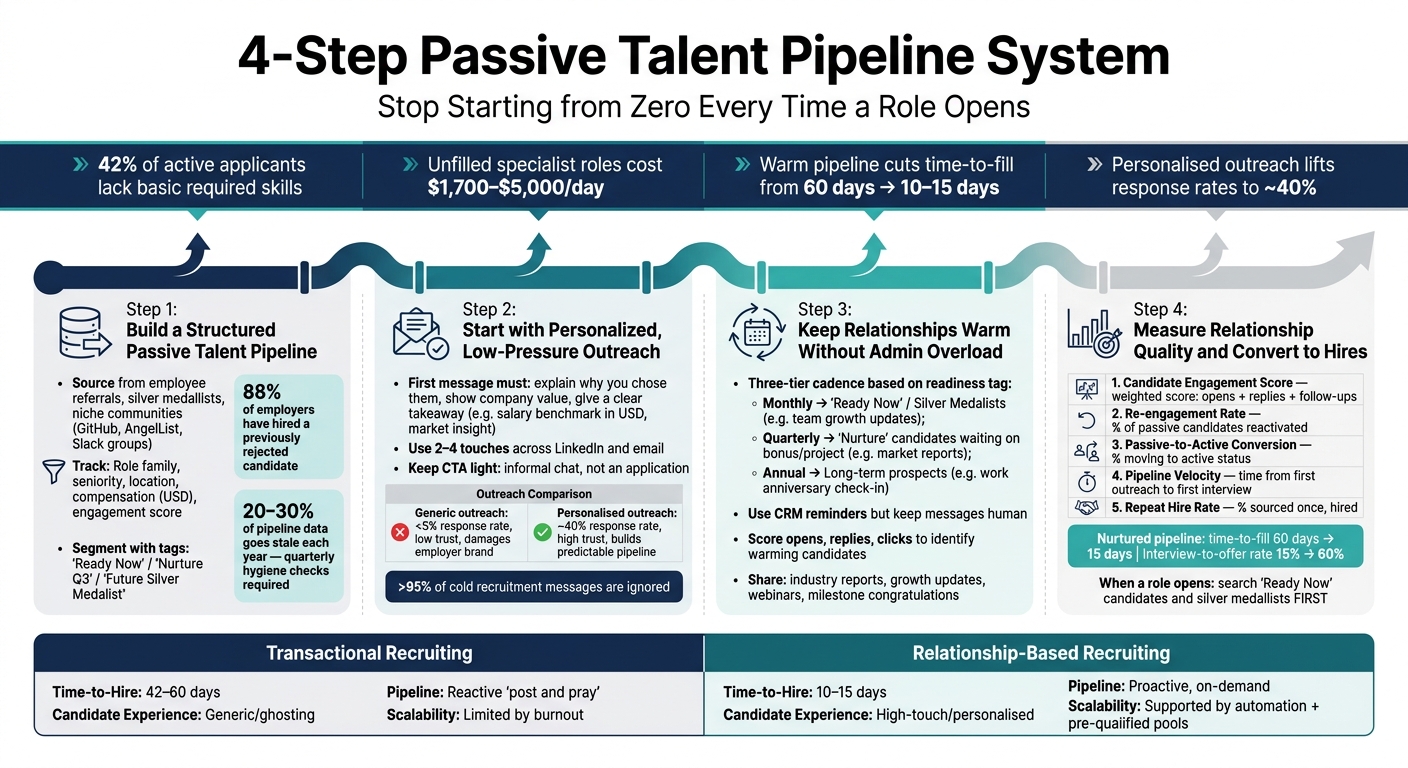
4-Step System to Build a Passive Talent Pipeline That Converts
Stop Posting & Praying: Passive Candidate Sourcing That Works
sbb-itb-a23bd6a
Step 1: Build a structured passive talent pipeline
A passive talent pipeline only works when it’s set up before you need it. The aim is simple: know who to revisit, when to reach out again, and why. Think of it less like a candidate list and more like a memory system for future hiring conversations.
Start with the highest-value talent sources
Begin with the sources most likely to give you warm, high-quality candidates. Employee referrals should be one of your first channels. Your team often knows strong people in the market, and those introductions tend to start with more trust.
Then go back to your silver medallists, the finalists who came close but did not get the offer. Tag them for future roles and keep them in view. Nearly 88% of employers have eventually hired a candidate they previously rejected [2].
After that, move into niche communities where strong talent already spends time. That includes GitHub, AngelList, and industry-specific Slack groups. These channels often bring in better-fit, less saturated talent than broad outbound outreach on its own.
Track the right data fields for long-term follow-up
A passive pipeline is only as good as the data inside it. If the right fields are missing, relationships slip through the cracks and warm leads go cold.
At a minimum, each candidate record should include:
- Role family
- Seniority level
- U.S. location
- Compensation expectations in USD
- Past interactions
- Interests and motivations
- An engagement score based on opens, replies, and follow-ups
You should also segment each contact by readiness with clear tags. "Ready Now" works for someone open to moving straight away. "Nurture Q3" fits someone waiting on a bonus or project milestone. "Future Silver Medalist" works for a strong person who was not the right fit at that point. The tag should make the next follow-up obvious, so no one on your team has to guess.
Pipeline data goes stale fast. Around 20% to 30% becomes outdated each year [2]. That’s why quarterly hygiene checks matter. They help you keep records clean, contact details current, and outreach timing on track.
How Rent a Recruiter helps build and manage passive pipelines
For high-growth SMEs, the issue usually is not knowing what a passive pipeline should look like. It’s having the time and hiring skill to build and maintain one while the rest of the business keeps moving.
Rent a Recruiter places experienced recruiters directly into your team, often within days, to manage this work end-to-end. They map talent by role family, seniority, and U.S. location. They set up structured pipeline stages. They keep follow-up consistent, so you get the visibility and control busy hiring teams often lack.
That means less admin for your internal team, less chance of losing warm talent, and a pipeline that’s ready when a role opens.
Once the pipeline is in place, use low-pressure outreach to start the relationship.
Step 2: Start the relationship with personalized, low-pressure outreach
With your pipeline structured and tagged, the next move is first contact. The aim is simple: start a conversation, not force a hire. Passive candidates are not actively job hunting, so asking them to apply too early often kills the reply. More than 95% of cold recruitment messages are ignored [1]. The messages that cut through feel relevant, well-timed, and specific.
Write outreach that gives value before asking for anything
Go past LinkedIn. Look at public work, community activity, and other signals that tell you what this person cares about. The tags in your pipeline should shape the message, the timing, and even the channel. Use them to match outreach to role family, seniority, and readiness.
A strong first message does three jobs:
- Explains why you picked this person
- Shows why your company matters right now
- Gives them a clear takeaway
That takeaway matters more than most hiring teams think. A salary benchmark in USD, a short note on where the market is heading, or a quick update on team growth gives the person a reason to reply, even if they are not planning a move. It shifts the message from "another embedded recruitment service filling a req" to someone worth talking to.
Keep the call to action light. A short, informal chat is much easier to accept than an application request.
Set up a simple multi-touch outreach sequence
From there, follow up without piling on pressure. Use 2 to 4 touches across LinkedIn and email. Each one should add something new, not just repeat the first note.
Think of it like good sales outreach. If every follow-up says the same thing, you look lazy. If each touch adds context, market insight, or a reason the timing may matter, you give the relationship room to grow.
Generic outreach vs. personalized outreach: a comparison
Personalization lifts response rates and gives your team a stronger pipeline. This is not about sending more messages. It is about building a relationship you can come back to later.
| Approach | Trust Level | Typical Response Lift | Time Required | Future Value |
|---|---|---|---|---|
| Generic | Low | Very low (<5% [1]) | Low | Low; often damages employer brand |
| Personalized | High | High (~40% [2]) | High | High; builds a predictable talent pipeline |
Once the first touch lands, keep the relationship warm with a low-touch cadence that respects their timeline.
Step 3: Keep relationships warm without creating admin overload
First contact is only the starting point. The harder job is staying relevant to someone who is not actively looking, without tiring out your team or irritating the candidate. The answer is structure, not more outreach, often achieved by comparing different recruitment models to find the right fit for your team.
Match follow-up frequency to where each candidate stands
Use the tags from Step 1 to set follow-up timing. Not every passive candidate needs the same level of contact, so build a three-tier cadence around candidate readiness.
Let your CRM handle reminders, but keep the message itself human and personal. That matters. A timed reminder saves admin. A message that sounds like it came from a person gets the reply.
Use quarterly check-ins to confirm:
- availability
- priorities
- contact details
This keeps your data clean and helps your team spend time on people who may move, not names sitting cold in a database.
Use touchpoints that build credibility over time
"Just checking in" messages get ignored. Each touchpoint needs a reason to be opened.
Share industry reports, growth updates, webinars, and milestone congratulations. Tie each message to the candidate’s readiness tag. If a role opens that fits goals they have already shared, your outreach feels timely rather than opportunistic.
That is where good nurture work pays off. You are not starting from zero when hiring demand spikes. You already know who is warming up, what matters to them, and when to reach out.
Score opens, replies, and clicks to spot warming candidates. That helps you focus personal attention where it counts, while automation handles the rest. Less admin, better timing, stronger response rates.
Monthly, quarterly, and annual cadences: a comparison
| Cadence | Best-Fit Candidate Type | Message Example |
|---|---|---|
| Monthly | "Ready Now" / Silver Medalists | "We’ve expanded the engineering team by 20% since we last spoke; would love to share the new roadmap." |
| Quarterly | "Nurture" candidates (waiting on bonus/project) | "We just released our Q3 Fintech Market Report – thought you’d find the data on [Trend] useful." |
| Annual | Long-term prospects / General database | "Happy work anniversary! How has your role at [Company] evolved over the last year?" |
Track engagement so you know which warm candidates are ready to move.
Step 4: Measure relationship quality and convert warm candidates into hires
Once your cadence is in place, measure whether it leads to hires, not just activity.
That matters because relationship-led recruiting needs leading indicators, not just lagging metrics like time-to-fill or cost-per-hire. If you only look at end results, you miss what is building momentum inside the pipeline.
Track each segment separately by readiness tag. That gives you a clear view of which group is closest to hire, where deals are stalling, and where your team should spend time.
| Metric | What It Measures | Why It Matters |
|---|---|---|
| Candidate Engagement Score | A weighted score based on email opens, replies, and follow-ups | Helps prioritise the warmest leads in your pipeline |
| Re-engagement Rate | % of previously passive candidates successfully reactivated | Shows the health of your long-term pipeline |
| Passive-to-Active Conversion | % of nurtured candidates who move to active status | Proves the nurture strategy is working |
| Pipeline Velocity | Time from first outreach to first interview | Measures how efficiently relationships convert |
| Repeat Hire Rate | % of candidates sourced once and hired later | Shows the ROI of long-term nurture strategies |
A nurtured talent pool can cut time-to-fill from 60 days to 15 days and lift the interview-to-offer pass-through rate from 15% to 60% [2].
That kind of shift has a direct business effect. You shorten vacancy time, reduce drag on team output, and improve offer conversion without starting from scratch every time.
When a role opens, search your pipeline for "Ready Now" candidates and silver medalists first. These are your top-priority groups, and they often give you the fastest route to hire before you spend money on a new job ad.
Candidates with scorecards already on file can often skip early screening rounds and move straight to final-stage conversations [2]. That saves time for hiring managers and keeps strong people from dropping out during slow early-stage screening.
Transactional recruiting vs. relationship-based recruiting: a comparison
The difference comes down to speed, experience, and predictability.
That is why relationship-based recruiting tends to beat transactional hiring, especially for scaling teams where every open role has a cost.
| Feature | Transactional Recruiting | Relationship-Based Recruiting |
|---|---|---|
| Time-to-Hire | 42-60 days for technical roles [2] | As low as 10-15 days [2] |
| Candidate Experience | Generic outreach, frequent ghosting [2] | High-touch, personalised, value-driven [1] |
| Pipeline Predictability | Reactive "post and pray" [2] | Proactive, calibrated, on-demand [2] |
| Scalability for Growing Teams | Limited by recruiter burnout and manual screening | High, supported by automation and pre-qualified pools |
Transactional hiring starts from zero every time a role opens.
Relationship-based hiring starts with a warm list of people who already know your company, have passed your internal bar, and are ready to engage when the timing is right.
That changes the economics of hiring. You spend less time sourcing from scratch, less time screening poor-fit applicants, and less money fixing slow hiring later.
Conclusion: Build the system, hold the cadence, measure the results
If the metrics improve, the pipeline is working.
Build the pipeline, keep the cadence, and measure conversion so you can prove the system is doing its job. For scaling companies, that proof matters. It links recruiting effort back to hiring speed, team output, and cost control. This data-driven approach helps teams overcome the biggest challenges in recruitment like talent shortages and candidate drop-off.
For companies trying to do this while growing fast, extra support can be the difference between a pipeline that keeps moving and one that stalls under pressure. Rent a Recruiter can help keep that cadence steady by embedding experienced recruiters directly into your team.
FAQs
How do I know which passive candidates are worth nurturing?
Look for signs of high performance and likely fit.
That means paying close attention to people who speak at industry conferences, contribute to open-source projects on GitHub, or have worked at recognised high-growth companies. These signals can help you spot stronger talent earlier, before your team wastes time on low-fit outreach.
It also pays to focus on candidates who have been in their current roles for two to three years. That’s often the point where people are more open to a move, which can lift response rates and shorten sourcing time.
And don’t ignore silver medalists from past hiring rounds. They already know your brand, they’ve shown interest before, and they’re four times more likely to respond. For hiring teams under pressure to fill roles fast, that’s one of the easiest ways to get more from the talent pool you already have.
What should I say in a first message to a passive candidate?
Start with a real point of connection, not a pitch. Skip generic outreach and mention a specific project, article, or talk so they know you’ve done your homework. Keep it short, around 200 to 400 characters, and make the tone relaxed and low-pressure.
The goal is to start a conversation about their career path, not sell the role straight away.
“Would you be open to a quick 15-minute chat?”
How often should I follow up without being annoying?
If a candidate isn’t interested, acknowledge it and step back.
Send one thoughtful follow-up 5 to 7 days after your first outreach. If there’s still no reply, stop after a second follow-up. That keeps your team from wasting time on dead-end outreach, and it protects your employer brand at the same time.
For candidates already in your talent pool, check in about every 90 days. Share something useful, like industry reports or company news, instead of only asking if they’re interested. It’s a simple way to keep the relationship warm without adding noise.