Hiring managers in SMEs often make or break your growth trajectory. Yet, only 38% receive formal interview training, leaving your business exposed to costly mistakes, poor hires, and even legal risks. Structured training can double the accuracy of hiring decisions, improve retention, and save time.
Why It Matters:
- Cost of Poor Hires: A bad hire can cost up to 30% of their annual salary.
- Time Wasted: Without structured processes, you risk wasting 33+ hours per role on ineffective interviews.
- Retention Challenges: Lack of training often leads to high turnover and disengaged employees.
Key Training Focus Areas:
- Structured Interviewing: Techniques like STAR reduce guesswork and improve decision-making.
- Bias Awareness: Tools like scorecards and bias testing eliminate unconscious biases.
- Legal Safeguards: Avoid discrimination claims with clear compliance training.
- Candidate Experience: Professional, consistent interviews enhance your employer brand.
The result? Better hires, faster processes, and lower costs. Want to scale hiring effectively? Start with training your hiring managers. If your team is stretched thin, embedded recruitment solutions can add capacity and expertise to your hiring process. Learn more at Rent a Recruiter.
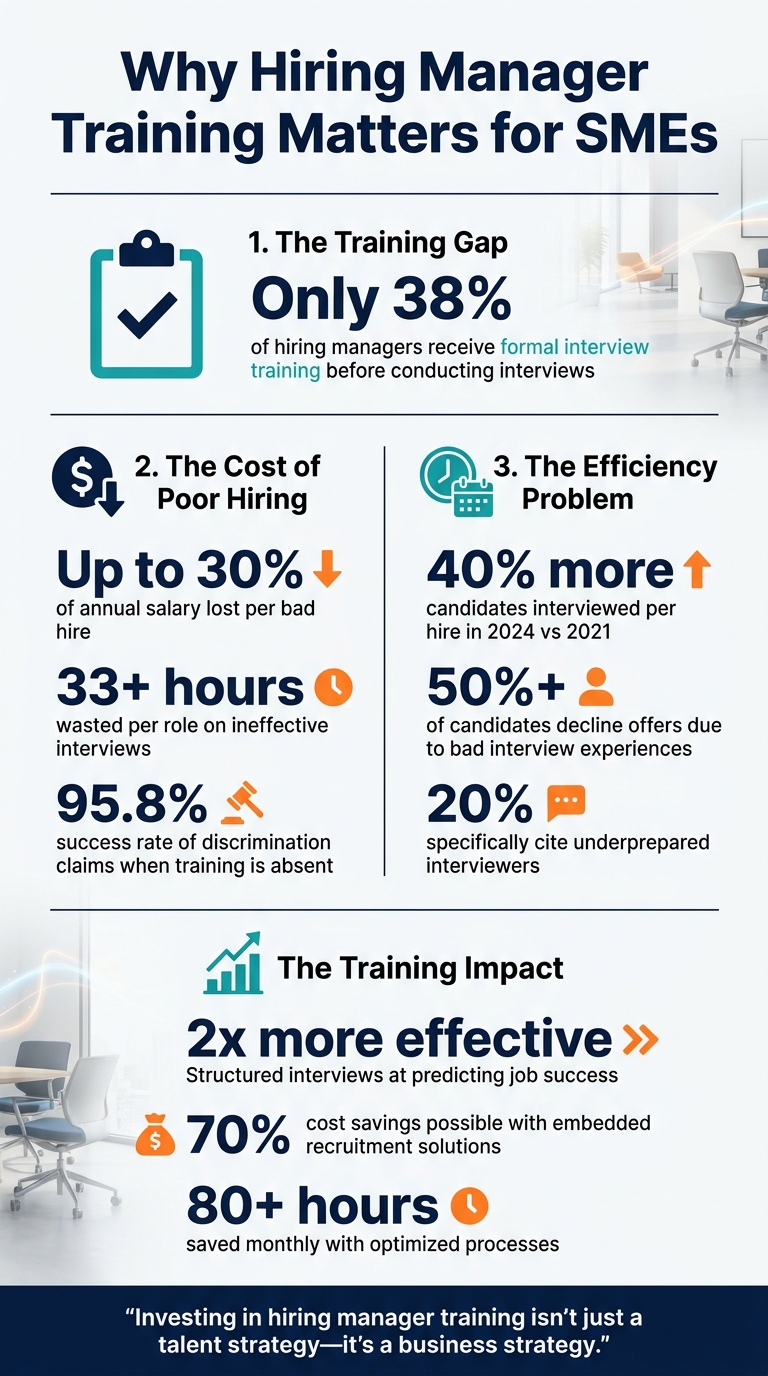
The Business Case for Hiring Manager Training in SMEs: Key Statistics and ROI
Identifying Training Needs for Hiring Managers
Assessing Current Skills and Processes
To identify where hiring managers need support, start by evaluating their current skills and processes. Use a combination of tools like surveys to uncover perceived gaps, direct observation of interviews (live or mock), and a review of HR metrics. Together, these methods give a well-rounded view of their capabilities [5][6][7].
Recruitment data can highlight specific areas for improvement. Metrics such as time-to-hire, quality of hire, and new hire retention rates often point to challenges in decision-making or assessing candidate fit [7][2]. For instance, if a department sees consistently high turnover, it might indicate a need for better training on evaluating cultural fit or setting clear role expectations.
For small and medium-sized enterprises (SMEs), auditing your recruitment process is especially helpful. By reviewing past interview notes and hiring decisions, you can spot inconsistencies or biases. Many managers, without formal training, tend to rely on intuition rather than structured criteria, which can lead to uneven outcomes.
It’s also smart to break down your assessment data by department or role instead of treating all managers uniformly. This targeted approach ensures training addresses the unique challenges each team faces. Validating these findings with department heads can confirm whether the identified issues align with actual day-to-day challenges [5].
These insights lay the groundwork for designing training programs that align with measurable goals.
Setting Training Priorities Based on Business Results
Once gaps are identified, the next step is prioritizing training efforts to deliver business results. With around 70% of employees reporting a lack of necessary professional skills [5], it’s crucial to focus on areas that directly impact performance metrics. This could include reducing time-to-fill for critical roles, improving retention in high-turnover departments, or boosting candidate satisfaction.
Start with the most urgent needs. For example, if the business requires rapid hiring, prioritize training that accelerates the process while maintaining quality. A structured three-level assessment – covering organizational, occupational, and individual needs – can help ensure the training is relevant [7].
Focus on measurable outcomes. If data shows low candidate satisfaction or high turnover in specific roles, direct training resources to these areas for maximum impact. Additionally, tracking the costs of poor hiring decisions can strengthen the case for investing in targeted training that not only enhances recruitment quality but also delivers clear financial benefits.
sbb-itb-a23bd6a
Building Hiring Manager Training Programs
Key Training Topics for Hiring Managers
Creating a training program for hiring managers starts with addressing common gaps. A great starting point is teaching structured interviewing techniques, such as the STAR method (Situation, Task, Action, Result). This approach helps managers focus on behavioral questions tied directly to role-specific competencies, rather than relying on instinct or vague impressions.
Another critical component is bias mitigation. Research shows that only 38% of hiring managers receive formal interview training before conducting interviews [3], leaving room for unconscious biases like "similar-to-me" bias to creep in. To counteract this, train managers to use objective scorecards and rating scales. Encourage them to take tools like the Harvard Implicit Association Test (IAT) to uncover hidden biases [9].
Incorporate legal and compliance essentials to protect your organization from potential risks. Managers should clearly understand what questions are off-limits, such as those related to age, race, religion, disability, or marital status, ensuring compliance with EEOC regulations [11]. Complement this with guidance on inclusive hiring practices, such as writing unbiased job descriptions, identifying transferable skills, and prioritizing "cultural add" over "culture fit."
Lastly, focus on improving the candidate experience. Managers should communicate clearly, maintain professionalism, and apply consistent evaluation methods. Every interaction shapes your company’s reputation, as discussed in The Talent Fix Recruitment Blog, so ensuring fairness and transparency throughout the process is vital.
"Training your interviewers is a crucial piece of a great hiring system. Well-trained interviewers protect your company from unintentional discrimination and ensure a consistently positive process that results in better hires." – Workable [9]
Once these topics are outlined, the next step is selecting the best ways to deliver this training.
Selecting Training Delivery Methods
For small and medium-sized enterprises (SMEs), training delivery needs to balance cost and effectiveness. SMEs have the flexibility to adapt methods to their budget and team structure without the red tape often found in larger organizations [10]. Start with low-cost options like self-study guides, educational videos, and free resources such as Harvard’s IAT or the New York Times confirmation bias puzzle [9]. These tools are excellent for building awareness and foundational knowledge.
To refine skills, mock interviews are invaluable. Pair less experienced managers with HR professionals or seasoned colleagues to practice interviewing and improve note-taking before they meet actual candidates [9].
Peer learning and mentorship programs can also be highly effective. Pairing newer hiring managers with experienced ones helps them observe and adopt proven best practices [2][8]. For more in-depth needs, consider external workshops from providers like Recruiting Toolbox or InterviewEdge, which offer tailored training on behavioral interviewing techniques [9].
A blended approach often works best for SMEs. Combine virtual instructor-led training (VILT) for foundational topics with e-learning modules that managers can complete at their own pace [12]. If your company uses an Applicant Tracking System (ATS), take advantage of built-in scorecards and templates to provide real-time guidance during active hiring cycles [10][9].
Getting Buy-In from Leadership and Teams
Connecting Training to Company Goals
One common misstep is treating hiring manager training as just another HR initiative. Instead, position it as a core business strategy that directly supports your company’s growth – whether that’s scaling teams after securing funding, entering new markets, or accelerating product development [11][2]. When leadership recognizes training as an operational improvement rather than a "nice-to-have", it’s easier to secure both the budget and attention it deserves.
The financial impact of poor hiring is hard to ignore. A bad hire can cost up to 30% of their first-year salary when you factor in lost productivity, recruitment fees, and team disruptions [11]. For demanding roles like product management, companies spend an average of 33.6 hours interviewing a single candidate [11]. Without structured hiring processes, those hours are wasted – keeping engineers and managers stuck in interviews instead of focusing on product innovation.
The numbers speak for themselves. Teams interviewed roughly 40% more candidates per hire in 2024 compared to 2021, highlighting the need for better training and efficiency [11]. Yet, only 38% of hiring managers receive formal interview training before leading interviews [3]. This leaves companies vulnerable to inconsistent hiring decisions and even legal risks.
"Investing in hiring manager training isn’t just a talent strategy – it’s a business strategy." – TalentAlly [2]
Start small by piloting the program with critical roles. Use this as an opportunity to measure improvements in metrics like time-to-hire or quality of hire [11]. Once you can show tangible results, scaling the program across your organization becomes much easier.
Creating Accountability for Applying New Skills
Getting leadership buy-in is just the first step; the next challenge is ensuring that training leads to real, measurable outcomes. Accountability is key. One effective approach? Require certification before managers can lead interviews. For example, HubSpot mandates formal training and assessments to ensure managers are equipped to evaluate candidates effectively. By March 2026, this initiative has led to more consistent evaluations and higher candidate satisfaction scores [3].
Salesforce takes it a step further by tracking compliance with interviewer training as a formal metric [3]. Their training covers structured interviews, bias reduction, and legal safeguards, with completion rates monitored as a key performance indicator.
Beyond certifications, implement structured post-interview debriefs. Dedicate 30 minutes to shift conversations from gut instincts to evidence-based decisions [11]. Use metrics like pass-through rates (typically 20–40%) and offer-accept rates (aiming for 70% or higher) to identify managers who may need additional coaching [11].
Calibration sessions are another valuable tool. Have your team review the same mock interview together to align on what "meets expectations" looks like [11]. This ensures consistency – so a candidate’s success doesn’t depend on which interviewer they happen to meet.
"Training is not a checkbox exercise but a commitment to elevating hiring as a strategic capability." – TalentAlly [3]
Measuring Training Program Results
Monitoring Performance Metrics
Tracking the right metrics turns training into a measurable business investment. Begin with time-to-hire and time-to-fill to assess how well training is addressing delays caused by hiring managers [13]. For instance, cutting time-to-hire from 45 to 30 days indicates faster, more confident decision-making.
Speed is important, but quality of hire carries even more weight. Measure new employees’ performance ratings during their first year and monitor probation failures [13][3]. Poor hires can cost up to three times an employee’s annual salary when factoring in lost productivity and team disruption [13]. Training should help managers make better hiring decisions, reducing these costly errors by improving their ability to identify candidates with long-term potential.
Don’t overlook candidate experience scores. Over 50% of candidates decline job offers due to bad interview experiences, with 20% specifically pointing to underprepared interviewers [14]. Additionally, track diversity metrics, such as the percentage of diverse candidates progressing to interviews, to evaluate the impact of unconscious bias training [2].
Instead of relying solely on company-wide averages, review these metrics on a per-manager basis [13]. This approach highlights individuals who may need extra coaching, such as those whose candidates regularly rate interviews poorly. Combine these quantitative insights with qualitative feedback for a fuller view of training outcomes.
Collecting Participant Feedback
While metrics provide hard data, feedback from participants adds valuable context. Gather input immediately after training and follow up three to six months later to see if managers are applying their new skills or slipping back into old habits [14].
"It’s important to promote post-interview reflection. This includes encouraging managers to complete their scorecards immediately after each interview while the information is still fresh in their minds."
– Annelise Pretorius, Psychometrics Assessments Expert, AIHR [14]
Conduct post-cycle debriefs after each hiring round to identify what went well and where challenges remain [2]. For example, managers might struggle with behavioural interview techniques or evaluating technical skills. These insights can inform updates to future training sessions.
Peer learning sessions also offer valuable insights. When managers share their experiences, you’ll uncover which training aspects were most effective and which need improvement [4]. It’s worth noting that 99% of hiring managers who receive interview training report they genuinely needed it [14].
Think of training as a continuous process rather than a one-off event. Use feedback loops to regularly refine training materials, ensuring they stay relevant to your business goals and address ongoing challenges [3][4]. The aim is steady progress, not instant perfection.
Training Your Line Managers to Hire Effectively
Using Embedded Recruitment Support Alongside Training
To get the most out of training, small and medium-sized enterprises (SMEs) need to tackle deeper structural issues in their hiring processes.
Recruitment Health Checks: Identifying the Real Problems
A recruitment health check can uncover systemic flaws – like vague job descriptions or undefined success metrics – that training alone can’t resolve. Many SMEs mistakenly believe they face a talent shortage, when the real problem lies in structural inefficiencies, such as poor hiring sequences or inconsistent evaluation methods [1]. These assessments examine every step of your hiring process, from job description creation to candidate interview feedback, often revealing gaps like managers relying on intuition instead of structured scorecards [3].
"Workforce planning for SMEs often fails not because leaders lack clarity but because they lack capacity to execute consistently."
– Mark Loughnane, Lead of Rent a Recruiter [1]
Addressing these issues often requires a combination of better manager training and a complete audit of hiring processes. Once gaps are identified, bringing in embedded recruiters can be the next logical step to boost hiring efficiency.
Boosting Capacity with Embedded Recruiters
Even the most skilled hiring managers can struggle when stretched too thin. Embedded recruiters can step in quickly – often within days – taking on administrative tasks so managers can focus on strategic decision-making [1].
The results speak for themselves. Take MasterTech, for example: they partnered with an embedded recruiter for 27 months, completing 29 placements with a 4:1 CV-to-interview ratio and saving $123,000 compared to traditional agency fees [1]. Similarly, Unique streamlined global hiring across five cities, managing 291 interviews and securing 10 successful hires in just a few months [1].
Beyond filling roles, embedded recruiters mentor managers, helping them apply structured interview techniques and implement training insights. This creates a scalable, efficient recruitment process that aligns with your broader business goals.
Conclusion
Hiring managers in SMEs play a critical role in shaping both talent acquisition and overall company growth [2]. However, only 38% of them receive formal interview training before stepping into the hiring process [3]. This gap leads to poor hiring decisions, reputational damage, and even legal risks – workplace discrimination claims succeed 95.8% of the time when proper training is absent [14].
Research shows that structured interviews are twice as effective at predicting job success. Companies that invest in comprehensive training see improvements in quality-of-hire and reduced turnover – key benefits for SMEs that are often working with limited resources [2][3][8].
"Investing in hiring manager training isn’t just a talent strategy – it’s a business strategy." – TalentAlly [2]
To address these challenges, start by auditing your recruitment process for inconsistencies and bias. Implement structured tools like standardized scorecards to ensure measurable improvements [2][3][11]. Tracking metrics such as time-to-hire, quality of hire, and new hire retention can help clearly demonstrate the value of training initiatives [2].
If your internal resources are stretched too thin, consider external support. Embedded recruitment solutions from Rent a Recruiter can help streamline your hiring process, cutting costs by up to 70% and saving over 80 hours each month.
FAQs
What should hiring manager training cover first?
The initial focus of hiring manager training should be on mastering the fundamentals of effective hiring. This means teaching managers how to:
- Prepare thoroughly for interviews, ensuring they understand the role and what success looks like.
- Craft structured, role-specific questions that evaluate both skills and cultural fit.
- Assess candidates objectively, avoiding biases and relying on clear criteria.
By starting with these core skills, managers can lead fair and efficient interviews while gaining a solid understanding of the hiring process from start to finish.
How can we tell if the training is working?
To measure how effective the training is, focus on tracking key metrics that directly reflect its impact. Pay close attention to areas like:
- Interview quality: Are interviews becoming more structured and aligned with role requirements?
- Candidate experience: Are candidates reporting smoother, more professional interactions?
- Hiring outcomes: Are you seeing better hires who stay longer and perform well?
Look for tangible results, such as higher quality hires, lower early turnover rates, and more consistent, unbiased decision-making across teams. These metrics will give you a clear picture of whether the training is delivering the results you need.
When should an SME add embedded recruitment support?
Small and medium-sized enterprises (SMEs) should think about bringing in embedded recruitment support when hiring demands start to grow, processes feel inconsistent, or there’s a need to create a recruitment function that can scale effectively. This approach ensures that talent acquisition aligns closely with your business objectives, minimizes risks, and can cut hiring costs by as much as 70%.
It’s particularly useful in unpredictable markets, when facing skill shortages, or when prioritizing initiatives like diversity and inclusion. By embedding a recruiter directly into your team, you gain a tailored solution that supports both immediate hiring needs and long-term growth.