
Hiring delays and poor negotiation strategies can cost your business top talent and drive up costs. Companies using the right tools cut time-to-fill by 29% and reduce candidate drop-offs by 58%. For SMEs competing with larger corporations, leveraging negotiation tools isn’t optional – it’s a necessity to stay competitive.
Here’s a quick overview of five tools that can help you navigate offer negotiations efficiently, save money, and secure the best hires:
- Salary.com Salary Wizard: Provides HR-reported salary data for precise benchmarking.
- Gain Frame Technique: A behavior-based strategy focusing on market value, not personal needs.
- Video Negotiation Platforms: AI-driven roleplay tools to refine negotiation skills.
- Indeed Salaries Research Tool: Free salary insights refreshed weekly for accurate benchmarking.
- Rent a Recruiter: Embedded recruiters who streamline hiring and reduce costs by up to 70%.
Each tool addresses specific challenges, from salary benchmarking to managing counter-offers and improving negotiation outcomes. Whether you need data-driven insights or hands-on recruitment support, these solutions ensure you’re hiring faster, smarter, and at a lower cost.
Let’s dive into how each tool works and the business impact they deliver.
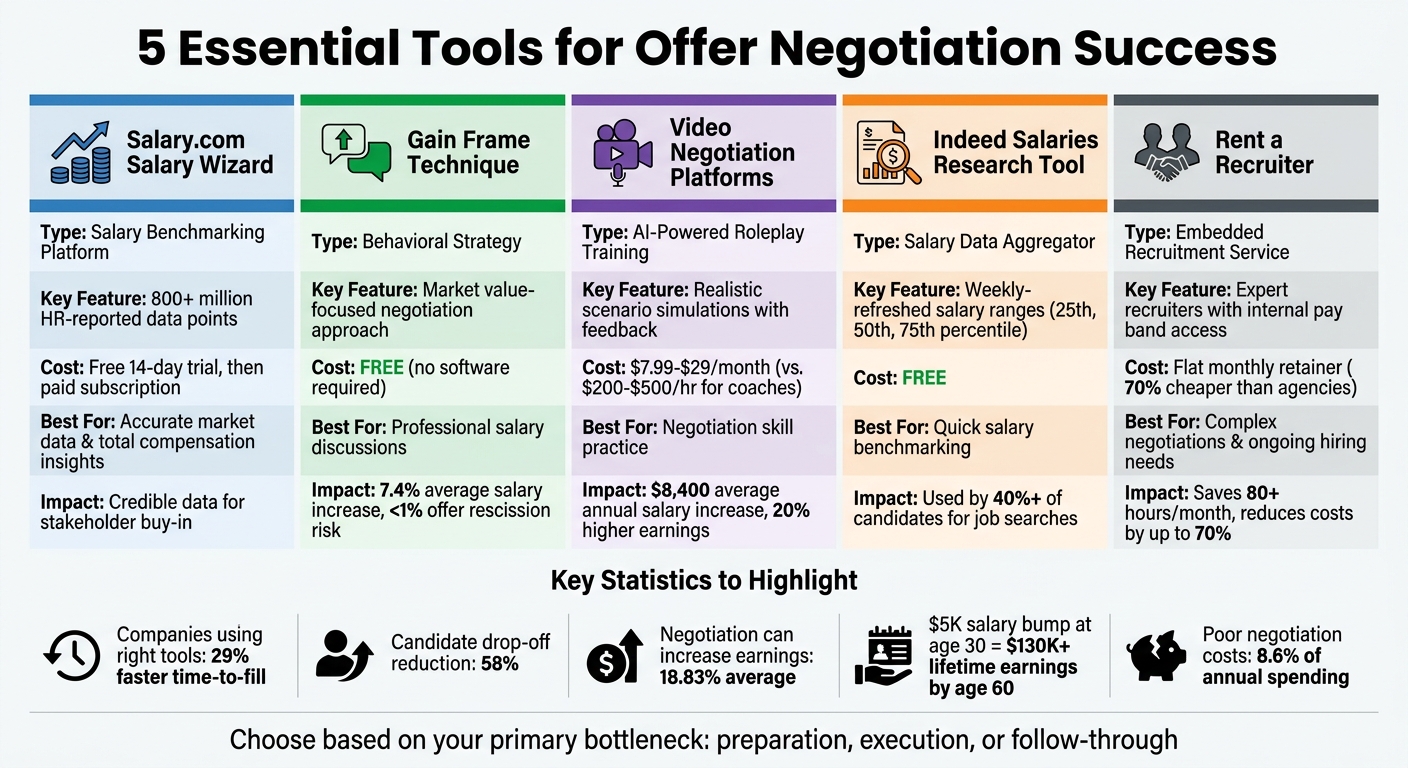
5 Offer Negotiation Tools Comparison: Features, Costs, and Benefits for SMEs
1. Salary.com Salary Wizard
Accuracy of Salary Data and Market Insights
What sets Salary.com apart is its reliance on HR-reported data, not self-reported inputs from job seekers. This approach ensures its benchmarks are far more dependable for professional salary negotiations [4][5]. The platform boasts an extensive global dataset that spans numerous industries, offering a broad perspective on compensation trends [4]. Its SalaryIQ tool continuously scans job postings and public salary information, allowing you to adjust offers to stay aligned with current market conditions [4].
With the CompAnalyst tool, you gain access to over 800 million data points for benchmarking, backed by a proprietary compensation framework refined over 25 years [4][5]. You can customise pay markets using filters like industry, geography, and company size, ensuring the insights are tailored to your needs [5]. For SMEs, especially those competing against larger businesses, this real-time data is invaluable for staying competitive.
Gary Fleenor, VP of Human Resources at Caris Healthcare, explains: "CompAnalyst gives me credibility – it’s like having a compensation expert on staff. I’m not just giving opinions; I’m presenting data that gets stakeholder buy-in" [5].
This solid data foundation enables SMEs to develop stronger negotiation strategies and make informed decisions.
Effectiveness in Improving Negotiation Outcomes
Salary.com helps you move beyond just discussing base salaries by providing data-driven insights into total compensation packages, including benefits [5]. This makes pay discussions clearer and less awkward. The platform’s AI-powered tools allow you to match jobs and price roles faster, a crucial advantage when competing for talent in tight hiring markets [4][5].
Shaun Drawdy, Senior Compensation Analyst at HD Supply, shares: "The software has greatly reduced the amount of time we spend on survey management and increased the amount of time we can spend providing strategic direction to the business" [4].
Joe Winkler from MSU Federal Credit Union adds: "We don’t have to do any guesswork anymore. We actually have processes built out for everything compensation-related now" [4].
These tools not only simplify compensation planning but also integrate seamlessly into existing workflows, helping you make decisions with confidence.
Ease of Integration into SME Workflows
Salary.com integrates effortlessly with existing HRIS systems, enabling you to pull employee data directly into its compensation tools without manual input [4]. By centralising job descriptions, salary structures, and market trends, it eliminates the need for spreadsheets and scattered systems [4].
Liz DiFlorio, Employment Manager at The Ken Blanchard Companies, notes: "Salary.com’s CompAnalyst and JobArchitect is a one-stop-shop for staying up-to-date on market trends and ensuring our jobs are updated with internal content and reflect current market salaries" [4].
This streamlined integration makes it easier for SMEs to maintain competitive and accurate compensation strategies.
Cost-Effectiveness for Small and Medium-Sized Enterprises
Salary.com offers a free 14-day trial of its CompAnalyst Market Data Max platform with no credit card required, letting you test its capabilities risk-free [4]. By consolidating multiple tools into one platform, it helps reduce overall costs while delivering high-quality, defensible data. Recognised as a "Leader in Enterprise Compensation Solutions" by G2, the platform is widely praised for its ability to justify salary decisions to both candidates and internal stakeholders [4][5].
This all-in-one solution is designed to simplify negotiations, cut hiring delays, and help SMEs manage budgets more effectively.
sbb-itb-a23bd6a
2. Gain Frame Technique
Effectiveness in Improving Negotiation Outcomes
The Gain Frame Technique shifts the focus in negotiations from personal financial needs to showcasing market value, a crucial adjustment for SMEs navigating competitive hiring challenges. Instead of discussing personal expenses, the emphasis is on how your skills align with industry benchmarks. This method is particularly effective for SMEs, as it reflects the candidate’s ability to engage in professional discussions once they join the team [6].
Statistics back this up: employees who negotiate their starting salaries see an average increase of 7.4%, with most successful negotiations resulting in 5% to 15% above the initial offer [6]. The risk of a counter-offer leading to a rescinded job offer is extremely low – less than 1% [6]. As a senior tech recruiter shared in Harvard Business Review, “I’ve never had a candidate’s offer pulled because they negotiated. I have had candidates I respected more because they did” [6].
When base salary isn’t negotiable, consider value-added perks like signing bonuses, equity, additional paid time off, or flexible work arrangements. These options keep the conversation collaborative and ensure both parties walk away satisfied [2][6]. The simplicity of this approach makes it easy to integrate into everyday hiring discussions while still delivering strong results.
Ease of Integration into SME Workflows
One of the biggest advantages of the Gain Frame Technique is how straightforward it is to adopt. There’s no need for expensive software, subscriptions, or technical tools – it’s a behavior-based strategy that can be implemented immediately. Start by gathering market data for the role using free resources, and follow the 24-48 hour rule: always request time to review an offer so you can craft a thoughtful, value-driven response instead of making a hasty decision [6]. Pre-written scripts can also help maintain a professional and approachable tone during negotiations [6][3].
Cost-Effectiveness for Small and Medium-Sized Enterprises
For SMEs, the Gain Frame Technique is not only effective but also cost-efficient. Unlike procurement software, which can cost between $18,000 and $36,000 annually, this method requires zero financial investment [8]. Free tools like OfferJudge and JobsByCulture offer salary calculators and ready-to-use scripts at no cost, while NexTool AI provides three free salary analyses each month, with an affordable Pro plan at $9.00/month for up to 50 analyses [2][3][6].
3. Video Negotiation Platforms
Effectiveness in Improving Negotiation Outcomes
Video negotiation platforms use AI-driven roleplay to help candidates practice realistic conversations with virtual recruiters. Tools like NegotiatorIQ and Negio simulate scenarios such as "That’s outside our budget" or "This is our standard offer for this level" [9]. Research shows that candidates who negotiate their offers can earn nearly 20% more than those who accept the initial offer [11].
These platforms provide structured "battle plans" after each session, detailing key opening strategies, walk-away points, and feedback on weak language or missed opportunities. On average, users report salary increases of $8,400 per year, with only 6% of employers retracting offers as a result [11].
Sarah M., a software engineer, shared: "I practiced 5 times before my real negotiation. When the recruiter used the ‘budget’ excuse, I knew exactly what to say. Got $15k more than the initial offer" [9].
By combining realistic simulations with actionable feedback, these tools ensure candidates are well-prepared to navigate tough conversations.
Ease of Integration into SME Workflows
Most modern negotiation platforms are browser-based, eliminating the need for software installation or IT approval. For instance, NegotiateAI allows users to create a strategy in under 60 seconds without requiring an account [10]. These platforms are available 24/7, catering to the demanding schedules of fast-growing businesses. They also employ advanced AI-powered recruitment tools like GPT-4o and Claude 3.5 Sonnet, alongside voice technologies from Deepgram and ElevenLabs, to simulate lifelike voice interactions [12]. Strategies are delivered as downloadable PDF reports, making it easy for candidates or hiring managers to review them before critical calls [11]. This flexibility makes these tools easy to adopt without disrupting existing workflows.
Cost-Effectiveness for Small and Medium-Sized Enterprises
In addition to being user-friendly, these platforms are cost-efficient for SMEs. Unlike traditional salary coaches, who charge between $200 and $500 per hour, AI negotiation platforms offer affordable pricing models [11]. For example, NegotiatorIQ charges $12 for five sessions or $29 for unlimited access, Negio starts at $7.99 per month, and NegotiateAI provides three free strategies daily with a one-time fee of $19 [9][10][11].
James K. noted: "The feedback showed me I was using apologetic language. Once I fixed that, my whole approach changed. This tool paid for itself 100x over" [9].
For businesses with frequent hiring needs, these platforms deliver professional-grade negotiation support at a fraction of the cost of human coaching.
4. Indeed Salaries Research Tool
Accuracy of Salary Data and Market Insights
The Indeed Salaries Research Tool provides data-driven insights to strengthen your salary negotiation strategy. Using its proprietary model, Indeed pulls from both employer and job seeker data to estimate salaries based on job title, required experience, education, and specific location [13]. These models are refreshed weekly, ensuring the information stays up to date [13].
The tool offers salary ranges at the 25th, 50th, and 75th percentiles, giving small and medium-sized enterprises (SMEs) a clear picture of how their offers stack up in the market [1]. Since the data includes crowdsourced input, it’s wise to cross-check with other sources like the Bureau of Labor Statistics or Payscale to filter out any anomalies [15][16]. This layered approach ensures more precise and objective salary benchmarks.
Effectiveness in Improving Negotiation Outcomes
Having clear salary benchmarks makes salary discussions more straightforward and objective. By referring to specific figures tied to the role, location, and experience, businesses can shift negotiations away from subjective opinions and toward data-backed conversations [2][6].
Interestingly, over 40% of candidates use the salary filter as their primary search tool on Indeed [13]. For SMEs, including accurate salary ranges in job postings is one of several talent acquisition strategies that demonstrate transparency and attract the right talent. Additionally, businesses can override Indeed’s automated estimates by entering their own salary ranges to better reflect their budget [13].
Cost-Effectiveness for Small and Medium-Sized Enterprises
The best part? Indeed’s salary research tool is completely free [14]. For SMEs operating on tight budgets, this tool eliminates the need for expensive compensation consultants. It integrates seamlessly into the job posting process, making it a practical resource for high-growth companies aiming to stay competitive without breaking the bank.
5. Rent a Recruiter
Accuracy of Salary Data and Market Insights
Bringing an embedded recruiter into your team gives you direct access to internal pay bands and approved salary ranges for every role[1]. These recruiters use this information to ensure offers are aligned with your internal benchmarks. On top of that, they tap into multiple salary aggregation tools to compare pay levels across roles, experience, and locations. This combination of internal and external data eliminates guesswork, making salary negotiations more precise and informed.
Effectiveness in Improving Negotiation Outcomes
Experienced recruiters understand that counter-offers are part of the hiring process – they see them as a "mini audition" of a candidate’s negotiation skills[3]. By building negotiation buffers into initial offers, they can handle candidate requests quickly and confidently. This speeds up decision-making, especially in competitive markets, by combining internal data with a strategic approach to negotiations.
Cost-Effectiveness for Small and Medium-Sized Enterprises
Traditional agencies typically charge 15–25% of a candidate’s salary, but Rent a Recruiter offers a subscription-based recruiting model that reduces hiring costs by up to 70%. Beyond cost savings, this model also frees up over 80 hours a month in recruitment tasks. Whether you’re scaling up after securing funding or managing seasonal hiring spikes, this subscription-based solution lets you adjust recruitment capacity without the expense of maintaining a full-time in-house team.
Mastering the Offer and Negotiation Game
Conclusion
When it comes to negotiation, the tools you choose should directly address the gaps in your process – whether that’s salary benchmarking, handling counter-offers, or navigating intricate contracts. For salary benchmarking, platforms like Salary.com and Indeed offer free, reliable market data. If counter-offers are your pain point, affordable AI tools, ranging from $9 to $29 per month, can help craft tailored scripts and assess offers effectively.
For more complex challenges, embedded recruitment solutions provide the expertise and hands-on support that automated tools may lack. For instance, Rent a Recruiter places seasoned recruiters within your team, offering guidance throughout the negotiation process to ensure better outcomes.
The financial stakes of negotiation are high. Ineffective strategies can cost organizations up to 8.6% of annual spending [7]. Meanwhile, professionals who negotiate can see an average pay increase of 18.83% [1][18]. Even a modest $5,000 salary bump at age 30 can translate to over $130,000 in additional lifetime earnings by age 60 [1]. These figures underscore the importance of a structured, thoughtful approach to negotiation.
"A well-prepared negotiator with strong market data, a clear BATNA, and a practiced script will outperform an unprepared negotiator with better natural charisma almost every time." – Connie, Author, Happycapy Guide [17]
To improve your negotiation outcomes, identify your primary bottleneck: is it preparation (research and planning), execution (negotiation itself), or follow-through (finalizing agreements)? [17] For straightforward salary talks, basic research tools might do the job. But for more nuanced negotiations involving equity, intellectual property, or restrictive clauses, advanced AI tools or professional recruitment support can be game-changers.
Choose tools that align with your hiring needs, budget, and internal resources to drive better results.
FAQs
Which tool should I start with first?
An AI-powered preparation tool can be your secret weapon when it comes to successful offer negotiations. These tools simplify complex tasks like market research, mapping your Best Alternative to a Negotiated Agreement (BATNA), drafting negotiation scripts, and even practicing through role-play simulations. By using such a tool, you’ll walk into negotiations armed with the knowledge and confidence needed to secure better terms. It’s all about laying a solid groundwork to improve your chances of achieving outcomes that work in your favor.
How can I benchmark salaries more accurately for my location?
To determine salaries that align with your location, leverage tools that offer up-to-date, employer-reported data specific to your region. Platforms such as SalaryCube, Pave, Payscale, and Salary.com provide detailed insights into local salary trends, industry benchmarks, and pay ranges for various roles.
By comparing data from multiple sources, you can account for factors like cost of living and talent demand. This ensures your compensation packages remain competitive and fair.
When should I use Rent a Recruiter instead of DIY negotiation?
Scaling fast? Facing a surge in hiring needs? Or maybe your recruitment process feels clunky and inefficient? That’s where Rent a Recruiter steps in.
They place seasoned recruiters directly within your team, handling the entire hiring process from start to finish. The result? Time saved, up to 70% cost reduction, and a more organized approach to recruitment.
While a DIY approach might work for smaller or straightforward hiring needs, Rent a Recruiter is built for businesses tackling complex, high-volume recruitment challenges. They make hiring scalable and cost-efficient without compromising on quality.