Your employer brand directly impacts hiring costs, retention rates, and candidate quality. Companies with strong brands save up to 50% on cost-per-hire, reduce turnover by 28%, and attract 50% more qualified candidates. Yet, only 18% of businesses measure the ROI of their branding efforts.
To stay competitive, you need to track key metrics that reveal how your brand resonates with employees and candidates. This includes internal data like Employee Net Promoter Scores (eNPS) and referral rates, as well as external metrics such as Glassdoor reviews, social media engagement, and offer acceptance rates.
Key takeaways:
- Measure both internal and external perceptions to identify gaps.
- Use tools like eNPS surveys, review platforms, and career site analytics.
- Regularly evaluate metrics like cost-per-hire, time-to-fill, and turnover rates.
- Translate results into financial impact to secure leadership buy-in.
If you’re struggling to align your employer brand with hiring goals, consider an embedded recruitment model. It reduces costs and improves hiring efficiency by embedding a recruiter directly into your team. Learn more about how Rent a Recruiter can help here.
Employer brand that works: How to measure real business value
sbb-itb-a23bd6a
Key Metrics for Measuring Employer Branding Effectiveness
When it comes to measuring the success of your employer branding efforts, the focus should be on metrics that align with your brand promise. These metrics serve as the foundation for evaluating results and calculating ROI. To get a complete picture, you’ll need to assess both internal data (how current employees perceive your workplace) and external data (how potential candidates view your brand).
As Andrea Boatman and Neelie Verlinden from AIHR explain:
"Building an employer brand without tracking relevant employer branding metrics is like baking a cake without watching the clock: a waste of time and energy with a significant risk of things going wrong" [3].
By combining leading indicators like social media engagement and career site traffic with lagging metrics such as retention rates and cost-per-hire, you can gain both predictive insights and tangible proof of impact [9].
Internal Metrics: Employee Experience Data
Start by measuring how your employees feel about working for your company. One key metric is the Employee Net Promoter Score (eNPS), which shows how likely your team is to recommend your company as a workplace – directly reflecting satisfaction and advocacy. Similarly, the new hire retention rate sheds light on whether the reality of the job matches the expectations set during recruitment [5].
Another telling metric is the employee referral rate, which indicates how much employees trust your culture to recommend it to others. This can be calculated using the formula: (referred hires / total hires) x 100 [2]. On top of that, tracking the quality of hire – measured through performance ratings and productivity of new employees – helps confirm whether your employer brand is attracting the right talent [5].
Qualitative insights, such as exit interview feedback and hiring manager satisfaction surveys, can help identify gaps between the promises of your employer brand and the day-to-day employee experience [6][7]. Additionally, segmenting turnover data by department, job level, and location can pinpoint specific areas where improvements are needed [2]. This matters because replacing an employee can cost between 90% and 200% of their annual salary [4].
While internal data focuses on your existing workforce, external metrics are essential for understanding how potential candidates perceive your brand.
External Metrics: Brand Perception Tracking
Begin with employer review site ratings on platforms like Glassdoor, Indeed, and The Org. These reviews are critical, as 85% of employees and job seekers check them before applying [7]. Improving your brand sentiment by just one star can lead to better applicant quality and lower recruitment costs [8].
Track social media engagement – followers, impressions, reach, and interactions – to measure brand awareness [7][2]. With 52 million weekly LinkedIn job searches, having a strong presence is key [7]. Also, monitor career site analytics and application rates to see if your branding efforts are driving candidates to take action.
Outcome-based metrics provide further validation of your external brand impact. For instance, a high offer acceptance rate indicates that your employer brand and recruitment messaging resonate with candidates [7][2]. On the flip side, companies with a weaker brand often need to increase salary offers by at least 10% to attract talent [2]. Additionally, use candidate satisfaction scores – gathered through post-interview surveys – to evaluate and rate your recruitment process. These surveys typically ask candidates to rate communication, transparency, and professionalism on a one-to-ten scale [2].
For a more comprehensive view, the Employer Brand Index (EBI) analyses online mentions across 16 attributes like diversity, innovation, and work-life balance [7]. Comparing these external perceptions with your internal engagement scores can reveal misalignments that may lead to employee dissatisfaction or negative reviews [7]. As Heather Cameron from Recruitics aptly puts it:
"We built Brand Navigator to answer a question every customer kept asking: Is my reputation helping or hurting my ability to hire?" [8]
Tools and Techniques for Assessment
Once you’ve pinpointed the metrics that matter, the next step is finding the right tools to gather and analyze that data. A combination of internal feedback and external monitoring provides a comprehensive view of employee and candidate sentiment.
Employee Surveys and Feedback
Structured surveys are a dependable way to understand how employees perceive your brand. Surveys focused on engagement, satisfaction, and overall sentiment can reveal insights into motivation, advocacy, and alignment with company values. Using a Likert scale (1–5, from Strongly Disagree to Strongly Agree) helps to quantify these responses effectively [10][6][7].
Incorporating lifecycle feedback, such as onboarding and exit surveys, is equally important. These surveys help determine whether your employer branding aligns with the actual workplace environment [6][5][2]. For instance, if new hires frequently report discrepancies between job descriptions and their actual roles, it signals a need to adjust your branding messages. Platforms like SurveyMonkey and Qualtrics make it easy to deploy and track these surveys [10][7].
Segmenting survey data by department, location, or job level can highlight specific areas where the employee experience needs attention [12][2]. Reviewing this data annually is crucial, as shifting economic conditions and generational preferences often reshape what top talent values most [10].
Once you’ve assessed internal sentiment, it’s time to examine how your brand is perceived externally.
Social Listening and Review Platforms
Understanding external perception starts with monitoring platforms where candidates research employers. Glassdoor, Indeed, and LinkedIn are key sources of feedback. Pay attention to your ratings, sentiment trends, and recurring themes from recent reviews [7][5].
On LinkedIn, track metrics such as follower growth, engagement (likes, comments, shares), and audience demographics to gauge your brand’s visibility among professionals [11][5]. With 52 million people using LinkedIn weekly to explore job opportunities, maintaining an active and engaging presence is essential [7]. Platforms like Built In, The Muse, and Welcome to the Jungle also offer editorial-style profiles paired with analytics, giving you a deeper understanding of how candidates engage with your content [11].
For more advanced insights, tools like Universum‘s Talent Insights, Veris Insights‘ Employer Attribute Explorer, and the Employer Brand Index (EBI) by Link Humans provide detailed benchmarking. These platforms allow you to compare your brand’s performance across attributes like diversity, innovation, and work-life balance against competitors [10][5][7]. They also help measure your share of voice and sentiment within your industry [12].
These external insights provide the foundation for evaluating the ROI of your employer branding efforts.
Recruitment Health Check by Rent a Recruiter
For a tailored evaluation of your hiring practices and employer branding, Rent a Recruiter offers a free Recruitment Health Check. This service benchmarks your current hiring strategies, employer branding impact, and diversity initiatives, delivering a customized PDF report with actionable recommendations.
The Health Check highlights gaps between your brand promise and candidate experience, identifies inefficiencies in your recruitment process, and uncovers opportunities to enhance cost-efficiency and reduce time-to-hire. By using this tool, you can adopt a data-driven approach to scaling your recruitment efforts effectively.
How to Interpret Results and Calculate ROI
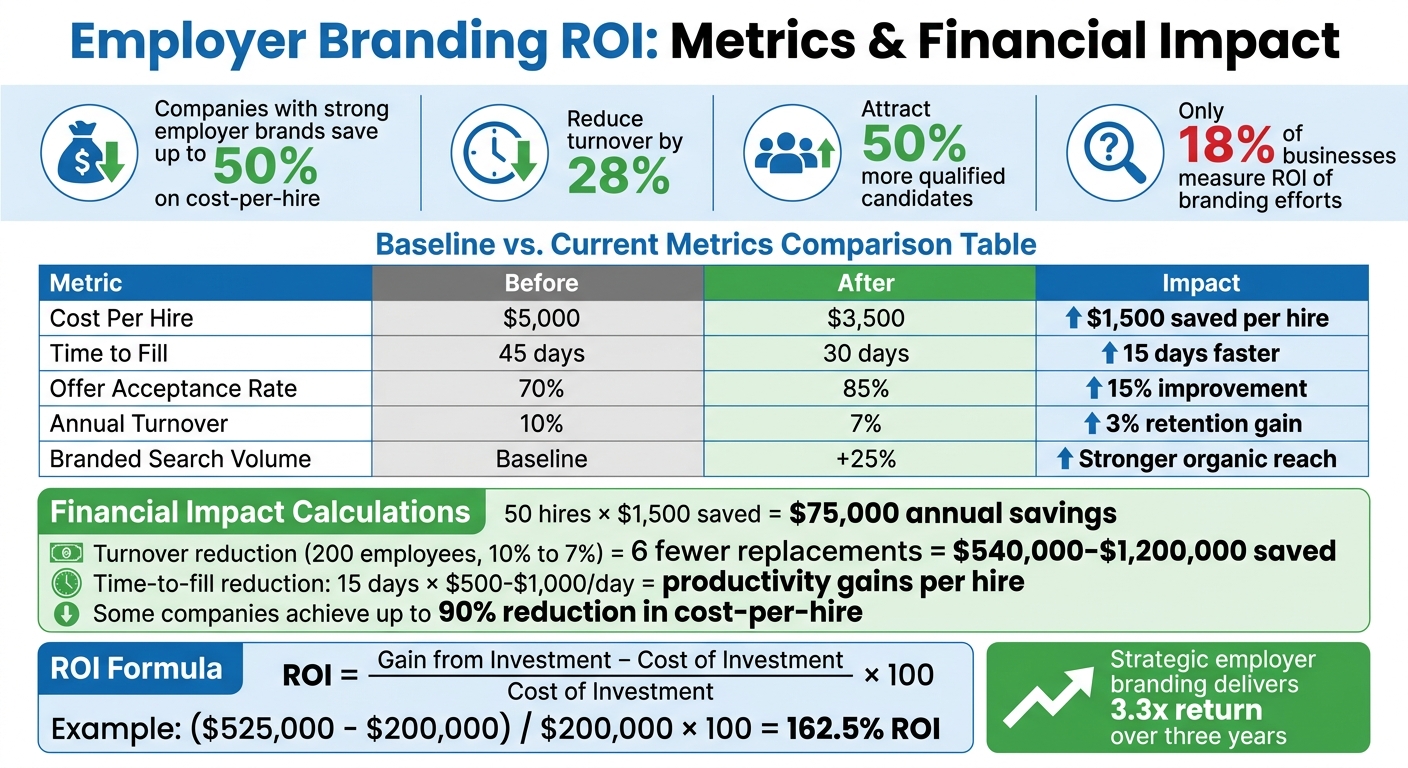
Employer Branding ROI Metrics and Financial Impact
Baseline vs. Current Metrics: Spotting Trends
Once you’ve defined your key metrics, the next step is interpreting the data to calculate ROI. Start by tracking baseline metrics like cost-per-hire, time-to-fill, turnover rates, and application volumes [15]. These benchmarks help you measure progress and identify trends over time. Compare these metrics monthly, quarterly, or annually to see if your efforts are streamlining processes or revealing new gaps [9][1].
Using a dashboard to monitor these metrics side-by-side can highlight the compounding benefits of consistent investment [13]. For instance, a 25% increase in branded search volume and an improvement in offer acceptance rates from 70% to 85% signal stronger trust among candidates [14]. By looking at trends across the entire hiring process – from early awareness (e.g., branded search volume) to final engagement (e.g., offer acceptance) – you can spot where your strategy is working or needs adjustment [13][14].
"Employer branding ROI cannot be measured by a single metric. The organisations that measure it well track impact across three distinct stages: awareness, attraction, and engagement." – Flexa Careers [13]
Connecting Metrics to Business Outcomes
Employer branding improvements don’t just look good on paper – they directly impact business performance. For example, cutting cost-per-hire by $1,500 and hiring 50 people annually translates to $75,000 in savings [16]. If your company has 200 employees and reduces turnover from 10% to 7%, you avoid replacing six employees. With replacement costs ranging from 90% to 200% of an annual salary, this could save you anywhere from $540,000 to $1,200,000 [4][9].
Unfilled roles come with hidden costs too – each one can cost $500 to $1,000 per day in lost productivity [14]. If you reduce time-to-fill from 45 days to 30 days, you’re reclaiming 15 days of productivity for every hire.
Translate these gains into financial terms to make the impact clear. For instance, "We cut agency spend by $150,000 by developing a stronger passive talent pool" [13][15]. Strong employer branding can reduce employee turnover by 28% and cut cost-per-hire by up to 50% [4][9], results that resonate with leadership teams focused on ROI from their human capital investments.
Using Tables to Show ROI
Tables make it easier to visualize how your efforts translate into tangible business outcomes. Here’s an example that compares baseline and current metrics with their financial impact:
| Metric Category | Baseline (Pre-Investment) | Current (Post-Investment) | Business Impact |
|---|---|---|---|
| Cost Per Hire | $5,000 | $3,500 | $1,500 saved per hire [16] |
| Time to Fill | 45 days | 30 days | 15 days faster productivity [14] |
| Offer Acceptance Rate | 70% | 85% | 15% higher efficiency [14] |
| Annual Turnover | 10% | 7% | 3% improvement in retention [16] |
| Branded Search Volume | Baseline index | +25% increase | Stronger organic reach [13] |
To calculate your ROI, use the formula: (Gain from Investment – Cost of Investment) / Cost of Investment × 100 [15]. For instance, if you invest $200,000 annually in branding efforts and see $525,000 in gains from reduced agency fees, lower advertising costs, productivity boosts, and decreased turnover, your ROI would be 162.5% [15]. Over three years, strategic employer branding investments can deliver a 3.3x return [4].
Some companies have even reduced cost-per-hire by up to 90% by implementing branding strategies across the entire hiring funnel [13]. While results will vary, tracking these metrics consistently will help you pinpoint where your investment delivers the most value.
Next Steps
Key Takeaways
Building and maintaining a strong employer brand isn’t a one-time effort – it requires regular monitoring and adjustments. Set up a consistent review schedule, whether monthly or quarterly, to track key metrics like cost-per-hire, time-to-fill, and offer acceptance rates [7].
Ensure your brand aligns with what candidates are promised and what employees actually experience. Use a mix of quantitative data (like Net Promoter Scores) and qualitative feedback (such as Glassdoor reviews and exit interviews) to pinpoint any gaps. If inconsistencies surface, address them swiftly by setting clear expectations during recruitment and gathering employee feedback through focus groups to uncover internal challenges [7].
Reallocate recruitment budgets toward channels that consistently deliver high-quality candidates. This approach not only optimizes spending but also protects your reputation in the talent market [7]. By refining these strategies, you’ll attract top-tier talent more effectively.
Partner with Rent a Recruiter
Strengthen your employer brand while simplifying your hiring process with Rent a Recruiter. Our embedded recruitment model places experienced recruiters directly into your team, ensuring a structured and transparent hiring process. We help identify the most effective channels, messages, and campaigns to engage your ideal candidates [2].
Take advantage of our free Recruitment Health Check, which benchmarks your hiring performance and delivers a tailored PDF report with actionable advice on employer branding, recruitment efficiency, and diversity. Companies partnering with us typically cut hiring costs by up to 70% compared to traditional commission-based models, while saving over 80 hours per month on hiring and admin tasks. Whether you need short-term help to meet hiring goals or a long-term solution to scale your recruitment, we’re ready to deliver results without delay. Visit Rent a Recruiter to get started today.
FAQs
Which employer branding metrics should I track first?
Start by focusing on candidate quality, offer acceptance rate, and brand awareness. These metrics give you a clear picture of how well your employer brand is performing:
- Candidate quality: Are you attracting the right talent for your roles? This metric reflects how well your brand resonates with skilled candidates.
- Offer acceptance rate: What percentage of candidates are saying "yes" to your offers? A strong employer brand often leads to higher acceptance rates.
- Brand awareness: How visible and well-regarded is your company as an employer? This includes how candidates perceive your workplace culture and values.
Tracking these metrics early on helps you assess whether your branding efforts are hitting the mark and lays the groundwork for improving your hiring outcomes.
How often should I review employer branding performance?
To keep your employer branding aligned with business objectives, it’s important to evaluate its performance on a regular basis. Many companies monitor metrics like employee retention, referral rates, and employer perception either monthly or quarterly. Conducting these reviews – particularly on a quarterly basis – helps you measure progress, adjust strategies, and respond to shifts in the market or workforce dynamics. While the ideal frequency will depend on your specific goals and available resources, consistent tracking is essential to ensure your branding efforts remain effective.
How do I calculate employer branding ROI in dollars?
To figure out the ROI of employer branding in dollar terms, focus on metrics you can quantify, like lower hiring costs, reduced turnover, and shorter time-to-fill. For instance, if strong employer branding cuts your cost per hire (say, $4,700) by 50%, that’s a saving of $2,350 per hire. Similarly, reducing turnover can save a significant percentage of replacement costs. By combining these numbers, you can clearly measure the financial impact of employer branding.