
75% of job seekers research your employer brand before applying. If your company isn’t standing out, you’re losing top talent to competitors. A strong employer brand doesn’t just attract more candidates – it reduces hiring costs by 50%, increases applicant volume by 2.5x, and can cut turnover by nearly 70%.
Here’s the problem: while 75% of organizations struggle to hire, only 28% have a clear employer branding strategy. That’s a missed opportunity. For scaling companies, building a standout employer brand is about clarity, consistency, and delivering on your promises.
Key Takeaways:
- Define your EVP (Employee Value Proposition): Highlight 3–5 specific reasons why people should work for you. Focus on what your company delivers today, not aspirations.
- Leverage digital channels: Your career page and social media must showcase real employee stories and clear growth opportunities.
- Turn employees into advocates: Employee testimonials and shared experiences resonate more than corporate messaging.
- Invest in growth: Offer training and clear career paths to retain top performers.
- Measure and refine: Track metrics like application rates, Glassdoor reviews, and retention to ensure your strategy delivers measurable results.
Scaling businesses don’t need big budgets to compete with larger corporations. You need a clear, honest approach that highlights what makes your company worth joining. Let’s break it down step by step.
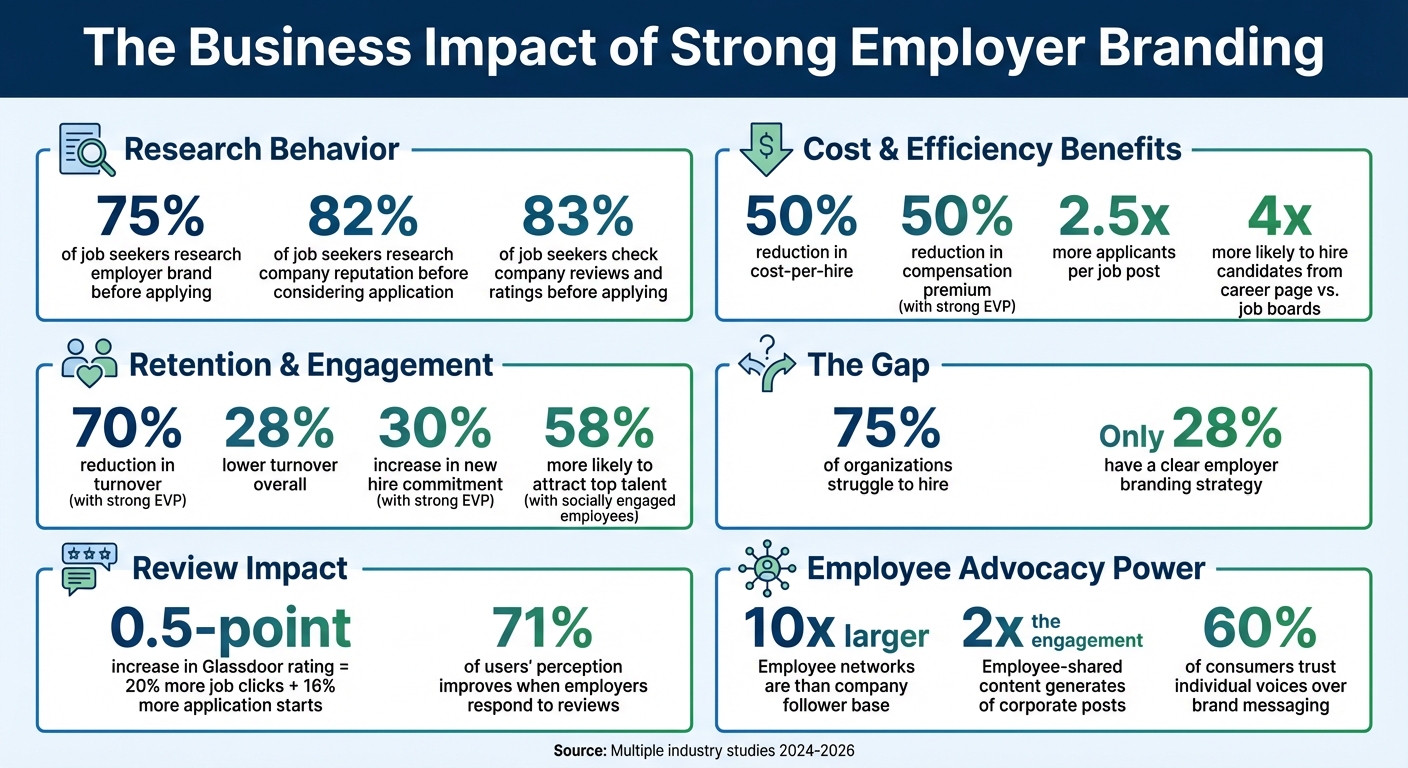
Employer Branding Statistics: Impact on Hiring Costs, Applications, and Retention
Employer Branding Explained: Attracting Top Talent Strategy
sbb-itb-a23bd6a
Define Your Employee Value Proposition (EVP)
Your Employee Value Proposition (EVP) is the promise you make to employees in exchange for their skills and dedication. It answers a fundamental question: Why should someone work here instead of somewhere else? Think of it as the unspoken agreement between you and your team, grounded in the actual experience of working at your company.
As Pin.com puts it:
"Your EVP should describe what you deliver today, not what you aspire to become someday."
A well-defined EVP doesn’t just attract talent – it can reduce the compensation premium by 50% and boost new hire commitment by nearly 30%. But here’s the catch: it only works if it reflects reality. If your EVP doesn’t match the day-to-day experience of your employees, it risks being dismissed as empty marketing.
What Matters in Modern EVPs?
Today’s EVPs are about more than paychecks and perks. Top candidates, especially younger generations like Gen Z, are looking for purpose, growth, and flexibility. In fact, 76% of Gen Z candidates value these factors, while 70% prioritize companies that offer tools and training to thrive in an AI-driven world. They want to know: Will I grow here? Can I make an impact? Is this company preparing me for the future?
For small and mid-sized businesses, the key is specificity. Avoid vague claims like "great culture" or "collaborative environment." Instead, highlight 2–3 tangible qualities that truly set your company apart. For example, instead of saying you value professional development, say, “Our engineers deploy code to production in their first week.”
To define your EVP, start by understanding what’s happening inside your organization.
Conduct an Internal Audit
Before crafting your EVP, take a deep dive into your company’s current state. Start by talking to 15–20 of your top performers across various teams. Ask them three simple but revealing questions: Why did you join? Why do you stay? What might make you leave? Look for recurring themes in their answers – these are the building blocks of your EVP.
Next, examine external feedback. Analyze the last 50 reviews on platforms like Glassdoor and Indeed to uncover trends in areas like leadership, growth opportunities, and work-life balance. With 83% of job seekers researching company reviews before applying, understanding how outsiders view your organization is essential. If you spot a disconnect between leadership’s vision and employees’ experiences, that’s your starting point for improvement.
It’s also worth surveying recent hires to find out what drew them to your company and reaching out to candidates who declined offers to identify perception gaps. Once you’ve drafted an EVP, test it by asking employees, “Does this feel true?” Refine anything that feels more aspirational than real.
Your goal is to identify 3–5 specific, verifiable qualities that make your company stand out. For instance, instead of general claims about career development, say, “We promote 75% of our managers from within.”
Align Your EVP with Business Goals
A strong EVP doesn’t just attract talent – it attracts the right talent for your business’s current stage and future direction. For example, if you’re a startup, focus on opportunities for ownership and rapid career growth. If you’re expanding into new markets, highlight learning opportunities and cross-functional collaboration.
Map your EVP to the five core factors candidates care about: Compensation, Work-Life Balance, Career Development, Culture & Values, and Stability. While you don’t need to excel in every area, be transparent about where you shine and competitive where it matters most. For instance, 63% of candidates rank pay and benefits as their top priority, followed by work-life balance (49%) and flexible work arrangements (44%).
Looking ahead, consider adding a sixth pillar: AI-readiness. As AI becomes more integral to business, companies that help employees adapt through tools, training, and experimentation are setting themselves apart.
Finally, make sure your EVP aligns with your company’s mission and values. Use straightforward language that reflects real, everyday experiences. If sustainability is a core part of your mission, show how employees contribute to it in their roles. This connection between purpose and daily work makes your EVP feel grounded and helps build long-term employee engagement. By aligning your EVP with business goals, you’ll ensure it resonates both inside and outside your organization.
Showcase Company Culture Through Digital Channels
Once you’ve nailed down your EVP, the next step is to bring it to life on digital platforms. Why? Because 82% of job seekers research your reputation and employer brand before even considering an application. Your career page and social media accounts? They’re essentially your first interview with every potential hire.
For small and medium-sized businesses, the challenge is standing out amidst the noise. Candidates can easily spot superficial messaging. What resonates instead is showcasing the genuine experiences of your team. As Tony Prudente, Senior Specialist at Brother, emphasizes:
"Always do your best to highlight and showcase your employees – people respond to people more than they do brands."
Optimize Your Career Page
Think of your career page as more than just a job board – it’s a risk assessment tool for candidates. They’re evaluating whether your company lives up to its promises or if it’s just another marketing pitch. A well-designed career page should reflect the core qualities of your EVP while being engaging and informative.
Speed and clarity matter. With 75% of job seekers researching employer brands before applying, your page needs to pass the "30-second rule": within half a minute, visitors should understand your mission, open roles, and company culture. Even load time is critical – a one-second delay can cut conversions by 7%.
Here’s what makes a career page stand out:
- Lead with purpose. A strong opening statement about your mission can captivate the right candidates and gently filter out those who don’t align. Skip generic claims like "we value teamwork." Instead, detail how your teams operate, make decisions, and collaborate.
- Show real people. Replace stock photos with actual team snapshots or short videos (60–90 seconds). When Coca-Cola HBC revamped its employer brand across 28 countries, it focused on employee voices and real-life culture, reaching 4 million people and boosting retention.
- Be upfront about growth and pay. Transparency builds trust. Post salary ranges and clarify your remote or hybrid work model. For example, instead of vague promises like "we promote from within", say "75% of our managers are promoted internally" or "Engineers deploy code in their first week." Stripe exemplifies this by highlighting its 5–7 day hiring cycles for senior roles and showcasing its engineering-driven culture.
- Mobile-first design. With two-thirds of job applications coming from mobile devices, streamline your process. Keep applications under five minutes and use tools like "Quick Apply" to simplify the experience, potentially boosting conversions by up to 365%.
Candidates who apply directly through your career page are four times more likely to be hired than those from job boards. Why? Because they’ve already engaged deeply with your brand. Make your career page an authentic reflection of your company, then extend this approach to your social media strategy.
Use Social Media to Connect with Candidates
Social media is where you can meet candidates where they already are. 90% of Instagram users follow at least one business, and 77% of candidates consider company culture before applying. The secret? Share content that feels real and aligns with your EVP.
Here’s how to use different platforms effectively:
- LinkedIn: Focus on professional updates, industry insights, and employee success stories. Promote internal career growth and amplify employee voices – employee-shared content often outperforms corporate posts.
- Instagram: Ideal for behind-the-scenes glimpses and "day-in-the-life" content. Southwest Airlines, for example, uses Instagram to highlight employee achievements and personal milestones. Try employee takeovers to showcase various roles authentically.
- TikTok: Perfect for short, informal, and relatable content aimed at younger audiences. Think candid employee stories, not polished corporate pitches.
- Facebook: Use this for community engagement and sharing employee stories. It’s also a good platform for posting industry tips or amplifying diverse voices.
As Jillian O’Malior, VP of Brand & Creative Development at Recruitics, explains:
"Social media is a great place to get your employer brand voice out there, engage directly with your audience of candidates and employees, and drive awareness."
The most impactful content comes directly from employees. Encourage your team to share their experiences using a company hashtag. To make it easy, provide pre-written posts and links to job openings.
Consistency is key. Use an editorial calendar to maintain a steady posting schedule across platforms. Engage actively – respond to comments, answer questions, and show there are real people behind your brand.
Finally, let your values shine through your content. If diversity, equity, and inclusion are priorities, amplify diverse voices and share tangible progress. For instance, Salesforce publicly shares its diversity metrics and invests millions in pay equity adjustments. GitLab highlights its remote-first culture by making its internal handbook public, reinforcing its "bias for action" ethos.
Your digital channels should reflect the reality of your company. Let your employees tell the story – it’s the most powerful way to connect with future talent.
Turn Employees into Brand Ambassadors
When employees share their experiences, it resonates in ways corporate messaging never can. Their voices bring a level of trust and authenticity that no marketing campaign can replicate. Consider this: 60% of consumers trust individual voices over brand messaging. And here’s the kicker – your employees’ networks are, on average, 10 times larger than your company’s follower base. Content shared by employees reaches a broader audience and generates twice the engagement of corporate posts.
But for this to work, advocacy must feel genuine. Companies with socially engaged employees are 58% more likely to attract top talent. The key? Participation has to be voluntary, driven by employees who are genuinely excited to share their stories.
Collect and Share Employee Testimonials
Start by asking employees specific, meaningful questions: Why did you join the company? What’s a project you’re proud of? These kinds of prompts help uncover authentic, relatable stories. Capture these testimonials in various formats – video, text, or audio – and always include the employee’s name and title to add credibility.
Take DaVita as an example. By using Hootsuite Amplify in 2025, they empowered employees to share their work experiences. The result? A 136% increase in LinkedIn traffic to their careers page and a 27% boost in job applications from social media. The secret? Employees spoke in their own words.
Showcase testimonials from across departments and seniority levels to reflect the full spectrum of experiences in your company. Use these stories strategically – place them on your careers page, embed them in job descriptions, share them on LinkedIn and Instagram, and feature them in recruitment videos. Keep the content fresh by updating it regularly.
Beyond testimonials, structured advocacy programs can amplify these authentic voices even further.
Create Employee Advocacy Programs
A good starting point is identifying the top 5–10% of employees with active personal brands. Personally invite them to join a three-month pilot program – it’s far more effective than generic mass emails.
Shopify’s "Life at Shopify" program is a great example. By 2026, it empowered over 10,000 employees to create 5,000 posts per month. With monthly themes and customizable graphics, their employee-generated content achieved 15 times the reach of corporate channels.
To make participation seamless, provide pre-written copy tailored for different platforms (e.g., longer posts for LinkedIn, shorter ones for X), along with ready-to-use visuals and one-click sharing tools. The goal? Employees should spend less than 15 minutes per week on this. As Eileen Kwok, Social & Influencer Marketing Strategist at Hootsuite, explains:
"I’ve found that encouraging employees to begin their workday by sharing a post through Amplify helps make it a natural part of their daily routine."
Recognition-based rewards are another powerful motivator. Public shoutouts during team meetings, access to exclusive events, or professional development opportunities often feel more meaningful than monetary rewards – and they sidestep FTC compliance issues. Gamification can also help. Leaderboards and badges for thoughtful engagement (like meaningful comments) can inspire friendly competition, but avoid rewarding sheer volume alone.
Keep your social media policy short and simple. Policies under 200 words can increase employee understanding from 42% to 88%. A clear guideline like "Share thoughtfully, be kind, avoid confidential info, disclose employment" is far more effective than a dense corporate document.
Most importantly, never force participation. Advocacy works best when employees are genuinely proud of their work and excited to share it. That enthusiasm shines through, building trust with candidates and strengthening your employer brand. Authentic advocacy not only attracts top talent but also reinforces your company’s reputation in a way no paid campaign can.
Invest in Employee Growth and Development
Top performers aren’t just looking for a paycheck – they’re looking for a company that invests in their future. Here’s the reality: 72% of workers say career advancement opportunities are very or extremely important, but only 43% feel satisfied with what their current employer offers. That gap? It’s your chance to stand out.
Globally, 86% of employees are willing to retrain or reskill to meet changing work demands, yet 56% lack access to the resources they need. If you can provide clear, actionable development opportunities, you’ll position your company as a magnet for ambitious talent.
Jay Jones, Talent and Employee Experience Lead at SHRM, puts it simply:
"If you say you want high-performers, you have to offer high-value learning opportunities."
This isn’t just about training – it’s about aligning development with your company vision. Organizations that deliver on their Employee Value Proposition, including growth opportunities, can reduce turnover by nearly 70% and boost new hire commitment by almost 30%. These numbers make it clear: investing in employee growth isn’t just good for morale – it’s good for business.
Offer Training and Upskilling Programs
Providing structured learning programs sends a strong message: you care about your employees’ long-term success. With 76% of organizations struggling to find qualified candidates, developing talent from within isn’t optional – it’s essential.
Think about offering benefits like:
- A $2,500 annual learning budget for certifications, courses, or conferences
- Weekly technical workshops to sharpen skills
- Mentorship programs with biweekly check-ins for personalized guidance
One area where you can truly stand out? AI training. Over 70% of employees and managers are more likely to join or stay with a company that helps them thrive in an AI-driven world. Yet, 82% of employees have received no training in generative AI use at work. This gap is a golden opportunity to differentiate your organization.
Make your learning culture visible. Short, 60- to 90-second videos featuring employees sharing how they’ve grown professionally can be far more engaging than plain text testimonials. Highlight real success stories – degrees earned, certifications completed, or new skills applied to impactful projects – on your careers page.
As Jay Jones notes:
"If learning and development aren’t tied to the company’s vision and your employees’ needs, it’s just another program."
Tie every training initiative directly to your company’s goals. When candidates see that development programs are designed to prepare them for meaningful roles, your employer brand becomes irresistible.
Establish Clear Career Progression Paths
Growth isn’t just about learning – it’s about seeing a future. Candidates want to know how they can move forward in your organization. Career development is one of the strongest tools you have to retain top talent.
Start by mapping out career trajectories for key roles. For example, let candidates know what success looks like: "In 90 days, you’ll master the codebase; in a year, you’ll be mentoring junior developers." Sharing these career ladders on your careers page shows you’re serious about long-term success.
Transparency matters. Regularly audit promotion processes through pulse surveys to ensure employees feel advancement is fair and accessible. A disconnect between leadership’s promises and employees’ experiences can quickly erode trust – and your employer brand.
Looking ahead, 44% of core skills are expected to change by 2027. Career progression isn’t just climbing a vertical ladder – it includes horizontal growth through stretch assignments, exposure to new business areas, and cross-functional projects. This holistic approach appeals to a wider range of talent.
And don’t forget about passive candidates – 74.4% of the talent pool isn’t actively job hunting. When your employees share genuine stories of career growth, from entry-level roles to leadership positions, it can spark interest from those who weren’t even considering a move.
As TuraHire wisely points out:
"The standard that employer branding should meet is not perfection. It is accuracy."
Show candidates a real, achievable path forward. Invest in their growth, and your reputation as an employer of choice will grow naturally.
Measure and Refine Your Employer Branding Strategy
You can’t improve what you don’t measure. 75% of job seekers research an employer’s brand before even clicking "apply". That means your employer branding efforts need the same level of tracking and analysis as any other business initiative. Companies with strong employer brands not only cut their cost-per-hire by 50%, but they also attract 2.5x more applicants per job post.
As Jen Dewar explains:
"Employer branding is a powerful way to improve your hiring outcomes, but how do you know if your efforts are working? The answer lies in tracking the right employer branding metrics."
This isn’t about vanity metrics. It’s about connecting your branding efforts to real business outcomes: fewer unfilled roles, higher-quality candidates, and lower turnover. Measurement gives you the insights to see what’s working and what needs adjustment.
Track Key Metrics
Employer branding metrics can be grouped into four stages: top funnel, mid funnel, bottom funnel, and post-hire. Here’s how to approach each stage:
- Top funnel: Monitor career site traffic, social media engagement, and overall brand sentiment.
- Mid funnel: Focus on application completion rates and candidate satisfaction.
- Bottom funnel: Track offer acceptance rates, quality of hire, and cost-per-hire.
- Post-hire: Measure retention rates, employee referral rates, and Employee Net Promoter Score (eNPS) to ensure internal experiences align with external promises.
A 0.5-point increase in your Glassdoor rating can lead to 20% more job clicks and 16% more application starts. Use tools like your Applicant Tracking System (ATS) to centralize key metrics such as time-to-fill and source of hire. This data eliminates guesswork and highlights which channels bring in the best candidates.
To calculate ROI, multiply your annual hires by the cost-per-hire reduction from organic traffic and referrals. For example, if you hire 50 people annually and save $3,000 per hire through stronger branding, that’s $150,000 in savings. On the flip side, companies with poor reputations often need to increase salary offers by at least 10% to attract talent.
Keep an eye on retention and satisfaction rates by department and demographic. If one team has higher turnover, dig deeper – it could point to issues like unclear career paths, a challenging manager, or a disconnect between expectations and reality. These numbers can guide you toward the specific areas that need attention.
Use Feedback for Continuous Improvement
While metrics provide the "what", feedback explains the "why." Interview your top performers with three simple questions: Why did you join? Why do you stay? What would make you leave?. Their answers can help shape your Employee Value Proposition (EVP).
Survey candidates who decline offers to uncover reasons behind their decision. Maybe the interview process was too slow, or the role didn’t match the job description. These insights allow you to fix issues before they impact future hiring.
Conduct 30/60/90-day surveys with new hires to identify gaps between the promises made during recruitment and the actual experience. If new hires consistently mention chaotic onboarding or lack of transparency from leadership, address those issues internally before adjusting your external messaging.
Don’t underestimate the power of online reviews. 83% of job seekers check company reviews and ratings before applying, and 71% of Glassdoor users say their perception of a company improves when employers respond to reviews – even negative ones. Keep your responses professional and concise (under 100 words), and thank positive reviewers to show you’re paying attention.
Ian Cook, Creative Lead at Vouch, sums it up well:
"Your employer brand isn’t one campaign – it’s the sum of all candidate and employee interactions."
Review your KPIs quarterly and reassess your strategy annually. Experiment with small changes – A/B test visuals on your career page, tweak your EVP messaging, or adjust the tone of your job descriptions. Track what works, double down on it, and refine what doesn’t. This ongoing process ensures your employer brand stays relevant in a constantly evolving talent market.
Conclusion
By implementing the strategies outlined above – from crafting a genuine Employee Value Proposition (EVP) to encouraging your team to become brand ambassadors – you create the foundation for a standout employer brand. This isn’t just for large corporations; it’s a must for any business aiming to attract and retain top talent. The impact is clear: companies with strong employer brands reduce cost-per-hire by 50%, experience 28% lower turnover, and attract 2.5 times more applicants per job post.
Start by defining an EVP that genuinely reflects your employees’ experiences. Make your digital presence work harder – your careers page should feature authentic employee stories, clear salary details, and a mobile-friendly application process. Encourage your team to share real, behind-the-scenes moments to showcase your workplace culture. Offer growth opportunities that show candidates you’re invested in their future, and keep an eye on key metrics like Glassdoor ratings and offer acceptance rates to refine your approach.
The opportunity here is enormous. Standard job boards and generic postings no longer cut it. A well-thought-out employer brand connects with top talent early in their decision-making process.
Ready to take your employer brand to the next level? Rent a Recruiter can help. We embed skilled recruiters into your team to streamline your hiring process, cut costs, and bring consistency. Whether you’re looking for long-term embedded recruitment, temporary staffing solutions, or one-off strategic placements, we provide the expertise to support your growth. Start with a free Recruitment Health Check to measure your performance and identify areas to strengthen your employer brand. Let’s build a hiring process that sets you apart.
FAQs
How do I write an EVP that feels real?
To craft an Employee Value Proposition (EVP) that genuinely connects, focus on what makes your company a standout place to work. Showcase real employee experiences that reflect your company’s culture and values. The goal? To align your message with how employees and candidates see your organization.
Use authentic employee testimonials and share meaningful stories across various platforms. When your EVP is built on sincerity and real-life examples, it resonates more deeply with top talent and strengthens your employer brand.
What should I prioritize fixing on my careers page first?
To make your careers page stand out, focus on clearly communicating what it’s like to work at your company. Highlight real examples of your workplace culture – think benefits, career development opportunities, and transparent leadership practices. These details build trust and resonate with potential candidates.
Equally important? Simplify your application process. A straightforward, user-friendly experience reduces barriers and keeps candidates engaged. A well-structured page that showcases your values and makes applying easy will help you attract and keep the best talent.
Which metrics best prove employer branding ROI?
To measure the impact of your employer branding efforts, focus on metrics that clearly connect to recruitment outcomes and cost savings. Here are the key indicators to track:
- Career site traffic and engagement: An increase in visits and time spent on your site shows heightened brand awareness and interest.
- Application volume and quality: A rise in applications – especially from well-qualified candidates – signals that your brand resonates with the right talent.
- Offer acceptance rates: Higher acceptance rates often reflect a strong employer reputation and alignment with candidate expectations.
- Employee retention rates: Lower turnover demonstrates that your branding efforts are attracting and retaining employees who fit your culture.
- Hiring costs: Reduced expenses on recruitment point to the efficiency of a well-established employer brand.
For example, if your career site sees a surge in traffic or if you’re consistently hiring top-tier candidates while cutting recruitment costs, these are clear signs that your employer branding strategy is delivering results. Each metric ties directly to measurable outcomes, making it easier to showcase the return on investment.