Contract staffing pays off only when the return exceeds the full cost, not just the hourly rate. We measure that return through added margin, avoided overtime, and reduced delays, after counting onboarding, supervision, equipment, and handover costs.
For your next assignment, start with a 90-day baseline and review results at days 30, 60, and 90:
- Count each cost once, including charges already covered by the agency invoice.
- Track output and quality together, so faster delivery does not hide rework.
- Price time savings only when they reduce costs or protect margin.
- Separate staffing from outsourcing recruitment and selection. One delivers the work; the other helps you hire.
We treat research and provider claims as context, not promised returns. Your own costs and results should guide the decision.
Below, we explain how to calculate staffing ROI, compare hiring options, and decide whether to extend, change, or end an assignment.
How to Calculate the ROI of HR Projects
sbb-itb-a23bd6a
What Research Says About Flexible Staffing
Treat academic studies, industry benchmarks, and provider-reported results as different types of evidence. This helps you avoid basing staffing budgets on weak claims. Observational studies show correlation, not cause and effect.
Labor Costs and Financial Performance
A Federal Reserve Bank of Chicago review identifies lower hiring and resizing costs as possible benefits of temporary staffing. A theoretical model, however, shows how lower performance and higher turnover can wipe out those savings. Neither guarantees higher profit.[8][7]
For small and midsize enterprises (SMEs), check these claims against assignment-level savings, output, overtime avoided, and delay costs. Lower labor spending only helps if output does not fall faster than costs.
Productivity Findings and Evidence Gaps
Choi, Choe, and Lee’s 2021 study used South Korean workplace-panel data and frontier analysis to compare firms using temporary workers with firms using only permanent workers.[5]
The temporary-worker group’s technical-efficiency score was 0.8123 versus 0.8152 for the permanent-worker group. Meta-frontier scores were 0.9320 and 0.9609, respectively.[5] These figures estimate relative efficiency. They do not measure recruitment ROI, profit margins, or output per worker-hour.
The study linked temporary-worker use with lower measured efficiency. Higher temporary-worker ratios were also associated with a larger gap between actual and potential output.[6]
These associations do not prove cause and effect or establish results for U.S. SMEs. Results may differ by industry, role complexity, assignment length, worker classification, and management practices.[5][6]
To test the research in practice, track time to proficiency, accepted output, rework, and supervisor hours on comparable assignments.
Use those metrics to calculate ROI in the next step.
Calculate Contract Staffing ROI
Contract Staffing ROI = [(Financial Benefits − Total Staffing Cost) / Total Staffing Cost] × 100.
This tells you whether contract staffing delivers more value than it costs. Choose an evaluation period, such as 90 days, and document what would happen without the contractor: overtime, delayed delivery, a permanent hire, a delayed start, or unfinished work.
Measure all costs and benefits over that same period. An hourly rate or invoice alone does not establish ROI. You need a cost-by-cost comparison of staffing models.
Compare Staffing and Recruiting Costs
Assess hiring support and assignment delivery separately, each with its own ROI. Use the table below to identify which costs change with contract staffing and which stay fixed.
| Factor | Permanent hiring | Contract staffing |
|---|---|---|
| Direct costs | Upfront: recruiting, onboarding, equipment. Recurring: salary, employer taxes, benefits, software, workspace | Upfront: sourcing, onboarding, equipment. Recurring: invoice or pay, possible agency markup, software, workspace, supervision. Closeout: handoff and access removal |
| Hiring speed | Usually slower to source and onboard | Often faster when a qualified worker is available |
| Commitment | Continued employment; possible separation costs | Assignment term and any early-termination costs |
| Flexibility | Less flexibility after hiring, but stronger continuity and institutional knowledge | More flexibility, but requires clear scope and worker coordination |
| Administration | Payroll, benefits, training, supervision, compliance, closeout | Time approval, training, supervision, compliance, closeout |
Count each cost only once. Include interview time and access setup where applicable, but exclude costs already covered by the invoice.
Measure Hiring Time and Worker Output
Track time to start, from offer acceptance to the first working day, and time to full output, when the worker consistently meets agreed output and quality standards.
Put a dollar value on faster delivery only through overtime avoided, work recovered, or margin protected. Track output alongside defects, rework, and supervisor time so delivery gains do not hide extra costs. Count freed-up staff time only when you can price it.
Balance Staffing Benefits and Delivery Risks
| Potential benefit | Measurable indicator | Associated cost or risk | Conditions for positive ROI |
|---|---|---|---|
| Demand-spike coverage | Backlog reduced; orders handled | Higher short-term rates and rushed onboarding | Temporary demand generates enough value to cover total cost |
| Faster delivery | Days saved; contribution margin protected | Defects and rework | Clear scope and acceptance criteria |
| Leave coverage | Coverage hours; service levels maintained | Handoff gaps; knowledge loss | Budgeted overlap and documented work |
| Specialist skills | Milestones completed; problems resolved | Premium rates; dependence on one worker | Needed expertise delivers value above its cost |
| Overtime reduction | Actual overtime pay avoided | Supervision and coordination | Avoided pay exceeds added staffing costs |
| Fixed-cost control | Permanent headcount or severance avoided | Variable rates may be higher | Demand uncertainty justifies paying for flexibility |
Assign a manager, schedule check-ins, and require a handoff plan to keep the worker engaged and retain knowledge. Worker classification determines which payroll and compliance costs belong in your ROI calculation.[9][10]
At 30, 60, and 90 days, review the costs and output you have defined. Check whether the value of speed, coverage, or skill still outweighs the delivery risk.
Review Assignment ROI at 30, 60, and 90 Days
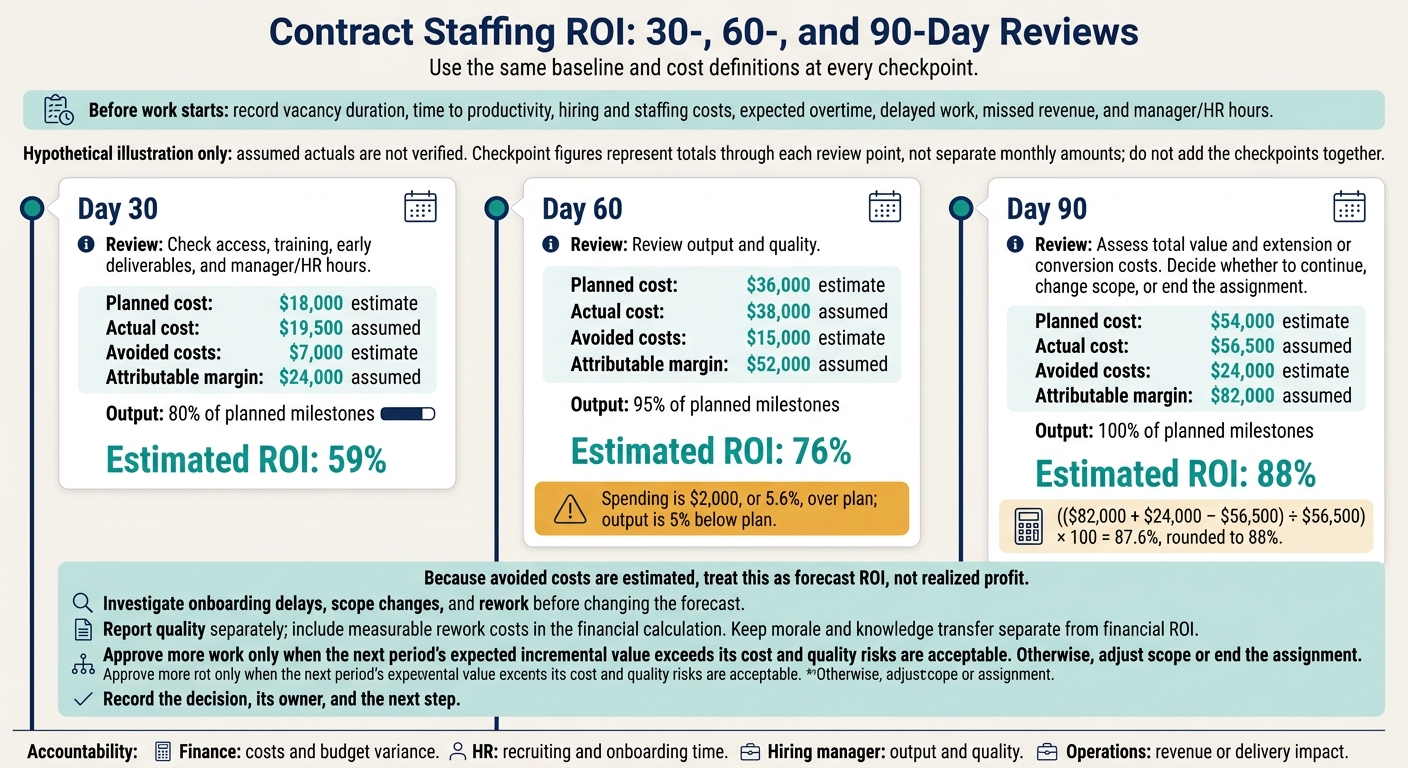
Contract Staffing ROI: 30-, 60-, and 90-Day Reviews
Use the same baseline and cost definitions from your ROI model to check whether the contract hire delivers more value than it costs. Each review should support a decision:
- Day 30: Check access, training, early deliverables, and manager/HR hours.
- Day 60: Review output and quality.
- Day 90: Assess total value and extension or conversion costs. Decide whether to continue, change scope, or end the assignment.
Track Baselines and Assignment Results
Before work starts, record baselines for vacancy duration, time to productivity, hiring and staffing costs, expected overtime, delayed work, missed revenue, and manager/HR hours.
Give each measure a clear owner. Finance tracks costs and budget variance. HR tracks recruiting and onboarding time. The hiring manager tracks output and quality, while Operations tracks revenue or delivery impact.
Track each role and assignment separately. Include cost per productive hour, completed deliverables, attributable output, defects, management time, budget variance, and proposed extensions or conversions.
Compare Actual Results With Estimates
Use checkpoint data to update your ROI forecast, as shown below.
Hypothetical illustration only: assumed actuals are not verified.
Review point Planned cost Actual cost Avoided costs Attributable margin Output Estimated ROI 30 days $18,000 estimate $19,500 assumed $7,000 estimate $24,000 assumed 80% of planned milestones 59% 60 days $36,000 estimate $38,000 assumed $15,000 estimate $52,000 assumed 95% of planned milestones 76% 90 days $54,000 estimate $56,500 assumed $24,000 estimate $82,000 assumed 100% of planned milestones 88% At 90 days, ROI is (($82,000 + $24,000 − $56,500) ÷ $56,500) = 87.6%, rounded to 88%. Because avoided costs are estimated, treat this as forecast ROI, not realized profit. At day 60, spending is $2,000, or 5.6%, over plan, while output is 5% below plan.
Before changing the forecast, investigate onboarding delays, scope changes, and rework. Keep morale and knowledge transfer separate from financial ROI. Report quality separately, and include measurable rework costs in the financial calculation.
Approve more work only when the next period’s expected incremental value exceeds its cost and quality risks are acceptable. Otherwise, adjust the scope or end the assignment. Record the decision, its owner, and the next step.
Conclusion: Choose Staffing Based on Total Value
At your 30-, 60-, and 90-day reviews, assess contract staffing on total value, not rate alone.
Compare Strong and Weak Assignment Fits
Use these signals at each review to check whether the assignment fits the role.
| Stronger assignment fit | Conditions that need closer review |
|---|---|
| Temporary demand | Continuing core work |
| Defined deliverables and acceptance criteria | Unclear scope or quality standards |
| Revenue-sensitive deadline | Little measurable cost of delay |
| Short-term specialist need | High institutional knowledge needs or a long ramp-up |
| Clear accountability and manager capacity | Limited capacity or unclear accountability |
These are risk flags, not automatic exclusions. Set acceptance standards, estimate ramp-up costs, and require handoff plans when continuity matters.
If hiring capacity is holding you back, implement talent acquisition strategies. If the work itself is unclear, redesign the role first.
Match Recruitment Support to Your Hiring Needs
Rent a Recruiter places recruiters inside your team to manage hiring when you lack recruitment capacity. Embedded recruitment adds hiring capacity, not staff to carry out the work itself.
Company-reported results include up to 70% lower hiring costs and 80+ hours saved per month. These figures are not guaranteed contract-staffing returns. Measure your savings against your own hiring volume, spending, and internal time.
Start with one measurable need and a baseline. Name the people responsible for reviewing delivery and financial results. Use recruitment support when hiring capacity is the constraint; rethink the assignment when delivery is the constraint.
FAQs
What ROI should my business target for contract staffing?
Set an ROI target that accounts for lower costs and a more efficient hiring process. Clients typically see a return within 2 to 6 months [1]. Start by establishing your baseline cost per hire, including fees, internal staff time, and tools [2].
Track total cost per hire, vacancy days avoided, and internal time saved against that baseline. Benchmarks include cost reductions of up to 70%, 50% faster hiring, and over 80 hours saved per month [1][2][3][4].
How can I isolate a contractor’s impact on revenue?
Start with avoided vacancy cost: multiply the actual vacancy days saved by the role’s documented daily revenue impact [1][2].
Next, measure how quickly the contractor reaches full productivity against your standard time-to-productivity [3][4]. Track operational KPIs linked to their work, such as better order fulfillment, lower customer churn, or direct revenue growth [3][4].
How do I assess ROI for assignments under 90 days?
Focus on immediate hiring efficiency, not long-term retention. Compare your recruitment cost baseline with the total fixed costs of the assignment. Track avoided vacancy costs, reductions in time to fill, internal hours saved, and hires delivered relative to recruiter capacity.
Check that recruitment cost per hire falls without compromising speed or quality. Use hiring manager satisfaction and post-hire performance as early quality indicators. Review costs and recruiter capacity monthly against your baseline.