
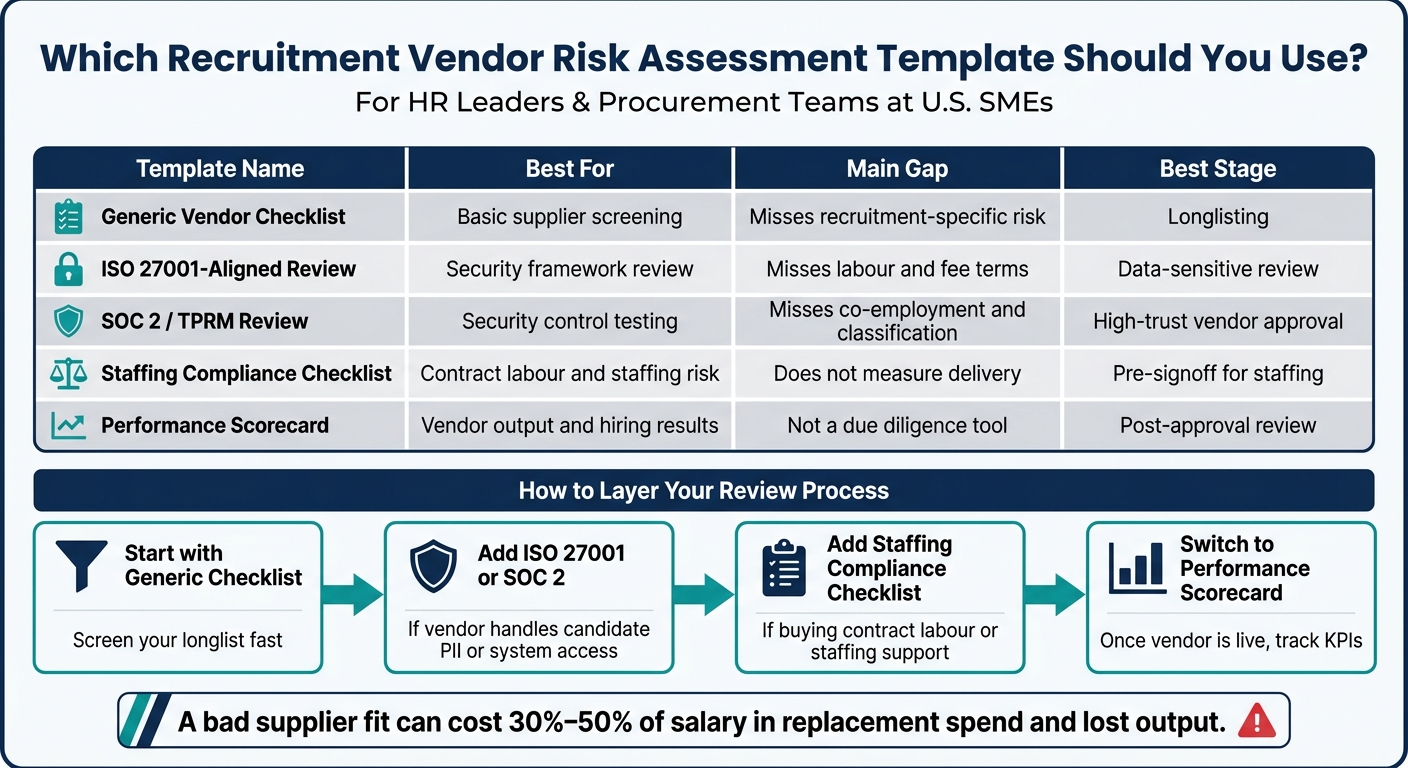
Pick the wrong vendor review template, and you can lose time, miss hiring targets, and add avoidable cost. In recruitment, a bad supplier fit can cost 30% to 50% of salary in replacement spend and lost output. For scaling firms, that is not a procurement issue. It is a hiring performance issue.
If I were choosing a recruitment partner, I would keep it simple. Use a generic checklist for first-pass screening, a security review for data or system access, a staffing compliance checklist for contract labour risk, and a scorecard for delivery. The point is not to run every template. The point is to use the right one for the risk in front of you.
Here is the short version:
- Generic vendor checklist: good for basic screening
- ISO 27001-aligned review: good for checking security framework scope
- SOC 2 / TPRM review: good for testing how security controls work over time
- Recruitment and staffing compliance checklist: good for worker classification, insurance, and co-employment risk
- Performance scorecard: good for time-to-fill, retention, and vendor output
If you are buying from embedded recruitment providers, staffing firms, tech vendors, or recruitment agencies, you should judge them on delivery, control, and cost exposure, not brand recognition. That matters even more in SaaS, Technology, IT, Fintech, Engineering, Security, Insurance, and Professional Services, where slow hiring can hit revenue plans and team output fast.
Recruitment Vendor Risk Assessment Templates: Quick Comparison Guide
Vendor Risk Assessment Explained
Explore our full library of recruitment videos for more expert hiring insights.
sbb-itb-a23bd6a
Quick Comparison
| Template | Best for | Main gap | Best stage |
|---|---|---|---|
| Generic checklist | Basic supplier screening | Misses recruitment-specific risk | Longlisting |
| ISO 27001-aligned | Security framework review | Misses labour and fee terms | Data-sensitive review |
| SOC 2 / TPRM | Security control testing | Misses co-employment and classification | High-trust vendor approval |
| Staffing compliance checklist | Contract labour and staffing risk | Does not measure delivery | Pre-signoff for staffing |
| Performance scorecard | Vendor output and hiring results | Not a due diligence tool | Post-approval review |
If you want a cleaner hiring model with more day-to-day control, embedded recruitment should still be reviewed in the same way. The article below shows which template to use, when to use it, and where each one can leave a gap.
1. Generic Vendor Risk Assessment Checklist Template
A generic vendor risk assessment checklist covers the basics: financial health, insurance, data privacy, pricing clarity, and reputation. It casts the widest net, but it does not go deep enough for recruitment risk.
Use it for broad screening. The later templates go deeper on security, compliance, and performance risk.
Risk coverage
A generic template checks broad risk categories. You can confirm company registration, ask for proof of insurance, and review public red flags in the vendor’s history.
That helps, but it leaves out recruitment-specific risk. It will not show joint-employer exposure, worker misclassification, or performance controls such as time-to-fill and retention.
That gap matters. Recruitment risk is operational, not just financial. If a provider cannot deliver the right hires on time, or if the engagement model creates compliance issues, the cost shows up fast in missed hiring targets, team drag, and extra legal review.
Recruitment-specific compliance
This is where the generic checklist starts to fall short.
It often misses replacement guarantees, conversion fee terms, candidate-introduction clauses, and sector rules tied to regulated roles.
For hiring leaders, that is not small print. Those terms shape your cost exposure and your room to move later. A low-fee vendor can still become expensive if contract terms lock you in or create fees you did not plan for.
Evidence requirements
| Risk Category | Evidence to Request |
|---|---|
| Financial / Reputation | Company registration, client testimonials, financial due diligence reports |
| Operational | Average time-to-first-submittal, placement volume in your specific industry |
| Compliance | Proof of insurance, worker classification protocols, background check documentation |
| Contractual | Written replacement guarantees, conversion fee schedules, liability allocation |
Ask for delivery evidence you can verify. That means placements by role and geography, plus the number of qualified candidates sourced for the role in the last 30 days.
That kind of proof gives you more than a sales claim. It shows whether the vendor can deliver in your market, in your sector, and at the pace your business needs.
SME fit
For U.S. SMEs, the generic checklist works well as a first-pass filter, not a full assessment. It works best for straightforward professional roles and low-risk engagements where the main aim is to confirm business legitimacy.
Once you move into regulated sectors, executive hiring, or high-volume demand, 100+ hires per year, the generic template leaves too many gaps open [3].
Use it as a baseline only. Move to a security or compliance template when the vendor will handle sensitive data or support regulated hiring.
2. ISO 27001-Aligned Vendor Security Assessment Template
When a generic checklist won’t cut it, use this template to test security controls that matter to hiring.
This is not a general vendor legitimacy check. It’s built to test whether a vendor protects candidate data, controls access, and keeps auditable records [4][1].
Risk coverage
Here’s the gap: an ISO 27001 certificate shows the vendor has a structured security programme. It does not tell you whether candidate data handling, background checks, or third-party processor access controls are actually sound in day-to-day recruitment work [4].
That matters if you’re hiring into SaaS, Fintech, Security, Engineering, or other sectors where sensitive data moves fast and mistakes are expensive.
Recruitment-specific compliance
ISO 27001 also does not cover joint-employer exposure or sector-specific checks, such as FDA Part 11 for pharma or enhanced screening for banking roles [3].
So even if the vendor has a security framework in place, you can still carry risk elsewhere. For example, vague indemnification language in a vendor contract can shift wage, hour, and benefit eligibility exposure back to your company, and no security certificate will flag that.
If you need broader governance and operating control checks, the next move is a SOC 2 / TPRM review.
Evidence requirements
Self-reported claims are not enough [4]. Ask for the evidence that directly tests the controls, nothing more.
| Evidence Type | What to Validate | SME Priority |
|---|---|---|
| ISO 27001 Certificate | Expiration date and scope of registration | High |
| Statement of Applicability (SoA) | Which Annex A controls are included or excluded | High |
| Incident Response Plan | Documented procedures for data breaches | High |
| Background Check Logs | Consistency of screening across all submittals | Medium |
Pay close attention to the scope of registration on the certificate. It should cover the recruitment services you’re buying, not just the vendor’s internal IT function [1][3].
That’s a common miss. A certificate can look fine on paper while leaving the actual service you rely on outside scope.
SME fit
Use this template for regulated or data-sensitive hiring.
For standard professional roles, this process is often too heavy for low-risk hiring. You should also plan for a 6 to 10 week procurement cycle [4], which has a direct impact on hiring speed and internal team time.
If the vendor needs broader control assurance, move to SOC 2 / TPRM next.
3. SOC 2 / TPRM Vendor Due Diligence Template
SOC 2 / TPRM checks whether a vendor’s security, confidentiality, and privacy controls work in day-to-day use. ISO 27001, by contrast, describes the vendor’s security management program. Use SOC 2 / TPRM when you need proof that controls operate as intended, not just proof that a program is in place.
Risk coverage
For staffing firms, flexible embedded recruitment partners, and recruiting tech vendors, the main issue is simple: does candidate data and confidential hiring information stay protected? This template looks at how the vendor handles candidate PII, who can access confidential project data, and whether the vendor’s systems stay secure and available during normal operations [1]. It makes sense when a breach or outage would slow hiring, disrupt delivery, or create legal and financial exposure.
SOC 2 / TPRM does not deal with co-employment liability, worker misclassification, or tax exposure, all of which matter in staff augmentation arrangements [1][3]. If those risks matter more than data security, the staffing compliance checklist should sit next to this review.
"The biggest risk when selecting talent vendors is non-compliance… their failure to do so may mean fines, penalties and legal liabilities for you!" – Sanhita Mukherjee, TalentDesk [1]
Recruitment-specific compliance
SOC 2 does a good job on privacy and confidentiality. But it does not fully cover recruitment workflows such as background screening for regulated roles, EEO/OFCCP reporting duties, or cross-border data transfers where statutory rules differ [3].
That matters for hiring leaders in sectors like Fintech, Security, Insurance, and Engineering. If your hiring model spans regulated work or cross-border delivery, a standalone SOC 2 / TPRM review leaves gaps. A separate staffing compliance checklist should run alongside it [3].
Evidence requirements
Ask for a SOC 2 Type II report, written security policies, and audit trails that show how controls were run over time [1][4]. The Type II point matters because it covers a period of time, not a single snapshot.
| Evidence Item | What It Proves | SME Priority |
|---|---|---|
| SOC 2 Type II Report | Controls tested over a defined period | High |
| Written Security Policies | Written procedures for handling confidential hiring data | High |
| Access Logs | Access logs for recruiter and client data | High |
| Candidate Data Handling Policies | How candidate PII is collected, stored, and protected | High |
SME fit
This template is best for high-sensitivity hiring where candidate PII and vendor system access create direct business risk. The trade-off is more procurement work and more time spent reviewing evidence. For more details on how these models work in practice, see our recruitment model FAQs.
If your main concern is co-employment exposure or sector-specific screening compliance, move to the Recruitment and Staffing Compliance Checklist instead [3].
4. Recruitment and Staffing Compliance Checklist Template
When security is not the main issue, switch to the staffing compliance checklist.
SOC 2 and TPRM reviews look at security. This checklist looks at employment law, pay, and worker classification risk in staffing relationships.
Risk coverage
This template covers the main compliance areas that matter most in staffing: worker classification, joint-employer risk, payroll and tax compliance, licensing and background checks, and safety and incident management for temporary labour [4][3].
That means checking whether workers are set up correctly as W-2 or 1099, whether the staffing partner is meeting payroll tax duties, and whether the right checks are in place for regulated roles. It should also confirm right-to-work and onboarding documents, plus role-specific screening such as criminal history and credit checks for finance roles [3].
If the vendor also handles sensitive candidate data, use a security template separately. This checklist deals with a different part of the risk picture.
Put simply, it covers what security reviews often miss: who the vendor hires, how they classify those workers, and who carries the liability if something goes wrong.
Recruitment-specific compliance
Joint-employer clauses need close review. Your staffing agreement should clearly say the agency is responsible for wage and hour compliance, benefit eligibility, workers’ compensation, and misclassification claims.
If the indemnification language is vague, or if it pushes liability back onto you, that’s a red flag [3]. This is where many hiring teams get caught out. Reviewing embedded recruitment case studies can help identify how other firms manage these compliance and liability handovers. On paper, the agency supplies the worker. In practice, the client can still end up exposed.
For temporary labour, the checklist should also confirm the vendor’s safety training and incident-response governance [4]. If workers are on-site, operating equipment, or working in higher-risk settings, that detail matters fast.
Evidence requirements
Ask for proof, not promises. You should request insurance documents, written screening and onboarding protocols, and any sector-specific certifications tied to the roles being filled [1][3].
| Evidence Item | Why It Matters |
|---|---|
| Worker Classification Protocols | Written W-2 vs. 1099 controls and audit readiness |
| Joint-Employer Liability Clause | Clear split of wage/hour, benefit, and misclassification responsibility |
| Payroll and Tax Compliance Records | Proof the agency is managing payroll taxes and related duties |
| Certificates of Insurance | Liability, workers’ compensation, and data breach cover |
| Screening and Onboarding Documentation | Consistent background checks and right-to-work verification |
| Industry-Specific Certifications | Required compliance for regulated roles and sectors |
| Documented Privacy Controls | Written handling of candidate data and confidential project information |
| Safety and Incident Management Procedures | Proof of safety training and incident-response governance for temporary labour |
SME fit
This checklist does not cover delivery performance or data security. It does, however, help surface hidden fees and location-based pricing differences [4][3], which can hit both cost and risk if left unchecked.
Use this checklist for staffing compliance. Then pair it with the performance scorecard to review speed and retention. Add a security template if the vendor handles candidate data.
Use this checklist as the compliance lens, then compare it with the performance scorecard for delivery results.
5. Recruitment Vendor Performance Scorecard Template
Once legal and security checks are cleared, the next step is simple: score delivery performance.
At that point, the question is no longer whether the vendor can be approved. It is whether they can fill roles on time and with the right level of quality.
Risk coverage
This template is built around delivery risk. A vendor can pass compliance checks and still miss hiring targets, drag out timelines, or send weak shortlists.
So, focus on the metrics that show whether a provider can deliver in practice:
- Time-to-fill
- Time-to-first-submittal
- 12-month retention
For mid-level roles, time-to-fill often sits between 21 and 45 days. First qualified candidate submittals should land within 7 to 14 business days. Strong vendors tend to hold 90%+ retention at 12 months [4][2][3].
There is also a big difference between active and reactive delivery. Active pipelines often produce the first qualified candidate submittal in 7 to 14 business days. Reactive models often take 28+ days [3].
That gap matters. If you’re scaling in SaaS, Technology, Fintech, or Professional Services, a slow start can push out revenue plans, delay team buildouts, and add pressure to internal leaders.
Treat legal and security issues as pass/fail gates. Only score delivery after those checks are passed. The scorecard should also flag vague replacement guarantee terms [2][3].
Evidence requirements
Ask for verifiable delivery data, not polished sales claims.
You want proof the vendor can deliver across the roles and locations you care about. That usually means placement records by role and geography, submittal-to-interview ratios, monthly KPI reports, and ATS/VMS exports.
| Scorecard Category | Metrics to Track |
|---|---|
| Delivery Quality | Time-to-first-submittal, submittal-to-interview ratio, interview-to-offer ratio |
| Business Impact | 12-month retention rate, assignment completion rate, bill rate transparency, replacement guarantee adherence |
| Operational Fit | Account manager responsiveness, reporting frequency, ATS/VMS integration |
| Risk & Compliance | Worker classification accuracy, background check completion, insurance validity, co-employment liability clarity |
This kind of scorecard helps you cut through opinion and compare vendors on facts. For CFOs and HR leaders, that makes spend easier to defend. For talent teams, it cuts down back-and-forth and helps you spot delivery issues before they turn into missed headcount goals.
SME fit
For smaller hiring teams, this scorecard takes a lot of the guesswork out of vendor selection.
A simple weighted model usually works well. Score vendors 0 to 2 points per criterion across specialization, pipeline depth, compliance, and responsiveness [4][3]. Then compare vendors in a consistent way instead of relying on whoever made the best pitch.
That matters when your team is lean and every hiring delay lands on the same few people. A light scorecard gives you a cleaner way to judge trade-offs, defend your decision, and use the results in the side-by-side comparisons that follow.
Side-by-Side Tradeoffs for U.S. SMEs
No single template covers every vendor risk. Each one is built to check a different issue, and if you use the wrong one, you leave gaps that can cost time, money, or both.
The table below shows where each template fits best, and where it falls short.
| Criterion | Strongest Template | Least Suitable Template | Key Gap |
|---|---|---|---|
| Broad Vendor Screening | Generic Vendor Checklist | ISO 27001-Aligned | Lacks focus on industry fit and pricing clarity |
| Security and Data Privacy | SOC 2 / TPRM | Recruitment and Staffing Compliance Checklist | Fails to assess technical data protection and encryption |
| Staffing and Labor Compliance | Recruitment and Staffing Compliance Checklist | Performance Scorecard | Does not address joint-employer risk or worker classification |
| Ongoing Performance Monitoring | Performance Scorecard | Generic Vendor Checklist | Lacks KPI tracking like time-to-fill and retention |
Use this matrix to match each vendor with the template that covers its highest-risk gap.
For most U.S. SMEs, one universal review is not enough. You usually need a primary template for the main risk, then a secondary check for the areas the first review misses. That keeps the process tight without turning procurement into a drag on hiring.
Template choice also shifts as your company grows. What works for an early-stage team hiring under pressure will not suit a regulated mid-market business dealing with audits, data handling, and labor exposure.
| SME Maturity Stage | Primary Template | Secondary Template | Core Priority |
|---|---|---|---|
| Early-Stage | Generic Vendor Checklist | Recruitment and Staffing Compliance Checklist | Speed and basic credibility; avoid hidden costs like steep termination fees |
| Post-Funding Scale-Up | Performance Scorecard | Recruitment and Staffing Compliance Checklist | Delivery quality and joint-employer risk during rapid growth |
| Regulated Mid-Market | SOC 2 / TPRM Due Diligence | ISO 27001-Aligned | Audit readiness, data security, and joint-employer risk reduction |
Here’s the practical point: a 6 to 10 week procurement cycle may work for regulated reviews, but it does not fit urgent backfills. If you need hiring support fast, your review process has to match the business need, not slow it down.
Pros and Cons
Every template gives you a different trade-off. Some help you move fast. Others give you more depth and control. The right choice depends on the risk sitting in front of you, not the template that looks most complete.
The table below gives you one clear view of the trade-off between speed, depth, and what each option can miss.
| Template Type | Advantages | Limitations | Best Use Case |
|---|---|---|---|
| Generic Checklist | Fast to implement; covers broad criteria like track record, capacity, and pricing | Shallow; can miss niche technical gaps and specific legal risks | Initial vendor longlisting and general suitability checks |
| ISO 27001 / SOC 2 | High security rigor; strengthens data protection and audit readiness | High review burden; often requires technical expertise to assess properly | Vendor reviews involving candidate PII or system access |
| Staffing Compliance Checklist | Directly addresses U.S. co-employment liability, worker classification, and tax risks | Highly specialized; requires regular legal updates; does not measure delivery performance | U.S. staffing and contract labor engagements |
| Performance Scorecard | Supports auditable performance tracking; tracks KPIs like time-to-fill and candidate quality | Not an upfront due diligence tool; focuses on execution metrics rather than structural or security risks | Ongoing vendor governance and post-placement evaluation |
In practice, generic checklists work well when you need a fast first pass. They help you narrow a longlist without tying up your HR, legal, or procurement team too early.
If the vendor will handle candidate data or touch your systems, security templates matter more. That extra review can feel heavy, but the cost of getting it wrong is usually much higher.
For U.S. staffing or contract labor, compliance checklists should come first. Co-employment, worker classification, and tax risk can create direct cost exposure, not just admin headaches.
Performance scorecards do a different job. They won’t tell you whether a vendor is safe to appoint at the start, but they will tell you whether that vendor is delivering once the work begins.
A simple way to handle this is:
- Use generic checklists for fast screening
- Use security templates where candidate data or system access is in scope
- Use staffing compliance checklists where labor-law exposure is the main risk
- Use scorecards for ongoing vendor oversight
The smart move is to match the template to the first risk you need to control. Then, only add a second review where the first one leaves a gap. That keeps the process lean, saves internal time, and gives you better control over hiring risk without turning vendor review into a slow, expensive exercise.
Conclusion
The matrix above leads to one clear rule: use a layered review process. Start broad, then go deeper only where the risk justifies it.
Begin with a generic checklist to screen your longlist. If a vendor will handle candidate PII or connect to your ATS or HRIS, add ISO 27001 or SOC 2 controls. If you’re buying staffing or contract labour support, use a recruitment compliance checklist to cover worker classification and co-employment liability.
Once the vendor is live, the focus should shift from selection checks to performance tracking. Lower-volume hiring can usually run with lighter reviews. High-volume hiring or embedded recruiting needs tighter controls. When comparing different recruitment models for embedded arrangements, both security and compliance checks should be in place from day one.
If you need extra hiring capacity without handing control to a third party, Rent a Recruiter places experienced recruiters directly into your team within days. That gives you more structure, more consistency, and better control over hiring outcomes.
FAQs
Which template should I start with?
Start by documenting your hiring needs, including hiring volume, role types, and timelines. When those points are clear, use a structured, vendor-neutral framework so the process stays auditable and unbiased.
A custom RFP template helps you standardise how you gather information. A weighted evaluation scorecard then helps you rank potential partners against your criteria. That keeps selection consistent and aligned with your internal standards, while giving you a clear record of how decisions were made.
When do I need a security review?
Run a security review any time a recruitment vendor needs access to your internal systems, such as your ATS or candidate databases.
Bring in your IT and Information Security teams early. They should review security questionnaires, check for gaps or compliance issues, and sign off on data processing agreements before any access is given.
This matters for more than box-ticking. If a vendor is working inside your systems, they’re touching business-critical data. A weak review process can lead to data risk, access issues, and extra cleanup work later.
Make sure your security team also approves all credentials before they’re issued, especially where sensitive data or higher-risk areas are involved.
Can I use more than one template?
Yes. Using more than one template can help you tailor your recruitment vendor assessment to your organisation’s specific needs.
For example, you might use a general request-for-proposal template to cover baseline requirements, then add a scoring matrix to assess areas like candidate pipeline depth or compliance capability.
This gives you a more complete and consistent way to assess vendors. It also makes it easier to compare options side by side, spot gaps early, and back your decision with a clear scoring method.
For hiring leaders, that matters. Better structure usually means less back-and-forth, less bias in the process, and a faster vendor decision.