
If you can fill a role from inside your business, you will often cut cost, shorten ramp time, and lower hiring risk.
For most scaling companies, the choice is simple. Use internal mobility when someone is close to ready. Use external hiring when the skill gap is clear and cannot wait. That decision affects agency spend, time-to-fill, manager workload, retention, and output.
Here’s the short version:
- Internal mobility usually means lower hiring cost, no agency fee, and a shorter path to output.
- External hiring helps when you need new skills, niche expertise, or volume hiring your team cannot cover alone.
- Agency fees often land at 15% to 25% of first-year salary, and some external searches go higher.
- Senior external roles can take 90 to 120 days to fill.
- Many external hires still need 3 to 6 months to reach full output.
- If external hiring volume grows, embedded recruitment can give you more control, fixed monthly cost, and less admin load than commission-led models.
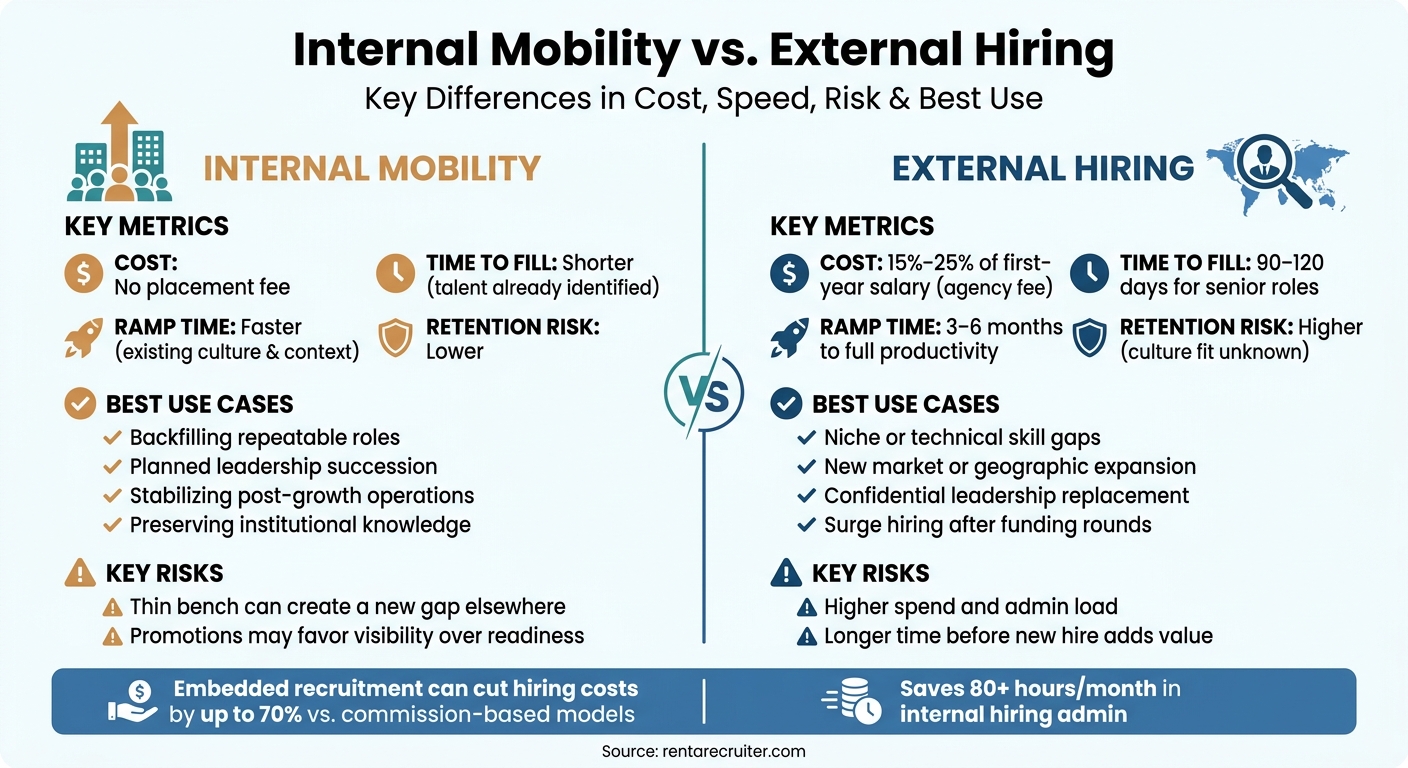
Internal Mobility vs. External Hiring: Cost, Speed & Risk Compared
Internal Hiring vs External Hiring – What’s Better? Ft. Fit Small Business
Quick Comparison
| Criteria | Internal Mobility | External Hiring |
|---|---|---|
| Cost | Lower, no placement fee | Higher, often 15% to 25% of salary |
| Time to fill | Shorter if talent is ready | Often longer |
| Ramp time | Shorter, people know the business | Longer, more onboarding time |
| Risk | Lower fit risk | Higher fit and ramp risk |
| Best use | Repeat roles, planned succession, team stability | Skill gaps, new markets, fast headcount growth |
| Main limit | Thin bench can create another gap | More spend, more uncertainty |
The core question is not which model is better in general. It is which one gives you the best hiring outcome for this role, at this stage, with this level of risk and cost.
2. Internal Mobility: Lower Cost, Faster Ramp, Stronger Retention
For established roles, internal mobility often costs less and moves faster than external hiring. But that only works when someone inside your business is already close to ready.
The cost structure is different too. An internal hiring function spreads its cost across multiple hires. Agency fees hit every single placement, which adds up fast when hiring volumes grow.
Where Internal Mobility Delivers Measurable Value
The clearest upside is faster productivity. Someone moving internally already knows your systems, team dynamics, and how decisions get made. That means less onboarding friction, a shorter ramp, and less drag on manager time [3][4].
There’s also a clear retention upside. When people can see a path forward inside the business, they’re less likely to leave. If internal moves are handled in a consistent and open way, it sends a strong signal that growth is possible without changing employer, and that can cut turnover risk [3].
For SMEs, this matters even more. A bad hire is expensive, and the cost doesn’t stop at replacement. You also lose time, output, and management focus while the gap sits open.
What SMEs Need in Place for Internal Mobility to Work
The upside disappears if the process is vague. Internal mobility needs a few basics in place:
- An open internal posting process so employees hear about roles before you go to the external market
- Clear role definitions and success criteria so move and promotion decisions are based on merit, not familiarity
- A skills inventory so managers and HR leaders know who is ready, and for what
- Manager buy-in so team leads support moves instead of blocking them to hold on to talent
- A basic succession plan for your most business-critical roles
There are limits. Small teams often don’t have much bench depth, so one internal move can create another gap somewhere else [3]. And if promotion decisions aren’t structured, the role can go to the most visible person, not the most ready one [2][3].
Comparison Table: Internal Movers vs. External Hires
| Factor | Internal Movers | External Hires |
|---|---|---|
| Cost | Low, fixed internal time, no placement fee [2] | High, 15% to 25% of first-year salary [2] |
| Time to productivity | Fast, existing culture and context [3][4] | Slower, longer time-to-fill and ramp-up time [4] |
| Retention | Higher, clear career path and proven culture fit [2][3] | Lower, culture fit risk and higher fall-off risk [2][3] |
| Culture fit risk | Minimal, already integrated [3] | Higher, unknown culture fit adds selection risk [2] |
When the skill you need doesn’t exist inside the company, external hiring is usually the better call.
sbb-itb-a23bd6a
3. External Hiring: New Skills, but at a Higher Cost and Risk
When internal moves won’t fix a critical gap, external hiring is the next step. It gives you skills the business can’t build fast enough on its own.
But there’s a clear trade-off. You bring in new capability, and you also take on higher costs, a slower ramp, and more hiring risk.
When External Hiring Is the Right Business Decision
External hiring makes sense when the role needs skills you simply don’t have in-house. That could mean niche technical expertise, a confidential leadership replacement, or fast entry into a new market. It also fits when you’re building a new function or scaling headcount fast after a funding round [5][2].
The Hidden Costs Behind External Recruitment
The agency fee is only the part you can see.
Traditional recruitment agencies usually charge 15% to 30% of a new hire’s first-year salary [5][2]. But much of the cost sits elsewhere: vacancy time, hiring manager hours, interview load, and the delay before the new person is fully up to speed.
Senior and executive roles often take 90 to 120 days to fill on average [4]. After that, many new hires still need 3 to 6 months before they reach full productivity [5].
So the cost of external hiring goes well past the invoice. You’re paying in time, lost output, and internal bandwidth.
How Embedded Recruitment Support Improves External Hiring Control
External hiring gets easier to manage when the process is structured and visible.
Rent a Recruiter places experienced recruiters directly into your team on a fixed monthly model, with no commission. They run the process end-to-end as part of your business, which gives you more visibility, more consistency, and better control.
For scaling SMEs that can’t absorb the cost or admin load of high-volume external hiring, that matters. Companies often cut hiring costs by up to 70% compared with commission-based models and save more than 80 hours per month in internal hiring and admin time [1][3].
4. Direct Comparison: Cost, Speed, Risk, and Long-Term Value
Cost and Efficiency: Which Option Protects Budget and Hiring Capacity
With the basics covered, the choice comes down to four things: cost, speed, risk, and long-term value.
If your goal is to protect budget and keep hiring moving, internal mobility often comes out ahead. You avoid placement fees. You also keep the company context that an internal person already has, which means less ramp time and less disruption across the business.
External hiring is usually more expensive, both on paper and in the day-to-day work it creates. Agency fees often sit at 15% to 25% of first-year salary[2]. On top of that, most external hires still need 3 to 6 months to hit full productivity[5].
So yes, cost and speed tend to lean internal. But once you look at risk and team capability, the gap gets wider.
Risk and Long-Term Value: Retention, Capability Building, and Business Stability
Internal movers bring something hard to buy from outside: they already know how your business works. They understand the pace, the people, and the behaviors that tend to work well inside the company. That lowers the chance of a poor fit.
There is a trade-off, though.
External hires can bring a new point of view and skills your team does not have today. If you’re entering a new market, rolling out unfamiliar technology, or replacing a senior leader quietly, an outside hire may give you more long-term return, even with the higher upfront cost.
That’s where the decision gets more commercial. Are you solving for speed and lower spend, or are you buying capability your team cannot build in time? In many cases, that’s the line that matters most.
Comparison Table: Best Fit by Hiring Scenario
| Hiring Scenario | Better Fit | Why |
|---|---|---|
| Backfilling a core repeatable role such as an engineer or customer success manager | Internal mobility | Lower cost, faster start |
| Adopting new technology or niche expertise | External hiring | Skills don’t exist in-house; can’t be built fast enough |
| Geographic or market expansion | External hiring | Local network and market knowledge are critical[2] |
| Leadership succession (planned) | Internal mobility | Preserves institutional knowledge; signals growth path to team |
| Leadership replacement (confidential) | External hiring | Requires discretion and a network the business may not have |
| Stabilizing operations after rapid growth | Internal mobility first | Leverages people who already know the business |
| Surge hiring after a funding round | External hiring (structured) | Volume and speed exceed internal capacity |
The next step is building a hiring model that uses each option where it fits best.
5. Build a Balanced Hiring Approach That Scales
Once the trade-off is clear, the next step is to make your hiring model repeatable.
When to Use Internal Mobility and When to Hire Externally
Use internal mobility for repeatable roles and clear successors. Use external hiring when you need new skills, fast headcount growth, or hard-to-fill executive roles.
The choice itself matters less than the rules behind it. Good hiring runs on clear decision-making, not guesswork.
How to Make Both Approaches More Predictable
Both models work better when you put clear process controls in place. Tighten role definitions. Use one scorecard. Track time-to-fill, cost-per-hire, and 90-day retention.
That gives you a cleaner view of what is working, where delays are coming from, and what each hire is costing the business. For smaller teams, structured screening can help you manage more hiring volume without losing consistency.
When your internal team hits capacity, outside support should give you more control, not more noise. When hiring demand grows beyond what your team can handle, embedded recruiters bring structure, visibility, and speed while keeping control inside the business. Rent a Recruiter places experienced recruiters into your team to improve control, cut cost, and help you execute faster.
Conclusion and Next Step
Use internal mobility where roles are repeatable. Use external hiring where capability gaps are clear.
If you want to see what a more structured, cost-efficient hiring model could look like for your business, book a call with Rent a Recruiter.
FAQs
How do I know if someone is close enough to ready?
Classify potential successors by readiness: Ready Now, Ready Soon (1 to 2 years), or Long-term Potential.
This gives you a simple way to see who could step into a role today, who needs more development, and where your future bench is thin. For CEOs, HR leaders, and Talent Leaders, that kind of visibility helps you cut risk, plan hiring with more control, and avoid last-minute scrambles.
Use regular talent reviews and Talent Talks to assess career goals and current skills. Keep a clear record of each employee’s skills, goals, and readiness level.
That makes it much easier to spot internal talent early and judge readiness before a role opens. In practice, it also saves time, supports stronger succession planning, and helps you make better hiring calls when growth puts pressure on the business.
What if an internal move creates another gap?
That’s a normal outcome of internal mobility, not a reason to avoid it.
The key is to manage it well. Look at the skills gap, then weigh how the newly open role maps to your product roadmap and business needs. That gives you a clear view of whether you need a backfill now, later, or not at all.
A centralised skills inventory makes this much easier. You can spot internal backfill options faster, cut delays, and keep work moving.
If you need extra support, Rent a Recruiter can manage hiring end to end, so your team keeps momentum.
When should I bring in embedded recruitment support?
Bring in embedded recruitment support when you need to scale hiring capacity fast, without the long-term overhead of adding permanent headcount.
It works well during growth phases, post-funding hiring surges, or seasonal spikes when demand jumps and your internal team can’t stretch much further.
It also makes sense when your team is already at capacity, hiring quality starts to slip, or you need specialist sourcing support for hard-to-fill roles.
The key point is control. You get extra hiring power while keeping your employer brand, your data, and your process in-house. That means more hiring output without handing the whole function to an external agency.