
Hiring faster can cost you more than agency fees if your process breaks on pay, classification, or documentation.
If you are scaling across the US, the legal risk tends to show up in the same places every time: salary range rules, worker status, overtime, I-9s, and manager-led hiring decisions that are not documented well. The cost is not abstract. In FY 2023, the US Department of Labor recovered $274 million in back wages for more than 163,000 workers. Misclassification can also trigger tax penalties, overtime claims, and back pay that can sit on your books for years.
If I were reviewing this as a CEO, CFO, or HR leader, I would focus on five things first:
- Check headcount triggers such as 15 employees for ADA coverage and 20 employees for ADEA coverage
- Review remote job postings against state and city salary range laws
- Audit contractor setups against how work is done in practice, not just what the contract says
- Tighten time, payroll, and I-9 records before hiring volume increases
- Standardise hiring steps so managers use the same process every time
This is the commercial point: small process gaps turn into back pay, tax exposure, manager time loss, and slower hiring. If you want growth without extra drag, you need hiring controls that hold up under volume. That is where embedded recruitment can help apply the same process across every role and hiring manager.
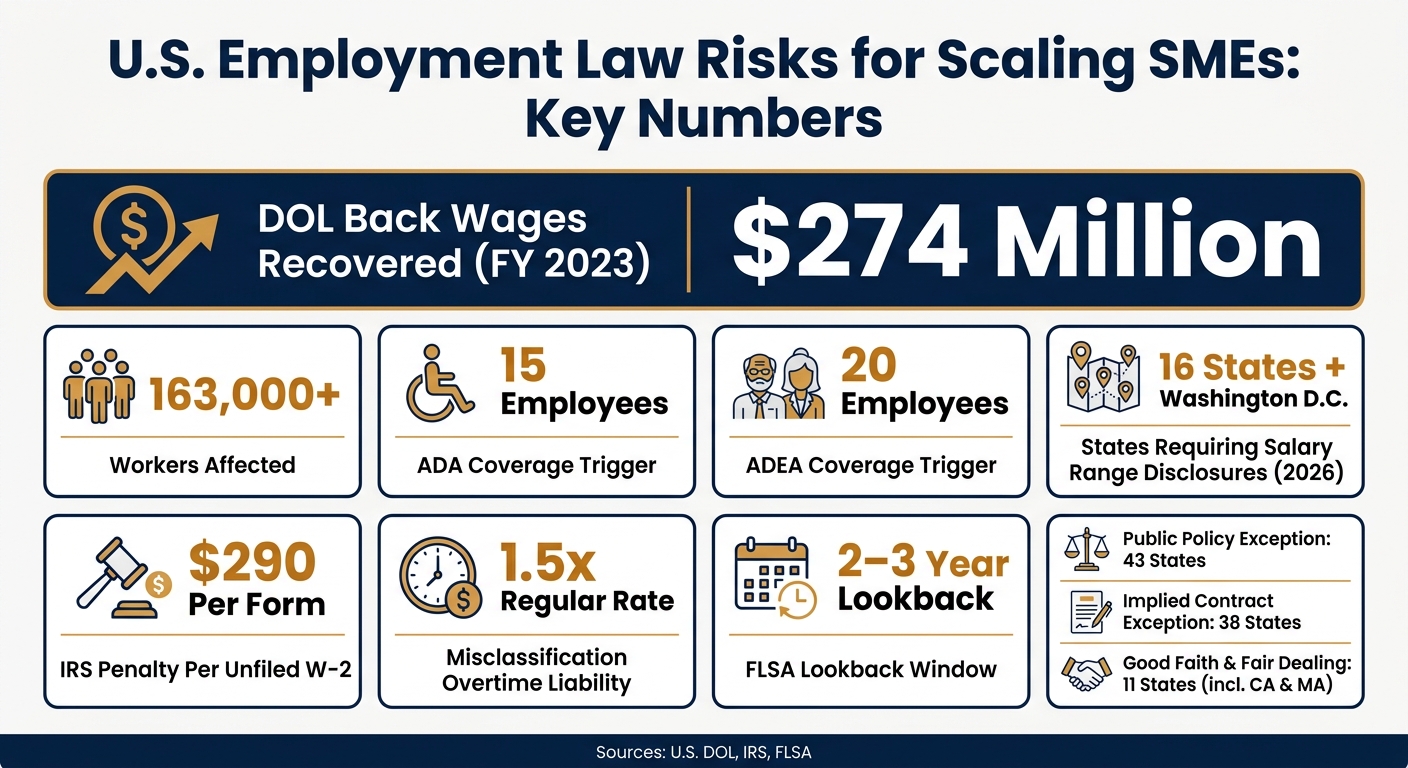
U.S. Employment Law Risks for Scaling SMEs: Key Numbers
The Core U.S. Employment Laws That Affect Hiring and Scaling
Federal employment law shapes who you can hire, how you pay them, and how you document each decision.
In practice, risk tends to show up early, during hiring, pay, screening, and onboarding. When your company starts adding more roles, more hiring managers, and more office locations, the odds of inconsistency go up fast. One team may follow the process closely. Another may improvise. That’s where trouble starts.
As hiring volume grows, inconsistent application becomes the main risk. The issue usually is not the policy on paper. It’s whether every manager applies it the same way.
Anti-Discrimination Laws in Recruitment: Title VII, ADA, ADEA, and Equal Pay Act
Title VII bars discrimination based on race, color, religion, sex, and national origin. The ADA, ADEA, and Equal Pay Act also limit how you screen candidates and make compensation decisions.
As teams scale, this gets harder to control. More interviewers means more room for biased wording, uneven screening, and pay calls that don’t stand up later. A casual interview comment, a different screening standard between offices, or pay ranges set without clear logic can create legal and commercial risk at the same time.
For hiring leaders, the point is simple: if your process isn’t structured, it’s hard to defend.
Wage and Hour Rules Under the Fair Labor Standards Act
The FLSA sets the rules for minimum wage, overtime, and recordkeeping.
For scaling companies, the biggest risk usually comes from worker misclassification and weak time tracking. If teams don’t track hours or overtime the same way across departments or locations, small process gaps can turn into expensive problems.
This is where growth can catch companies off guard. A process that worked for 20 employees often starts to crack at 100.
I-9 Verification, Background Checks, and Fair Screening
Form I-9 verifies work authorization for every U.S. hire.
Background checks and other screening steps should follow one standard, job-related process across roles, managers, and locations. That means the same approach to eligibility checks, the same screening logic, and the same documentation standard.
A single checklist can help keep this tight:
- eligibility verification
- screening steps
- decision records
That kind of consistency cuts avoidable exposure as hiring volume grows. Once those hiring controls are in place, worker-status and termination decisions usually become the next pressure point.
sbb-itb-a23bd6a
Employment Status and Termination Rules That Create Outsized SME Risk
Two legal issues tend to hit scaling SMEs harder than expected: worker misclassification and overreliance on at-will employment. Both shape how you build your team, what headcount will cost, and how much risk sits on the balance sheet when a hire goes wrong.
At-Will Employment and the Limits Employers Need to Understand
At-will employment means you can end employment for any lawful reason. On paper, that sounds simple. In practice, it is narrower than many employers think.
Three exceptions create the most risk for scaling SMEs [4]:
- Public policy (recognized in 43 states): You cannot fire someone for whistleblowing, refusing illegal conduct, or using protected rights.
- Implied contract (recognized in 38 states): If your handbook says termination requires "just cause" or a set warning process, a court may treat that as a binding promise.
- Covenant of good faith and fair dealing (recognized in 11 states, including California and Massachusetts): This can block terminations timed to avoid earned pay or commissions.
This is where growth can trip you up. When hiring speeds up, managers start making off-script promises, offer letters get rushed, and handbook language goes unchecked. That is often how employers weaken their own at-will position without meaning to.
Avoid "probationary period" language if it hints at a fixed-term promise. Use a clear at-will disclaimer in handbooks and offer letters, bold or in uppercase, on the first page and above the signature line. It should also say that verbal promises cannot change employment status [4].
The same discipline applies to contractor classification and termination wording. If your process changes from one hire to the next, your risk climbs.
Employee vs. Independent Contractor: A High-Cost Classification Decision
Contractor use often rises during a growth phase. It can look like a simple way to add capacity without adding payroll. But classification has to match the real working relationship, not just the title in the contract.
The IRS looks at three categories when assessing status: behavioral control , does the company control how the work is done; financial control , does the company control how the worker is paid and whether they can work for others; and type of relationship , are there contracts, benefits, or an open-ended arrangement [2][3]. The more control you have over how, when, and where work gets done, the more likely that person is an employee. Get that call wrong, and the cost can stack up fast.
Misclassification can lead to back pay, tax liability, and overtime claims. It can also trigger unpaid overtime at 1.5x the regular rate, statutory benefits, and IRS penalties of up to $290 per unfiled W-2 form [3]. The FLSA adds a two-to-three-year lookback window for unpaid overtime claims, which means a two-year contractor arrangement can create a large retroactive bill [3].
For hiring leaders and CFOs, this is not just a legal issue. It is a planning issue. If you are budgeting headcount without factoring in payroll taxes, exemption thresholds, and state-specific rules, your numbers may be off from day one.
States like California, Alaska, and New York apply stricter exemption tests and higher salary thresholds than federal rules [3]. That makes state-by-state workforce planning a must, especially if you are hiring across multiple markets.
A simple way to reduce risk is to review contractor status every quarter, with close attention to behavioral and financial control. Standardize how hiring teams handle classification, offers, and termination terms with structured talent acquisition services. Small inconsistencies are easy to miss early on. Later, they get expensive.
How Scaling Companies Reduce Employment Law Risk in the Hiring Process
Standardize Hiring Workflows Before Expansion Creates Inconsistency
The next risk point is the hiring workflow itself. Most hiring-law issues start when hiring volume grows faster than the process around it. The answer is not more legal review after the fact. It is putting structure into hiring before growth creates gaps.
A small number of controls can make a big difference.
Use approved job descriptions with documented pay bands tied to market data, plus a saved note that explains the method behind them. As of 2026, 16 states plus Washington, D.C. require salary ranges in job postings [1], and regulators are paying closer attention to ranges that look like placeholders.
Structured interview guides and consistent screening rules also matter. They help cut discrimination risk because every candidate for the same role goes through the same process. That protects your team and gives you a cleaner, more defensible hiring record.
Onboarding records need the same discipline. Capture I-9, W-4, withholding, payroll, and time records during onboarding. Do not try to piece them together during an audit. By that stage, what should have been routine admin turns into lost time, internal stress, and legal exposure.
If your internal team cannot hold that line on its own, recruitment as a service can apply the same standard to every hire.
Using Embedded Recruitment Support to Apply Rules Consistently at Scale
Even a well-built workflow can slip when hiring managers are moving fast and support is thin. This is where Rent a Recruiter helps keep hiring consistent.
An embedded recruiter works inside your team and runs hiring end-to-end. That means the same process gets applied across every role, every manager, and every stage. You are not relying on busy hiring managers to make judgment calls on compliance-sensitive points under pressure.
That matters in areas like contractor documentation or checking whether an offer letter includes the right at-will language. Left to individual managers, those details can drift. With an embedded recruiter, the rules are applied the same way each time.
The business impact is simple: fewer compliance gaps, less rework, and a hiring process that holds up as volume grows.
Conclusion: What Leaders Should Review Next to Stay Compliant While Hiring Fast
For high-growth SMEs, the biggest employment law risks usually do not come from one major policy mistake. They tend to build quietly inside day-to-day hiring decisions, a job posting with no defensible salary range, a contractor setup that looks a lot like employment, or a Form I-9 that never made it into the file.
Once the main legal risks are clear, the next move is simple. Review the few controls that fail most often.
- Audit worker classifications before your next hiring phase
- Review remote job postings and salary ranges against the rules in each applicant location
- Keep payroll, time, and tax records complete and up to date
This is not about adding more legal complexity. It is about consistent execution as headcount grows.
As hiring volume increases, small gaps turn into expensive problems. A missed record, a weak classification decision, or a non-compliant posting can cost time, money, and internal focus. That is why many scaling companies bring in embedded recruitment support, to keep hiring rules consistent while the team moves fast.
FAQs
Which employment laws apply at my current headcount?
As your business grows, new federal rules kick in at set headcount points. These are based on your total workforce across all locations, not one office or team.
- 15 employees: Title VII and ADA rules apply
- 20 employees: ADEA and COBRA apply
- 50 employees: ACA reporting and coverage rules apply
- 100 employees: EEO-1 reporting applies
This matters because hiring plans can trigger new compliance work faster than expected. If you’re scaling across the US, headcount is not just an HR metric, it can affect cost, admin load, and how you plan your next phase of growth.
How can I tell if a contractor should be an employee?
Look at the economic reality of the relationship, not just the contract.
A worker is more likely to be an employee if you control their schedule, priorities, and day-to-day work, or if their role sits at the heart of your core business. In plain terms, if they work like part of your team, the label in the agreement may not hold up.
If you’re unsure, you can file IRS Form SS-8 and ask for a formal determination.
What records should we standardize before hiring ramps up?
Before hiring ramps up, centralize candidate files and put clear approval workflows in place. When hiring volume climbs, scattered notes and ad hoc sign-offs turn into risk, wasted time, and weak audit trails.
Each candidate file should include:
- The application
- Interview notes
- Scorecards
- A clear hiring decision
That gives you a single source of truth for every hire. It also makes it far easier to show that decisions were consistent, structured, and tied to the role.
You should also keep formal records of budget approval and headcount approval. If you ever face an audit or a discrimination claim, those records matter. They show who approved the role, when it was approved, and whether the process followed internal policy.
Store identity and work authorization documents, including I-9 forms, in separate, secure files. This is not admin for admin’s sake. It helps protect sensitive data and reduces compliance risk if records are reviewed.
It also pays to remove salary-history questions from recruiting materials. On top of that, document the reasoning behind each offer. If pay decisions are ever challenged, you’ll want a clear record showing how compensation was set. That supports pay equity and gives your team a cleaner, more defensible process as hiring scales.