If you only start hiring when a role opens, you are already late.
I see the same pattern across scaling SaaS, IT, fintech, engineering, security, insurance, and professional services firms. Manual hiring slows teams down, drives up internal admin, and makes hiring quality less steady as volume grows. By contrast, data-led hiring can cut time-to-hire by up to 40%, lower cost-per-hire by 35%, and give you earlier visibility into likely vacancies, retention risk, and source performance.
Here is the short version:
- Manual hiring is familiar, but it gets harder to control at scale
- Predictive analytics helps you plan before gaps hit delivery
- Human judgement still matters for final hiring decisions
- For most growing companies, a hybrid model works best
- Clean ATS and HRIS data is the starting point, not the finish line
If you want lower hiring spend, less admin time, and more control over outcomes, this comparison shows where each model works, where it breaks, and what to fix first.
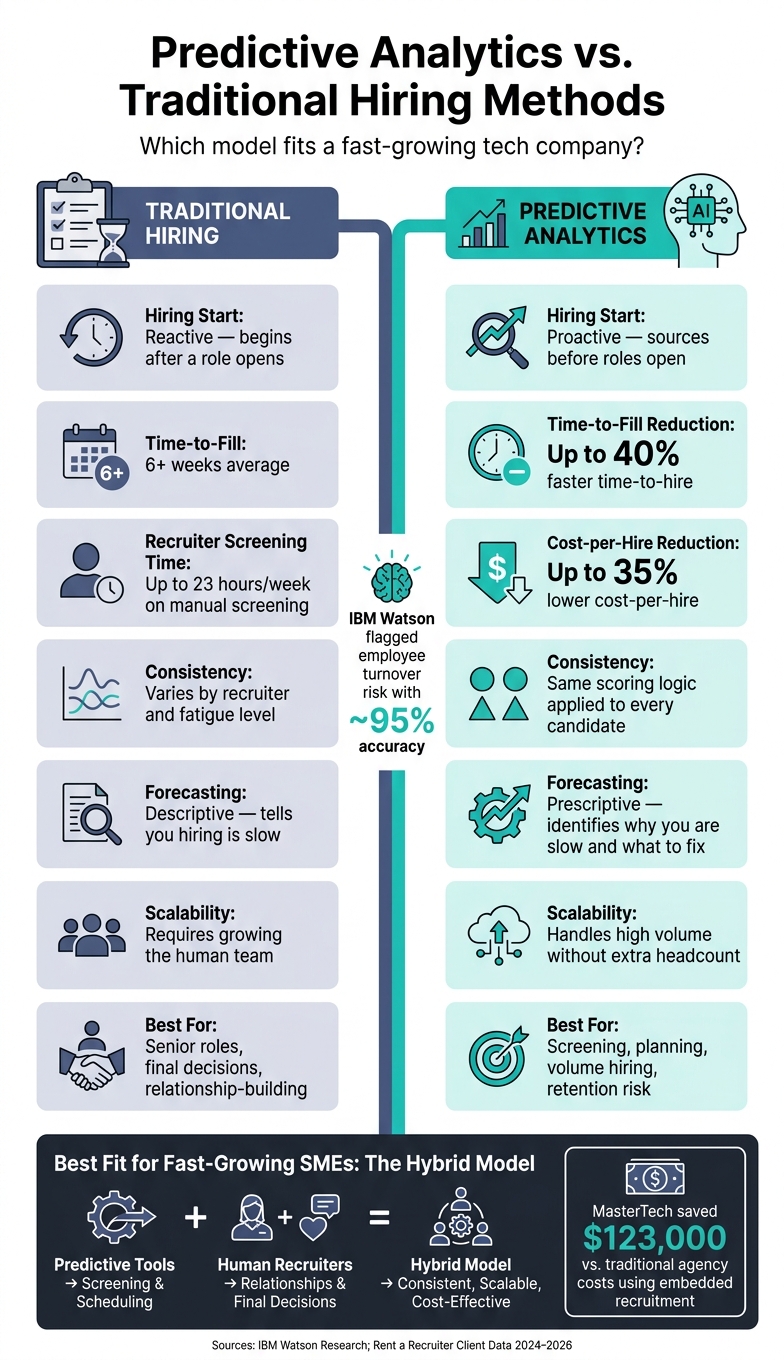
Predictive Analytics vs. Traditional Hiring: Key Metrics Compared
🎯 The Power of Predictive Analytics in Hiring! 🚀
Quick Comparison
| Area | Manual hiring methods | Predictive analytics |
|---|---|---|
| Hiring start point | After a role opens | Before demand peaks |
| Speed | Often slower under hiring pressure | Can cut time-to-hire by up to 40% |
| Cost | More recruiter admin and agency reliance | Can cut cost-per-hire by 35% |
| Consistency | Varies by recruiter and workload | Applies the same scoring logic each time |
| Forecasting | Limited | Can flag openings and turnover risk earlier |
| Best use | Senior judgement, final decision-making | Screening, planning, and volume hiring |
For most firms, the choice is not human versus data. It is how to use both without adding cost, delay, or process drift, which is where models like embedded recruitment often come in.
2. Conventional Hiring Methods: Strengths, Limits, and the Cost of Inconsistency
Where conventional methods still add value
Conventional hiring still has a place.
Human judgment matters when you’re hiring for team fit, especially in senior, niche, or hard-to-define roles. In those cases, the difference often shows up in time-to-fill, shortlist quality, and mis-hire risk.
Recruiters also help on the people side. They manage relationships, handle offer negotiation, and support the final hiring call in ways data on its own can’t fully match.
But here’s the trade-off: the same judgment that helps in complex hiring can become unreliable when the process has no structure behind it.
Where conventional methods slow down scaling teams
The issue isn’t only speed. It’s uneven decision quality as hiring volume climbs.
Different recruiters often judge the same resume in different ways. Add decision fatigue during long screening sessions, and shortlist quality starts to drift [2].
Reactive hiring makes this worse. Hiring begins only after a vacancy opens, so sourcing, screening, and scheduling start from scratch every time [1]. For scaling companies, that creates talent gaps during growth spurts or product launches, and it can lead to missed delivery targets [2]. Top candidates don’t wait around, and a six-week time-to-hire leaves little margin for delay [2].
Manual scheduling adds another drag. The back-and-forth of lining up interviews across calendars and time zones can eat up days in a process that’s already under pressure [2].
These breakdowns tend to show up in the same places, again and again.
Table: Common conventional hiring risks and their business impact
| Conventional Practice | Operational Bottleneck | Business Impact |
|---|---|---|
| Resume screening | Delays shortlisting and burns recruiter time [2] | Slower fills; recruiter burnout |
| Unstructured interviews | Inconsistent standards across interviewers [2] | Higher mis-hire risk; lower retention |
| Reactive hiring | Hiring starts only after a role opens [1] | Missed delivery targets; talent gaps during growth |
| Credential-first filtering | Focus on credentials over demonstrated capability [1] | Narrower talent pool; systemic bias at scale |
| Interview scheduling | Days of coordination across calendars and time zones [2] | Loss of top candidates to faster-moving competitors |
| Tracking the wrong metrics | Measures speed, not why hiring is slow [1] | Weak forecasting; inability to spot skill gaps early |
The core problem is structural. Processes built for low hiring volume tend to strain under growth.
That’s why more scaling teams are turning to data-supported hiring. Not to replace judgment, but to make it more consistent, more repeatable, and less costly as hiring demand grows.
sbb-itb-a23bd6a
3. Predictive Analytics: How Data Improves Hiring Efficiency and Accuracy
Conventional hiring tends to respond after a vacancy appears. Predictive analytics gets you ready before that happens.
In tech hiring, that means a process that is more consistent, faster, and less reliant on ad hoc judgement. Instead of waiting for pressure to build, you can spot patterns early and act before hiring turns into a scramble.
High-value use cases in tech recruitment
In tech recruitment, the biggest gains usually show up in four areas.
- Success modelling looks at the demonstrated technical performance of your top performers, then helps identify similar candidates in the market. That moves you beyond manual keyword searches.
- Vacancy forecasting uses project pipeline data to predict engineering hiring needs up to three quarters in advance, so you can hire ahead of demand.
- Retention risk flagging highlights employees who may leave within six months, with some models reaching roughly 95% accuracy [2].
- Source quality analysis tracks which channels, such as job boards, referrals, LinkedIn, and GitHub, keep producing high-converting candidates, so your sourcing spend works harder.
For technical roles, these tools can also lift shortlist quality by looking at demonstrated capability, such as GitHub commits, rather than leaning on proxy signals like degree titles or school pedigree.
IBM’s Watson AI has identified employees at risk of leaving within six months with 95% accuracy and helped cut turnover-related costs [2].
There is a catch, though. These gains rely on clean, consistent historical data.
What companies need before predictive hiring works
Predictive hiring only works when the data underneath it is solid: 12 to 24 months of scorecards, clear role success criteria, and joined-up ATS and HRIS inputs [1]. Companies can start building simple models with as few as 100 past hiring outcomes, although the model can do more as the dataset grows [1].
The main point of failure is usually not the model. It’s messy data.
If one team uses different stage labels from another, if candidate records are half-filled, or if recruiters enter ATS fields in different ways, the model has less to work with. At that point, you’re not getting a clean signal. You’re getting noise.
Fixing the data before rollout is not optional. It’s the starting point.
There’s also a practical limit worth keeping in view. Predictive tools should support decisions, not make them. Final hiring calls, culture conversations, and offer negotiations still need human judgement.
Once your data is in order, the efficiency gap becomes much easier to see.
Table: Predictive analytics vs. conventional methods on speed, accuracy, and scale
| Aspect | Conventional Methods | Predictive Analytics |
|---|---|---|
| Time-to-fill | Reactive; often takes 6+ weeks [2] | Proactive; can reduce time-to-fill by up to 40% and let teams source before roles open [2][1] |
| Recruiter workload | High; up to 23 hours per week on manual screening [2] | Lower; reduces manual screening and coordination [2] |
| Quality-of-hire | Based on gut instinct and manual vetting | Based on demonstrated technical performance and success modelling |
| First-year turnover | Measured after the fact | Forecasted via behavioural markers and churn modelling |
| Process consistency | Low; varies by recruiter and fatigue level | High; applies consistent logic across every application |
| Forecasting ability | Descriptive, tells you that hiring is slow | Prescriptive, identifies why you are slow and what to fix |
| Readiness for hiring spikes | Requires scaling the human team | Handles high volume without extra staff |
4. Choosing the Right Hiring Model for a Growing Company
For most fast-growing U.S. tech SMEs, the best option is usually a hybrid model. Predictive tools take care of repeatable work. Recruiters handle the calls that need judgment, context, and buy-in across the business.
That sounds simple. The hard part is making that mix work the same way every time.
Why a hybrid hiring model is usually the strongest option
Predictive analytics is best used for parts of hiring that do not need human judgment, such as screening and scheduling. Recruiters then spend their time on relationship building, stakeholder alignment, and final hiring decisions [1][3].
In day-to-day hiring, that means using predictive signals to spot candidates earlier and cut down manual screening time, while keeping the final call with recruiters and hiring managers. That split matters. It saves time without handing over high-stakes decisions to a system that lacks business context.
One practical rule is worth sticking to: recalibrate your success models at least every 12 months so they still match changes in your tech stack and business goals [1].
How embedded recruitment support helps put analytics into practice
Execution matters just as much as the model you choose.
Predictive tools only work well when your ATS and HRIS data is clean, consistent, and structured the same way across every hire [1]. If the data is messy, the output will be messy too. That is where embedded recruitment support helps.
Rent a Recruiter places experienced recruiters directly into your team, usually within five days, to standardise hiring workflows, improve data consistency, and build the repeatable process that analytics-led hiring depends on [3].
The business impact is clear in recent client results. Between 2024 and 2026, MasterTech worked with Rent a Recruiter for 27 months, with a dedicated Talent Partner embedded inside the business. That engagement led to 29 placements, reached more than 3,000 passive candidates at a 4:1 CV-to-interview ratio, and saved the equivalent of $123,000 compared with traditional recruitment agency costs [3].
Table: Implementation demands, governance, and fit for fast-growing U.S. SMEs
| Feature | Conventional Hiring | Predictive Analytics | Hybrid (Embedded) Model |
|---|---|---|---|
| Setup Effort | Low, manual | High, clean and structured data needed | Moderate |
| Data Requirements | Minimal, often subjective | High, clean unified schema [1] | Standardised workflows |
| Reporting Visibility | Reactive, descriptive | Proactive, prescriptive [1] | Real-time process visibility |
| Stakeholder Training | Low | High, data literacy needed [1] | Moderate, recruiter-led |
| Compliance | Manual checks | Documented decision rules and audit trails | Standardised and auditable |
| Best Fit | Hard to scale | Expensive for small datasets [1] | Best for fast-growing SMEs [3] |
5. Conclusion: What Predictive Analytics Changes and What Leaders Should Do Next
Predictive analytics helps teams plan earlier and hire with more consistency. For most growing tech SMEs, the bigger issue is not whether to use analytics. It is whether your hiring process is ready to support it.
Key takeaways for HR and business leaders
The gains are measurable. AI-powered recruitment can reduce time-to-hire by up to 40% and cut cost-per-hire by 35% [2].
It can also improve screening consistency. Manual screening often shifts during the day as attention drops and judgment varies. Predictive systems apply the same rules to every candidate, which gives leaders a clearer view of hiring outcomes [1][2].
That said, predictive analytics does not fix a weak process on its own. It works best inside a structured, recruiter-led model. For fast-growing SMEs, the strongest setup is predictive insight with human oversight.
Next step: assess your hiring model and process maturity
Before you add more hiring volume, pressure-test the process first.
Look at:
- ATS data quality
- Screening consistency
- Stage-level reporting
- Recruiter capacity
If any of these pieces are weak, more volume will just magnify the problem. Use analytics where they solve a clear hiring issue, not as a layer on top of an already messy process [1][2].
Get started: Book a Call or See Your Potential Savings
If your process is not yet structured enough for analytics, an embedded recruiter can help steady it fast.
Rent a Recruiter places experienced recruiters directly into your team within days. That gives you more structure, better visibility, and a steadier hiring process, so you can cut costs, reduce internal admin time, and keep more control.
Book a Call to talk through your current hiring setup and build a more predictable recruitment model.
FAQs
How much data do you need to use predictive hiring?
You can start simple. Even 100 hiring outcomes is enough to build early descriptive models that show what’s happening in your hiring process.
As your company grows, those models can do more. They move from basic reporting to stronger forecasting, which helps you plan headcount with less guesswork and spot hiring risks earlier.
For insights you can act on with confidence, use at least two years or 8 quarters of historical hiring and departure data. That gives you enough depth to see patterns over time, not just one-off spikes or dips.
Clean, consistent data matters. If your hiring and attrition data is patchy, duplicated, or logged in different ways across teams, your forecasts will be off. And when forecasts are off, planning slips, hiring costs climb, and teams lose time correcting avoidable mistakes.
Can predictive analytics reduce hiring bias?
Yes, predictive analytics can reduce hiring bias, but only if you use it with care. It does not remove bias on its own.
Done well, it can make hiring more consistent by steering decisions toward objective criteria and verified skills, instead of gut feel or subjective judgement. That gives you a cleaner process and can help cut risk across high-volume hiring.
The catch is simple: models learn from past data. If that data reflects biased hiring patterns, the model can repeat them at scale. In other words, software can standardise bias just as easily as it can reduce it.
That’s why regular audits, diverse training data, and human oversight matter. If you want better hiring outcomes, you need all three in place. Predictive analytics should support decision-making, not run it unchecked.
When should a growing company use a hybrid hiring model?
A growing company should use a hybrid hiring model when it needs to balance the speed and pattern-matching of hiring tech with the nuance of human judgement.
This works especially well during rapid scaling, such as after funding, a new product launch, or a hiring spike, when your internal team is stretched thin. An embedded recruiter can take care of day-to-day hiring operations and data hygiene, while your leaders stay focused on culture fit and final hiring decisions.