
Hiring bias isn’t just an ethical problem – it’s a business problem. For small and medium-sized enterprises (SMEs), biased practices can shrink your talent pool, drive up turnover costs, and expose your company to legal risks. Fixing this starts with structured, bias-free hiring processes that save money, improve hiring outcomes, and ensure compliance as your business grows.
Here’s what you need to know:
- Cost of bad hires: Replacing one employee can cost 30–50% of their first-year salary.
- Legal thresholds: U.S. anti-discrimination laws kick in at 15+ employees, with stricter state rules in places like California.
- Bias reduction tools: Blind resume reviews, structured interviews, and skills-based assessments ensure fair evaluations.
- Process standardization: Consistent hiring practices reduce subjectivity and improve decision-making.
Why it matters: For a 20-person SME, just two biased hiring mistakes annually can cost $30,000–$100,000. Adopting proven talent acquisition strategies not only reduces these costs but also positions your business for sustainable growth.
Looking for scalable hiring solutions? Rent a Recruiter offers embedded recruitment services that streamline hiring, reduce bias, and cut costs by up to 70% compared to traditional agencies.
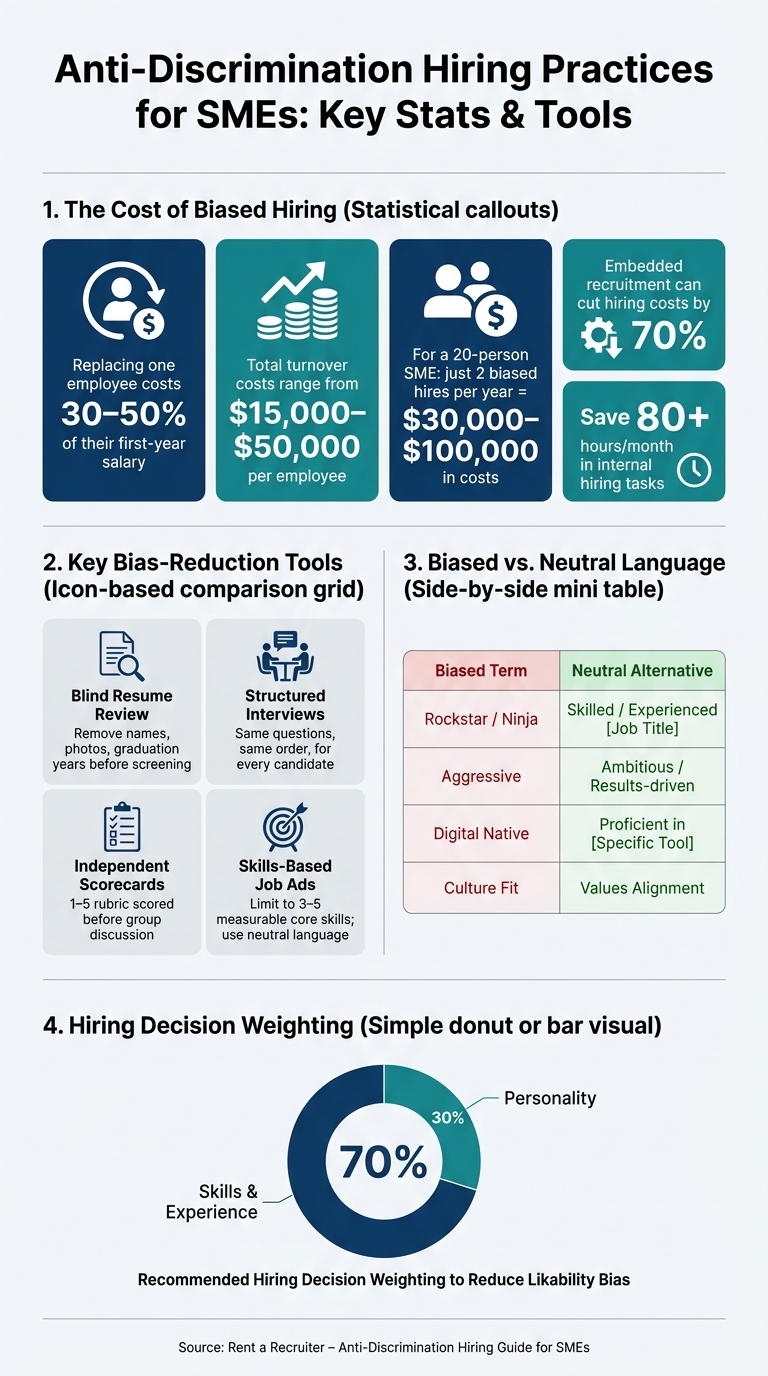
Anti-Discrimination Hiring Practices for SMEs: Key Stats & Tools
Breaking Down Barriers: Ethical and Inclusive Hiring Practices | All Things Work
sbb-itb-a23bd6a
Standardized Recruitment Practices to Reduce Bias
Once you’ve clarified your legal responsibilities, the next step is creating talent acquisition services that actively reduce bias. Standardization is your best tool here – it removes the guesswork and gut instincts that often lead to unintentional discrimination.
Structured Job Design and Role Requirements
Bias can creep in long before candidates even apply. Vague or overly demanding requirements can unintentionally exclude qualified individuals, particularly those from underrepresented groups.
Focus on specific, measurable skills rather than credentials or personality traits. Limit your must-have qualifications to 3–5 core skills that directly relate to the role’s responsibilities. Adding unnecessary requirements often acts as an invisible barrier; for instance, research shows that women are likely to apply only when they meet 100% of the listed qualifications, compared to 60% for men [7]. Only include degree requirements if they are absolutely essential to job success. Replace personality-driven criteria with measurable behaviors and define clear success metrics – what should this person achieve within their first 90 days? By prioritizing measurable skills, you’ll reduce bias and widen your talent pool.
Writing Bias-Free Job Ads
The language you use in job ads can subtly signal who belongs in your company. Phrases like "aggressive", "dominant", or "rockstar" often deter women, while terms like "digital native" can alienate experienced candidates from older age groups [7].
"Unconscious biases are so deep inside of us. Unless we identify them and talk about them, they are not going to change." – Dawn Smith, Chief Legal Officer, VMware [4]
To address this, run your job descriptions through tools like Gender Decoder or Textio, which identify biased language and suggest neutral alternatives. For example:
| Biased Term | Neutral Alternative |
|---|---|
| Rockstar / Ninja | Skilled / Experienced [Job Title] |
| Aggressive | Ambitious / Results-driven |
| Digital Native | Proficient in [Specific Tool] |
| Culture Fit | Values Alignment |
Beyond language, pay transparency is critical. Including a salary range in your job ad not only attracts more applicants but also signals fairness and openness. Pair this with a strong DEI statement – not a generic line, but a clear declaration of your commitment to welcoming candidates from diverse backgrounds.
Consistent Screening Processes
Even the most inclusive job ads won’t help if your screening process relies on subjective judgment. Standardizing your evaluation methods ensures fairness at every stage.
One effective approach is blind resume review. By removing names, photos, graduation years, and addresses from applications, you can focus entirely on qualifications and experience [6][7]. Additionally, use a consistent set of 5–7 screening questions for all candidates, scoring their responses independently to avoid early impressions influencing later decisions.
For scoring, apply a straightforward 1–5 rubric tied to specific competencies such as technical skills, communication, and problem-solving. This ensures candidates are assessed against objective benchmarks rather than being compared to one another. To prevent groupthink, interviewers should complete their scorecards individually before discussing candidates as a team [5][7]. A helpful rule of thumb: weigh 70% of the decision on skills and experience and 30% on personality – this prevents "likability" from overshadowing merit.
Fair Interview and Assessment Practices
To maintain fairness and reduce bias, the interview process needs to be as structured as the initial screening. Unstructured interviews can undo the benefits of standardized screening by introducing inconsistencies.
Structured, Panel-Based Interviews
The solution is simple: ask the same set of predefined, job-relevant questions in the same order for every candidate. This approach ensures fairness and eliminates the tendency to tailor questions based on a candidate’s background or personality. By maintaining consistency, you build on the standardization established during the screening phase.
"Structured interviews are one of the best tools we have to identify the strongest job candidates. Not only that, they avoid the pitfalls of some of the other common methods." – Dr. Melissa Harrell, Former Hiring Effectiveness Expert, Google [8]
Start by identifying 4–6 key competencies essential for the role, such as problem-solving, technical expertise, or communication skills. Every question should align with one of these areas. Combining behavioral prompts ("Tell me about a time you…") with hypothetical scenarios ("What would you do if…") provides insight into both past performance and future potential.
Diverse interview panels are another critical component. Including interviewers with varied roles and perspectives reduces the risk of individual biases influencing decisions. To avoid groupthink, each panel member should independently score candidates using a consistent rubric before discussing as a group. This keeps the focus on evidence rather than first impressions. On a practical level, structured interviews also save time – on average, 40 minutes per interview [8] – which is especially valuable for small and mid-sized businesses (SMEs) operating with limited resources, often benefiting from an embedded recruitment service to manage these processes.
In addition to interviews, assessments and background checks add another layer of unbiased, competency-based evaluation.
Fair Use of Tests and Background Checks
Skills assessments are most effective when they closely reflect the actual responsibilities of the role. For example, a coding challenge for a software engineer, a writing exercise for a content position, or a simulated customer interaction for a support role. These practical tests are far more predictive of job success than abstract puzzles or brain teasers.
To ensure fairness, keep work samples to 1–2 hours and provide all candidates with identical tasks, instructions, and time limits. Any variation can create an uneven playing field.
Background checks require careful handling. Federal law and many state regulations mandate that if a background check disproportionately excludes a protected group, it must be justified as a business necessity. Timing is equally important: best practice is to conduct background checks only after a conditional job offer is made, ensuring decisions are based primarily on merit. Additionally, several states have "ban the box" laws that limit when criminal history can be discussed – check your state’s regulations before including such questions in your process. SMEs must also accommodate candidates with specific needs, such as rescheduling assessments for religious observances or medical reasons. Adhering to these practices not only promotes fairness but also safeguards against compliance risks.
| Assessment Tool | Best Use Case | Key Compliance Note |
|---|---|---|
| Work Sample Test | Technical or task-oriented roles | Limit to 2 hours; ensure tasks reflect actual job duties |
| Structured Interview | All roles | Use consistent questions and a 1–5 scoring rubric |
| Background Check | Safety-sensitive or regulated roles | Conduct after a conditional offer; follow state "ban the box" laws |
| Blind Screening | Initial applicant review | Remove names, photos, and graduation dates before review |
Training and Policies That Support Anti-Discrimination
Even the most refined hiring processes can fall short without proper training and clear policies. Many small and medium-sized enterprises (SMEs) risk legal and reputational exposure if they don’t reinforce their hiring practices with consistent anti-discrimination training and well-defined policies.
Bias Awareness Training for Recruiters and Managers
Bias in hiring often operates below the surface, making unconscious bias training a critical step. Recruiters and managers need to understand common hiring biases, such as:
- Affinity Bias: Favoring candidates who share similarities with the interviewer.
- Halo/Horns Effect: Letting one positive or negative trait overshadow the overall evaluation.
- Confirmation Bias: Searching for evidence that validates initial impressions [1].
While awareness is a key first step, it’s not enough on its own. Training should be paired with practical tools like blind resume screening and standardized evaluation rubrics to ensure bias doesn’t creep into decision-making.
"Structure removes the opportunity for bias to influence decisions." – FirstHR [1]
Bias training shouldn’t stop at the hiring stage. Extend it into the onboarding process, especially during the first 90 days. Standardized onboarding practices, including regular check-ins, equal access to resources, and clear role expectations, help prevent biases like affinity bias from influencing mentorship. Without structure, managers might unconsciously invest more time and effort in employees they naturally relate to [1].
While training helps reduce bias, clear policies are equally important to anchor fair practices across the organization.
Written Policies and Grievance Channels
A strong Equal Employment Opportunity (EEO) policy is a cornerstone of anti-discrimination efforts. It should explicitly outline protected classes, which include race, color, religion, sex (including pregnancy, sexual orientation, and gender identity), national origin, disability, age (40+), and genetic information [2][3]. The policy must also define prohibited behaviors and actions.
Equally important is establishing a transparent, accessible complaint process. This should include multiple reporting channels, ensuring employees can report concerns even if their direct supervisor is involved [9]. The process should guarantee confidentiality wherever possible, promise impartial and timely investigations, and explicitly ban retaliation against those who raise concerns [9].
For SMEs, implementing an Alternative Dispute Resolution (ADR) program can be a practical way to address issues early and minimise workplace conflict [9]. Additionally, federal law mandates that employers retain employment records – such as applications and interview notes – for at least one year [2][3]. Finally, prominently display the EEO poster to ensure employees are informed of their rights [3].
Using Embedded Recruitment to Scale Anti-Discrimination Practices
Even with strong training programs and clear policies in place, maintaining fair hiring practices can become tricky as small and medium-sized enterprises (SMEs) scale. When hiring volumes increase and more managers get involved, inconsistency can creep into your processes. This is where embedded recruitment steps in.
An embedded recruiter works as part of your team, ensuring every hiring decision follows a structured and bias-free process. This includes writing inclusive job descriptions, conducting blind resume screenings, using standardized interview questions, and relying on independent scorecards for evaluations. By applying these methods consistently, embedded recruiters help eliminate bias at every stage. They also analyze hiring data to identify and address potential issues, such as disparities flagged by the adverse impact ratio – a measure used to detect discrimination if any group’s selection rate is less than 80% of the highest-performing group [1]. For SMEs hiring 20 or more people, this level of oversight is critical to achieving unbiased and compliant recruitment.
"Bias is not primarily a legal or ethical issue… It is a hiring quality problem. When bias influences decisions, you are more likely to hire someone who interviews well but cannot do the job." – FirstHR [1]
Cost and Time Savings with Embedded Recruitment
Fairness aside, the financial argument is compelling. Replacing a bad hire can cost an SME 30% to 50% of that employee’s first-year salary. Total turnover costs often range between $15,000 and $50,000 per employee [1]. Inconsistent or biased hiring processes only amplify these costs.
Partnering with Rent a Recruiter brings in experienced recruiters who simplify and standardize your hiring. SMEs working with Rent a Recruiter often cut hiring costs by up to 70% (calculate your potential savings with our ROI calculator) compared to traditional agency fees. On top of that, they save over 80 hours per month in internal hiring tasks and administrative work. For a growing SME, this means more time and resources to focus on scaling the business rather than managing recruitment headaches.
Conclusion: Key Takeaways and Next Steps
Summary of Best Practices
Creating a fair hiring process doesn’t mean overhauling everything at once. Many successful SMEs make small, focused improvements that lead to lasting change.
Here’s a quick breakdown of the practices discussed and the impact they deliver:
| Practice | What It Does |
|---|---|
| Skills-based job descriptions | Expands your talent pool and eliminates exclusionary or gendered language |
| Structured interview questions | Focuses on skills and competence rather than subjective “gut feel” |
| Independent scorecards | Reduces groupthink and ensures data-driven evaluations |
| Anonymized resume screening | Mitigates unconscious bias before the first review |
| Standardized onboarding | Boosts retention rates by up to 82% and safeguards your hiring investment [1] |
These strategies establish a strong foundation for inclusive hiring. As Adam Grant, an organizational psychologist, puts it:
"The starting point is to look at your culture and ask, ‘What’s missing?’ Then hire, promote, and reward people who can improve and evolve that culture." [10]
How to Get Started
With these practices in hand, you can start improving your hiring process today. Take one job description and, in just 30 minutes, rewrite it to focus on 5 to 7 clear, measurable skills, removing vague terms and unnecessary degree requirements. Then, create a structured interview script with standard questions and a simple 1–5 scoring system. These small but targeted changes can significantly reduce bias and align with the best practices discussed earlier.
If your business is scaling quickly and you need these practices implemented consistently across all hires, Rent a Recruiter can help. Their embedded recruiters integrate directly with your team, ensuring compliant, streamlined hiring processes for every role – without the high costs or delays of traditional agencies. You can even start with a free Recruitment Health Check to assess your current process and identify areas for improvement before making a commitment. Together, these steps create a scalable hiring framework that supports your SME’s long-term growth.
FAQs
What are the first 3 hiring changes I should make to reduce bias fast?
To reduce bias in hiring quickly, consider these three practical steps:
- Structured interviews: Use a consistent set of questions and scoring rubrics to evaluate candidates fairly and systematically.
- Blind resume screening: Remove personal details like names or demographics to focus purely on qualifications and skills.
- Revise job descriptions: Highlight required skills and avoid gendered language or irrelevant degree requirements that might discourage qualified applicants.
These adjustments are straightforward to implement and can make a big difference.
How can I tell if my hiring process is causing adverse impact?
To determine if your hiring process unfairly impacts certain demographic groups, consider using the adverse impact ratio (commonly known as the 80% rule). This method compares selection rates between groups. If a group’s selection rate is less than 80% of the highest rate, it may signal potential bias in the process.
Regularly review your hiring data to spot trends. Look at metrics like interview scores, offer rates, and retention statistics. You can also conduct anonymous employee surveys to uncover patterns that might not be obvious from the data alone.
To promote fairness, ensure your evaluation methods are structured and consistent. Focus strictly on job-relevant criteria, avoiding any subjective or irrelevant factors that could skew decisions. This approach helps create a more equitable hiring process for all candidates.
When should an SME use an embedded recruiter like Rent a Recruiter?
SMEs should consider working with an embedded recruiter like Rent a Recruiter during times of rapid growth, product launches, or when hiring needs surge unexpectedly. This approach is especially useful for businesses without dedicated HR teams, as it brings structure and consistency to the hiring process while cutting costs and saving valuable time.
Beyond efficiency, embedded recruiters ensure hiring practices align with anti-discrimination laws. They help design inclusive frameworks that support building diverse, equitable teams – essential for long-term success in today’s competitive market.