Slow hiring costs you. Nearly 41% of candidates ghost employers, and 58% abandon applications due to poor communication. For scaling companies, this means wasted time, higher costs, and missed opportunities to secure top talent.
The fix? Pre-offer candidate engagement. By mapping the candidate journey, communicating consistently, and leveraging tools to automate workflows, you can reduce drop-offs, cut hiring timelines, and improve offer acceptance rates by up to 84%.
Key Takeaways:
- Time-to-hire matters: Top candidates are off the market in 10 days, yet most companies take 24+ days to hire.
- Clear communication wins: Automated updates, transparent timelines, and prompt feedback reduce ghosting and boost engagement.
- Cost savings: Restarting a failed hire costs $4,700 on average. Structured engagement prevents these losses.
- Scalable processes: Tools like ATS and embedded recruitment streamline hiring while maintaining a personal touch.
Want to stay competitive? Start by fixing gaps in your pre-offer process. Whether it’s faster responses or embedding recruiters into your team, every improvement helps you secure the best talent before your competitors do.
How to boost candidate engagement pre-offer? Ft. PayPal | Instahyre Showrunners
sbb-itb-a23bd6a
Mapping the Pre-Offer Candidate Journey
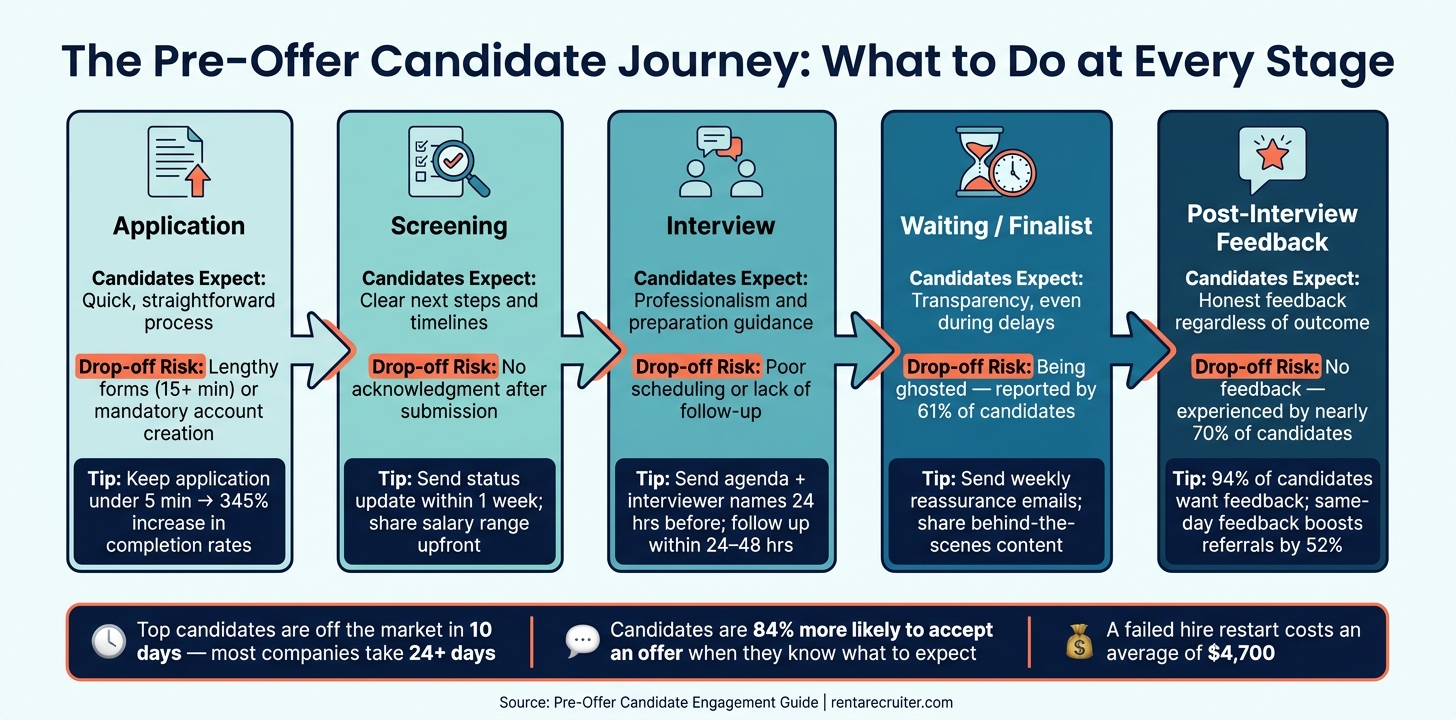
Pre-Offer Candidate Engagement: 5-Stage Journey & Communication Framework
Stages of the Candidate Journey
To boost candidate engagement, it’s crucial to understand each stage of their journey and what they expect along the way. The pre-offer journey typically includes five key stages: Application, Screening, Interview, Waiting/Finalist, and Post-Interview Feedback. Each stage comes with its own challenges and chances to enhance the experience.
| Stage | What Candidates Expect | Biggest Drop-off Risk |
|---|---|---|
| Application | A quick, straightforward process | Lengthy forms (over 15 minutes) or mandatory account creation |
| Screening | Clear next steps and timelines | Lack of acknowledgment or updates after submission |
| Interview | Professionalism and preparation guidance | Poor scheduling communication or lack of follow-up |
| Waiting/Finalist | Transparency, even during delays | Being ghosted – reported by 61% of candidates [9] |
| Post-Interview | Honest feedback, no matter the outcome | No feedback – experienced by nearly 70% of candidates [8] |
The application stage is where most candidates drop off, often before meaningful engagement even begins. As Yulia Bondar, Former Talent Acquisition Specialist at Tellent, notes:
"Complicated applications, excessive assessments, and redundant requirements frustrate candidates and lead to drop-offs." [5]
Streamlining the application process to take five minutes or less can result in a 345% increase in completion rates [9].
How Journey Mapping Improves Engagement
Journey mapping involves creating a detailed outline of every interaction a candidate has with your team, from their application to receiving an offer. This doesn’t require elaborate tools – even a simple spreadsheet or ATS pipeline can work.
The key benefit is identifying "black holes" – those silent periods where candidates hear nothing and start to assume the worst. These gaps often appear between submitting an application and receiving first contact, or after the final interview while waiting for updates. By mapping these moments, you can assign specific actions, such as automated updates or recruiter check-ins, to ensure consistent communication.
For instance, one software company cut its time-to-hire from 60 days to just 25 days – a 2.5× improvement – by adopting a structured, ATS-driven recruitment process. Sharing this mapped process with candidates, such as outlining "3 steps over 14 days", helps ease their anxiety during quiet periods. Candidates who know what to expect are 84% more likely to accept an offer [8].
Once the journey is mapped, assign clear responsibilities to avoid communication gaps.
Clarifying Roles and Responsibilities
Unclear ownership of candidate touchpoints can damage engagement. To avoid this, roles must be clearly defined:
- Recruiters: Manage communication timelines, establish service-level agreements (SLAs), and ensure transparency throughout the process.
- Hiring Managers: Provide clarity on the role, offer insights into the company culture, and build a personal connection during interviews.
- Employer Branding or Marketing Teams: Shape candidates’ first impressions through job postings and career site content [5].
Having clearly assigned roles ensures timely follow-ups and smooth communication. Embedded recruiters, in particular, excel at managing every interaction. They guarantee candidates receive updates within five business days and handle crucial pre-offer discussions to align expectations before formalizing details. For scaling companies without a dedicated recruitment team, this structured approach can make the difference between securing top talent or losing them to competitors.
Building a Structured Communication Framework
Key Components of a Good Communication Plan
With your candidate journey mapped out, the next step is ensuring no one feels forgotten. A structured communication plan is crucial—as seen in our embedded recruitment case studies—and it rests on three pillars: clear response times, the right communication channels, and reusable templates.
Quick responses are non-negotiable. 52% of candidates wait three months or longer for a response – or never hear back at all [10]. To avoid this, aim to provide a status update within five business days for all candidates, with same-day or next-day replies for time-sensitive steps.
Choosing the right channel is just as important. Text messages boast an open rate of 90%+, compared to only 20–30% for email [3]. Use SMS for quick updates like scheduling confirmations, while emails are better suited for detailed materials such as interview prep or formal documents. The table below offers a practical timing guide:
| Hiring Stage | Communication Type | Target Timing |
|---|---|---|
| Application Received | Automated Acknowledgment | Immediate [10] |
| Application Review | Status Update or Screening Invite | Within 1 week [10] |
| Phone Screen | Confirmation + Prep Info | 24 hours before [10] |
| Post-Phone Screen | Next Steps or Rejection | Within 48 hours [10] |
| Interview | Thank You + Timeline | Within 24 hours [10] |
| Decision Delay | Transparency Update | As soon as delay is known [4] |
| Verbal Offer | Follow-up Email + Formal Letter | Same day as call [10] |
By sticking to this framework, you eliminate "black holes" in communication, ensuring a smoother process for candidates. Once the structure is in place, the next focus is on personalizing these interactions to keep candidates engaged.
Personalizing Communication at Scale
Automation can help you scale personalization without losing the human touch. Save manual effort for critical moments – scheduling interviews, post-interview updates, and offers – while relying on automated templates for routine tasks like application acknowledgments [3].
Most applicant tracking systems (ATS) allow you to use merge fields to insert personal details like the candidate’s name, role title, or interviewer’s name into templates. This keeps messages personal without adding extra work [10]. For example, referencing a specific detail from a candidate’s resume in a screening invite shows that their application was genuinely reviewed.
"Candidate engagement is not about fancy tools… It is about making every candidate feel like a priority at every step." – Zakir Hossen, Founder, JuggleHire [3]
Segmenting candidates by role type or hiring stage also ensures the right tone and content. A senior engineering candidate in the final round needs a different level of detail than someone just starting the process for an entry-level role. Use your ATS to keep these groups separate and tailor communication accordingly [2].
From there, adapt your communication cadence to suit the specific needs of different roles.
Communication Cadences for Different Role Types
The frequency and method of communication should vary depending on the role you’re hiring for. High-volume roles (e.g., hourly or customer-facing positions) demand speed. Top candidates in these categories are often hired within 10 days [1], so automated, real-time updates via SMS or chatbot are essential. Aim to move candidates from application to offer within 10–14 days [3].
For specialized roles – such as senior tech, management, or fintech positions – the process is more involved, requiring longer evaluation periods and input from multiple stakeholders. Weekly updates are more appropriate here than daily touchpoints. While these candidates understand the process takes time, they still need regular reassurance. A short Friday email confirming their status can prevent drop-offs [4].
| Feature | High-Volume Roles | Specialized Roles |
|---|---|---|
| Initial Response | Immediate (Automated/Chatbot) [1] | Within 24–48 hours [8] |
| Update Frequency | Real-time via SMS or Chatbot [1] | Weekly status updates [4] |
| Interview Feedback | Same-day to prevent ghosting [1] | Within 2 business days [3] |
| Total Timeline | 10–14 days from application to offer [3] | 24+ days depending on complexity [1] |
Silence is the quickest way to lose candidate interest. Even a brief, honest update is better than a delayed, overly polished message.
Making Candidate Interactions Timely and Meaningful
When it comes to keeping candidates engaged, timing and meaningful communication are everything. A structured communication plan is only as effective as the effort you put into making each interaction feel personal and genuine.
Engagement During Application and Screening
The clock starts ticking the moment someone applies. If your response is slow or impersonal, you risk losing them. Recent data shows that 58% of job seekers have walked away from an application due to poor communication, and nearly 70% report a negative experience when they receive no feedback at all [8].
Start with a personalized auto-reply that acknowledges their application and sets clear expectations: "Hi [Name], thanks for applying for [Role]. We’ll update you within one week." This small touch requires no manual effort but shows respect for their time.
Next, move quickly to the screening phase. Use 8–12 standard questions to keep the process consistent and fair, and aim to deliver a decision within 24 hours [3]. Sharing the salary range upfront can also help avoid mismatched expectations down the line. To keep candidates informed, provide a simple hiring timeline that outlines the steps, what’s involved, and when they can expect updates. This transparency encourages trust and prevents unnecessary follow-ups.
Once you’ve captured their interest, it’s time to focus on perfecting the interview process to reinforce your commitment to a great candidate experience.
Improving the Interview Experience
The interview is where your employer brand is truly tested. Candidates will judge your company based on how prepared and organized you appear, so even minor details can leave a big impression.
Before the interview, send candidates an agenda that includes the names of interviewers and any preparation materials they might need. During the interview, use a structured scoring rubric (such as a 1–5 scale) to evaluate responses consistently and fairly. This approach not only improves decision-making but also demonstrates professionalism. Encourage candidates to ask their own questions to foster a two-way conversation.
After the interview, follow up within 24 to 48 hours. A personalized message referencing something specific from the discussion – like a project they’re passionate about or a challenge they mentioned – shows you were actively listening. For candidates who don’t make it to the next stage, a short explanation grounded in job-related criteria (e.g., "We moved forward with someone who had more direct experience in B2B SaaS") is respectful, clear, and legally safe [3][4]. This matters because 94% of candidates want feedback after interviews, but most never get it [8].
"Communication is your employer brand." – TalentAlly [8]
With a strong interview process in place, your next challenge is keeping finalists engaged and excited about the opportunity.
Keeping Finalists Engaged
At the finalist stage, the stakes are high. These candidates are likely exploring other opportunities, and any silence from your side can be interpreted as a lack of interest. In fact, 47% of candidates say poor communication would make them withdraw from the process [7].
To avoid this, stay proactive. If your decision-making process takes longer than a week, send a quick email to reassure them that they’re still under consideration and update them on the timeline. A personal touch, like referencing a specific detail from their final interview, can make all the difference in showing they’re valued rather than just another name in the pipeline.
You can also keep their interest alive by sharing engaging content about your company. This could be a behind-the-scenes team video, a product update, or even a glimpse of the team they’d be working with.
"Transparency about delays prevents frustration and keeps candidates engaged, even when the timeline shifts." – Byron Van Gisborne, The Recruitment Org [4]
The ultimate goal at this stage isn’t just to inform. It’s to make the candidate eager to say yes before the offer even lands on their desk.
Using Tools and Workflows to Scale Engagement
Scaling candidate engagement before an offer is made can be a real challenge, especially when you’re hiring at scale. Doing it manually? Nearly impossible. That’s where automation and clear workflows come in. With the right tools, you can keep candidates engaged at every stage without overloading your team. Here’s how to make it happen.
Tools to Automate and Simplify Engagement
Some of the most time-consuming tasks in pre-offer engagement include scheduling, follow-ups, and sharing post-interview feedback. Luckily, these are also the easiest to automate.
AI-powered scheduling tools cut out the endless back-and-forth emails. Instead of exchanging 15–30 messages just to lock in an interview time, candidates can use a self-booking link that syncs with your team’s calendars, adjusts for time zones, and sends automatic reminders. This reduces coordination to just a couple of messages, saving hours of admin time [11].
For interviews, tools like Metaview automatically transcribe and summarise conversations. This means recruiters can deliver accurate feedback to candidates faster, without spending hours on manual note-taking.
"Automation handles these repetitive tasks while maintaining a professional, timely experience for candidates." – Metaview [6]
On the communication side, recruitment CRMs like Augtal let you create automated nurture sequences. For example, you could set up a Day 1 follow-up email and a Day 21 check-in for candidates who aren’t ready to move forward yet. This keeps your pipeline warm without requiring constant manual effort. And here’s a tip: SMS outreach has a 98% open rate, making it ideal for urgent messages like interview reminders or deadline alerts [8].
Once automation takes care of the repetitive tasks, the focus shifts to standardising workflows to ensure every candidate has a consistent experience.
Standardising Workflows for Consistency
Automation only works well when backed by clear processes. Without defined roles and timelines, even the best tools can fall short.
Start by optimising your talent strategy and creating role-specific pipelines with clear service-level agreements (SLAs). For instance, you could set a rule that hiring managers must review candidate summaries within 48 hours, with automated alerts if they don’t [12].
Next, organise your pipeline into tiers based on candidate status – active, qualified but not currently fitting, and passive. Each tier should have its own communication cadence. For example:
| Engagement Tier | Candidate Type | Recommended Cadence |
|---|---|---|
| Tier 1: Hot | Actively interviewing | 1–2× per week during active stages |
| Tier 2: Warm | Qualified, no current fit | Every 2–3 weeks for 60 days, then monthly |
| Tier 3: Passive | High-quality, not actively looking | Quarterly (every 90 days) |
This structure ensures you’re not overwhelming some candidates while neglecting others.
How Embedded Recruitment Services Support Engagement
Keeping candidates engaged requires constant monitoring and quick action. That’s where embedded recruitment services come in.
Through Rent a Recruiter, you can embed experienced recruiters directly into your team. These recruiters take full ownership of candidate communication, workflow management, and reporting. Unlike overstretched HR teams or disconnected external agencies, embedded recruiters fully understand your roles, culture, and timelines. They can act in real time to keep candidates engaged and the hiring process moving. On average, clients save over 80 hours a month on internal hiring tasks, freeing up time to build relationships with top candidates instead of chasing admin.
"AI handles candidate communications at scale by orchestrating personalized, multi-channel outreach… so your team can focus on high-value conversations." – Austin Braham, Everworker [11]
The aim isn’t to cut humans out of hiring. It’s to let automation handle repetitive tasks so your team can focus on what really matters: meaningful conversations that win candidates over. By embedding recruitment services, you ensure your engagement strategy scales effectively while keeping the human touch intact.
Measuring and Improving Pre-Offer Engagement
Once your tools and workflows are set up, the next step is ensuring they deliver results. Tracking the right metrics helps you spot where candidates drop off and fine-tune your process.
Key Metrics to Track
Three metrics provide a solid view of pre-offer engagement: time-to-first-contact, interview feedback turnaround time, and offer acceptance rate. If your time-to-first-contact stretches beyond 48 hours, candidates may lose interest. Timely communication significantly boosts offer acceptance rates [8]. A low acceptance rate often points to issues in the candidate experience before the offer stage. These metrics also highlight areas where direct candidate feedback can make a difference.
Collecting and Acting on Candidate Feedback
Surprisingly, over 70% of companies don’t have a formal system for gathering candidate feedback [13]. That’s a missed opportunity. Short post-interview surveys, with three to five targeted questions, sent immediately after key milestones, can uncover valuable insights. Keep the tone friendly and the survey brief to encourage responses.
Don’t overlook feedback from candidates you didn’t select. They often provide the most honest critiques. For example, candidates are 52% more likely to refer others or reapply when they receive same-day feedback after an interview [1].
"By listening to and acting on candidate feedback, companies can establish themselves as an attractive employer and attract top talent." – Gautier Garin, Starred [13]
Once you gather feedback, act on it quickly. If candidates frequently mention unclear next steps, revise your follow-up email templates. If scheduling interviews is flagged as slow, it’s a workflow issue that needs immediate attention. This feedback loop allows for consistent, meaningful improvements.
Using Embedded Recruiters to Drive Continuous Improvement
Tracking metrics and acting on feedback requires ongoing effort and expertise. That’s where embedded recruiters come in. Through Rent a Recruiter, embedded recruiters can perform recruitment health checks, benchmark engagement against industry standards, and quickly identify problem areas. They experiment with changes – like adjusting communication timing or templates – and measure the results, all without burdening your internal team.
This approach keeps your hiring process evolving. Instead of reviewing engagement data quarterly, embedded recruiters maintain a continuous improvement cycle, ensuring your recruitment stays agile and effective. That’s the difference between a company that refines its hiring strategy and one that repeats the same mistakes.
Conclusion: Building a Pre-Offer Engagement Strategy That Scales
Key Takeaways
Strong pre-offer engagement can give scaling companies a real edge. It’s all about speed, transparency, and consistency. These are the factors that separate companies landing top talent from those losing out to faster competitors.
This guide broke down the essentials: mapping the candidate journey to spot where drop-offs happen, creating a structured communication plan that keeps candidates in the loop, personalizing key moments like post-interview updates and offer discussions, and leveraging tools and embedded recruitment support to ensure consistency as you grow. Here’s a compelling stat: clear salary and timeline transparency can increase offer acceptance rates from 65% to 90% [3]. That’s huge, especially when 10–15% of accepted offers fall through before Day 1 due to poor pre-boarding [3].
"Candidate engagement is not about fancy tools, employer branding campaigns, or AI-powered chatbots. It is about making every candidate feel like a priority at every step." – FirstHR [3]
Next Steps
Turn these insights into action. Start small – if response times or follow-ups are an issue, tackle one area today. For example, responding to every application within 24 hours can significantly improve how candidates view your company.
If you’re scaling fast and need structured hiring support, Rent a Recruiter can embed experienced recruiters directly into your team. They handle everything end-to-end, ensuring your hiring stays efficient and consistent. On average, clients cut hiring costs by up to 70% compared to traditional agency fees and save over 80 hours per month on admin. Want to see how our recruitment model stacks up? Try the free Recruitment Health Check or book a call to explore how we can help you hit your hiring goals.
FAQs
What should I automate vs. keep human in pre-offer communication?
Automate time-consuming tasks like scheduling interviews, sending reminders, and updating candidates on their status. This ensures communication stays consistent and on time without adding extra workload to your team.
When it comes to personal touches – like follow-ups, answering candidate questions, and building relationships – keep these human. These interactions are what make candidates feel appreciated and connected, which is crucial when competing for top talent in a crowded market.
How do I set realistic response-time SLAs with hiring managers?
To create realistic response-time SLAs, it’s crucial to set clear expectations from the start about recruitment timelines and decision-making processes. Outline the duration of each hiring stage and let candidates know when they can expect updates. This approach helps manage expectations and minimizes any uncertainty.
Keeping hiring managers in the loop with regular communication is equally important. Transparent updates ensure everyone stays aligned with the agreed timelines. This shared understanding not only makes SLAs more attainable but also helps smooth out the hiring process overall.
Which metrics best predict pre-offer drop-offs?
Metrics such as candidate drop-off rate and offer acceptance rate provide valuable insights into pre-offer disengagement. By tracking drop-off rates at each stage of the hiring process, you can pinpoint where candidates lose interest. Similarly, offer acceptance rates highlight how many candidates are willing to join your company once an offer is extended. Together, these metrics shed light on candidate perceptions and engagement, helping you tackle pre-offer attrition effectively.