
Hiring compliance isn’t just about avoiding lawsuits – it’s about building a hiring process that protects your business while driving results. In 2026, employment laws are evolving faster than ever, with AI hiring regulations, algorithmic bias, and retaliation claims adding complexity. Certifications equip your team with the tools to manage these risks effectively. However, even with certified staff, maintaining human judgement in AI hiring remains critical for nuanced decision-making.
Here’s what you need to know:
- Top certifications like SHRM-CP and SHRM-SCP are widely recognized and help HR teams align hiring practices with legal standards.
- Practical benefits include higher salaries (14–15% more for SHRM-certified professionals) and access to tools like checklists and sample scripts.
- Specialized options like CCEP (Compliance Certification Board) focus on ethical recruitment frameworks, while global programs address data privacy and international hiring challenges.
- Costs and renewal vary, with prices ranging from $199 to over $1,900 and most certifications requiring ongoing education every 3 years.
If your business is scaling fast, certifications like SHRM or HCI’s Employment Law & Compliance (ELC) can help embed compliance into your hiring strategy. But certifications alone may not be enough. For companies managing high hiring volumes or global expansions, embedded recruitment offers a scalable solution. Learn how embedded recruitment can save you time and reduce costs.
Interviewing & Hiring Lawfully (HR Compliance Training in 40 Minutes)
sbb-itb-a23bd6a
Best Certification Programs for Hiring Compliance in 2026
The SHRM-CP (Certified Professional) continues to be a top choice for recruitment compliance certification, with about 77% of applicants selecting it as their starting point [2]. This certification is tailored for early- to mid-career HR professionals who handle daily hiring activities. It draws on SHRM’s extensive knowledge of U.S. employment law, labor relations, and risk management [4][5]. Notably, SHRM-certified professionals earn 14–15% more than their non-certified counterparts [2]. The preparation course costs $1,615 for SHRM members and $1,940 for non-members, with recertification required every three years through 36 Professional Development Credits [4]. As one SHRM-CP holder shared:
"Earning my SHRM-CP landed me a job with a Fortune 500 company less than a month after earning my certification" [2].
For HR professionals aiming for strategic roles, the SHRM-SCP (Senior Certified Professional) shifts the focus to higher-level responsibilities, such as creating HR policies and aligning talent acquisition strategies with broader organizational objectives [5]. To qualify, candidates need three years of strategic HR experience or three years as a SHRM-CP holder, alongside 1,000 hours of strategic-level work annually [5].
In the realm of ethical hiring compliance, the Certified Compliance & Ethics Professional (CCEP) and Leadership Professional in Ethics and Compliance (LPEC) certifications are key options. The CCEP is designed for mid-level HR professionals working on ethical recruitment frameworks, while the LPEC is aimed at senior leaders managing organization-wide compliance efforts. Both certifications require documented professional experience and structured preparation, covering competencies like "Ethical Practice" and "Global Inclusive Mindset" [4][3].
Certification Program Comparison
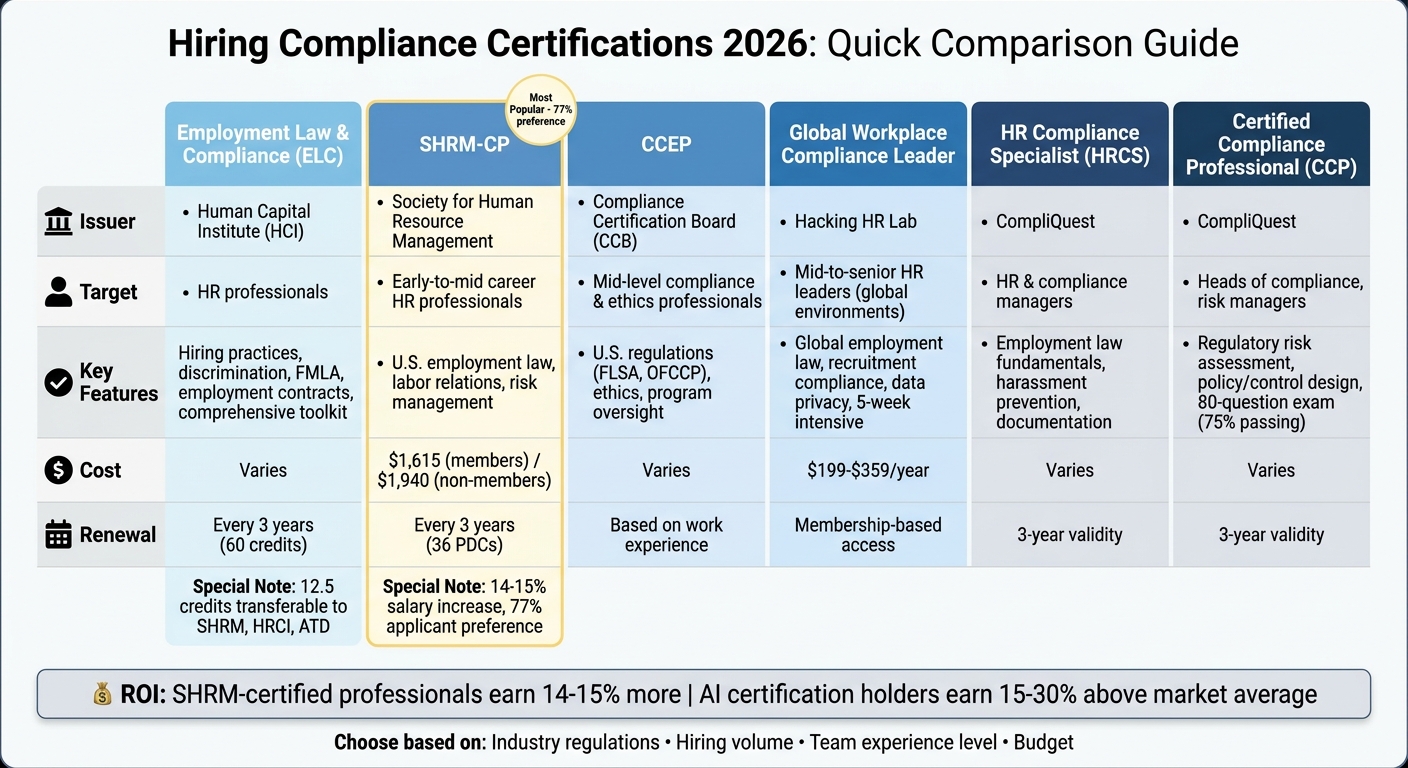
2026 Hiring Compliance Certification Programs Comparison Guide
Certification Comparison Table
Finding the right certification for your team hinges on your compliance priorities, budget, and capacity for renewal requirements, especially when hiring as you scale. The table below outlines key details for each program, including issuing bodies, features, target audiences, costs, and renewal terms, giving you a clear view of your options.
| Certification Program | Issuing Body | Key Features | Target Audience | Cost Range (USD) | Renewal Requirements |
|---|---|---|---|---|---|
| Employment Law & Compliance (ELC) | Human Capital Institute (HCI) | Covers hiring practices, discrimination, FMLA, and employment contracts; includes a comprehensive toolkit | HR professionals | Varies | Every 3 years (60 credits) |
| Certified Compliance & Ethics Professional (CCEP) | Compliance Certification Board (CCB) | Focuses on U.S. regulations (FLSA, OFCCP), ethics, and program oversight | Mid-level compliance & ethics professionals | Varies | Based on work experience |
| Global Workplace Compliance Leader | Hacking HR Lab | Addresses global employment law, recruitment compliance, and data privacy through a 5‑week intensive program | Mid-to-senior HR leaders in global environments | $199–$359/year | Membership-based access |
| HR Compliance Specialist (HRCS) | CompliQuest | Emphasizes employment law fundamentals, harassment prevention, and proper documentation | HR & compliance managers | Varies | 3‑year validity |
| Certified Compliance Professional (CCP) | CompliQuest | Involves regulatory risk assessment, policy/control design with an 80‑question exam (75% passing score required) | Heads of compliance and risk managers | Varies | 3‑year validity |
| Certified Regulatory Compliance Manager (CRCM) | American Bankers Association (ABA) | Specializes in banking regulatory compliance and related risk management | Banking compliance professionals | Varies | Maintenance through Continuing Education credits |
Some standout features include HCI’s transferable credit system, allowing 12.5 recertification credits to be applied across SHRM, HRCI, and ATD certifications [1]. Additionally, the Global Workplace Compliance Leader program offers a targeted approach to global compliance challenges [7]. As SCCE highlights, "Compliance professionals are on the front lines of protecting organizations from risk, supporting ethical culture, and building trust" [6].
How to Choose the Right Certification for Your Team
Align certifications with what your team actually needs. For corporate recruitment teams, options like SHRM or HCI’s ELC focus on HR leadership and legal compliance. On the other hand, agency recruiters might look at certifications such as AIRS PRC or NAPS CPC, which emphasize professional standards. Use the certification comparison table mentioned earlier to help you evaluate these options. Next, think about how industry regulations might shape your decision.
Industry-specific rules should guide your choice. For example, healthcare hiring demands knowledge of HIPAA and FDA regulations. Remember, penalties for HIPAA violations in 2026 can range from $100 to over $2 million annually per violation category, depending on negligence levels [10]. In financial services, expertise in SOX and AML regulations is critical. Meanwhile, tech and data-driven companies should focus on certifications that cover GDPR and CCPA compliance, especially since 87% of businesses now use AI in recruitment processes [8].
Your hiring volume also plays a role. Companies with large-scale recruitment efforts benefit from certifications that cover employment law essentials, like discrimination prevention, fair pay, and reasonable accommodations. These certifications help reduce risks of legal issues. For fast-growing SMEs, programs like HCI’s Employment Law & Compliance (ELC) offer practical tools and a framework to quickly integrate compliance into their processes [1].
Finally, weigh the long-term commitment and potential returns. Most certifications require ongoing renewal through continuing education. But this effort pays off: SHRM-certified professionals earn 14% to 15% more than their non-certified counterparts, and recruiters with AI-related certifications can see salary boosts of 15% to 30% above the market average [9]. Before you invest, conduct a compliance gap analysis to identify your organization’s vulnerabilities. This ensures your budget is spent on certifications that address actual risks [10]. The right certification can embed compliance into your hiring strategy and deliver real value.
Conclusion and Next Steps
Hiring compliance certifications lay the groundwork for building a recruitment function that is both scalable and mindful of risk. The programs highlighted in this guide provide your team with shared knowledge and frameworks, transforming compliance from a simple requirement into a business advantage [1]. Whether it’s managing GDPR data protocols, ensuring I-9 verification for global hires, or weaving anti-discrimination practices into your interview process, these certifications ensure your team operates with consistency and precision.
As the Human Capital Institute puts it:
"Equip your team with industry-recognized credentials that build strategic capability and strengthen organizational impact" [1].
The outcomes? Lower legal risk, faster hiring processes, and a culture where compliance becomes second nature. For fast-growing SMEs navigating post-funding expansions or hiring surges, certifications like HCI’s Employment Law & Compliance (ELC) or SHRM-CP by the Society for Human Resource Management offer practical tools and case studies that can be applied immediately [1].
However, certifications are only part of the equation. Scaling efficiently often requires external expertise. If you’re growing quickly and need recruitment support that prioritizes compliance, Rent a Recruiter can embed seasoned recruiters into your team within days. They bring structure, clarity, and compliance-focused processes to your hiring efforts. Businesses typically save over 80 hours of admin time each month and reduce hiring costs by up to 70% compared to commission-based recruitment models.
Take Action
Start by identifying your compliance vulnerabilities and selecting certifications that address your most pressing challenges, such as employment law, data handling, or international hiring. For companies experiencing high hiring volumes or expanding globally, embedded recruitment services can complement your certified team, ensuring seamless operations without delays. Ready to make your hiring process both compliant and efficient? Calculate your potential savings or book a call to see how Rent a Recruiter can help you build a compliant, scalable hiring function tailored to your growth.
FAQs
Which hiring compliance certification is best for my role?
The right certification depends on your specific role and priorities. For HR leaders or recruitment managers aiming to refine advanced hiring strategies, the Certified Talent Acquisition & Recruitment Manager (CTARM)® is an excellent choice. If ensuring legal compliance is at the top of your list, the Employment Law & Compliance (ELC) Certification is worth exploring. For those focused on navigating international regulations, the Global Workplace Compliance, Risk & Governance Leader program provides hands-on insights into global compliance challenges.
How do I choose a certification for my industry’s rules?
When choosing a certification, prioritize those that are widely recognized and directly applicable to your industry. Opt for programs that address essential regulations such as GDPR, AML, or ESG standards, depending on your area of focus. Think about whether you need a broad compliance certification, one targeting a specialized niche, or something tailored to specific industry rules. Certifications with exam requirements often demonstrate a higher level of expertise and credibility. Be sure to assess factors like how the certification is delivered, the time investment required, and how well it fits with your current role or long-term career objectives.
Do certifications cover AI hiring and data privacy risks?
Certifications such as the FairHire Academy and the AI Ethics & Compliance Certification tackle the challenges of AI hiring and data privacy risks. These programs emphasize ethical and responsible practices, helping organizations maintain compliance with recruitment regulations while adopting AI-driven hiring solutions.