
If your tech hiring takes 44 days, your process is costing you output, revenue, and headcount plans.
I see collaborative hiring as a simple fix for that problem. It gives you clear ownership, faster feedback, and better hiring decisions without turning recruitment into a slow group exercise. Done well, it can help teams hire 30% faster, cut turnover by 25%, and reduce wasted time spent chasing feedback and restarting searches.
Here’s the short version:
- One person should not carry tech hiring alone
- Shared scorecards improve decision quality
- 3 to 5 interviewers is usually enough
- 48-hour feedback SLAs keep roles moving
- AI can cut admin, but people should still make the final call
- Embedded recruitment can add structure fast if your team is stretched
For CEOs, CFOs, HR leaders, and Talent Leaders, the business case is simple: better hiring systems save time, lower cost-per-hire, and reduce mis-hires. You can audit your current strategy to find specific bottlenecks. That is the point of collaborative hiring, and that is what this article covers.
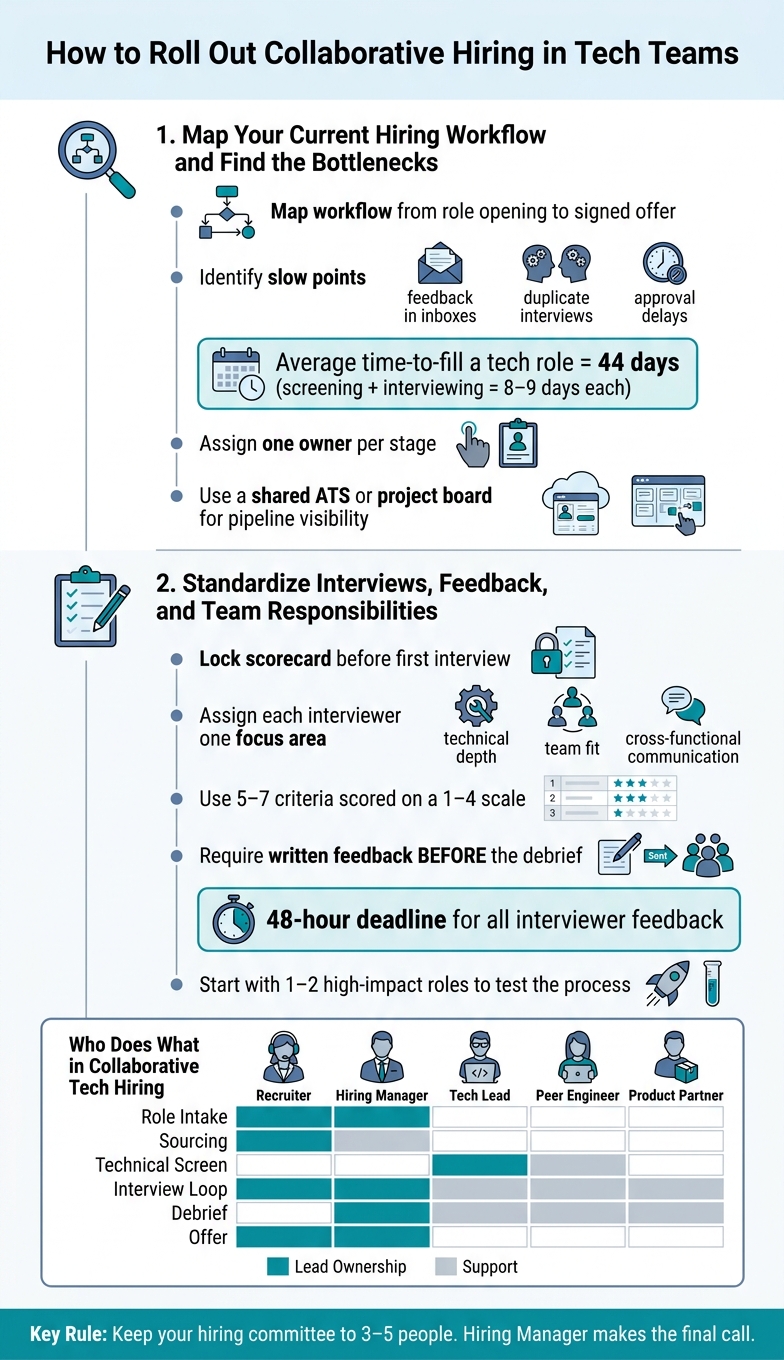
How to Roll Out Collaborative Hiring in Tech Teams: Step-by-Step
1. How Collaborative Hiring Improves Tech Recruitment Outcomes
Better Quality of Hire and Stronger Team Fit
Once roles and scorecards are clear, collaborative hiring starts to improve results in ways you can track.
When one person assesses a candidate, you get one point of view. In tech hiring, that’s a risk. A poor read on technical ability or team fit can turn into an expensive mis-hire.
Collaborative hiring solves that by giving each stakeholder a clear job in the assessment. Engineers test technical depth. Hiring managers look at business and role fit. Cross-functional partners add input on communication and how the person is likely to work with others.
Put together, that gives you a full-team view that one interviewer simply can’t build alone. One interview rarely tells you whether a technical candidate can perform across the whole team.
That broader view helps cut hiring mistakes. 90% of companies report fewer hiring mistakes when multiple stakeholders are involved in the process [4].
Faster Decisions, Less Bias, and a Better Candidate Experience
More stakeholders don’t have to slow hiring down. In a well-run process, they often do the opposite.
When recruiters, hiring managers, and technical interviewers split the work, candidates can be reviewed in parallel instead of one stage at a time. That saves time where it matters most. Teams using structured collaboration hire 30% faster and make 20% more accurate decisions [5].
Bias drops as well. Diverse interview panels and standardised rubrics help reduce unconscious bias. For engineering and product teams, that matters. You want hiring decisions based on evidence, not gut feel.
Candidates notice the difference too. When they meet future teammates and get clear, steady communication, they move through the process with more confidence. That often leads to stronger trust and better offer acceptance rates.
Comparison Table: How Collaborative Hiring Improves Tech Recruitment Metrics
These gains show up most clearly in four hiring metrics.
| Metric | Traditional Hiring | Collaborative Hiring | Impact for Tech Teams |
|---|---|---|---|
| Quality of Hire | Based on one or two opinions | Full-team view; 20% more accurate decisions [5] | Reduces costly mis-hires |
| Time to Hire | Slow due to siloed feedback and manual coordination | 30% faster [5] | Secures top talent before they accept competing offers |
| Candidate Experience | Impersonal; limited view of the actual team | Candidates meet future peers and leaders [2] | Higher candidate trust and stronger offer conversion |
| Team Alignment | New hire is handed to a team that had no input | Team has ownership and buy-in [2] | Smoother onboarding and faster ramp-up time |
| Retention | Higher risk of mis-hire and turnover | 25% lower turnover [5] | Lower turnover from stronger early-fit decisions |
These gains only hold when the process is structured. The next step is making roles clear and using shared scorecards. You can also rate your recruitment process to identify specific areas for improvement.
sbb-itb-a23bd6a
2. How to Prepare Your Team for Collaborative Hiring
Define Who Owns Each Step Across Recruiters, Hiring Managers, and Interviewers
Collaborative hiring only works when each person knows what they own from day one.
Before you post a role, set that out clearly. Recruiters handle sourcing, screening, and scheduling. Hiring managers shape the role and make the final decision. Interviewers test for skill and fit.
When recruiters and hiring managers are aligned, the process moves faster and stays focused on the candidate.
The line that matters most is this: shared input is not the same as final ownership. People can add perspective, but one person still needs to decide. In most cases, that’s the hiring manager. If that line gets blurred, hiring slows down. Feedback loops drag on, decisions stall, and strong candidates drop out.
| Role | Owns | Key Responsibilities |
|---|---|---|
| Recruiter / HR | Process & Logistics | Sourcing, compliance, scheduling, candidate experience |
| Hiring Manager | Role Definition & Final Call | Defining must-haves, technical requirements, final selection |
| Interviewers | Skill & Fit Validation | Technical assessments, peer fit, objective feedback |
Build Role Scorecards and Train Interviewers to Use Them
A scorecard gives your team one shared standard for judging every candidate.
Before the role goes live, agree on must-have skills, preferred skills, and what good performance looks like in the job. That sounds simple, but it saves a lot of time later. Without it, interviewers often assess different things and compare people on instinct instead of evidence.
Each scorecard should cover technical skills, soft skills, core competencies, team values, and working style. Use one scoring scale, such as 1 to 10, and ask interviewers to back every score with clear behavioural evidence.
Training matters too. Plenty of interviewers have strong instincts, but instincts alone can lead to uneven decisions. Give them structured question sets linked to the scorecard. Cover common bias patterns like affinity bias and halo effects. Ask for written feedback before any debrief starts. That one step helps stop anchoring and conformity bias before they take hold.
"The most important facilitation principle is structured independent reflection before discussion. Each interviewer should submit written feedback before the debrief begins… capturing their evaluation against the defined criteria with specific behavioral evidence." – Treegarden [5]
There’s a clear business case here as well. Teams that use structured collaborative processes see 35% lower adverse impact rates [5].
Once the criteria are clear, it becomes much easier to standardise interviews and feedback.
Use Tools and Embedded Recruitment Support to Keep the Process Visible
Even a good process can fall apart if communication lives in too many places.
Feedback stuck in email threads, missed scheduling handoffs, and unclear pipeline status all slow hiring down. And in fast-moving sectors like SaaS, Technology, IT, Fintech, Engineering, Security, Insurance, and Professional Services, delays cost money. They also cost you strong candidates.
An Applicant Tracking System (ATS) gives everyone one place to check candidate status, leave feedback, and see what happens next. It also helps you set clear internal SLAs. For example, a 48-hour deadline for hiring managers to review applications can stop candidates from going cold [7].
For scaling tech teams, Rent a Recruiter places experienced recruiters into your workflow within days, adding structure, visibility, and steady execution. Companies often cut hiring costs by up to 70% and save 80+ hours a month in hiring admin [6].
With ownership, scorecards, and visibility in place, the next step is to map the workflow and standardise handoffs.
3. Step-by-Step: How to Roll Out Collaborative Hiring in Tech Teams
Step 1: Map Your Current Hiring Workflow and Find the Bottlenecks
With roles and scorecards set, this is where hiring moves from planning into action.
Map your current workflow from role opening to signed offer. In most tech teams, the same slow points show up again and again: feedback stuck in inboxes, duplicate interviews, approval delays, and no clear view of where each candidate stands. The average time-to-fill a technical role in the U.S. is 44 days, with screening and interviewing each taking 8 to 9 days within that window [8]. When you audit the workflow, you can usually see exactly where those days are slipping away.
Once the map is clear, give each stage one owner. That matters more than most teams think. If nobody owns a handoff, it tends to sit. A shared ATS view or project board gives everyone one place to track status, next steps, and blockers.
Step 2: Standardize Interviews, Feedback, and Team Responsibilities
Once the bottlenecks are out in the open, standardise interviews and feedback.
Before the first interview starts, lock the scorecard and give each interviewer one focus area, such as technical depth, team fit, or cross-functional communication. Use 5 to 7 criteria scored on a 1-4 scale, and require written feedback before the debrief [8] [2]. Set a firm 48-hour deadline for every interviewer to submit feedback [4]. A short shared scorecard check after the first round can spot misalignment early, before the process drags out.
Start with one or two high-impact roles. That gives you a cleaner test case and keeps the admin light. Use those hires to test your scorecard, your feedback SLAs, and your debrief format. Then tighten the process before you roll it out across the team.
Responsibility Table: Who Does What in Collaborative Tech Hiring
| Hiring Step | Recruiter | Hiring Manager | Tech Lead | Peer Engineer | Product Partner |
|---|---|---|---|---|---|
| Role Intake | Support / Market Data | Lead Ownership | Consult on Tech | – | Consult on Scope |
| Sourcing | Lead Ownership | Support / Referrals | Support / Outreach | – | – |
| Technical Screen | Coordination | – | Lead Ownership | Support / Shadow | – |
| Interview Loop | Candidate Exp. | Final Interview | Tech Deep-dive | Peer / Culture Fit | Cross-functional |
| Debrief | Facilitator | Decision Maker | Key Input | Input | Input |
| Offer | Lead Negotiation | Support / Closing | – | – | – |
Keep the core hiring committee to 3 to 5 people [4]. Once you go beyond that, coordination starts eating time. More people does not always mean better hiring. Often, it just means slower decisions.
Everyone can give input, but the hiring manager should make the final call. That line keeps accountability clear and stops decision-making from turning into committee drift.
If you need to set this up fast, an embedded recruiter can help put the structure in place within days.
With the workflow standardised, the next step is measurement and automation.
4. How to Scale Collaborative Hiring with Data, AI, and Embedded Recruiters
Track the Right Metrics to Improve Hiring Speed, Cost, and Consistency
Once your workflow is standardised, metrics help you keep it tight and spot friction before it turns into delays.
Track Time to Hire, Cost to Hire, Interview-to-Hire Ratio, Quality of Hire, Hiring Manager Satisfaction, and Candidate Experience. Then break each stage down further, screening, technical tests, and feedback turnaround, so you can see exactly where things start to slow down [2].
That level of visibility matters. If your team knows hiring is taking too long, but no one can see where it’s stalling, the process stays stuck.
You should also track 6- and 12-month retention and 3-, 6-, and 12-month performance reviews to check whether the process is producing strong hires over time [9]. If retention starts to drop or candidate experience scores slide, don’t just blame sourcing. Look at your evaluation criteria and process design too. That’s often where the real issue sits.
Those signals also help you decide where automation will save time, and where extra recruiting support will have the biggest effect on hiring output.
Use AI to Support Coordination and Screening, Not Replace Human Judgment
Once bottlenecks are clear, automate the repetitive work that slows decisions down.
Use AI for scheduling, resume parsing, one-way technical screens, and feedback summaries. Async technical screening alone can cut average time-to-hire from 45 days to around 28 days [8].
That said, final technical and fit decisions should stay human-led.
Use AI to handle early filtering against basic requirements, but have a human technical reviewer assess coding submissions and make the final technical call [8] [1]. That balance matters. Structured collaborative processes that keep humans in the loop reduce adverse impact rates by up to 35% [5].
AI should speed up admin and triage. Your team should still own judgment.
That leaves hiring teams free to focus on what matters most, evaluation, alignment, and final decision-making.
Comparison Table: Scaling Collaborative Hiring with Data, AI, and Embedded Recruiters
| Approach | Key Benefits for Tech Teams | Potential Risks | Mitigation Strategies |
|---|---|---|---|
| Data-Driven Metrics | Identifies bottlenecks; improves forecasting and quality of hire [2] [3] | Data overload; optimizing for speed over quality | Focus on a balanced scorecard: Time to Hire and Quality of Hire |
| AI & Automation | Speeds up resume triage and scheduling; reduces time-to-hire by about 17 days via async screening [8] | Algorithmic bias; loss of the human touch | Use AI for coordination and triage, not final judgment; monitor regularly for bias [8] [5] |
| Embedded Recruiters | Saves 80+ hours/month in admin; offers up to 70% cost savings compared with traditional agency fees; standardises workflows [6] | Integration period needed to align with company culture | Use a discovery and alignment phase to embed the recruiter into internal systems and meetings [6] |
For teams scaling after funding or a hiring spike, embedded recruiting adds capacity fast. Rent a Recruiter places experienced recruiters directly into your team within days, managing hiring end-to-end with structure, visibility, and consistency, typically saving companies over 80 hours per month in hiring and admin time [6].
With that setup, collaborative hiring is far easier to keep repeatable as headcount grows.
Uniting Hiring Managers and Recruiters – Collaborative Recruitment Approach
Conclusion: Make Collaborative Hiring a Repeatable Part of Your Growth Process
Collaborative hiring works when ownership is clear, feedback comes in fast, and everyone works from one visible system. That’s what turns hiring from a messy group exercise into a process that leads to fewer mis-hires and faster decisions.
Companies that bring multiple stakeholders into hiring report 90% fewer hiring mistakes [4]. For you, that means lower cost from bad hires, less rework, and better retention.
Keep your hiring committee tight, usually 3 to 5 people, and set a hard rule that interviewer feedback lands within 48 hours [4]. If your team can’t keep that pace, embedded recruitment helps keep hiring on track without adding drag.
If your team is scaling and needs that kind of consistency, Rent a Recruiter can place experienced recruiters into your team within days, bringing structure, visibility, and end-to-end hiring support. Book a call to see how much your team could save.
FAQs
How do I start collaborative hiring with a small team?
Start by getting HR and hiring managers aligned on the candidate profile. That means agreeing on the must-have skills, the level of experience needed, and the kind of person who will work well with your team. If that isn’t clear from the start, hiring slows down fast.
You also need clear ownership. Decide who handles sourcing, screening, interviews, feedback, and final sign-off. Clear roles cut bottlenecks and stop the usual back-and-forth that drags out time-to-hire.
Use shared tools to keep everything in one place. Centralise feedback, move candidates through clear stages, and make the process visible to everyone involved. When people are working from the same system, you save time and avoid missed updates or duplicate work.
Standardised scorecards help teams assess candidates in the same way, not based on gut feel or whoever speaks last. Regular check-ins keep the process moving and help the team spot issues early.
If you need help putting that structure in place, Rent a Recruiter can embed recruiters into your team to build repeatable hiring workflows that save time, improve consistency, and give you more control over hiring outcomes.
What should be on a hiring scorecard for tech roles?
A hiring scorecard for tech roles should spell out the hard skills, soft skills, and role-specific qualifications needed for the job.
Use the same criteria for every interview so you can assess people fairly and compare feedback side by side. That usually means scoring technical ability, like coding and problem-solving, along with communication and collaboration.
Keep the scoring simple with a clear numerical scale. Give more weight to the must-have skills, especially the ones tied most closely to job performance. Then finish with an overall call, such as hire, no hire, or advance.
The goal is simple: better hiring decisions, less guesswork, and a process your team can use at scale.
How can we speed up hiring without sacrificing quality?
Speed up hiring by cutting out linear, siloed steps and moving to team-based evaluation.
Instead of passing a candidate from one stage to the next, have your team review coding samples or assessments asynchronously. That reduces back-and-forth, shortens scheduling delays, and lets you combine feedback into a single stage.
It also gives you a clearer view of fit, without dragging the process out.
Assign each interviewer a clear focus area. Then use standardized scorecards so every person is judging the same competencies, not going off instinct or repeating the same ground.
That means:
- less duplicate interviewing
- faster decision-making
- better signal from each stage
- less time lost for hiring managers
If you need added support, Rent a Recruiter can embed experienced recruiters into your team to run the process end to end.