
Hiring delays cost you top talent and slow growth. But scaling recruitment doesn’t have to mean skyrocketing costs or inefficiencies.
For companies hiring 40+ roles annually, traditional agency fees and reactive processes often break down. Embedded recruitment offers a smarter, cost-effective alternative, reducing hiring costs by up to 70% and saving over 80 hours per month in admin time.
Here’s how to build a hiring model that aligns with your growth goals:
- Assess your current capacity: Review metrics like time-to-hire and cost-per-hire to uncover inefficiencies.
- Forecast hiring needs: Tie hiring plans to business goals, using data-driven projections to avoid under- or over-staffing.
- Separate core and flexible needs: Use embedded recruiters for long-term roles and contract staffing for temporary surges.
- Track performance: Define metrics like offer acceptance rates and first-year retention to measure success.
The result? Faster, more cost-efficient hiring that scales with your business.
Partner with Rent a Recruiter to embed experienced recruiters into your team within five days. Cut costs, save time, and hire smarter.
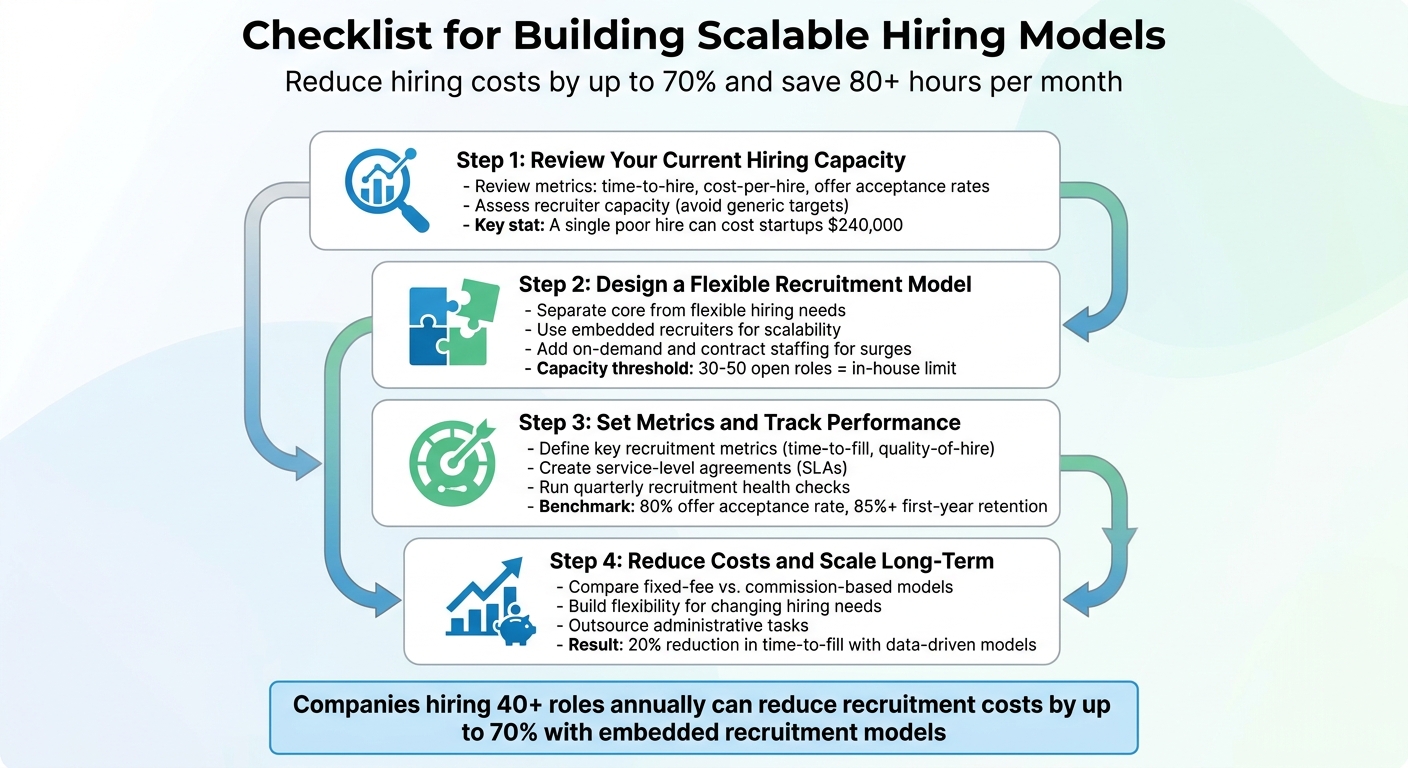
4-Step Framework for Building Scalable Hiring Models
Step 1: Review Your Current Hiring Capacity
Review Your Processes and Metrics
Start by examining the metrics that shape your recruitment outcomes. Focus on time-to-hire, cost-per-hire, and offer acceptance rates to uncover inefficiencies like process delays or candidate drop-offs. Why does this matter? A single poor hire can cost startups around $240,000 when you factor in salary, benefits, training, and lost opportunities [5]. Keeping these metrics in check is crucial to avoiding costly mistakes.
Next, take a realistic look at your recruiters’ capacity. Avoid generic targets, such as "5 hires per recruiter", without accounting for the complexity of roles [4]. For instance, sourcing senior engineers requires far more effort than filling high-volume entry-level positions. Consider factors like recruiter experience, vacation schedules, and onboarding periods, and use historical performance data to set achievable goals [4].
| Metric Category | Key Metrics to Track | Purpose |
|---|---|---|
| Capacity | Hires made vs. targets, Recruiter ramp time | Understand if your team can hit growth goals [4] |
| Efficiency | Time-to-fill, Cost-per-hire | Spot bottlenecks and assess budget impact [2] |
| Quality | Offer acceptance rate, Turnover rate | Measure candidate experience and long-term fit [5] [2] |
| Sourcing | Channel effectiveness, Dropout points | Fine-tune where time and budget are spent [5] |
By understanding these metrics, you can align your current recruitment performance with your future hiring needs.
Forecast Hiring Needs from Growth Plans
Your hiring forecast should be tied directly to your business goals. For example, sales projections and revenue targets dictate when you’ll need to grow sales, marketing, and customer support teams. Similarly, product roadmap milestones signal when engineers and designers are required for key feature launches [2]. Work backward from these deadlines to determine when hiring must begin.
In 2023, Notion used a rolling 12-month hiring forecast, updated quarterly, to align team growth with product milestones and OKRs. This proactive approach allowed them to scale engineering and product teams in time for feature releases, avoiding last-minute hiring chaos [2].
It’s also smart to run "what-if" scenarios. For instance, what happens if you need to add 10 new roles mid-cycle? These models highlight the trade-offs in recruiter capacity and help leadership understand the limits of your hiring team before committing to aggressive growth targets [4].
Once your forecast is clear, you’ll need to identify where your current processes and resources fall short of meeting these goals.
Find Gaps in Skills and Resources
Identify the weak points in your setup. Relying on static spreadsheets instead of dynamic tools that sync with your Applicant Tracking System often leads to inaccurate forecasts [4]. Manual processes can result in missed targets and strained relationships with finance teams.
Pay attention to communication breakdowns as hiring scales. If candidate emails are left unanswered or feedback gets lost, it’s a sign your process can’t handle higher volumes [6]. Check metrics like your applicants-to-hire ratio and 90-day attrition rate to see if you’re hiring the right people or simply filling roles [8].
Also, assess which roles need permanent hires versus flexible support. Early-stage companies often rely on generalists, but as you grow from 20 to 60 employees, you’ll need specialists and functional leaders [5]. If you’re still using informal processes for these critical hires, it’s a gap that needs urgent attention.
Step 2: Design a Flexible Recruitment Model
Separate Core from Flexible Hiring Needs
To build a recruitment model that can scale, it’s essential to distinguish between roles requiring long-term integration and those better suited for short-term or flexible solutions. Your core team should focus on positions where deep alignment with company values and strategic goals is critical. Think of roles like Talent Acquisition (TA) Managers or Directors of TA – these individuals shape your hiring strategy and guide organisational growth as your business evolves.
For tasks like high-volume screening, market research, or specialised technical hiring, flexible recruitment models are more effective. These models are also ideal for managing temporary spikes in hiring demand.
A fully in-house recruitment team often hits its capacity limit when managing 30 to 50 open roles simultaneously. Beyond this point, teams can become reactive, focusing on urgent needs rather than strategic hiring. Flexible models are better equipped to handle such high-volume scenarios.
| Model Type | Volume Threshold | Breaking Point Trigger |
|---|---|---|
| Fully In-House | 30–50 open roles | Role specialisation exceeds team expertise |
| Agency-Heavy | 40+ roles/year | Costs become unsustainable; quality drops |
| Hybrid | 60+ roles | Coordination breaks down; unclear authority |
To ensure your recruitment model scales effectively, map out decision points and bottlenecks. Use capacity ratios as a guide – typically, one recruiter can manage 20–25 generalist roles or 10–15 technical hires [9].
This clear separation of core and flexible hiring needs lays the foundation for scalable solutions, like embedding recruitment expertise directly into your team.
Use Embedded Recruiters for Scalability
Embedded recruiters offer a practical solution to the challenges of traditional agency models. They provide immediate recruitment capacity at a predictable cost, bypassing the limitations of commission-based fees. Instead of charging per hire, embedded models operate on fixed monthly fees, giving you consistent costs and faster hiring timelines – all while staying aligned with your company culture [3].
"Agencies solve a capacity problem in the short term, but they create a cost and quality problem in the long term. The model works as a temporary bridge. It fails as permanent infrastructure."
- Workfully [3]
Rent a Recruiter simplifies this process by embedding skilled recruiters into your team in just a few days. These embedded recruiters manage the entire hiring process, helping companies cut recruitment costs by up to 70% compared to traditional agency fees. They also save over 80 hours per month in internal hiring and admin time.
Start with a 30- to 90-day pilot program for one or two high-demand roles. This allows you to test how well an embedded recruiter integrates with your existing systems, such as your Applicant Tracking System. A phased approach – Audit & Design (weeks 0–2), Build & Test (weeks 2–6), Pilot & Embed (weeks 6–12), and Scale & Govern (months 3–9) – ensures the model aligns with your business goals [8].
While embedded recruiters are ideal for scaling core functions, on-demand staffing solutions can address fluctuating needs.
Add On-Demand and Contract Staffing
For short-term surges, specialised projects, or temporary gaps, contract professionals are an excellent choice. This approach, often referred to as the "shamrock organisation" model, uses core employees for strategic roles while leveraging contract staff for overflow or specialised tasks. This strategy not only increases flexibility but also protects your core team from burnout [7].
The numbers back this up: 85% of hiring managers at small and midsize businesses report challenges in finding talent, and over 50% are turning to contract professionals to fill the gap [7]. On-demand staffing allows businesses to adapt quickly to changing market conditions or shifts in product development timelines.
Link contract staffing decisions to measurable business goals. For instance, in 2024, Zapier implemented a hiring strategy that tied headcount directly to revenue and customer growth. This data-driven approach ensured that every hire – whether permanent or flexible – contributed to the company’s overall success [2]. Scenario planning, which considers best-case, worst-case, and most-likely outcomes, can help determine how much contract support you’ll need under various growth scenarios [2].
"A scalable talent model can be a critical safety net when your company’s staffing needs change unexpectedly, or when deadlines are looming and you know your team needs reinforcements."
- Steve Saah, Executive Director, Robert Half [7]
Step 3: Set Metrics and Track Performance
Define Key Recruitment Metrics
Tracking the right recruitment metrics transforms hiring from guesswork into a strategic process. Start with time-to-fill, which measures the entire hiring cycle from job approval to accepted offer. This helps identify where delays, like approval bottlenecks, might be slowing you down[11]. Another critical metric is quality-of-hire, combining 90-day manager feedback with first-year retention data. This metric shows whether you’re hiring the right people and ties recruitment directly to business outcomes[11].
On average, teams hire one person for every 150–250 applications received, converting just 0.4–0.8% of applicants[11]. If your interview-to-offer ratio exceeds 4:1, it may signal a misalignment between your screening process and hiring managers’ expectations. A healthier benchmark is closer to 3:1[11]. Meanwhile, offer acceptance rates should hover around 80%. If they drop below 75%, issues with compensation or candidate experience could be to blame[10][11].
Pay attention to first-year attrition. High-performing hiring models aim for retention rates above 85%[10]. If new hires leave within 12 months, it’s often a sign of mismatched expectations, poor screening, or inadequate onboarding[11]. Keeping retention high is also cost-effective, as non-executive hires typically cost $4,000–$6,000 at larger companies[11].
Review your key metrics regularly. Pipeline conversion rates and offer acceptance rates should be checked weekly, while broader metrics like time-to-fill and quality-of-hire can be reviewed monthly[11]. Introducing salary ranges early in discussions helps candidates self-select, which can improve acceptance rates[11]. Sourced candidates, for instance, convert at about 2%, which is five times higher than inbound applicants[11].
These metrics provide a foundation for setting measurable performance standards.
Create Service-Level Agreements
Once you’ve defined your metrics, the next step is creating service-level agreements (SLAs) to formalize expectations. These agreements outline clear performance standards, ensuring everyone involved in the hiring process knows what success looks like. For example, sourcers might focus on pipeline health and response rates, recruiters on time-to-fill and offer acceptance, and coordinators on scheduling accuracy and turnaround times[9].
Before finalizing SLAs, set specific goals. These could include reducing time-to-fill, improving the applicants-to-hire ratio, or lowering 90-day attrition rates[8]. A focused 30–90-day pilot program using these benchmarks can lead to a 15–30% reduction in time-to-first-interview[8]. Align recruitment metrics with actionable steps, such as prioritizing top 20% candidates for immediate phone screens[8].
Accountability is key, so schedule regular reviews. During pilot phases, operational KPIs should be reviewed weekly. Broader leadership impact reports can be done monthly, while governance and fairness audits should occur quarterly[8]. For external partners, SLAs should include clear timelines, total cost considerations, and data-sharing methods[8][9]. Consistent job codes and clear outcomes, like "90-day retention", are essential for accurate tracking across systems[8].
Run Regular Recruitment Health Checks
With SLAs in place, regular health checks are vital to ensure your recruitment strategy stays aligned with business goals. Quarterly reviews are a practical way to keep everything on track. Start with a data audit: review your HRIS and applicant tracking system fields, identify data owners, and ensure consistent labeling[8]. Check if recruiter-to-hire ratios are sustainable – typically, technical recruiters handle 10–15 hires per year, while generalist recruiters manage 20–25[9].
Quarterly audits should also include fairness checks to detect potential biases in hiring decisions[8]. During periods of high growth, monitor weekly dashboards to catch issues early and gather feedback from recruiters[8]. Ask yourself key questions: Are you still reacting to hiring needs, or have you shifted to a proactive approach? Are you focused on hiring for volume or long-term value?[9]
If you’re using predictive analytics, retrain your models every 3–6 months or after any major changes in hiring volume or job requirements[8]. These tools can reduce 90-day attrition rates by a small but impactful percentage within the first six months of use[8]. As your system matures, move from weekly updates to monthly leadership reports and quarterly governance reviews[8].
sbb-itb-a23bd6a
Step 4: Reduce Costs and Scale Long-Term
Compare Fixed-Fee vs. Commission-Based Models
Commission-based recruitment models often lead to unpredictable and rising costs, making it harder to manage budgets effectively. In contrast, fixed-fee models provide a consistent monthly rate for embedded recruitment services, offering a more stable and predictable way to control hiring expenses.
"With flexible staffing, your firm can mitigate these fixed costs while retaining the ability to scale your workforce up or down as business demands dictate."
- Steve Saah, Executive Director, Robert Half [7]
Beyond cost predictability, fixed-fee models align better with long-term hiring goals, reducing the risk of poor hires and improving retention rates. For example, in complex B2B sales roles, a bad hire can cost anywhere from $50,000 to $500,000 when factoring in lost revenue, training, and team disruptions [12]. A fixed-fee approach not only saves money but also creates a scalable hiring structure that supports sustainable growth.
Build Flexibility for Changing Hiring Needs
Cost control is just one piece of the puzzle; your recruitment model also needs to adjust to shifting market conditions. Flexibility is crucial. The "shamrock organization" model combines core employees with contract professionals and outsourced resources, enabling businesses to respond quickly to changing demands [7].
Start by creating multi-scenario hiring plans – best-case, worst-case, and most-likely forecasts – for the next 12 months. Update these plans quarterly to reflect actual performance [2]. Align new hires with key revenue milestones or product launches to ensure every addition directly supports your growth strategy.
Contract professionals are particularly useful for filling critical roles or addressing short-term skills gaps without long-term commitments. Over half of managers at small and midsize companies are now relying more on contract talent to manage workloads and meet immediate needs [7]. Using a rolling 12-month forecast, updated quarterly, helps you stay ahead of staffing challenges, avoiding both understaffing and overstaffing [2]. This approach also frees up internal resources, as detailed below.
Outsource Administrative Recruitment Tasks
As your hiring needs grow, offloading administrative tasks becomes essential to focus on strategic priorities. Outsourcing repetitive tasks like scheduling, resume screening, and candidate communications can save your internal team over 80 hours per month, allowing them to concentrate on high-value hiring activities.
For instance, recruiting coordinators can handle scheduling and logistics for 25–30 interviews per week [9]. Similarly, outsourcing early-stage resume screening and sourcing to external partners or automated tools lets your internal recruiters focus on final interviews and crucial hiring decisions.
Recruitment Operations (RecOps) roles are increasingly important for keeping costs in check. A single RecOps professional can support 10–15 recruiters by managing funnel analytics, improving tool usage, and lowering cost-per-hire [9]. They also audit sourcing channels to identify which platforms deliver the best candidates, helping you cut spending on underperforming job boards.
Using predictive analytics for early-stage candidate screening can further streamline your process. Companies that leverage historical data for screening have reduced time-to-first-interview by 15–30% [8]. Success in this area depends on maintaining clean data – consistent job codes, clear outcomes like 90-day retention rates, and accurate tagging of sourcing channels are all critical [8]. These steps ensure your recruitment process is not only efficient but also data-driven and aligned with your business goals.
Conclusion
Key Takeaways for Decision-Makers
To keep up with business growth, it’s clear that a more adaptable and cost-efficient hiring strategy is essential. Recruitment isn’t just about filling vacancies; it’s about aligning your hiring efforts with your business objectives. Treating recruitment as a strategic priority, rather than an administrative task, can transform your approach. Shifting from rigid annual headcount plans to flexible, quarterly reviews allows for better responsiveness to market changes while maintaining your ability to drive revenue.
The numbers speak for themselves: companies using data-driven hiring models see a 20% reduction in time-to-fill. Meanwhile, embedded recruitment can slash hiring costs by up to 70% compared to traditional agency fees, while also saving over 80 hours per month on internal admin tasks [1][2]. These are not just statistics – they’re opportunities to improve your business.
Next Steps: Partner with Rent a Recruiter
Take the leap from reactive hiring to a scalable recruitment model with Rent a Recruiter. In just five days, you can integrate an experienced recruiter directly into your team. Whether you’re scaling after a funding round, launching a new product, or managing a hiring surge, the embedded approach provides the hiring power you need – without the steep costs of traditional agencies.
Consider this: MasterTech partnered with Rent a Recruiter for 27 months, resulting in 29 placements, a 4:1 CV-to-interview ratio, and $123,000 in savings compared to agency fees [1]. Similarly, Unique streamlined hiring across five cities and achieved 10 successful hires from 291 interviews in just a few months [1]. These results aren’t outliers – they’re what you can expect when you adopt this model. Book a consultation at Rent a Recruiter and see how much you could save.
Calculate Your Potential Savings
Before opening a new role, ask yourself: What value does this hire bring, and what would a three-month delay cost us? This simple question ensures your hiring focuses on future needs, not just immediate gaps [1].
With a fixed-fee structure, you’ll gain predictable monthly costs and the flexibility to adjust your hiring capacity as your business evolves – without the unpredictable fees of commission-based recruitment. It’s a smarter, more controlled way to scale.
SocialTalent Live: TA Maturity Models | Scaling TA – Lessons from the Mid-Maturity Stage
FAQs
When should we switch to an embedded recruiter?
When your organization faces rapid growth, product launches, or sudden spikes in hiring demand, it might be time to consider an embedded recruiter. This approach works especially well when your HR team needs extra support to handle increased recruitment volumes effectively.
An embedded recruiter doesn’t just manage hiring; they bring the expertise and structure needed to ensure better visibility, consistent processes, and scalable solutions. Plus, they can help you cut hiring costs and free up valuable administrative time, letting your team focus on other priorities.
What metrics show our hiring model is effective?
Key metrics such as quality of hire, time to fill, and candidate satisfaction rate provide clear insights into how effective your hiring process is. These numbers show whether your recruitment efforts align with your goals and contribute to your company’s growth.
How do we forecast hiring without overhiring?
To plan hiring effectively without the risk of overhiring, rely on a flexible, data-driven capacity model that ties directly to your business goals. Set clear hiring targets, track real-time metrics, and be ready to adapt your strategy as market conditions shift. This approach helps you scale your workforce efficiently, ensuring you meet demand without unnecessary headcount.