
Engagement metrics are the hidden drivers of recruitment success. Companies with engaged employees see lower turnover, faster hiring, and reduced costs. For scaling businesses, this isn’t just HR data; it’s a tool to predict retention, improve hiring efficiency, and build a stronger workforce.
Here’s why it matters:
- Retention: Engaged employees are 69% more likely to stay for at least three years. Early engagement reduces first-year turnover, saving costs tied to replacing staff.
- Cost Impact: Replacing an employee can cost up to 200% of their annual salary. Even a 5% drop in attrition offsets engagement initiatives.
- Hiring Efficiency: Positive candidate experiences boost offer acceptance rates by 38% and prevent costly dropouts during recruitment.
Metrics like Employee Engagement Scores, eNPS, and turnover rates provide actionable insights into workforce stability and hiring performance. Businesses that track these data points can reduce costs, improve team productivity, and attract top talent.
Scaling companies can integrate these metrics into their hiring processes with tools like embedded recruitment. Services like Rent a Recruiter offer embedded recruiters who work as part of your team, ensuring engagement data drives better hiring outcomes. With potential cost savings of up to 70% and 80+ hours saved monthly, this approach turns hiring into a measurable business advantage.
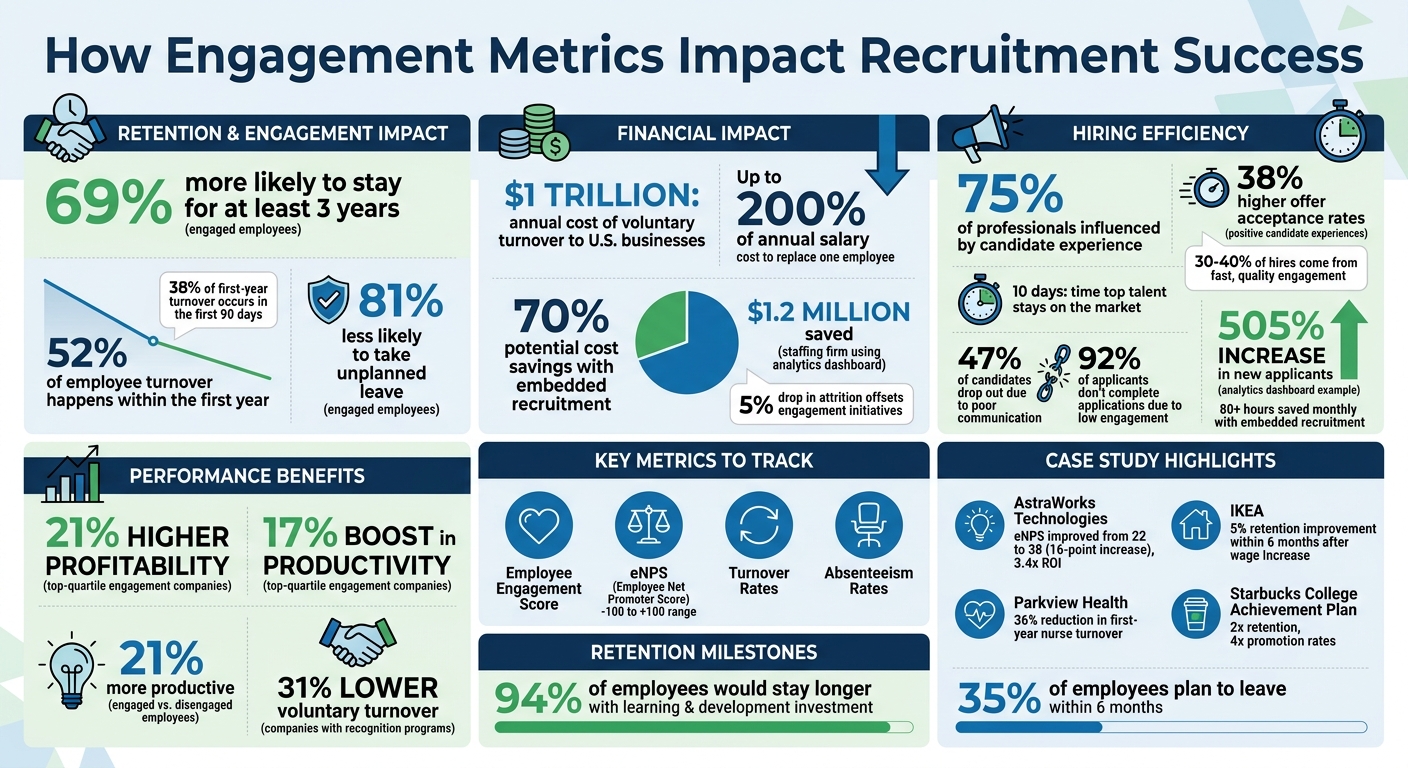
How Engagement Metrics Drive Recruitment Success: Key Statistics and ROI
People Metrics Explained: Attrition, Engagement & Productivity 📊
sbb-itb-a23bd6a
Key Engagement Metrics Explained
Tracking specific metrics connects employee engagement directly to recruitment success. These aren’t just HR numbers – they’re critical indicators of whether your hires will stay, whether your team will recommend your company to others, and whether you’re building a stable talent pipeline or constantly battling turnover. Let’s break down three key metrics that turn engagement data into actionable hiring insights.
Employee Engagement Score
The Employee Engagement Score combines data on motivation, purpose, alignment, and recognition into a single figure [1]. This score provides a clear picture of how connected employees feel to their work and the company. Companies with top-quartile engagement see 21% higher profitability and a 17% boost in productivity compared to their peers [1]. A strong engagement score reflects a thriving workplace culture that not only attracts high-quality candidates but also encourages employees to act as ambassadors for your brand.
Employee Net Promoter Score (eNPS)
eNPS gauges employee advocacy by posing a straightforward question: "How likely are you to recommend this organization as a great place to work?" [1][3]. Scores range from -100 to +100, with any positive number signaling favorable sentiment. For example, in 2026, AstraWorks Technologies improved their eNPS from 22 to 38 – a 16-point increase – which resulted in a 3.4x ROI on engagement efforts and significantly lowered recruitment costs [1]. Strong eNPS scores not only boost morale but also strengthen your employer brand, making it easier to attract top talent.
Absenteeism and Turnover Rates
Absenteeism tracks unplanned absences, which can highlight issues like burnout or ineffective management [2][3]. Engaged employees are 81% less likely to take unplanned leave [4]. Similarly, voluntary turnover rates – the percentage of employees who leave by choice – are a direct indicator of disengagement [1][2]. The financial impact is staggering: replacing just one employee can cost 30% to 200% of their annual salary, and voluntary turnover costs U.S. companies around $1 trillion annually [4]. High turnover in certain teams or departments often points to deeper cultural or leadership challenges that need addressing. By tracking these metrics, businesses can shift from reactive hiring to proactive retention strategies, ensuring a more stable and cost-effective talent pipeline. For companies needing immediate support, on-demand recruitment offers a flexible way to scale these efforts.
How Engagement Affects Retention
Did you know that 52% of employee turnover happens within the first year – and 38% of that occurs in the first 90 days? [5][11] Early engagement plays a massive role in these numbers. When new hires feel connected to their roles and supported by their teams from the start, they’re far more likely to stay. In fact, employees who feel engaged during their first 90 days are 69% more likely to remain with the company for at least three years [6]. These early moments aren’t just about making a good impression – they directly impact recruitment strategy efficiency and long-term cost savings.
Retention at 90 Days, 6 Months, and 1 Year
Retention challenges shift as employees hit key milestones like 90 days, six months, and one year. At 90 days, new hires are still evaluating whether the job aligns with what was promised during recruitment. By six months, they start questioning their long-term fit – 35% of employees plan to leave their job within this period [9], often due to unclear career growth paths. By the one-year mark, the focus shifts to professional development. A striking 94% of employees say they’d stay longer at a company that invests in their learning and development [7].
Real-world examples highlight how addressing these milestones can make a difference. In 2014, IKEA increased wages, which improved retention by 5% within six months [8]. Similarly, Parkview Health tackled a first-year nurse turnover crisis – where one in three nurses left – by using exit interviews to uncover unmet job expectations. After making targeted adjustments, they reduced first-year nursing turnover by 36% [10].
Improving retention doesn’t just stabilize your team; it creates measurable financial and operational benefits.
Cost Savings and Performance Benefits
Reducing turnover saves money and boosts overall performance. Replacing employees is expensive, with voluntary turnover costing U.S. businesses an estimated $1 trillion annually [9]. Beyond the financial hit, high turnover disrupts institutional knowledge, damages customer relationships, and makes attracting talent harder.
The solution? Prioritize engagement. Companies that do see tangible results. Engaged employees are 21% more productive than disengaged ones [7], and businesses with strong recognition programs experience 31% lower voluntary turnover [7]. For example, Starbucks launched its College Achievement Plan, offering free online tuition. Employees enrolled in the program were retained twice as long and promoted four times as often as their peers [8]. These aren’t just statistics – they’re proof that investing in engagement leads to a more stable, high-performing workforce.
How Engagement Metrics Improve Hiring Efficiency
Engagement doesn’t just keep employees loyal; it also transforms your hiring process into something faster and more cost-effective. By tracking how candidates interact with your recruitment process, you gain early insights into their potential performance and fit. For instance, research highlights that candidates with positive early experiences are 38% more likely to accept a job offer[12][13], and 75% of professionals admit that a good candidate experience influenced their decision to join a company[13]. These numbers aren’t just feel-good stats – they directly impact time-to-hire and recruitment costs, giving you a clearer, more efficient hiring pipeline.
Candidate Engagement as a Hiring Predictor
A candidate’s behavior during the recruitment process can reveal a lot about their future engagement and fit within your organization. Engaged candidates tend to respond quickly, show up on time, and complete application steps without delays. These proactive actions often signal long-term commitment and alignment with your team’s values[12][14]. In fact, fast and quality engagement contributes to 30%–40% of hires[12].
On the flip side, delays in communication or inattentive interview behavior may raise red flags about a candidate’s potential fit. This is especially crucial when top talent typically leaves the market within just 10 days[12]. By focusing on candidate engagement, you’re not only assessing their interest but also predicting their future contributions and team compatibility – all while accelerating the entire hiring process.
Faster Hiring and Lower Costs
Speed is everything in recruitment, and engagement metrics can help you move quickly without sacrificing quality. One staffing firm, for example, used an advanced analytics dashboard to boost new applicants by 505% in four and a half months, saving $1.2 million in the process.
On the other hand, poor engagement can be costly. Nearly 47% of candidates drop out of the recruitment process due to inadequate communication[14], and a staggering 92% of candidates who click "apply" fail to complete their applications because of low engagement or technical issues[13]. Every dropout wastes recruiter time and drains your advertising budget, ultimately slowing down the hiring cycle. Strong engagement practices, therefore, aren’t just nice to have – they’re essential for saving both time and money.
How to Apply Engagement Metrics in Your Hiring Process
Using engagement metrics in hiring is about creating a system that blends numbers with real-world insights and then acting on what you discover. Combine measurable data like eNPS (Employee Net Promoter Score) and turnover rates with qualitative input from stay interviews or regular check-ins. This mix helps you uncover issues early, such as onboarding gaps or deeper challenges affecting new employees. By leveraging these metrics, you can track employee sentiment while fine-tuning how you assess candidates. The result? A hiring process that’s informed by data and designed for continuous improvement.
Employee Surveys and Recruitment Health Checks
Forget annual reviews – weekly pulse surveys are a better way to track what’s happening in real-time. These short surveys give you a snapshot of employee sentiment, allowing you to address issues as they arise [15]. Pair this with your eNPS, which measures how likely employees are to recommend your company as a workplace. Tracking eNPS quarterly can reveal trends in your employer brand, but aim for at least 65% participation to ensure the data is reliable [15].
Stay interviews are another powerful tool. Conduct these at the six-month mark for new hires to identify pain points in onboarding before they lead to turnover. Asking questions like “What keeps you here?” and “What might make you leave?” adds context to your data and helps you spot areas for improvement [3].
Building Scalable Hiring Systems
Once you’ve gathered engagement data, the next step is turning it into action. Use this feedback to refine your hiring process: standardize how you evaluate candidates, monitor engagement during the hiring journey, and create feedback loops to keep improving. For companies on a growth trajectory, having the right recruitment capacity is crucial.
That’s where services like Rent a Recruiter come in. With an embedded recruiter on your team, you gain the ability to track engagement metrics consistently, respond to candidate behaviors in real time, and build systems that scale. This approach doesn’t just save time – up to 80 hours per month in admin – it can also cut hiring costs by up to 70%. Whether you’re scaling after securing funding or scaling your startup or navigating a hiring surge, embedded recruitment ensures your engagement data drives better hiring outcomes. Instead of just collecting metrics, you’ll turn them into a strategic advantage for scaling your team effectively.
Conclusion
Engagement metrics are more than just numbers – they’re a guide to better hiring outcomes. By monitoring key indicators like eNPS, turnover rates, and pulse survey results, businesses gain real-time insights into the health of their recruitment processes. Companies with high engagement levels see real benefits: a 21% boost in profitability and a 17% jump in productivity compared to their peers[1]. Engaged employees stick around longer, refer stronger candidates, and significantly reduce replacement costs. Considering that replacing an employee can cost anywhere from 50% to 200% of their salary, even a modest 5% drop in attrition can offset the yearly expense of engagement initiatives[1].
The real value lies in connecting sentiment data to measurable business outcomes. Take AstraWorks Technologies, for example – they achieved a 16-point eNPS increase and reduced turnover costs, proving the ROI of tracking engagement metrics[1].
"When HR connects sentiment data… with measurable outcomes… you stop justifying engagement and start monetizing it." – Learnerring[1]
This shows how turning data into action can reshape recruitment strategies.
For scaling businesses, particularly high-growth SMEs, integrating data-driven recruitment systems is no longer optional – it’s essential. Every hiring decision matters. Engagement metrics not only help predict retention but also improve hiring efficiency. The key is to consistently track these metrics, act on the insights they provide, and respond quickly.
Rent a Recruiter offers embedded recruitment solutions designed to work as part of your team. By providing structure and visibility, they help transform engagement data into hiring success. With potential savings of up to 70% on costs and over 80 hours saved per month, you can create a scalable recruitment function that fuels growth.
Engagement metrics provide the insight; the right recruitment partner ensures execution. Together, they turn hiring into a competitive edge.
FAQs
Which engagement metrics best predict new-hire retention?
Employee engagement metrics can offer powerful insights into predicting new-hire retention. For instance, employees actively using tools like Viva Engage are associated with a 21% higher retention rate. Beyond tool usage, broader engagement factors play a critical role. These include job satisfaction, a clear sense of purpose, regular recognition, and a strong connection to the company. Together, these elements significantly influence whether employees stay for the long term.
How can we track candidate engagement without slowing hiring?
To keep candidate engagement high without creating bottlenecks in your hiring process, focus on real-time metrics that matter. These include response times, participation in interviews, and how candidates interact with updates or messages.
Leverage automation tools to handle routine communication, but don’t lose the personal connection – balance efficiency with a human touch. Regular updates and clear communication build trust, keeping candidates engaged and responsive throughout the process.
Metrics like email open rates and interview attendance offer valuable insights into engagement levels. The best part? You can track these without slowing down your hiring workflow. It’s all about gathering data efficiently while keeping the process seamless.
What’s a good eNPS score for a growing company?
A strong eNPS score for a growing company is generally considered to be above +48. Top-performing organizations often see even greater increases, such as a +48-point improvement, which can drastically reduce employee turnover. High eNPS scores indicate strong employee engagement, which plays a direct role in boosting recruitment outcomes by enhancing retention and streamlining hiring processes.