Remote hiring is now a core business strategy, but it comes with challenges that can impact time, cost, and hiring outcomes. Scaling companies face issues like evaluating soft skills virtually, managing time zones, and securing global compliance. Without structured processes, businesses risk delays, mis-hires, and lost productivity.
Key Insights:
- Interview fraud has risen by 340% since 2023, and poor hiring processes can cost companies top talent.
- Structured remote hiring reduces mis-hires by up to 40% and improves new hire retention by 58% over three years.
- SMEs using embedded recruitment save up to 70% on hiring costs and reclaim over 80 hours per month in admin tasks.
Solutions:
- Assess soft skills with structured interviews and trial projects.
- Test team fit through panel interviews and paid collaboration projects.
- Overcome time zone challenges with asynchronous tools and overlapping work hours.
- Use remote-specific job boards and embedded recruiters to attract qualified candidates.
- Ensure compliance with global hiring laws using EOR platforms or expert support.
Remote hiring doesn’t have to be complicated. With structured workflows and expert recruitment support, you can hire faster, reduce costs, and build a scalable hiring function. Learn how Rent a Recruiter can help you streamline your process today.
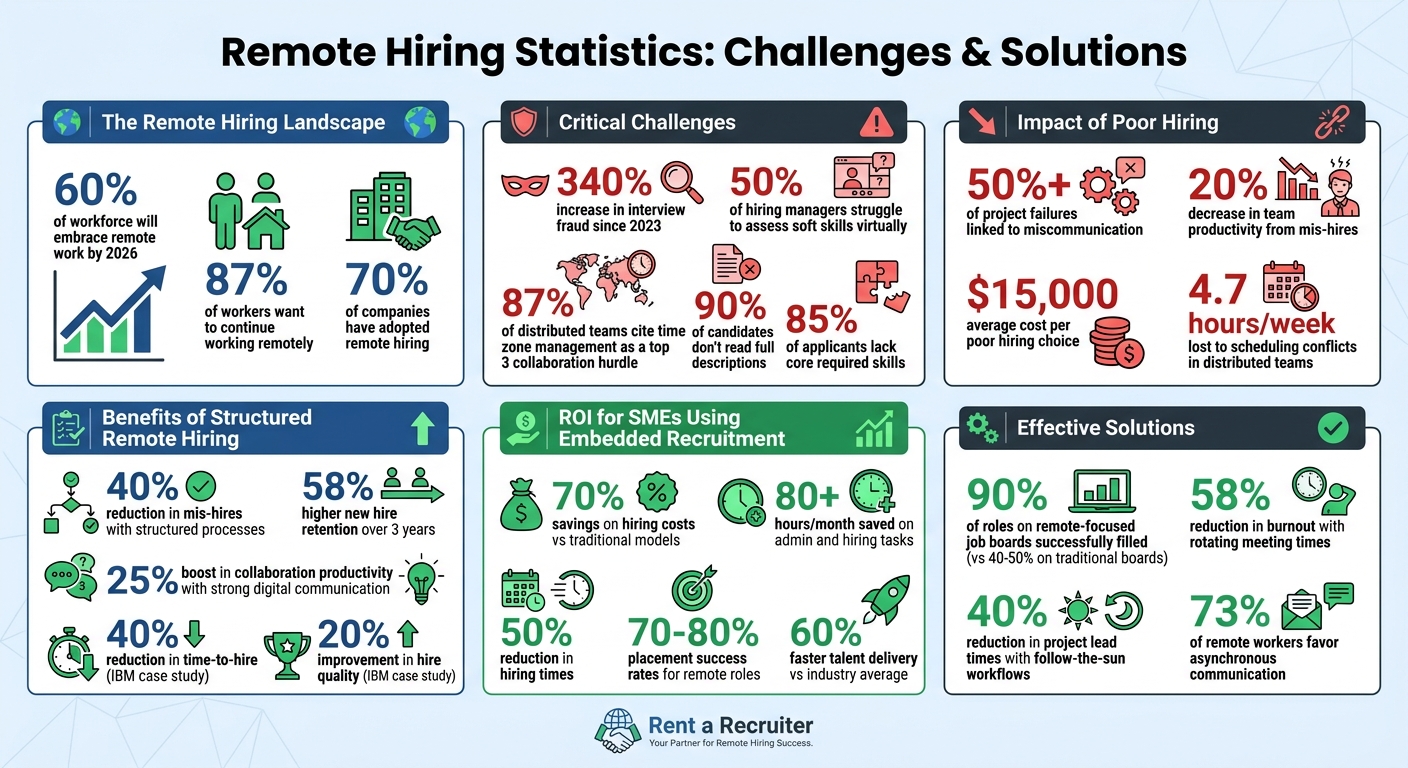
Remote Hiring Statistics: Key Challenges and ROI Benefits for SMEs
1. Evaluating Soft Skills Without In-Person Meetings
Virtual interviews make it harder to read body language, energy, and rapport compared to face-to-face interactions [5]. In fact, 50% of hiring managers admit they struggle to assess soft skills in a virtual setting [6]. Yet, over 90% of talent professionals agree that soft skills are just as critical – if not more so – than technical skills [7]. Miscommunication, often tied to weak soft skills, is linked to over 50% of project failures [7]. On the flip side, strong digital communication can boost collaboration productivity by 25% [7]. These statistics highlight the importance of having clear and structured ways to evaluate soft skills remotely.
When companies fail to evaluate soft skills effectively, the consequences are costly. Misjudging a candidate’s ability to adapt or self-manage can lead to poor team integration, higher turnover, and reduced job satisfaction [6]. Alarmingly, only 41% of companies have formal processes for measuring these skills [7].
"Miscommunication causes more than half of project failures. But having the right digital communication soft skills… can improve collaboration productivity by 25%." – Miguel Marques, Founder, Remote Crew [7]
The solution? Replace gut feelings with structured, evidence-based methods. For instance, assess digital communication and adaptability by assigning tasks that mirror real-world scenarios, such as drafting emails for non-technical audiences or managing sudden mid-task changes [7].
1.1 Using Structured Interviews and Trial Projects
Structured tools like the STAR method (Situation, Task, Action, Result) provide a framework for candidates to demonstrate their soft skills with real examples [7]. Ask targeted questions like, "Can you describe a time you made a decision without immediate approval?" or "How did you handle feelings of isolation while working remotely?" [7]. These questions reveal how candidates navigate challenges in remote environments.
For senior roles, consider short, paid trial projects. These trials allow you to see firsthand how candidates manage their time, communicate challenges, and deliver results independently [8]. Tools like Slack, Jira, or Notion can also simulate real-time collaboration, offering insights into how well they handle feedback and discussions [7].
1.2 Using Video Interview Platforms for Assessment
Video platforms can help bridge the virtual gap by allowing you to observe body language, eye contact, and engagement – key indicators of communication style. Many AI-driven video platforms go a step further, analyzing communication patterns and problem-solving abilities objectively [6].
For example, IBM’s "Watson Recruitment" platform, implemented in 2025, uses AI to analyze candidate data. This tool reduced IBM’s time-to-hire by 40% and improved the quality of new hires by 20% [6].
You can also conduct virtual group interviews or peer-led "coffee chats" to evaluate how candidates interact with others and contribute to team dynamics. Use a scoring rubric to ensure evaluations focus on objective criteria rather than subjective impressions [6][7].
sbb-itb-a23bd6a
2. Determining Cultural Fit from a Distance
Hiring remotely makes it harder to assess how well a candidate will fit with your team. But cultural alignment is key to retention and workplace harmony. A poor hiring choice can cost a company around $15,000 in recruitment fees and onboarding, not to mention months of lost productivity. Without in-person interactions like hallway chats or lunch breaks, it’s tough to gauge personality and compatibility [10].
"Culture fit was this fluffy concept that would naturally work itself out. It doesn’t. You need to actively evaluate whether someone will thrive in your specific remote environment." – Teamcamp Blog [10]
To assess fit, replicate your work environment during the hiring process. For example, if your team relies on asynchronous communication, start by observing how candidates handle email or chat threads before moving to video calls [9][10]. This mirrors how they’d interact daily and reveals whether they can adapt to your setup. Use structured interview questions and scoring rubrics to minimize unconscious bias and ensure consistency in evaluating cultural alignment [5].
Focus on qualities that support remote work success: independence in decision-making, clear communication, and systems thinking (how their work connects to the bigger picture) [10]. Ask insightful questions such as, "What do you value in a leader?" or "Can you share an example of solving a problem with minimal guidance?" These help you understand how well they can work autonomously [9][10]. Involve your team early in the process to validate whether a candidate aligns with your company’s remote culture.
2.1 Involving Team Members in the Interview Process
Panel interviews and virtual meet-and-greets with the team are crucial for identifying cultural mismatches. This method brings in different perspectives, ensuring a thorough evaluation. Instead of relying solely on hiring managers, an embedded recruitment service can help you include 2-3 team members who will work closely with the candidate. You could also assign a "culture buddy" – a peer, not a manager – during the final stages. This person can answer candid questions about team dynamics and norms [10].
Pay attention to how candidates interact with various team members during these sessions. A culture buddy can also provide an honest perspective on what it’s truly like to work on the team, helping candidates opt out if they feel it’s not the right fit. When checking references, ask specifically how the candidate handled ambiguous situations and whether their former employer would recommend them for a remote role [10].
2.2 Testing Collaboration Before Hiring
Paid trial projects are one of the best ways to evaluate a candidate’s performance and collaboration style. Assign them a real-world task – such as investigating a bug report or drafting a brief – and pay them for a week of work [10]. This lets you see how they document their process, handle challenges, and interact with the team.
During the recruitment phase, use your actual collaboration tools to test how candidates work. For instance, observe how they engage with Slack threads, Trello boards, or Notion documents to get a sense of their communication and teamwork [5]. If your team values documentation, give them a task that requires writing a detailed explanation or a "how-to" guide to assess their habits in this area [10]. This process ensures you hire someone who can thrive in your remote work environment while aligning with your team’s dynamics.
3. Coordinating Across Multiple Time Zones
As remote teams refine their ability to work together effectively, managing time zones becomes a pressing challenge.
When teams operate across several time zones, scheduling can quickly become complicated. By 2026, the average fully remote team will span 4.2 time zones, compared to 2.7 in 2022 [13]. Additionally, 87% of distributed teams cite time zone management as one of their top three collaboration hurdles. Without clear policies, these teams lose an average of 4.7 hours each week to scheduling conflicts and missed handoffs [13].
Sticking to a strict 9-to-5 schedule can slow things down. For example, a developer in Berlin waiting for a quick approval from a lead in Seattle might face a full day of delays if real-time communication is required [12].
"The legacy mindset of synchronous collaboration – the belief that real work only happens when faces are arranged in a neat grid on a video call – is fundamentally broken." – RemoteTips [12]
The key is to create a system that respects individual working hours while keeping the team moving forward. This means striking a balance between brief windows for live collaboration and a strong focus on asynchronous communication, which helps boost efficiency and reduce burnout.
3.1 Setting Up Overlapping Work Hours
Start by identifying a "golden window" of 1 to 3 hours for essential real-time collaboration, such as brainstorming or making critical decisions [11]. These core hours allow for live interaction while giving team members the flexibility to work during their most productive times.
To keep things fair, rotate meeting times every 2–4 weeks, ensuring that early-morning or late-night calls are shared evenly across the team. This approach has been shown to reduce burnout by 58% [11][13]. You can also introduce "meeting-free days" (like Wednesdays) to give everyone uninterrupted time for deep, focused work.
Key meetings should be recorded, with detailed notes shared promptly, so attending live becomes optional. Tools like Slack can display local time and availability, helping to avoid unnecessary notifications outside of work hours. Always include UTC offsets in meeting invites (e.g., "3pm EST (UTC-5)") to eliminate confusion during daylight saving changes [13].
When live collaboration isn’t possible, asynchronous tools can keep the momentum going.
3.2 Using Asynchronous Communication Tools
Adopting an asynchronous-first approach can transform cross-time zone collaboration. In fact, 73% of remote workers favor asynchronous communication over live meetings for this type of work [13]. Instead of constant video calls, use tools like Loom for recorded walkthroughs and platforms like Slack, Trello, or Notion for project updates.
Centralizing information in hubs like Notion or Confluence ensures everyone has access to the same resources, reducing confusion. Encourage public discussions in shared channels to maintain transparency and avoid information silos. End-of-day summaries are also a great way to ensure smooth handoffs as colleagues in other time zones start their workday.
This "follow-the-sun workflow" can cut project lead times by up to 40% by keeping progress continuous [13]. To avoid burnout, encourage the use of "Do Not Disturb" modes during local night hours, reserving off-hours communication for true emergencies [13].
4. Finding and Attracting Qualified Remote Candidates
Once you’ve streamlined collaboration, the next hurdle is finding the right remote talent.
Remote work is far from a passing trend. By 2026, nearly 60% of the workforce will embrace it, and 87% of workers want to continue working remotely [1]. For SMEs, this creates a unique challenge: competing with larger companies that have bigger budgets and stronger employer brands. It’s not just about posting a job; it’s about standing out and attracting candidates with both the technical skills and the traits needed for remote success, like self-discipline and proactive communication.
Here’s the reality: 90% of candidates don’t read full job descriptions, and 85% of applicants lack the core skills required [19]. This influx of unqualified applications can overwhelm your team, especially when you’re already juggling day-to-day operations.
"Remote-first work is here to stay. For employers, the question is no longer if you should adapt – but how quickly." – TalentAlly [5]
The solution starts with a strategic approach to sourcing talent. Instead of relying on generic job boards, focus on platforms and methods that connect you directly with candidates who are already equipped to thrive in a remote-first environment.
4.1 Using Remote-Focused Job Boards
Generic job boards might generate volume, but remote-focused platforms like We Work Remotely, Remote OK, FlexJobs, and AngelList Talent are designed to attract professionals experienced in digital collaboration [15][16][17]. These niche boards boast impressive results, with 90% of roles posted there successfully filled [18], compared to the 40–50% success rates seen on traditional job boards for remote positions [19].
When creating your job posting, clarity is key. Define what "remote" means for your company. Is the role global, limited to specific countries, or tied to certain time zones? For example, include details like "must be available 11 a.m.–3 p.m. EST" [5][14]. This level of detail helps filter out mismatched applicants early on, saving time for both sides.
Use your job ad to showcase your remote culture. Mention the tools your team uses (e.g., Slack, Notion, Asana), your approach to work-life balance, and perks like home office stipends [5][17]. Be transparent about salary ranges and career growth opportunities – this builds trust with candidates who don’t have the usual in-office cues to evaluate your company [5].
While these platforms can sharpen your candidate pool, SMEs often face another challenge: limited internal capacity to manage the hiring process.
4.2 Working with Embedded Recruiters
For many SMEs, the issue isn’t finding candidates – it’s having the bandwidth to manage the process effectively.
This is where specialized talent acquisition services come in. They handle the entire remote hiring process, from sourcing and screening for remote-readiness to managing interviews and ensuring compliance with international regulations [19]. These agencies often achieve 70–80% placement success rates for remote roles and deliver talent 60% faster than the industry average [19].
Rent a Recruiter offers a tailored solution by embedding experienced recruiters directly into your team. Within days, they can take over your hiring process, bringing structure, consistency, and speed. This is particularly useful for SMEs scaling after funding rounds or dealing with sudden hiring surges. With this approach, companies typically cut hiring costs by up to 70% compared to traditional commission-based models and save more than 80 hours per month on internal hiring and admin tasks.
5. Handling Technology and Compliance Requirements
Securing your remote hiring process and staying compliant with legal standards is non-negotiable.
As remote hiring grows, so do its challenges. Beyond assessing skills and team fit, businesses must address risks unique to remote recruitment. For example, interview fraud has surged by 340% since 2023 [2]. At the same time, 70% of companies have adopted remote hiring, yet many struggle with safeguarding candidate data and complying with international labor laws [6].
A data breach during recruitment can expose sensitive details like Social Security numbers, addresses, and financial information. Compliance also varies by region: hiring in Germany requires adherence to GDPR, while California-based workers fall under CCPA regulations [20].
"We caught a candidate with ChatGPT open on a second monitor. But honestly, I’m not sure if that’s meaningfully different from having documentation open. Where does ‘reference material’ end and ‘cheating’ begin?" – Engineering Director, Fortune 500 [2]
This highlights a growing issue: candidates using AI tools during interviews. To counter this, companies need smarter processes to verify identities and assess skills accurately, particularly those essential for remote work.
5.1 Setting Up Secure Technology Infrastructure
Start by auditing your tools for interviews and onboarding. Ensure file-sharing platforms are encrypted and video conferencing software includes identity verification features. Half of hiring managers report difficulties in assessing soft skills virtually [6].
Look for platforms offering real-time identity checks and tools that flag inconsistencies between interview stages. For example, sudden changes in a candidate’s communication style or problem-solving approach could indicate potential fraud. Multi-signal assessments – evaluating code quality, communication, and behavior – are especially effective for remote roles. These assessments not only test skills like written communication and asynchronous problem-solving but also make it harder for candidates to cheat.
A strong example comes from IBM, where AI-driven recruitment reduced time-to-hire by 40% and improved the quality of hires by 20% [6].
Once your tech infrastructure is secure, the next step is navigating global compliance.
5.2 Meeting Global Hiring Regulations
Hiring across borders adds layers of complexity. Employment contracts must include location-specific terms addressing benefits, termination policies, and working hours [20]. Tax residency rules and double taxation agreements further complicate matters.
Key regulations to keep in mind include:
| Regulation | Region | Primary Focus |
|---|---|---|
| GDPR | UK / Germany | Data security and employee privacy [20] |
| CCPA | USA (California) | State-level data protection laws [20] |
| PIPEDA | Canada | Privacy laws for personal information and electronic documents [20] |
| Fair Work Act | Australia | Employer/employee rights and obligations [20] |
Many companies turn to Employer of Record (EOR) platforms to handle payroll, taxes, and benefits, ensuring compliance across jurisdictions [20].
Rent a Recruiter simplifies this process. Their embedded recruiters bring a deep understanding of international regulations, ensuring your hiring practices meet data protection and compliance standards from day one. This expertise is especially valuable when scaling quickly, helping you avoid costly mistakes while maintaining hiring momentum.
6. Reducing Mis-Hires Through Better Processes
Poor evaluation methods and misaligned expectations often lead to costly mis-hires, especially in remote teams. Without structured hiring frameworks, companies risk falling into the "osmosis trap" – assuming culture and accountability will develop naturally, as they might in a physical office setting. In remote environments, these elements must be intentionally embedded into the hiring process to ensure success[8].
Mis-hires can decrease team productivity by 20%, delay critical projects, and increase training costs[8][21]. These issues often arise from subjective decision-making and unclear role expectations. When job descriptions lack defined 30-60-90 day outcomes, early misalignment becomes inevitable. Disorganized processes can lead to missed deadlines and isolated efforts within the team[8].
To avoid these pitfalls, companies need structured, data-driven hiring processes that focus on clear evaluation and alignment.
6.1 Creating Standard Workflows and Evaluation Criteria
Start by defining success for the role before posting the job. Outline the top three measurable outcomes for the first 30, 60, and 90 days. For instance, instead of saying "Oversee customer support", specify an objective like "Deliver a weekly analytics report by Friday at 5:00 PM EST with ticket resolution times and customer satisfaction metrics."
Implement a clear, three-step hiring funnel:
- Application Review: Assess candidates’ written communication skills.
- Skills Exercise: Use a rubric to grade practical assignments.
- Structured Interview: Conduct interviews guided by a scorecard to ensure consistency and fairness.
Develop evaluation rubrics that prioritise skills essential for remote work, such as written communication, self-management, and proactive updates. For example, a practical trial tied to real deliverables can demonstrate how a candidate performs without direct supervision. Treat asynchronous communication as a core skill rather than a personality trait – it’s vital for remote team success[8][3].
Once these processes are in place, external expertise can help refine and scale your recruitment efforts.
6.2 Getting Scalable Recruitment Support
Many small and medium-sized businesses lack the resources to build these frameworks from scratch. This is where expert recruitment support becomes invaluable. Rent a Recruiter embeds experienced recruiters directly into your team, bringing structure and consistency to your hiring process. This approach not only reduces mis-hires but also saves over 80 hours per month in administrative and hiring tasks.
Their embedded recruitment model ensures your business needs are translated into role definitions tailored for remote work[8]. They evaluate candidates for key remote attributes like self-management, communication style, and time zone compatibility, while also navigating global compliance and local labor laws[8][3].
With this model, companies can cut hiring costs by up to 70% compared to traditional commission-based agencies. Whether scaling after funding, launching a product, or managing a hiring surge, you can maintain a steady recruitment pace while focusing on achieving specific business outcomes instead of logistical challenges.
Conclusion
Remote hiring becomes far more manageable when supported by structured, evidence-based processes. These frameworks not only improve the quality of applicants but also reduce the likelihood of costly mis-hires[4]. Companies with well-planned remote onboarding programs even achieve 58% higher new hire retention over three years[4].
For small and medium-sized enterprises (SMEs), structured workflows can cut hiring times by up to 50% and reduce costs by as much as 70% compared to traditional recruitment models[4][6]. They also prevent productivity losses caused by poor coordination or siloed teams[8] and eliminate the need for fragmented recruitment tools, which often cost between $6,500 and $8,000 annually[4][6].
For SMEs lacking the internal resources to create these systems, Rent a Recruiter provides an effective solution. By embedding experienced recruiters directly into your team, you gain instant hiring capacity while laying the groundwork for consistent, scalable growth. Most companies save up to 70% on hiring costs compared to commission-based models and reclaim over 80 hours per month in reduced admin and internal hiring tasks.
Whether you’re scaling after funding, launching new products, or facing a hiring surge, the right recruitment support can turn remote hiring into a true advantage. Learn how Rent a Recruiter can help you build scalable hiring capacity and take full control of your recruitment process today.
FAQs
What are the quickest ways to spot interview fraud in remote hiring?
Interview fraud can be subtle, but there are clear signs to watch for. Look out for inconsistent backgrounds that change between calls or seem artificial, as well as unnatural lip-syncing or eye movements, which could indicate someone else is speaking for the candidate. Sudden persona shifts between interviews or overly staged setups are also red flags.
To verify authenticity, consider checking the candidate’s digital footprint or contacting previous employers for validation. Conducting live, on-camera interviews early in the process can make it harder for fraud to go unnoticed. Additionally, ask structured yet unpredictable follow-up questions to test the candidate’s genuine knowledge and reactions. These steps can help you spot deception before it becomes a costly mistake.
How can I test remote soft skills without making the process too long?
To test soft skills effectively in a remote setting without dragging out the process, opt for structured virtual interviews. These can focus on key areas like communication, problem-solving, and flexibility. Use tools like scenario-based questions, screen-sharing tasks, and clear scoring rubrics to maintain consistency and fairness.
Set the tone by creating a comfortable atmosphere – engage in some small talk and practice active listening. This helps you gauge emotional intelligence and interpersonal abilities naturally. By combining these techniques, you can assess soft skills efficiently while keeping the interview short and focused.
When should I use an Employer of Record (EOR) for global hires?
An Employer of Record (EOR) can be a game-changer when hiring international employees in countries where your business doesn’t have a legal entity or local setup. By handling compliance, payroll, taxes, and employment regulations, an EOR reduces legal risks and streamlines the hiring process. This approach is particularly helpful for onboarding talent across different countries, entering new markets quickly, or managing remote teams without the complexity of establishing local entities.