
Your hiring process directly impacts your ability to attract and retain top talent. Poor candidate experiences lead to declined offers, negative reviews, and a damaged employer brand. In 2023, nearly half of job seekers turned down offers due to bad experiences, and 72% shared their frustrations online. These numbers highlight the urgent need to improve how your team handles recruitment.
The solution? Train your team to deliver a professional, streamlined, and respectful hiring process. This includes structured interviews, clear communication, and timely follow-ups. Companies that prioritize candidate experience see better offer acceptance rates, stronger employer branding, and reduced hiring costs.
Here’s how to approach it:
- Evaluate your current process: Use feedback surveys and metrics like Candidate Net Promoter Score (cNPS) to identify bottlenecks.
- Train your team: Focus on interview techniques, communication, and legal compliance to ensure consistency.
- Set up feedback systems: Regularly gather and act on candidate feedback to continuously refine your process.
- Scale with support: Embedded recruitment can help manage hiring spikes without sacrificing quality.
The bottom line: A smooth, respectful hiring process isn’t just about filling roles – it’s about protecting your brand and securing the talent your business needs to grow.
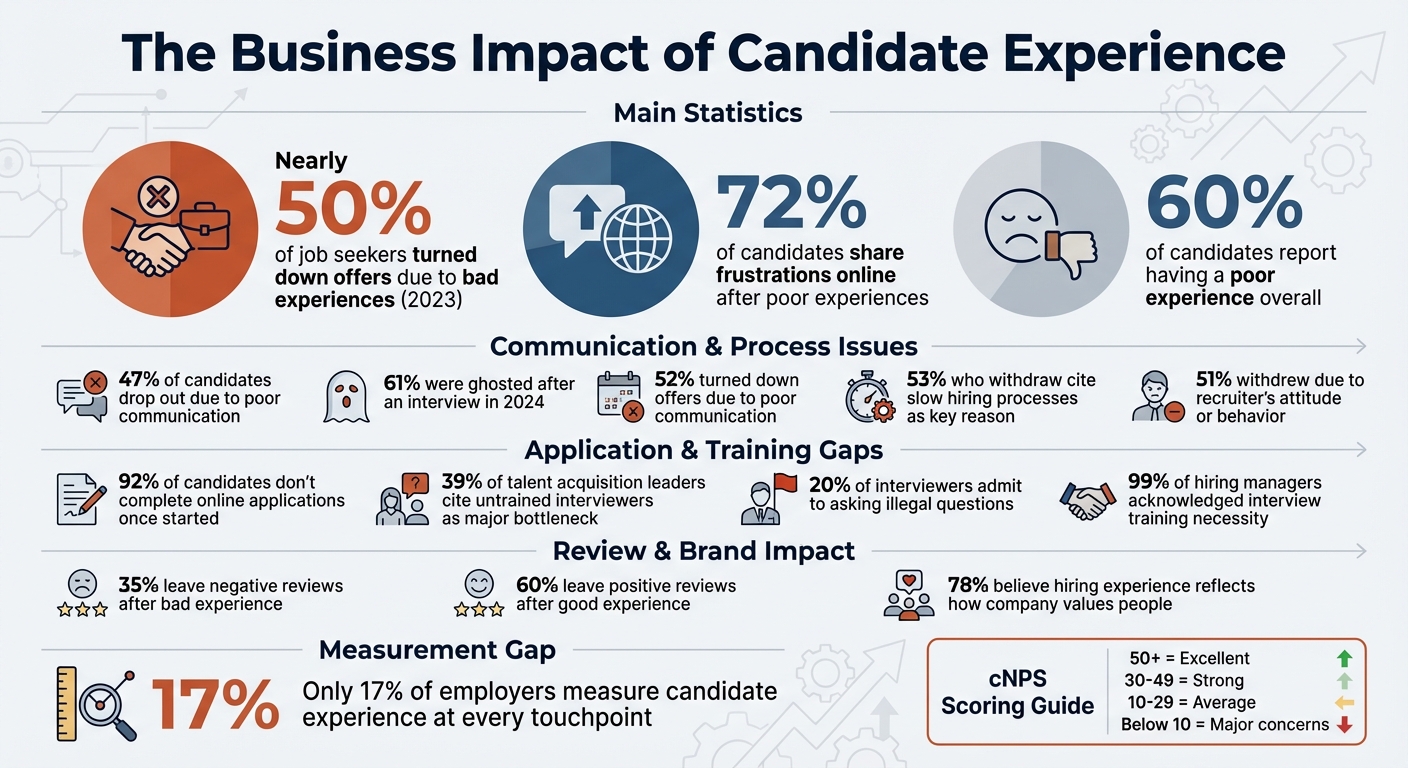
Candidate Experience Statistics: Impact on Hiring Success and Employer Brand
Candidate Experience Optimization – Course Trailer – TalentLibrary™
sbb-itb-a23bd6a
Step 1: Evaluate Your Current Candidate Experience
Before diving into team training, take a close look at your current candidate experience. Here’s why it matters: 60% of candidates report having a poor experience, and 72% of them share that experience online. This means your hiring process is always under scrutiny.
"You can’t improve what you don’t measure!" – Spark Hire
Start by gathering feedback through multi-stage surveys at four critical points: 24-48 hours after application, within 24 hours of interviews, at the offer stage (whether accepted or declined), and 1-2 weeks post-rejection. Keep these surveys short – 6 to 10 questions that take no more than five minutes to complete. Assure candidates of anonymity and explain that their responses won’t impact their chances. Honest feedback is essential for building a clear picture of your recruitment health.
Run a Recruitment Health Check
To get measurable insights, calculate your Candidate Net Promoter Score (cNPS). Ask candidates, “How likely are you to recommend a friend to apply to our company?” on a scale from 0 to 10. Here’s how it works:
- Promoters (9-10): Enthusiastic supporters of your process.
- Passives (7-8): Neutral participants.
- Detractors (0-6): Those who had a negative experience.
Subtract the percentage of Detractors from Promoters to get your cNPS. A score of 50+ signals an excellent candidate experience, while anything below 10 indicates major problems.
"A company that maintains a positive cNPS even among people it does not hire has truly excellent candidate experience." – Koji
For deeper insights, try "mystery candidate" tests, where team members or trusted partners apply to your roles to uncover friction points. Pair this with internal metrics like time-to-fill, offer acceptance rates, and stage-to-stage conversion rates to identify where candidates drop out. Don’t overlook application abandonment data – 92% of candidates don’t complete online applications once they’ve started. High drop-off rates can signal serious flaws in your process.
Review Candidate Feedback
Feedback from rejected candidates or those who withdrew voluntarily can be incredibly revealing. While new hires are easier to survey, their feedback often skews positive due to their successful outcome. To get a fuller picture, conduct phone interviews with candidates who declined offers or withdrew to understand their reasons.
Stay on top of external reviews on platforms like Glassdoor, LinkedIn, and Indeed. These public opinions matter – 35% of candidates leave negative reviews after a bad experience, while 60% leave positive reviews after a good one. Combining this external feedback with your internal surveys gives you a well-rounded view of how your employer brand is perceived.
Find Bottlenecks in Your Recruitment Process
Dig into your data by department, recruiter, and hiring stage to locate problem areas. 53% of candidates who withdraw cite slow hiring processes as a key reason. If you notice delays in specific stages, they’re likely causing candidates to drop out.
Look closely at application drop-off rates – forms taking longer than 15 minutes to complete have a 40% abandonment rate. If candidates drop out after interviews, the issue may lie in unclear communication or next steps. Use a mix of closed questions (like rating scales) for quantitative insights and open-ended questions to understand the root causes of frustrations. Pinpointing these bottlenecks ensures your training efforts target the areas that need the most improvement.
Step 2: Create and Roll Out Team Training
Once you’ve identified the gaps in your hiring process and refined your talent acquisition strategies, the next step is to build a training program that addresses them. This program should focus on refining interview techniques, improving communication, and ensuring legal compliance. Here’s why it matters: 39% of talent acquisition leaders cite untrained interviewers as a major hiring bottleneck, and 99% of hiring managers who received interview training acknowledged its necessity. These numbers make it clear – training isn’t optional; it’s essential.
Your training should zero in on three key areas: structured interview techniques, consistent communication, and legal compliance. Start with the basics. Teach interviewers to review materials ahead of time, arrive on time, and use open, welcoming body language. These small habits create a professional and positive experience for candidates. From there, introduce structured interviewing methods, such as the STAR method (Situation, Task, Action, Result), to assess soft skills objectively. Pair this with standardized scorecards so every interviewer evaluates candidates using the same criteria.
Build Core Training Modules
Focus your training on areas where your team struggles the most. For example, 20% of interviewers admit to asking illegal questions, which can lead to compliance risks. To tackle this, create a module on unconscious bias and legal compliance. Cover what questions are off-limits – like those about age, marital status, or race – and include role-playing exercises and mock interviews to give teams practical experience.
Another critical area is shifting from evaluating "culture fit" to "culture add." As Annelise Pretorius, Psychometrics Assessments Expert at AIHR, explains:
"Training on how to evaluate ‘culture add’ is as important as training on evaluating cultural fit. While alignment with company culture is crucial, overemphasizing cultural fit can lead to biases, a lack of diversity, and stagnation".
Lastly, ensure your team can clearly articulate your company’s mission, values, and growth opportunities. Why? Because over 50% of candidates decline offers due to a negative experience, and nearly 20% of those cite poor interviewer performance.
Standardize Recruitment Communication
After building core skills, shift your focus to external communication. Clear and consistent communication is critical to keeping top candidates engaged. 47% of candidates drop out of hiring processes due to poor communication, and 61% reported being ghosted after an interview in 2024. To avoid these pitfalls, establish clear Service Level Agreements (SLAs) for candidate updates: acknowledge applications within an hour (automated responses are fine), provide a personal response within 48 hours, and send updates every five business days.
Use standardized email templates for key touchpoints, such as application acknowledgments, interview confirmations, status updates, and rejection letters. For candidates who’ve completed multiple interview rounds, skip the automation for rejections – send a personalized email or make a quick call instead. Additionally, provide candidates with a branded interview guide. This guide should include preparation tips, interview schedules, team bios, and an overview of your company values. Distribute it 48 hours before the interview and include a clear hiring roadmap outlining the stages, decision-makers, and expected timelines. This reduces candidate anxiety and shows professionalism.
Train Teams on Interview Best Practices
The interview itself can make or break the candidate experience. In fact, 51% of candidates have withdrawn from a process due to a recruiter’s attitude or behavior. To avoid this, train your team to actively listen, avoid interruptions, and ask thoughtful follow-up questions.
Make sure interviewers end each session with clear next steps and a specific follow-up timeline. Avoid vague phrases like "we’ll be in touch soon." Instead, give candidates a concrete timeframe for when they can expect to hear back.
Finally, stress the importance of completing scorecards immediately after each interview. Encourage teams to log their feedback in your Applicant Tracking System (ATS) right away, ensuring evaluations are accurate and based on fresh observations. This step not only improves decision-making but also keeps the process moving efficiently.
Step 3: Set Up Feedback and Improvement Systems
Training your team and refining processes is just the start. To ensure these changes stick and deliver results, you need systems that capture feedback and track performance. Without these, it’s impossible to know if your candidate experience is improving or where adjustments are needed. Surprisingly, only 17% of employers measure candidate experience at every touchpoint, leaving most companies guessing instead of making data-driven decisions.
Add Candidate Feedback Tools
One effective way to gather insights is by using a Candidate Net Promoter Score (cNPS) survey. This simple survey asks candidates: “How likely are you to recommend applying here to a friend?” Candidates rate their experience on a scale from 0 to 10, which categorizes them as Promoters (9–10), Passives (7–8), or Detractors (0–6). A cNPS of 50+ is excellent, 30–49 is strong, 10–29 is average, and anything below 10 signals major concerns.
Timing matters. Send surveys within 24–48 hours of key touchpoints – after the application, post-interview, once an offer is accepted or declined, and during onboarding. Feedback from rejected candidates is especially valuable. For instance, Virgin Media discovered in 2014 that 6% of rejected candidates canceled their subscriptions due to poor recruitment experiences, costing the company $5.7 million annually. By addressing these issues and improving their interview process, they significantly reduced these losses.
Once feedback is collected, the next step is to track metrics that highlight inefficiencies.
Track Key Metrics
In addition to cNPS, monitor metrics like offer acceptance rates, dropout rates, and time-to-hire. These numbers, combined with external feedback, can help identify bottlenecks in your process. Reapplication rates also provide valuable insights – if candidates who were previously rejected apply again, it’s a strong indicator of a positive overall experience.
Don’t overlook external platforms such as Glassdoor, Indeed, and LinkedIn. These sites offer unfiltered feedback that can reveal gaps in your candidate experience. Keep in mind that 72% of candidates share poor recruitment experiences with others or post them online, which can directly impact your employer brand. Regularly reviewing these platforms ensures you stay ahead of potential reputation issues.
Refine Based on Feedback
Use survey results to guide improvements. Share insights with hiring managers and break down scores by department, recruiter, and hiring stage to identify areas that need attention. For example, if technical assessments are causing high dropout rates, tweak one element – like reducing the test length or clarifying instructions – and measure the results.
Closing the loop is key. Show candidates that their feedback leads to real changes. When they see improvements, they’re more likely to engage in future surveys. As the Kira AI team explains:
"The gap between what hiring teams think they deliver and what candidates actually experience is where good hires quietly disappear".
Step 4: Use Rent a Recruiter for Scalable Recruitment Support
When hiring demand surges, even the most well-oiled internal processes can falter. Overwhelmed teams, delayed responses, and inconsistent candidate experiences become all too common. This is where embedded recruitment support steps in, providing the capacity and expertise to keep everything running smoothly – without compromising on quality.
Why Embedded Recruitment Is a Game-Changer for High-Growth SMEs
Rent a Recruiter places seasoned recruiters directly within your team to manage hiring from start to finish. These professionals don’t just fill roles – they work alongside your team, showing best practices in action. This approach tackles a critical issue: 39% of talent acquisition leaders cite untrained or unprepared interviewers as a major hiring bottleneck.
By embedding recruiters, companies shift from reactive, "habitual" hiring to a more thoughtful, strategic approach. As Monika Mester from Union Properties PJSC puts it:
"Consistency – A fair and structured process builds trust both inside and outside the organisation".
Embedded recruitment ensures that the core elements of successful hiring – Clarity, Culture, Competence, Communication, and Consistency – stay intact, even as your business scales rapidly.
Hands-On Training and Process Optimization
Embedded recruiters don’t just focus on filling current roles – they actively enhance your internal hiring processes. This includes:
- Standardizing recruitment communication.
- Streamlining your Applicant Tracking System (ATS).
- Establishing workflows that reduce candidate frustration.
For example, they implement structured interviews, which are proven to predict job performance three times more effectively than unstructured ones (r=0.51 vs r=0.14). They also train hiring managers to provide timely feedback, ensuring candidates remain engaged throughout the process. By maintaining a personal touch – like making a quick phone call during critical moments such as rejections or offer negotiations – embedded recruiters protect your employer brand and build long-term goodwill.
These recruiters also bring expertise in creating inclusive job descriptions, reducing bias in interviews, and using storytelling to give candidates a clear picture of the role. This results in stronger engagement and sets the stage for sustainable, scalable hiring practices.
Time and Cost Savings That Add Up
Rent a Recruiter clients often see up to 70% lower hiring costs compared to traditional commission-based recruitment models. On top of that, they save over 80 hours per month in hiring admin and internal effort. These savings come from predictable monthly fees, faster hiring timelines, and improved retention.
Consider this: replacing an employee costs about 33% of their annual salary, and when factoring in lost productivity, the total cost can rise to 1.5x to 2x their annual salary. By improving candidate experience and reducing turnover, embedded recruitment delivers immediate returns.
Speed also matters. With top talent leaving the market in just 10 days, response time can make or break your hiring success. Embedded recruiters maintain a 48-hour service level agreement for candidate updates, ensuring you stay ahead of slower competitors. As the TuraHire team aptly notes:
"The companies winning top talent in 2026 aren’t the most famous – they’re the most consistent, transparent, and respectful in how they hire".
Conclusion
Key Takeaways for Scaling Companies
A strong candidate experience isn’t just a nice-to-have – it’s a strategic edge. The numbers back this up: 78% of candidates believe the hiring experience reflects how a company values its people, and 52% of job seekers have turned down offers due to poor communication. By focusing on structured training, clear communication, and actionable feedback, you protect your employer brand and build a talent pipeline that lasts.
The path forward is clear: evaluate your recruitment metrics, train your team, gather feedback, and scale with embedded recruitment support. Each step tackles a specific weak point that might otherwise lead to disengaged candidates or declined offers. Feedback doesn’t just fix today’s issues – it boosts future candidate engagement by up to 4x. And with embedded recruitment expertise, you ensure consistency and scalability in your efforts. The time to act is now.
Next Steps: Take Control of Your Recruitment Process
Ready to overhaul your hiring approach? If your internal team is maxed out or lacks the specialized skills needed, you don’t need to start from scratch. Rent a Recruiter provides experienced recruiters who integrate into your team in just days. They bring the structure, training, and consistency required to deliver exceptional candidate experiences at scale. Most companies save over 80 hours per month on hiring admin and cut costs by up to 70% compared to traditional agency fees.
Whether you’re scaling after a funding round, launching a new product, or managing a hiring spike, embedded recruitment gives you the resources to meet demand without sacrificing quality. Book your free Recruitment Health Check today to measure your hiring performance and uncover opportunities for faster, more efficient results.
FAQs
What’s the fastest way to measure our candidate experience?
The fastest way to gauge candidate experience is by leveraging tools like surveys and Net Promoter Scores (NPS). These methods deliver instant feedback on how candidates view your hiring process. With this data, you can quickly spot problem areas and make adjustments to improve their overall experience.
How do we train interviewers to be consistent and avoid bias?
Equip your interviewers with structured training programs that focus on identifying and minimizing unconscious biases. This is a critical step in ensuring a fair and consistent hiring process.
Here’s what works:
- Standardize the interview process: Use the same set of questions and evaluation criteria for every candidate. This levels the playing field and reduces variability in assessments.
- Practice through role-playing: Simulated interviews help interviewers refine their techniques and recognize potential pitfalls in real scenarios.
- Provide practical tools: Checklists and clear guidelines for writing objective feedback go a long way in promoting balanced evaluations.
Regular training sessions and opportunities for reflection are essential. They help interviewers stay aligned with best practices, avoid common mistakes, and maintain fairness throughout the hiring process.
When should we use embedded recruiters to scale hiring?
Embedded recruiters can be a game-changer when you’re facing long hiring cycles, need to speed up your recruitment process, or want more control over how hiring is handled. They shine during periods of rapid growth or when you’re tackling high-volume hiring. By integrating directly into your team, they streamline communication, reduce delays that might cause candidates to lose interest, and ensure a smooth, consistent experience for every candidate – all while managing the entire hiring process from start to finish.