Want to reduce hiring costs by up to 19% while increasing offer acceptance by 38%? Personalized recruitment strategies deliver exactly that. Scaling companies that tailor their hiring process don’t just attract top talent – they improve retention and protect their employer brand.
Here’s why it matters:
- Bad experiences cost you: 26% of candidates reject offers due to poor recruitment, and 77% share negative experiences with their networks.
- Good experiences pay off: Personalized hiring boosts first-year retention by 18% and reduces turnover by 36%.
- It’s what candidates expect: 72% now demand tailored processes, and companies that deliver see up to 45% higher engagement.
The message is clear: personalization isn’t optional – it’s the competitive edge scaling companies need to hire smarter, faster, and more cost-effectively. Let’s break down how it works and why it’s worth investing in to overcome the biggest challenges in recruitment.
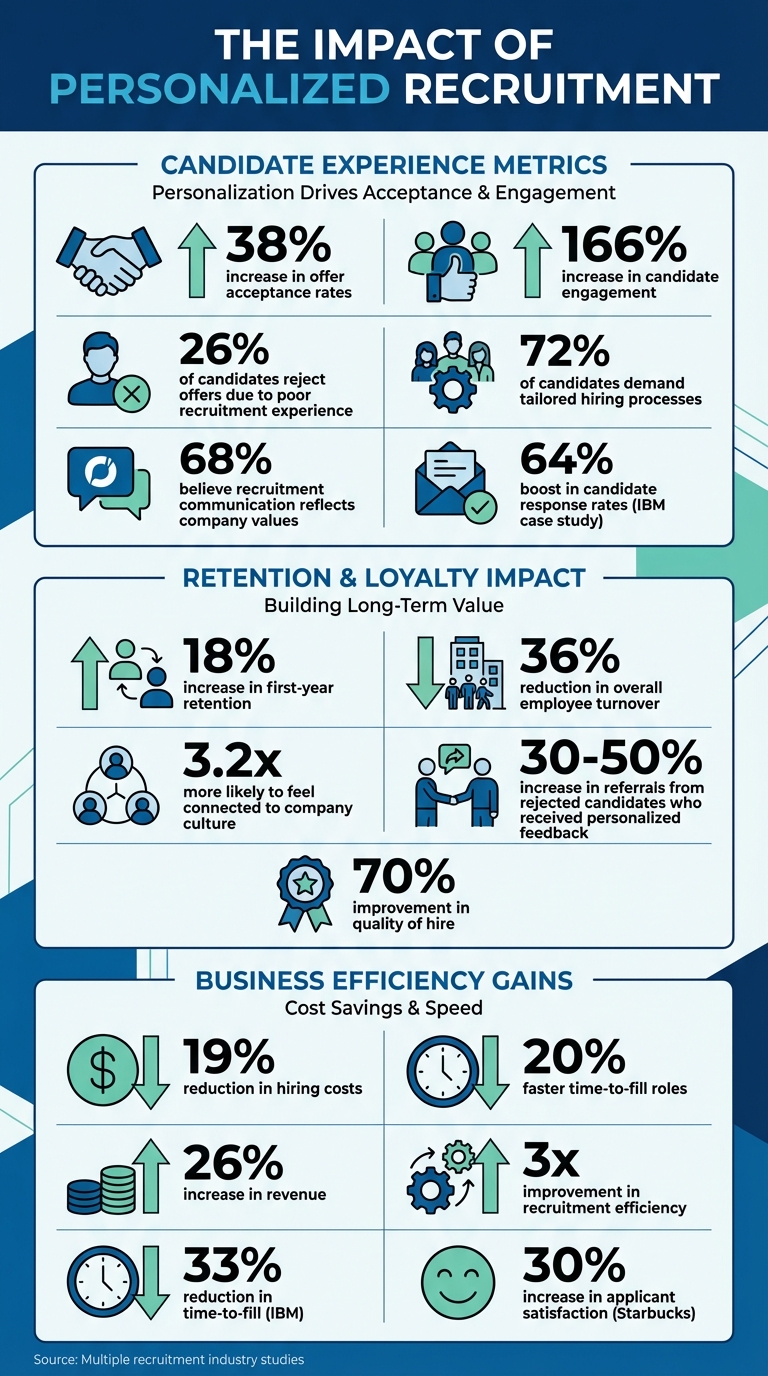
Impact of Personalized Recruitment: Key Statistics on Candidate Experience and Business Outcomes
Research Findings: How Personalized Offers Affect Candidate Experience
Higher Candidate Satisfaction and Offer Acceptance
The numbers speak for themselves: personalization in recruitment makes a huge difference. Candidates who experience personalized communication during the hiring process are 38% more likely to accept a job offer [4]. On the flip side, over a quarter of candidates – 26% – turn down offers due to a poor recruitment experience, even when the role and pay align with their expectations [5].
Take IBM as an example. By implementing a personalized approach, they saw a 64% boost in candidate response rates and reduced their time-to-fill roles by 33% [2]. Similarly, Starbucks leveraged data analytics and AI to increase applicant satisfaction by 30% and cut time-to-fill by 20% [2]. These results highlight the competitive edge personalization provides in a tight talent market.
Why does it work? Personalization makes candidates feel valued. Researchers call this "considerateness" [7]. In fact, 68% of candidates believe a company’s communication during recruitment reflects how it values employees overall [2]. Mentioning specific achievements or aligning outreach with a candidate’s career goals shows genuine effort, building trust and respect right from the start. This thoughtful approach doesn’t just win candidates over – it lays the groundwork for loyalty and long-term retention.
Retention and Long-Term Value
Personalized recruitment doesn’t just help you hire – it helps you keep talent. Companies that focus on tailored candidate experiences report an 18% increase in first-year retention and a 36% reduction in overall turnover [4][2]. Employees who feel they were treated exceptionally during recruitment are 3.2 times more likely to feel connected to the company culture and highly satisfied with their job [6].
Even candidates who don’t get the job can become advocates. Providing personalized feedback to rejected finalists increases their willingness to refer others by 30–50% [5]. These thoughtful interactions build a stronger employer brand and create a ripple effect that’s especially important for companies looking to grow their talent pipeline.
sbb-itb-a23bd6a
The Business Impact: Employer Branding and Cost Efficiency
Strengthening Employer Branding with Personalization
Every interaction during recruitment shapes your employer brand. In fact, 68% of candidates believe that how a company communicates during hiring reflects how it values its employees [2]. A poor experience doesn’t just harm your reputation – it can hurt your bottom line. Candidates who feel undervalued are 56% less likely to stay loyal as customers, turning a bad hiring process into a direct revenue risk [5].
But the flip side is just as powerful. A positive, personalized hiring process can transform even those who don’t get the job into advocates for your brand. This ripple effect strengthens your reputation and creates a foundation for measurable cost and efficiency improvements.
Cutting Costs and Boosting Efficiency
Personalized recruitment doesn’t just improve the experience – it saves money and speeds up hiring. Companies using data-driven, tailored strategies fill roles 20% faster and reduce hiring costs by 19% compared to traditional approaches [4]. Focusing on candidate experience also triples recruitment efficiency and increases revenue by 26% [4].
The risks of neglecting personalization are just as clear. A poor hiring process leads 26% of candidates to reject offers – even if the role and pay are appealing [5]. On the other hand, personalized recruitment reduces employee turnover by 36%, breaking the expensive cycle of rehiring and retraining [2]. For scaling businesses with small HR teams, these gains are critical. They allow teams to achieve more without overextending or heavily relying on external agencies.
How Scaling Companies Can Implement Personalized Offers
Using Data for Offer Customization
The key to personalized offers lies in understanding what truly matters to each candidate. By tracking candidate interactions – like email open rates, response times, and engagement with specific content – you can fine-tune not just what to communicate, but also when and how to deliver it [1].
Go beyond the traditional resume-first approach by focusing on skills. As Fernando Bellon, Head of Talent Acquisition at BBVA, pointed out:
"Skills would be the future currency of talent" [8].
Breaking roles into specific competencies and aligning them with candidates’ proven skills can significantly expand your talent pool – up to 10x – while ensuring offers resonate on a deeper level [8].
Gather data on what drives candidate decisions, including their preferences for remote work, start dates, career growth opportunities, and salary expectations [1][3]. Post-interview surveys and Candidate Net Promoter Scores can also provide valuable feedback on whether candidates feel their needs and motivations are being understood [1]. With 76% of job seekers highlighting the importance of personalized communication in their decision-making, these insights aren’t just helpful – they’re essential [4]. This approach allows you to scale personalization without losing the individual touch, even when managing high volumes.
Scalable Personalization Methods
Personalization doesn’t mean reinventing the wheel for every candidate. By using intelligent segmentation, you can group candidates based on factors like role type, seniority, and engagement levels, creating tailored communication tracks that feel personal while remaining efficient [9].
Integrating your Applicant Tracking System (ATS) with a CRM can centralize candidate data, avoiding impersonal or redundant interactions [8][9]. A Preference Center – where candidates can select the type of information they want to receive and their preferred communication channels – can further enhance trust while offering valuable personalization insights [8][1].
Automation tools powered by AI can take over routine tasks like scheduling, status updates, and initial screenings, freeing up your team to focus on high-impact activities like cultural fit assessments and finalizing offers [9][1]. As RecruitBPM aptly put it:
"Automation is the mechanism. Personalization is the outcome" [1].
These strategies have already been shown to reduce time-to-fill metrics and improve candidate satisfaction [2].
For scaling companies ready to implement these strategies, working with a service like Rent a Recruiter (https://rentarecruiter.com) can simplify the process. By combining expert human insights with advanced data-driven tools, you can deliver personalized offers that not only attract top talent but also strengthen your competitive position in the hiring market.
Conclusion: Personalized Offers as a Competitive Advantage
Key Takeaways for Decision-Makers
Personalized offers aren’t just a nice-to-have – they deliver measurable results. Companies using personalized recruitment strategies report a 166% increase in candidate engagement[2] and a 70% improvement in quality of hire[4]. They also see a 66% acceptance rate while reducing the 26% rejection rate caused by poor candidate experiences[1].
The financial ripple effects are just as striking. A bad candidate experience makes individuals 56% less likely to become future customers[1]. On the flip side, even rejected candidates who receive tailored feedback are 30–50% more likely to refer others[1]. By 2026, delivering a personalized candidate experience is no longer optional – it’s what top talent expects.
Companies that prioritize this approach are three times more likely to improve their talent acquisition efficiency[4]. Add to that a 36% reduction in employee turnover for businesses using personalized strategies[2], and the benefits go beyond hiring – they directly impact your ability to scale and grow sustainably. These numbers make it clear: personalization isn’t just a trend; it’s a strategic imperative.
Next Steps: Transform Your Recruitment Process
Turning these insights into action means bridging the gap between recognizing the value of personalization and implementing it effectively. For scaling companies balancing high hiring volumes, tight deadlines, and limited resources, delivering tailored experiences can feel daunting – but it doesn’t have to be.
Personalization is the key to scalable and cost-efficient recruitment. Rent a Recruiter (https://rentarecruiter.com) places experienced recruiters directly into your team to implement data-driven, personalized hiring methods – without the overhead of traditional agencies. Companies cut hiring costs by up to 70% and reclaim over 80 hours per month in administrative time. Whether you’re scaling after funding, launching a new product, or navigating a hiring surge, this approach gives you the structure, visibility, and consistency to deliver personalized offers at scale.
Want to make personalized offers your competitive edge? Book a Call to explore how embedded recruitment can reshape your hiring process – or See Your Potential Savings to calculate the financial impact for your business.
Ep 629: A Personalized Candidate Experience
FAQs
What is a “personalized” job offer?
A personalized job offer takes into account the candidate’s specific preferences, priorities, and the feedback they’ve shared throughout the hiring process. It shows the employer has genuinely listened and values the individual, making the offer feel more thoughtful and aligned with their needs.
How can we personalize offers at scale without adding work?
Personalizing offers at scale doesn’t have to be overwhelming. By leaning on automation and building out structured processes, you can create a more seamless and tailored experience for candidates without adding to your team’s workload.
Automate repetitive tasks like interview preparation reminders and candidate updates. Not only does this save time, but it also ensures candidates feel acknowledged and valued. Tools such as applicant tracking systems (ATS) and AI-driven platforms can adapt communications to match the specific role or individual preferences.
The result? A streamlined workflow that provides greater transparency, enhances the candidate experience, and strengthens your employer brand – all without overburdening your recruiters.
What candidate data should we collect to customize offers?
To create offers that truly resonate, start by gathering essential details like resumes, work history, education, and areas of expertise. Beyond this, dig into preferences such as salary expectations, preferred locations, ideal work environments, and long-term career aspirations. You can collect this information through direct conversations, surveys, or application forms. By understanding these factors, you can craft offers that align with individual needs, improving the candidate experience and boosting acceptance rates.