
Gut-driven hiring decisions cost you time and money. Without a structured approach, interviews often lead to inconsistent evaluations, bias, and wasted resources. Implementing effective talent acquisition strategies can mitigate these risks. Enter interview scorecards: a simple tool that helps you hire smarter by turning subjective opinions into measurable data.
What’s the impact?
- Faster decisions: Clear, standardized criteria eliminate guesswork.
- Reduced bias: Focus on evidence, not gut feelings.
- Cost savings: Avoid bad hires that could cost 5x an employee’s annual salary.
- Consistency: Every candidate is assessed using the same framework, no matter the interviewer.
Scorecards ensure your team evaluates candidates fairly, efficiently, and based on what matters most for the role. Here’s how they work and why they’re a game-changer for scaling businesses.
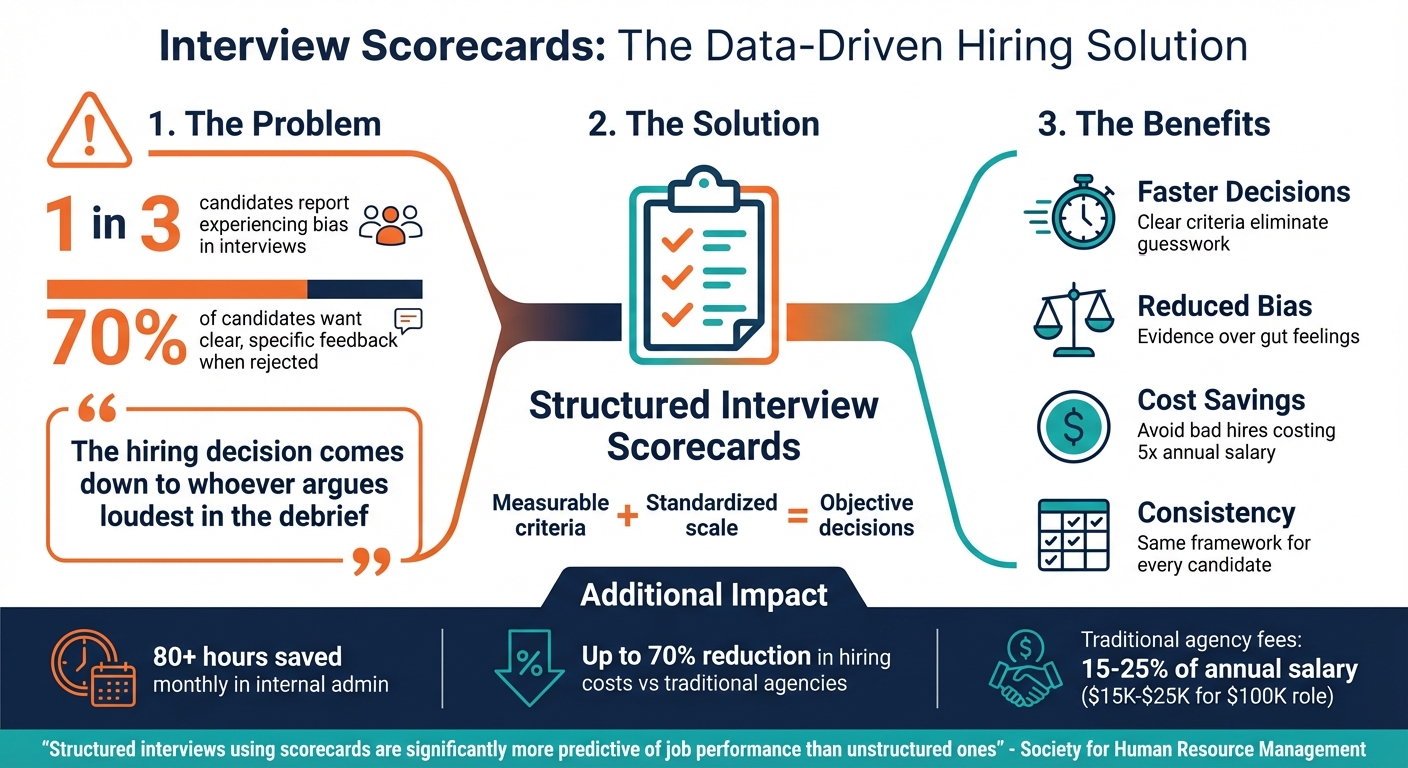
Interview Scorecards Benefits: Key Statistics and Impact on Hiring
How to Build the Hiring Scorecard That Stops You From Choosing the Wrong Candidate
sbb-itb-a23bd6a
Common Problems in Candidate Evaluation
Before diving into the role of interview scorecards, it’s important to understand the recurring issues that plague traditional candidate evaluation. These challenges often derail hiring processes, especially for high-growth SMEs under pressure to scale quickly [2].
Inconsistent Evaluation Across Interviewers
When interviewers lack a shared framework, assessments can vary wildly. One person’s "3" might be another’s "4", simply because they’re using different criteria – or none at all. This inconsistency grows when interviewers focus on different aspects of the candidate or delay providing feedback, making it harder to align on a decision. Ultimately, hiring decisions often rely on fuzzy recollections instead of solid evidence.
Bias in Decision-Making
Bias creeps into many interviews, with one in three candidates reporting its impact [6]. Common examples include the halo effect, where one standout trait skews the entire evaluation, or anchoring, where first impressions dominate the decision. These biases often lead to gut-driven decisions rather than objective assessments. For scaling companies, the cost is high: increased turnover and wasted resources on onboarding and training.
"Without scorecards, interviewers often give unstructured feedback." – Maya Patel, PeopleOpsClub [1]
Team dynamics can further complicate matters. During debriefs, junior team members may feel pressured to align their feedback with senior leaders, a phenomenon known as social anchoring. This stifles independent perspectives and undermines the value of diverse input.
Inefficient Post-Interview Discussions
Debriefs often become bottlenecks when feedback is vague or unstructured. Comments like "seemed fine" or "nothing special" don’t provide actionable insights, making it difficult to compare candidates or reach a consensus. Sean Griffith, COO at Truffle, highlights this frustration:
"The hiring decision comes down to whoever argues loudest in the debrief." [3]
These inefficiencies can derail hiring timelines, especially when discussions stray from the original job requirements – a phenomenon known as decision drift. On top of that, 70% of candidates say they’d appreciate clear, specific feedback if rejected, which many companies fail to provide [6].
These issues underscore the need for a structured approach, like interview scorecards, to bring clarity and consistency to candidate evaluation.
How Interview Scorecards Solve These Problems
Interview scorecards bring clarity and consistency to candidate evaluations by replacing subjective impressions with measurable, comparable data. They ensure every interviewer assesses candidates on the same criteria, using a standardized numerical scale backed by specific evidence.
What Are Interview Scorecards?
An interview scorecard is a structured tool that outlines the key hard and soft skills, along with role-specific qualifications, required for a position. Each competency is rated on a defined numerical scale, often with behavioral anchors to guide evaluations. For example, a score of "3" might indicate the candidate meets expectations by addressing the essentials, while a "5" reflects exceptional performance, demonstrating deep knowledge and a proven track record.
Scorecards also include an overall recommendation – such as whether to hire, not hire, or advance the candidate to the next stage.
Another important feature is weighting. Not all skills carry the same importance for every role, so scorecards allow hiring managers to assign greater weight to critical competencies. For instance, technical expertise might be weighted more heavily than secondary traits to ensure the evaluation aligns with the job’s priorities.
With this foundation in place, scorecards create a fair and consistent framework for hiring decisions.
How They Standardize the Hiring Process
Scorecards establish consistent evaluation criteria across the interview panel. Every interviewer assesses the same competencies using the same scale, which transforms subjective opinions into objective data. Sean Griffith, COO at Sinch, highlights this benefit:
"Interview scorecards turn interviews into apples-to-apples evaluations by forcing every interviewer to grade the same competencies on a defined scale, replacing gut feel with comparable data." [3]
To further enhance consistency, interviewers should complete their scorecards independently before group discussions. This approach prevents anchoring bias, where junior team members might feel pressured to align their feedback with senior colleagues. Research from the Society for Human Resource Management shows that structured interviews using scorecards are far more predictive of job performance than unstructured ones [4].
Let’s explore how to integrate scorecards into your hiring process effectively.
Integrating Scorecards into the Interview Process
To reduce bias and maintain objectivity, scorecards should be integrated thoughtfully into your interview workflow.
Start by defining the essential criteria for the role. Recruiters and hiring managers using an embedded recruitment service should collaborate to identify the critical skills and values needed, ensuring that every interview question maps directly to a specific competency on the scorecard.
Next, align the team by conducting a calibration exercise. Have all interviewers score a mock interview and compare their results to ensure a shared understanding of what constitutes a strong performance. This step minimizes variations in interpretation and sets a clear standard for evaluations.
During the interviews, encourage interviewers to complete their scorecards within 10 minutes of finishing the conversation. This ensures that assessments are based on fresh impressions and detailed observations. Some teams simplify the scale to four points instead of five, removing the neutral middle option and prompting more decisive judgments.
Finally, requiring brief, evidence-based notes for each score not only holds interviewers accountable but also creates a transparent record for compliance purposes.
Benefits of Interview Scorecards for Hiring Managers
Clearer Candidate Evaluation with Measurable Insights
Interview scorecards transform subjective opinions into measurable data points. For example, instead of vague impressions, you might rate a candidate’s communication skills as 4/5 based on their ability to manage stakeholders effectively. This structured approach is especially useful when hiring managers typically interview six to ten candidates per role, with finalists often undergoing two to three rounds before an offer is made [7]. Additionally, scorecards allow for weighted prioritization – assigning extra importance (e.g., 2× or 3× weight) to must-have skills ensures that essential competencies carry more weight in the final decision. This prevents candidates with only secondary strengths from overshadowing those with the critical skills you need.
Mitigating Bias for Fairer Hiring Practices
Bias in hiring is a well-documented issue, with one-third of candidates reporting bias during interviews [6]. Scorecards help reduce this by requiring interviewers to base evaluations on specific, observable behaviors rather than personal impressions. By focusing on concrete examples of a candidate’s performance, scorecards shift attention away from unconscious biases. This evidence-based approach ensures more consistent and fair evaluations across all candidates, leveling the playing field and fostering a more equitable hiring process.
Unified Standards Across Interview Panels
Scorecards create a shared evaluation framework, eliminating discrepancies between interviewers. Whether it’s a recruiter or a technical manager, a "3" for technical skills means the same thing, making comparisons between candidates more reliable. This consistency ensures that all interviewers assess candidates using the same criteria, rather than relying on subjective or inconsistent descriptors [5]. Additionally, aggregated data from scorecards can reveal patterns and opportunities to refine the hiring process over time.
Streamlined Team Discussions and Better Feedback Documentation
Debrief meetings become more efficient with scorecards. Instead of debating gut feelings, teams can focus on specific, data-backed observations. For instance, if there’s disagreement about a candidate, the conversation can center on the documented evidence rather than vague impressions. Digital scorecards make this process even smoother by enabling real-time collaboration and easy access to feedback. This centralized documentation also enhances the candidate experience – 70% of candidates say they value clear, evidence-based feedback when rejected, as it leaves a positive impression of the company [6].
Quicker Hiring Decisions and Long-Term Benefits
Scorecards simplify decision-making by providing clear evaluation patterns. If a candidate consistently excels in critical areas, the choice becomes obvious. On the flip side, gaps in essential skills are quickly identified, allowing for faster decisions. Beyond individual hires, aggregated data from scorecards offers valuable insights into long-term trends, helping to fine-tune hiring strategies and avoid costly mistakes in the future.
Combining Scorecards with Scalable Recruitment Solutions
Standardized evaluations are a game-changer for hiring, but their true potential is unlocked when paired with recruitment expertise. Together, they create a system that not only improves hiring decisions but also scales with your business.
Bringing Recruitment Expertise into Standardized Processes
Interview scorecards are only as effective as the system supporting them. Success depends on tailoring competencies to each role, training interviewers, and using tools like ATS or AI for seamless collaboration. As Truffle notes:
"A scorecard only works if it’s built and maintained like a system – tailor competencies to the role, train interviewers… and use ATS/AI tools to streamline collaboration" [3]
This is where embedded recruitment expertise makes all the difference. Experienced recruiters can step in to build this structure, ensuring scorecards are more than just templates. They define the core 5–10 competencies for each role, train teams to differentiate between average and exceptional ratings, and set up processes to minimize biases.
Take Rent a Recruiter, for example. Their embedded recruiters integrate into scaling teams quickly, managing hiring from start to finish while establishing standardized processes. They align scorecards to job-specific requirements, enforce independent rating submissions to reduce anchoring bias, and ensure evaluations are completed within 10 minutes [3][6]. This approach turns scorecards into dynamic tools that evolve alongside your hiring needs.
Smarter Recruitment for High-Growth SMEs
Traditional recruitment agencies often charge hefty fees – 15–25% of a new hire’s annual salary. For a $100,000 role, that’s $15,000–$25,000 per placement. Rent a Recruiter offers a fixed monthly pricing model instead, helping companies cut hiring costs by up to 70% while saving over 80 hours of internal admin each month.
This cost-efficient model is especially valuable for high-growth SMEs in industries like technology, SaaS, fintech, engineering, and professional services. Instead of paying per placement, you get a dedicated recruitment partner who implements standardized scorecards across all roles. Whether you’re hiring your fifth team member or your fiftieth, the process remains rigorous. The savings can then be reinvested into improving the candidate experience or strengthening your employer brand.
Creating a Recruitment Function That Scales
Scorecards lay the groundwork for scalable hiring, but maintaining quality is critical – especially during growth spurts, product launches, or seasonal hiring spikes. Rent a Recruiter helps businesses build a recruitment system that adapts to these changes, offering short-term support to meet immediate goals or long-term partnerships for a steady, scalable function.
Conclusion
Interview scorecards bring clarity and consistency to hiring by turning it into a measurable, data-driven process. When every interviewer evaluates candidates against the same pre-defined competencies using a uniform scale, it removes the guesswork and variability of unstructured interviews. The payoff? More consistent evaluations, quicker hiring decisions, and a clear feedback loop. In fact, 70% of candidates report that receiving a clear reason for rejection leaves them with a positive impression of the company [6].
But scorecards do more than streamline individual hiring decisions. They help prevent misaligned judgments as your team grows, reduce the impact of unconscious bias, and provide actionable recruiting data to improve your process over time. By relying on objective standards rather than gut instincts, you create a hiring framework that delivers fair, evidence-based assessments for every candidate.
However, to fully unlock their potential, scorecards need a structured system. This includes maintaining role-specific criteria, ensuring consistency across interviewers, and refining the process as your needs evolve. That’s where embedded recruitment support comes in – transforming static templates into adaptable, scalable tools that grow with your business.
If you’re ready to build a hiring system that delivers predictable results, Rent a Recruiter can help. Our embedded recruiters work directly with your team, bringing the expertise and structure needed to standardize your hiring process while cutting costs by up to 70% compared to traditional recruitment models.
FAQs
What should go on an interview scorecard?
An interview scorecard needs to have a few key components: job-specific skills and competencies, a clear and structured rating scale for each criterion, and space for detailed feedback or observations. These features help standardize how candidates are assessed, ensuring fairness and minimizing bias in the process.
How do you weight competencies on a scorecard?
When creating a scorecard, weighting competencies means assigning a level of importance to each skill or trait based on how crucial it is for the role. Start by pinpointing the key competencies required for success in the position. Then, decide how important each one is and assign a weight – such as a percentage or a point scale – to reflect its priority.
To evaluate candidates, multiply their ratings for each competency by its assigned weight. This ensures that the most critical skills have a greater impact on the final score, leading to a more balanced and objective assessment.
How do you get interviewers to score consistently?
The secret to consistent and fair interview scoring? Structured methods like interview scorecards.
Scorecards provide clear criteria and standardized rating scales, helping interviewers stay focused on what matters most while minimizing bias. They act as a guide, ensuring everyone evaluates candidates on the same playing field.
But scorecards alone aren’t enough. Training interviewers is crucial. Incorporate role-playing exercises and provide step-by-step instructions to ensure your team knows how to use them effectively. This not only improves scoring accuracy but also builds confidence among interviewers.
And don’t forget: roles evolve, and so should your scorecards. Regular updates ensure they stay aligned with the latest role requirements, keeping evaluations both relevant and consistent.