
Onboarding recruitment vendors doesn’t have to be a time-draining process. Done right, it can reduce onboarding time from 14–28 days to just 3–7 days and save your team over 15 hours per vendor. For companies working with 100 vendors annually, that’s a cost reduction of $40,000 to $90,000.
The stakes are high. Poor onboarding leads to delays, compliance risks, and misaligned expectations—often revealed during a recruitment health check – all of which impact hiring timelines and budgets. A structured process ensures vendors deliver results faster while protecting your business from unnecessary risks.
Key Takeaways:
- Define goals upfront: Clarify hiring needs, timelines, and success metrics (e.g., time-to-fill, retention rates).
- Verify compliance: Collect legal documents, NDAs, and insurance certificates.
- Streamline processes: Use clear timelines, centralized tools, and automated systems to cut admin time.
- Track performance: Set KPIs like time-to-hire and candidate retention to measure vendor success.
- Integrate effectively: Provide system access and training to align vendors with your workflows.
Vendor onboarding isn’t just paperwork – it’s about setting the foundation for hiring success. Follow this checklist to save time, reduce costs, and ensure your vendors deliver on their promises.
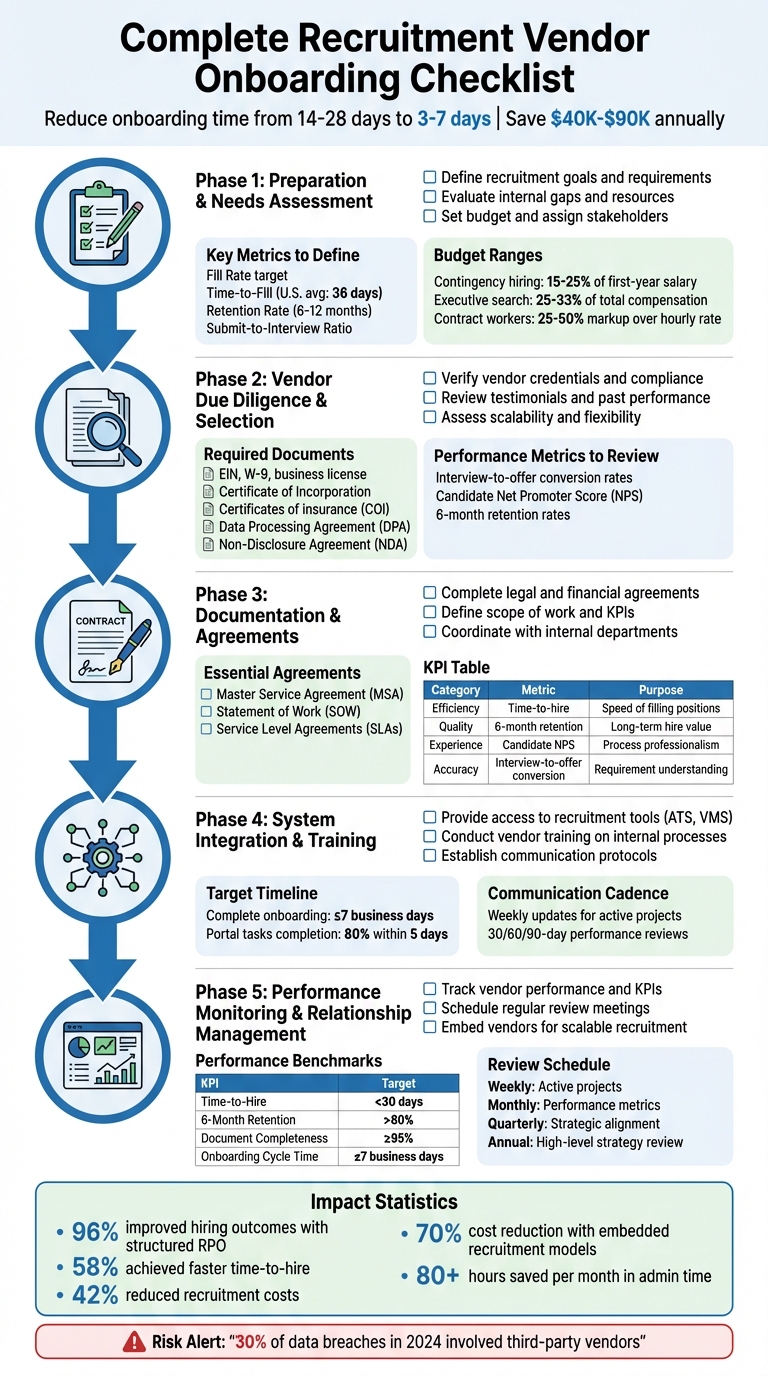
5-Phase Recruitment Vendor Onboarding Checklist with Key Metrics
Preparation and Needs Assessment
Define Your Recruitment Goals and Requirements
Start by documenting your exact hiring needs: how many roles need to be filled, what types of positions, and the timeline for each. Are you looking to fill 5 roles or 50? Are you hiring cybersecurity experts, machine learning researchers, or sales professionals? And how quickly do you need them – 30 days, 90 days, or longer?
Identify the main driver behind your hiring efforts. Is it speed, access to specialized talent, or the need to manage a high-volume surge? This clarity will help you set criteria for choosing the right vendor. Also, define the employment type: are these permanent hires, contract workers, or international roles requiring an Employer of Record solution? [6]
Establish clear metrics for success before any agreements are signed. Key performance indicators (KPIs) might include Fill Rate (the percentage of roles successfully filled), Time-to-Fill (target days to hire; the U.S. average is 36 days [7]), Retention Rate (the percentage of hires staying 6–12 months), and Submit-to-Interview Ratio. These metrics will act as a performance scorecard for your vendor. Remember, a bad hire can cost between 0.5x and 2x the employee’s annual salary [7], so quality benchmarks are critical.
Evaluate Internal Gaps and Resources
Before engaging external help, take a hard look at your current capabilities. Does your internal team lack the resources to build a sourcing pipeline for specific roles? Is the current workload delaying other key projects? A structured gap analysis can help you avoid paying a vendor to fix an issue you could resolve internally [7].
Review the capabilities of existing vendors or departments to see if they can meet your needs. You might already have a partner who can handle the work [2]. If the gap is genuine, assign a risk tier to the engagement. For example, Tier 1 might cover critical, high-cost roles with sensitive data access, while Tier 3 could handle routine, low-cost tasks. This risk assessment will guide how rigorous your onboarding and selection process needs to be [2].
Set Budget and Assign Key Stakeholders
Define your budget early in the process. For contingency hiring, fees typically range from 15% to 25% of the first-year salary. Retained search fees for executive roles are higher, often between 25% and 33% of the total compensation [7]. If you’re hiring contract workers, expect agencies to charge a markup of 25% to 50% over the worker’s hourly rate [7]. Know your spending limits and secure approvals before you start vendor discussions.
Appoint a single point of contact to manage the onboarding process. This person will oversee the vendor checklist, coordinate with Legal, Finance, IT Security, and Compliance, and address any issues that arise [4]. To keep things moving, set a firm timeline for onboarding tasks – such as completing them within 5 business days – so the process doesn’t stall [5].
When your goals are clear, gaps identified, and budget secured, you’ll be ready to dive into vendor evaluations with confidence. For more industry insights and hiring strategies, explore our recruitment blog.
sbb-itb-a23bd6a
Vendor Due Diligence and Selection
Verify Vendor Credentials and Compliance
Start by confirming the vendor’s legitimacy. Request essential legal and tax documents like their EIN, W-9, business license, and Certificate of Incorporation [4]. To gauge their financial stability, review audited financial statements, credit ratings, bank references, and valid Certificates of Insurance (COI) [9].
With data privacy standards constantly evolving, it’s crucial to secure a Data Processing Agreement (DPA) to clarify how candidate information is handled, including retention and deletion policies. Pair this with a Non-Disclosure Agreement (NDA) to protect your internal processes and candidate data. Modern vendors should also provide transparency around their AI sourcing practices by documenting training signals, blocking criteria, and consent logs [10].
When onboarding vendors, tailor your approach to the level of risk involved. For low-risk vendors handling routine tasks, a simplified process may suffice. However, strategic recruitment partners should undergo more rigorous due diligence and compliance checks [3].
Once you’ve verified legitimacy and compliance, shift your attention to evaluating the vendor’s real-world performance and quality.
Review Testimonials and Past Performance
Go beyond marketing materials by requesting sample candidate briefs, consent logs, and performance metrics [10]. Focus on key indicators like interview-to-offer conversion rates, candidate Net Promoter Score (NPS), time-to-hire, and 6-month retention rates. These metrics reveal whether the vendor consistently delivers quality candidates [10]. For instance, during a 2026 fintech hiring sprint, one recruitment partner that provided detailed data provenance and consent logs achieved a threefold improvement in both conversion and retention rates [10].
Also, check for industry-specific accreditations, such as PBSA, which signal a commitment to accuracy and integrity [11]. Be cautious with vendors whose high-volume outreach efforts result in low interview numbers – this often points to ineffective sourcing practices [10].
Next, evaluate whether the vendor has the capacity and flexibility to scale with your hiring demands.
Assess Scalability and Flexibility
Before signing a contract, ensure the vendor has a clear plan for scaling their internal teams while maintaining quality. Look for evidence of robust training processes and request quarterly trend reports and strategic roadmaps to confirm they can function as a long-term partner [12].
To test the waters, consider starting with a three-month pilot program. Define clear Service Level Agreements (SLAs) and include a "stop/go" checkpoint to assess performance. Use this trial period to measure real-world outcomes like conversion rates, candidate NPS, and retention. For long-term success, incorporate metrics like 6-month retention rates and performance deltas of hires into your contract. Schedule quarterly reviews to refine outreach strategies based on actual data [10].
For companies with fluctuating hiring needs, an embedded recruitment model offers flexibility without the added costs of traditional contingency fees. Rent a Recruiter‘s embedded model, for example, can reduce hiring costs by up to 70% (calculate your potential savings with an embedded recruitment ROI calculator) while maintaining consistent quality, even during hiring surges.
Documentation and Agreements
Getting the documentation and agreements right is key to turning vendor selection into a productive and compliant partnership.
Complete Legal and Financial Agreements
Start by formalizing the relationship through a Master Service Agreement (MSA) and a Statement of Work (SOW). These documents should clearly outline termination terms, deliverables, timelines, and intellectual property rights.
Secure the appropriate IRS tax form – either a W-9 or W-8BEN/E – and collect banking details through secure channels. If necessary, confirm the vendor’s financial stability to mitigate risks.
Make sure insurance certificates meet the agreed minimum standards. To stay ahead of expirations, set system alerts 60 and 90 days before certificates or licenses lapse, ensuring uninterrupted compliance.
With these legal and financial foundations in place, define the work scope and performance expectations upfront to avoid misalignment later.
Define Scope of Work and KPIs
Your SOW should include specific acceptance criteria for candidates. At the same time, establish measurable Key Performance Indicators (KPIs) within a Service Level Agreement. These metrics help track the partnership’s success and ensure accountability from the start.
| Recruitment KPI Category | Specific Metric | Purpose |
|---|---|---|
| Efficiency | Time-to-hire for agreed roles | Measures how quickly positions are filled |
| Quality of Hire | Six-month retention or performance improvement | Tracks the long-term value of hires |
| Candidate Experience | Candidate Net Promoter Score (NPS) | Reflects the professionalism of the recruitment process |
| Process Accuracy | First-pass interview-to-offer conversion | Shows how well the recruiter understands job requirements |
To maintain alignment, embed regular performance reviews – like 30/60/90-day evaluations or quarterly business reviews – into your agreement.
Coordinate with Internal Departments
Once contracts and KPIs are finalized, bring in your internal teams to ensure a smooth onboarding process. Assign a process owner, such as a Procurement Manager, to guide the vendor through the checklist and minimize delays. Your Legal team should tailor contract templates, execute NDAs, and ensure all necessary protections are in place. Meanwhile, Finance and Accounts Payable should handle tax forms, verify banking details, and set up payment terms like Net 30.
"Vendor onboarding is the process of gathering the information, documents, and approvals needed to approve and pay a new supplier. It ensures vendors are set up correctly in your systems before any work begins or payments are made."
– Ken Boyd, Accounting and Finance Expert, Ramp
If the recruitment vendor needs access to your applicant tracking system or candidate databases, loop in your IT and Information Security teams. They can review security questionnaires and finalize Data Processing Agreements (DPAs). Use a tiered onboarding approach based on vendor risk. Low-risk vendors might follow a streamlined 15-point process, while critical partners could require a deeper review of 60–80 items. For high-risk vendors, manual onboarding often takes 2–4 weeks, but automated systems can cut this to 5–10 business days [13].
System Integration and Training
Once your legal and operational groundwork is complete, the next step is integrating your recruitment vendor into your systems and ensuring they are trained to align with your internal workflows. This is where technical integration and proper onboarding play a critical role.
Provide Access to Recruitment Tools and Systems
For vendors to work effectively, they need access to your core systems. This often includes your Applicant Tracking System (ATS), Vendor Management System (VMS), and any internal procurement tools. Depending on your team’s communication setup, they might also need access to platforms like Slack or Microsoft Teams for real-time updates and collaboration [9].
Follow the "least-privilege" principle when granting access – only provide the data and permissions necessary for their role. Before issuing credentials, ensure your IT security team reviews and approves everything, especially for vendors handling sensitive data or working in high-risk areas [2]. Many modern platforms can sync onboarding portals with ERP systems, reducing manual errors and preventing unauthorized access [2]. For vendors managing high volumes, consider using Electronic Data Interchange (EDI) to replace manual spreadsheets with secure, automated data updates [9].
Conduct Vendor Training on Internal Processes
Effective vendor onboarding goes beyond access – it’s about ensuring they understand your systems and workflows. Start with a formal kick-off meeting to align on goals, key performance indicators, and communication expectations [1]. Use this time to introduce key stakeholders, such as connecting your accounts payable team with the vendor’s accounts receivable team.
Provide essential resources like brand guidelines, workflow instructions, and approval processes. Walk them through how to use your vendor portal for submitting data and documents [1]. Tailor the depth of training based on the vendor’s importance – strategic partners with higher risk or spend levels may need more detailed onboarding than transactional vendors [3].
"A smooth onboarding experience sets a positive tone for the entire partnership. It demonstrates professionalism, minimizes administrative headaches, and enables your new vendor to start delivering value faster." – Vendorfi [1]
Establish Communication Protocols
After technical setup and training, consistent communication ensures that both teams stay aligned. Assign a single point of contact to oversee the onboarding and manage the vendor relationship [4]. Make sure escalation paths are clear so everyone knows who to contact for issues that go beyond the primary contact’s scope [1].
Set a communication rhythm early on. Weekly updates are ideal for active recruitment projects, while 30/60/90-day reviews help track long-term performance [1]. Decide how updates and deliverables will be shared – whether through email, shared documents, or a vendor portal [2]. Also, confirm which collaboration tools will be used for daily interactions, ensuring vendors only have access appropriate to their responsibilities.
Kick off performance reviews during the onboarding phase to keep the momentum going. Top-performing procurement teams aim to complete onboarding within 7 business days, with at least 80% of vendor portal tasks finished within the first 5 days [2].
Performance Monitoring and Relationship Management
Once your vendor is fully integrated and trained, the focus shifts to maintaining and improving the partnership. Without consistent oversight, even the strongest vendor relationships can lose direction.
Track Vendor Performance and KPIs
Evaluate vendor performance against agreed metrics to ensure alignment. Key areas to monitor include:
- Time-to-hire: Aim for under 30 days for most roles.
- Interview-to-offer conversion rate: Ensure candidates meet your hiring standards.
- 6-month retention rate: Target over 80% to confirm hire quality.
- Candidate NPS: Track trends in candidate experience.
- Stakeholder satisfaction: Regularly check in with hiring managers to confirm vendor alignment with your processes.
- Onboarding efficiency: Measure cycle time (target: ≤7 business days) and document completeness (target: ≥95%).
Organizations leveraging structured RPO partnerships have reported significant improvements: 96% noted better hiring outcomes, 58% achieved faster time-to-hire, and 42% reduced recruitment costs [2][14].
| KPI Category | Specific Metric | Target Benchmark |
|---|---|---|
| Efficiency | Time-to-Hire / Time-to-Fill | Less than 30 days |
| Quality | 6-Month Retention Rate | Greater than 80% |
| Experience | Candidate NPS | Positive/Increasing trend |
| Onboarding | Cycle Time (Invitation to Active) | ≤7 Business Days |
| Compliance | Document Completeness | ≥95% |
Schedule Regular Review Meetings
Frequent communication ensures alignment and resolves issues promptly. Establish a meeting cadence based on activity and vendor importance:
- Weekly: For active projects.
- Monthly: To review performance metrics.
- Quarterly: For strategic alignment and broader discussions.
Conduct an annual high-level review to refine your vendor management strategy [4]. High-spend, strategic vendors may require more frequent and detailed check-ins than transactional suppliers [2][3]. Assigning a single internal point of contact can also streamline communication and maintain consistency across meetings [4].
Embed Vendors for Scalable Recruitment
Embedding recruitment vendors into your team creates a seamless hiring process. These vendors work within your systems and workflows, ensuring consistent data and full transparency into your pipeline [14]. This approach allows you to scale recruiter resources up or down based on hiring needs without compromising quality [14].
For example, embedded partners like Rent a Recruiter can integrate experienced recruiters into your team within days, managing the entire hiring process while bringing structure and efficiency. This model can cut hiring costs by up to 70% and save over 80 internal hours per month.
Shifting from task-based outsourcing to a consultative partnership is essential, as there are many benefits of outsourcing recruitment and selection processes. Vendors should proactively suggest workflow improvements, recommend technology solutions, and provide insights into the talent market [14][12]. They should also act as brand ambassadors, reflecting your company’s tone and values in every candidate interaction.
As Neha Naik, CEO and Founder of RecruitGyan, explains:
"An agency (or RPO) may contribute to a higher turnover rate if its main objective is to fill a role. If the agency is working with multiple companies, your company may not get the personalized attention it deserves to find a solid match for your nuanced culture and long-term needs" [14].
Establish clear escalation protocols for resolving issues like delayed hires or stakeholder dissatisfaction. Additionally, conduct quarterly audits to remove inactive vendor records and update compliance details [5]. With consistent monitoring and strong relationship management, your recruitment vendor can evolve into a true partner – an embedded extension of your team rather than just an external supplier. This approach strengthens your onboarding process and sets the foundation for sustained hiring success.
Conclusion
A strong onboarding process turns a signed contract into measurable value from your recruitment vendor. As Vendorfi puts it, "The selection process focuses on finding the right partner; the onboarding process focuses on activating that partnership" [1]. Without clear steps, you risk exposing your organization to security breaches, compliance issues, and delays – potentially costing over $35,000 per supplier when handled manually [8].
This checklist is designed to simplify integration and ensure your vendor delivers results quickly. By following a structured onboarding process, you can align your vendor with your goals, integrate them into your systems, and reduce inefficiencies. Companies using this approach have cut onboarding time from 14–28 days to just 3–7 days, while slashing staff hours per vendor from 18 to only 2–3 hours [2].
Onboarding isn’t just about paperwork – it’s a safeguard against risks and a foundation for success. Every vendor represents a potential vulnerability, and in 2024, third-party vendors were involved in 30% of all data breaches – double the rate from the previous year [8]. Steps like verifying credentials, defining KPIs, and setting clear communication protocols protect your organization while setting your vendor up for success.
For hiring that scales without adding administrative overhead, Rent a Recruiter embeds experienced recruiters directly into your team. This model manages the entire hiring process while bringing clarity and structure – cutting hiring costs by up to 70% and saving over 80 hours of internal admin time each month. Whether you need short-term hiring support or a long-term solution, embedded recruitment ensures your team can grow without unnecessary delays.
FAQs
What should I include in a vendor onboarding “risk tier”?
A vendor onboarding "risk tier" assesses the vendor’s potential security weaknesses, compliance obligations, and overall risk profile. This evaluation ensures the right onboarding steps and controls are in place, enabling a seamless and secure integration.
Which KPIs best prove a recruiting vendor’s quality of hire?
When evaluating a recruiting vendor’s ability to deliver top talent, focus on these key metrics:
- Candidate quality metrics: Measure how well candidates align with job requirements and their performance post-hire.
- Candidate experience scores: Gauge how candidates perceive the recruitment process, reflecting the vendor’s professionalism.
- Candidate Net Promoter Score (NPS): Assess how likely candidates are to recommend the hiring process to others.
- Sourcing effectiveness: Evaluate the vendor’s success in identifying and engaging the right talent.
These data points give a clear picture of the vendor’s performance in attracting and securing high-caliber candidates while maintaining a seamless hiring experience.
How do I give vendors ATS access without creating security risks?
To keep your ATS secure while granting vendor access, stick to the principle of least privilege – only give them access to the specific data and features they need to do their job. Implement role-based access control (RBAC) to block access to sensitive areas they shouldn’t touch.
Make sure to verify vendor credentials, perform thorough risk assessments, and work closely with your IT and compliance teams to define permissions. Use secure authentication methods and keep a close eye on access activity to minimize risks. Regular reviews are key to maintaining control.