
Yes, but only within strict legal boundaries. Employers can pursue Diversity, Equity, and Inclusion (DEI) initiatives, but hiring decisions must never be based on protected characteristics like race, sex, or age. Federal laws, such as Title VII of the Civil Rights Act, prohibit discrimination – whether intentional or unintentional – against any group.
Key Takeaways for Scaling Companies:
- Focus on process, not quotas: DEI strategies should aim to remove barriers, not enforce demographic targets. Examples include expanding outreach to underrepresented groups or removing unnecessary degree requirements.
- Stay compliant: Employment decisions cannot consider race, gender, or other protected traits, even partially. This applies equally to all groups.
- Avoid risky practices: Setting hiring quotas or basing decisions on identity creates legal exposure. The EEOC has clarified that even "well-meaning" actions can violate anti-discrimination laws.
- Adapt to state laws: Some states now restrict DEI initiatives, especially in public institutions. Align your practices with both federal and state regulations.
The bottom line? DEI can help you attract diverse talent, but success lies in creating fair, merit-based hiring processes – not in prioritizing identity over qualifications.
Legal Boundaries for DEI in Hiring
Federal Laws That Govern Hiring
Title VII of the Civil Rights Act of 1964 lays the groundwork for DEI practices in hiring. It prohibits discrimination in employment based on race, color, religion, sex (including pregnancy, sexual orientation, and transgender status), and national origin. This law applies to private employers, state and local governments, and educational institutions with at least 15 employees [3].
Additional protections come from laws like the ADA, ADEA, and GINA, which address discrimination based on disability, age, and genetic information [3].
The key takeaway? Employment decisions – whether it’s hiring, firing, or even deciding who gets an interview – cannot be influenced by protected characteristics. The U.S. Equal Employment Opportunity Commission (EEOC) emphasizes:
"Title VII’s protections apply equally to all racial, ethnic, and national origin groups, as well as both sexes" [1].
This includes protections against so-called "reverse" discrimination, making it clear that fairness must underpin all employment actions.
What the Law Allows
DEI initiatives are permissible when they aim to widen access to opportunities without relying on protected characteristics as a decision-making factor. For example, lawful practices include:
- Recruiting from Historically Black Colleges and Universities (HBCUs) or other institutions that serve underrepresented groups.
- Advertising job openings in outlets that reach diverse communities.
- Expanding hiring efforts beyond traditional networks.
- Applying neutral, job-related criteria consistently across candidates [2].
Programs like inclusive training and mentoring – available to all employees – are also allowed. The goal should be to refine processes to eliminate barriers, not to enforce quotas or predetermined outcomes.
Practices That Create Legal Risk
Some DEI strategies, while well-intentioned, can lead to legal complications. As the EEOC has clarified:
"An employment action still is unlawful even if race, sex, or another Title VII protected characteristic was just one factor among other factors contributing to the employer’s decision or action" [2].
Court cases like Frank v. Xerox Corp. and Taxman v. Board of Education highlight the risks of setting demographic quotas or favoring candidates solely to meet diversity goals [2].
Other practices that could trigger legal challenges include:
- Excluding candidates from consideration based on demographics.
- Segregating employees during DEI training sessions by race or sex.
- Making hiring decisions influenced by the racial preferences of clients, customers, or coworkers.
The EEOC has made it clear:
"Basing employment decisions on the racial preferences of clients, customers, or coworkers constitutes intentional race discrimination" [2].
Even claims of "business necessity" or a general interest in promoting diversity won’t shield employers from liability if intentional discrimination is involved.
sbb-itb-a23bd6a
Employment Law This Week® – EEOC/DOJ DEI Guidance, EEOC Letters to Law Firms, OFCCP DEI Enforcement
How to Implement DEI Hiring Legally
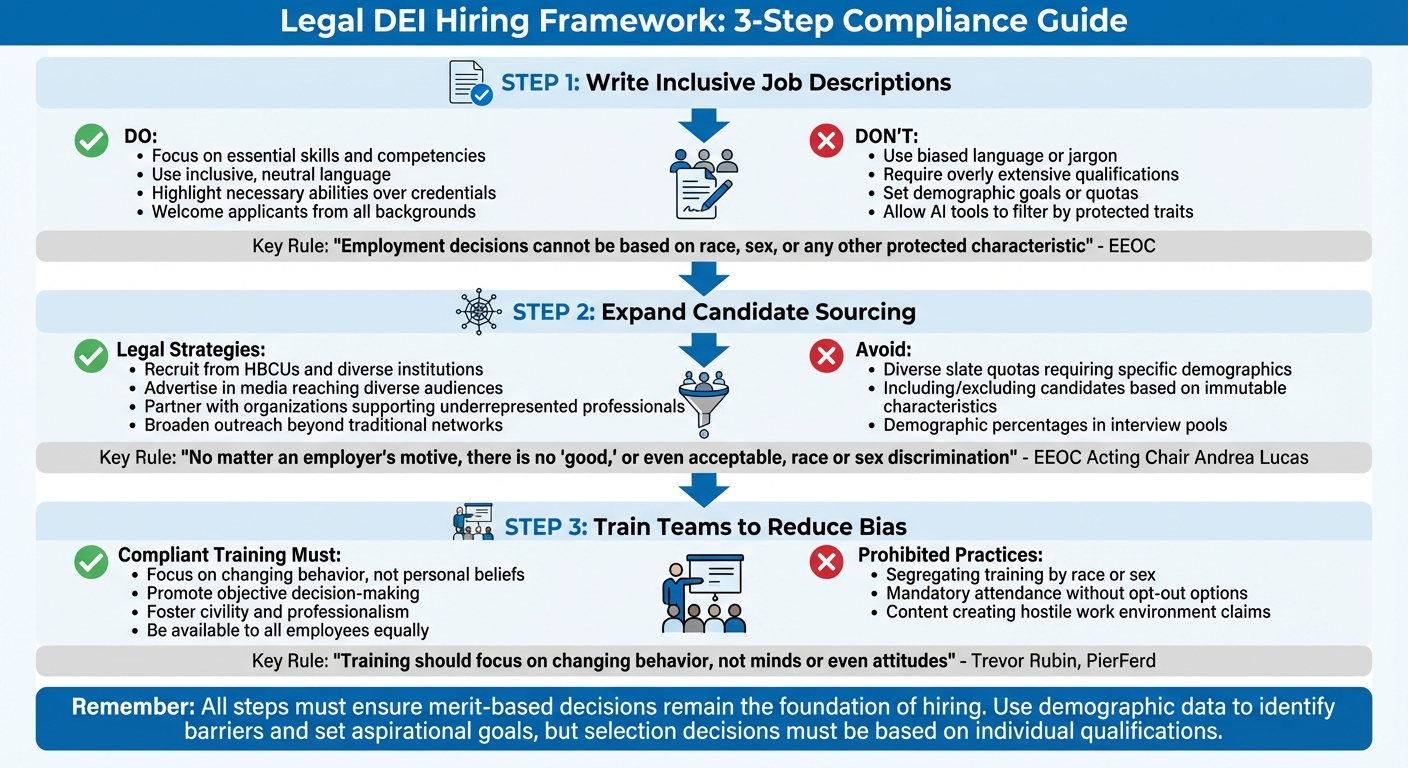
Legal DEI Hiring Framework: 3-Step Compliance Guide
Refining your hiring process to align with legal DEI frameworks ensures compliance with federal standards while promoting fairness.
Writing Job Descriptions That Attract Diverse Candidates
Your job descriptions play a critical role in shaping the diversity of your applicant pool. Eliminate biased language that might discourage qualified candidates from applying. Avoid casual terms or jargon that could unintentionally favor specific demographics. Overly extensive qualification lists can also deter some candidates – particularly women or individuals from underrepresented groups – who may hesitate to apply unless they meet every single requirement.
Instead, focus on the skills and competencies truly necessary for the role. For example, rather than requiring a degree from a specific institution, highlight the essential abilities and experiences needed to succeed. Be cautious with AI screening tools, as they can inadvertently filter candidates based on protected traits if not carefully monitored.
The EEOC emphasizes that while diversity programs can help expand applicant pools, "employment decisions cannot be based on race, sex, or any other protected characteristic" [5]. Use inclusive language to encourage applicants from all backgrounds, but avoid setting specific demographic goals or quotas in your hiring materials.
Once your job descriptions are inclusive, the next step is to expand your candidate sourcing strategies.
Expanding Where You Find Candidates
Widening your search for talent can be done legally and effectively by avoiding practices that exclude any group based on demographics. Consider recruiting from historically Black colleges and universities, advertising in media outlets that cater to diverse audiences, and collaborating with organizations that support underrepresented professionals.
However, be cautious with "diverse slate" policies that aim to mandate specific demographic percentages in interview pools. Such policies may violate legal standards if they require the inclusion or exclusion of candidates based solely on immutable characteristics. As Andrea Lucas, Acting Chair of the EEOC, has stated, "No matter an employer’s motive, there is no ‘good,’ or even acceptable, race or sex discrimination" [4]. Instead, design outreach efforts that broadly target underrepresented groups while ensuring that final hiring decisions are based on individual merit and qualifications. Use demographic data to identify barriers and set aspirational goals, but always ensure that selection decisions remain merit-driven.
After broadening your candidate pool, it’s crucial to train your team to recognize and mitigate hiring biases.
Training to Reduce Hiring Bias
Training hiring teams to address unconscious bias is essential, but it must be conducted in a way that complies with legal standards. Segregating training sessions by race or sex violates Title VII. The focus should be on changing workplace behaviors rather than personal beliefs. As Trevor Rubin of PierFerd explains, "Training should focus on changing behavior, not minds or even attitudes" [6].
Encourage objective decision-making during resume reviews and interviews. Former EEOC Commissioner Chai Feldblum highlights the importance of fostering a respectful workplace, noting that "uncivil behavior is the gateway drug to harassment" [6]. Promote civility and professionalism throughout the hiring process.
Additionally, allow employees to opt out of DEI-related training if they choose, without facing any negative consequences. Review training materials thoroughly to ensure they comply with Title VII standards and avoid discriminatory language. Having legal counsel review DEI training programs can help ensure alignment with current regulations and best practices. For more guidance on talent acquisition, explore our recruitment resources.
State Laws and Recent Legal Changes
Federal laws provide the framework for DEI hiring, but state legislatures are increasingly introducing measures that add new challenges. Companies must now navigate a growing web of state-specific regulations while adhering to federal standards. Since 2023, more than 80 bills targeting DEI policies have been introduced, with nine states banning affirmative action in employment by 2024 [7]. For businesses operating across multiple states, this creates a pressing need to carefully scrutinize their hiring practices and recruitment services.
States That Limit DEI Programs
Several states have passed laws that directly limit DEI initiatives, particularly in public institutions. For instance, Florida restricts public colleges from using state or federal funds for DEI programs and prohibits "political loyalty tests" in hiring. Texas has gone even further, eliminating DEI offices and staff at publicly funded colleges and banning mandatory diversity training and diversity statements based on identity [7]. Other states, such as North Carolina, North Dakota, Tennessee, and Utah, have implemented similar measures. In response, some organizations are shifting their language from "diversity" to "inclusivity" to align with these restrictions [7]. These legislative actions are shaping how courts and executive orders interpret DEI policies moving forward.
Court Rulings and Executive Orders Affecting DEI
The 2023 Supreme Court ruling in Students for Fair Admissions v. Harvard struck down race-conscious admissions policies under Title VI, a decision that some legal experts believe could influence corporate DEI programs regulated by Title VII [5][9]. At the same time, Executive Order 14173, titled "Ending Illegal Discrimination and Restoring Merit-Based Opportunity", has updated federal DEI standards for contractors [4]. In March 2025, the EEOC issued guidance clarifying that DEI efforts may violate the law if hiring decisions are influenced by an applicant’s race, sex, or other protected characteristics [4]. This guidance aligns state actions with federal prohibitions against discrimination, regardless of intent.
Additionally, a July 29 memo from Attorney General Pam Bondi argued that "diverse slate" policies requiring specific group representation in candidate pools could be considered discriminatory [8]. While nonbinding, this guidance has prompted several large companies to remove DEI-related language from their public disclosures. The focus is shifting toward expanding opportunities broadly, without targeting specific demographic outcomes [8].
Conclusion: Building Diverse Teams Within Legal Limits
Meeting DEI Goals Without Breaking the Law
Achieving diversity in hiring is possible while staying within legal boundaries. The key is to expand opportunities without giving preferential treatment, as required by federal and state laws. Title VII of the Civil Rights Act explicitly prohibits employment decisions influenced "in whole or in part" by protected characteristics like race or sex [2]. As EEOC Acting Chair Andrea Lucas emphasized:
"No matter an employer’s motive, there is no ‘good,’ or even acceptable, race or sex discrimination." [4]
To lawfully pursue diversity, focus on widening your talent pool to include underrepresented groups. Ensure Employee Resource Groups (ERGs) are accessible to all employees, including allies, and provide training and mentorship programs that are open to everyone, rather than targeting specific demographics. However, any DEI efforts that cross the line from outreach to preference could violate federal laws. Avoid quotas, remove demographic targets from performance evaluations, and ensure diverse slate policies encourage inclusivity without mandating or excluding individuals based on protected traits.
How to Improve Your Hiring Process
To ensure your hiring practices align with these legal standards, start by auditing your recruitment process. Examine job descriptions, sourcing strategies, and interview protocols to identify and address areas where protected traits might unintentionally influence decisions. Shift your DEI training to focus on promoting civility and fostering a respectful workplace environment, steering clear of content that could lead to claims of a hostile work environment. Keep in mind that Title VII protects all employees equally, and the EEOC does not differentiate between reverse discrimination and other forms of discrimination – it all falls under the same legal framework.
FAQs
What DEI data can we track without affecting hiring decisions?
You can monitor DEI (Diversity, Equity, and Inclusion) data by focusing on measurable goals, diversity metrics, and progress indicators. These tools help assess and improve your efforts in creating an inclusive workplace, all while ensuring they don’t interfere with individual hiring decisions.
Are “diverse slate” interview requirements legal under Title VII?
Yes, "diverse slate" interview requirements are typically allowed under Title VII, as long as they don’t lead to discrimination against individuals based on protected characteristics like race, gender, or other factors. These practices aim to promote fairness and inclusivity in hiring while staying within the bounds of anti-discrimination laws.
How can we spot and fix bias in AI resume screening tools?
Ensuring fairness in hiring and staying compliant with legal standards means tackling bias in AI-powered resume screening tools head-on. Start by auditing algorithms and training data regularly. This helps identify any biases related to protected characteristics like race, gender, or age. Another effective step? Blind screening – removing demographic information from resumes to focus solely on qualifications and experience.
When bias is detected, retraining the AI with diverse and representative datasets can help correct it. Adding a layer of human oversight during the review process further reduces the risk of unfair outcomes. Keep the process dynamic – continuous monitoring is key to maintaining fairness and improving hiring practices over time.