I see employer branding as a hiring promise you need to keep, not a shortcut to lower costs. Start by checking whether your job ads match actual pay, workload, flexibility, and career paths. Research links employer branding to applicant interest and intent to stay, but it does not guarantee more hires or fewer departures.
My approach is to focus on three checks:
- Prove your promises: Choose two or three strengths your employees can confirm, then use the same message across recruitment and onboarding.
- Measure hiring outcomes: Track qualified applications, offer acceptance, time to fill, cost per hire, and 90-day retention.
- Check what changed: Record pay changes and recruiting capacity alongside results before crediting branding for savings or faster hiring.
<u>The test is what happens after someone joins.</u> I would use employee feedback and hiring data to guide changes, with embedded recruitment support where your team needs help putting them into practice.
54 [EB Series] Linking Employer Brand and Experience at Scale | Meagan Michaels from Bupa Australia
sbb-itb-a23bd6a
What Research Says About Attraction and Retention
Applicant interest, completed applications, and employee retention are different measures. Scaling businesses need to track each separately. Research reviews distinguish attraction from commitment because engagement and identification do not prove that employees stay.[8] As hiring volume grows, gaps between recruitment promises and employees’ daily experience become harder to ignore.
Comparing Attraction and Retention Evidence
| Attraction evidence | Retention evidence |
|---|---|
| A systematic review of 60 studies (2010-2020) found recurring links to attraction. Measures varied and mostly tracked appeal or intent, rather than completed applications or accepted offers.[7] | A review of 66 studies reported findings on internal motivation and retention, but did not use a common measure of observed retention.[8] |
| A systematic review of 15 Gen Z studies (2018-2024) found positive links to attraction, mostly measured through perceptions or intent.[5] | The same review linked retention intent to value alignment, identification, and work-life balance, rather than verified turnover.[5] |
| These reviews do not establish a universal increase in qualified applications or offer acceptance. Differences in populations and measures limit comparisons.[7][8] | One sector-specific study identified organizational identification as a mediator between employer branding and retention.[9] |
Positive candidate opinions matter, but your hiring funnel needs to show whether interest becomes action. Compare matched roles or cohorts using qualified applications, offer acceptance, and observed retention at 6 and 12 months. Account for the possibility that already-engaged employees rate their employer more positively.
The test is whether your recruitment promises match employees’ daily experience.
What Makes Employer Promises Believable
Your employee value proposition (EVP) covers compensation, benefits, job design, development, flexibility, culture, and purpose. It gives you a way to test whether employer promises match employee experience.[8]
Pay and benefits can influence attraction. Development, recognition, autonomy, and manager quality can support engagement. Value alignment and believable career paths can support retention. The weight of each factor varies by role and employee group, so the same message will not work equally well for every hire.[8]
Gen Z reviews highlight work-life balance, meaningful work, sustainability, personal development, value alignment, and believable communication. Treat these as signals for that segment, not preferences shared by everyone.[5]
Check recruitment claims against your policies and employee feedback. Ask new hires at 30, 90, and 180 days which promises were fulfilled, unclear, or inaccurate. Use those checks to make the promises visible in hiring and onboarding.
Employer Branding and Hiring During Growth
As hiring volume grows, employer branding needs to become a repeatable hiring system, not just a careers-page exercise.
Tech, fintech, engineering, and professional-services roles each need role-specific proof points: mission, autonomy, security, safety, travel, utilization, and advancement.
These are applications of the research, not proof of causation.[6][10] For your hiring team, the practical test is whether recruiters, managers, and job ads deliver the same message.
Weak vs. Consistent Employer Branding
The table separates research-backed links from practical hiring practices.
| Area | Weak employer branding | Consistent employer branding |
|---|---|---|
| Applicant attraction | Generic or inflated claims may attract poorly matched applicants without explaining what sets the role apart. | Specific, believable messages explain the work, working conditions, and EVP. Research links employer-brand perceptions to job attraction and willingness to apply, not guaranteed hires.[13][14] |
| Candidate experience | Recruiters and managers may describe roles differently, creating inaccurate expectations. | Shared EVP language, role profiles, and job previews keep recruiter and manager messages consistent and accurate. |
| Retention | Unmet promises can lower satisfaction and commitment. Branding is one contributor, not the sole cause of turnover.[6][12] | Matching external promises to employees’ experience can support satisfaction, commitment, and retention.[10][6] |
| Process efficiency | Inconsistent messages create extra clarification work that becomes harder to handle as hiring volume grows. | Accurate, reusable messages reduce clarification work and make hiring easier to repeat across teams and locations. |
Candidate experience and process efficiency are practical interpretations, not established causal effects.
Replacement hiring can take recruiting capacity away from expansion hires. Departures can also cost you knowledge of customer accounts, systems, processes, supplier relationships, regulatory requirements, and informal ways of working.
That impact is likely greater in specialised engineering, fintech, SaaS, and professional-services roles, where knowledge can be difficult to document or transfer quickly. Track:
- Regrettable voluntary turnover and first-year attrition
- Time to productivity for replacement hires and repeat training hours
- Customer or project disruption
- The proportion of critical processes with documented backups
Employer branding may support workforce continuity. Research does not establish that it alone preserves knowledge or reduces turnover.[6][12]
Limits of the Evidence on Costs and Growth
Studies define employer branding, employer attractiveness, and EVP differently, which makes results hard to compare. Many measure perceptions or intentions rather than actual hiring outcomes. Cross-sectional studies cannot show causation, and convenience samples may not represent scaling U.S. SMEs. Findings also vary by company size, industry, and region.
Test cost claims against your own hiring data. Compare matched roles or teams before and after a defined change, across several hiring cycles. Separate internal recruiting labour, advertising, technology, and onboarding costs. Track accepted offers, actual departures, and manager hours.
Many factors beyond branding affect hiring and growth. Stronger evidence would use randomised or well-matched comparison groups and follow employees over time. Describe links to faster growth as associations unless the study design supports causation.
Put that consistency into practice through role profiles, recruiter guidance, and manager behaviour that reflect the promises you make.
Put Employer Branding Into Hiring Practice
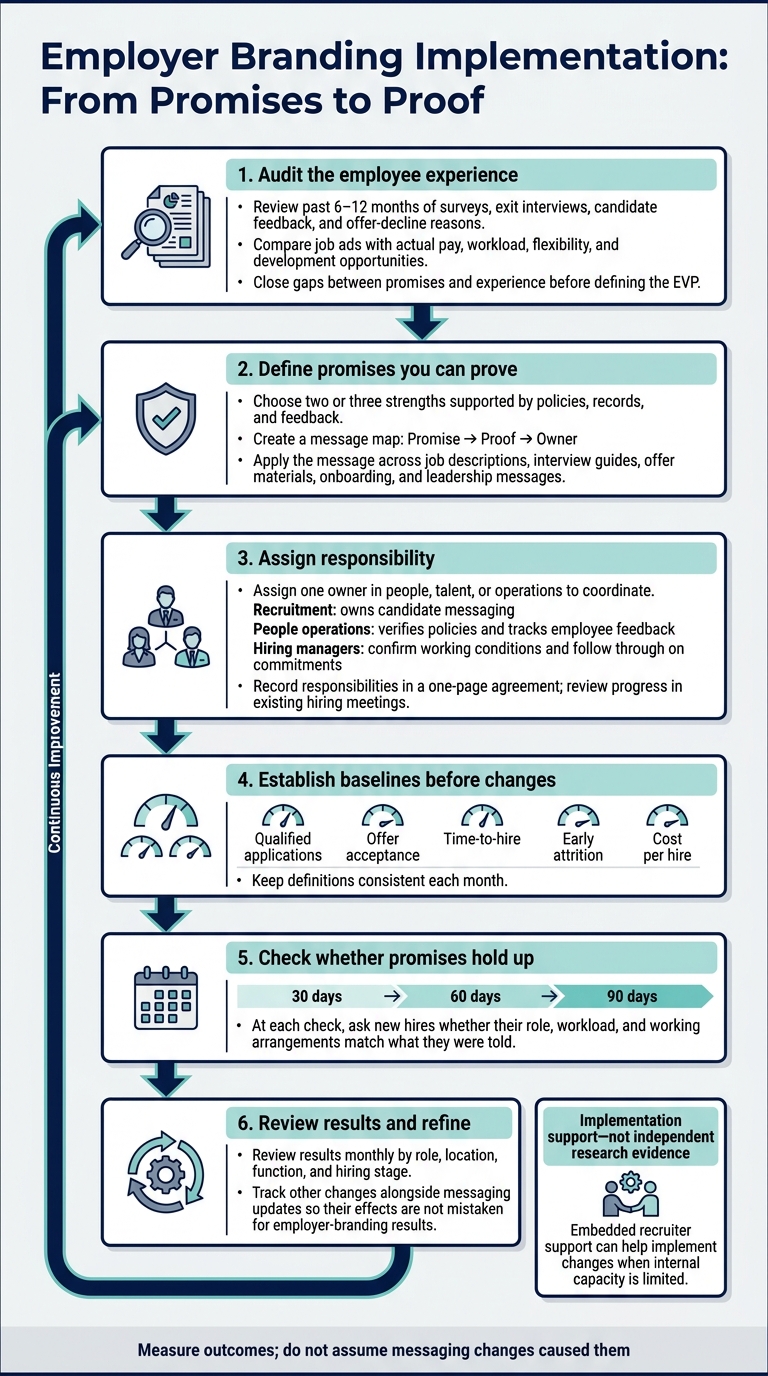
Employer Branding Implementation: From Promises to Proof
Review Employee Experience and Define Your EVP
Turn your findings into an EVP and hiring message you can back up. Review the past 6-12 months of employee surveys, exit interviews, candidate feedback, and offer-decline reasons. Compare job ads with actual pay, workload, flexibility, and development opportunities. Use that review to close the gap between what you promise and what employees experience, then define your EVP.[16][17]
Choose two or three strengths you can prove through policies, records, and feedback. Create a short message map linking each promise to its proof and an owner. Apply it across job descriptions, interview guides, offer materials, onboarding, and leadership messages.
Ask new hires at 30, 60, and 90 days whether their role, workload, and working arrangements match what they were told. Assign one person to keep the message consistent across hiring and onboarding.
Set Responsibilities and Track Results
Assign one owner in people, talent, or operations to coordinate the work. Recruitment owns candidate messaging. People operations verifies policies and tracks employee feedback. Hiring managers confirm working conditions and follow through on commitments.
Record these responsibilities in a one-page agreement and review progress in existing hiring meetings, rather than adding more meetings.
Before changing your messaging, establish baselines for qualified applications, offer acceptance, time-to-hire, early attrition, and cost per hire. Keep definitions consistent each month so you can compare results.
Review results monthly by role, location, function, and hiring stage. Track other changes alongside messaging updates so you do not mistake their effects for employer-branding results.
Use Embedded Recruiters to Support Implementation
If your team lacks time to put these changes into practice, embedded recruiter support can help. Rent a Recruiter places recruiters directly into your team to help apply employer-branding changes within your hiring workflow.[1]
Treat the service as implementation support, not independent research evidence.
Conclusion: Match Employer Promises to Employee Experience
Research links employer branding to attracting and retaining employees, but branding alone does not establish reduce costs or faster growth.[14][19][15] What matters is whether your promises hold up after someone joins. Compensation, management quality, and labor-market conditions also affect results.[18]
After making changes, review hiring results monthly as hiring volume grows. Track 90-day and one-year retention by cohort.[11] Record compensation changes and shifts in recruiting capacity alongside these results before crediting branding for any gains.[15][18]
If hiring demand exceeds your team’s capacity, schedule a call with Rent a Recruiter to discuss putting your employer brand into practice and adding embedded recruiting capacity as you grow.
FAQs
How can we build employer branding on a small budget?
A strong employer brand depends on consistency, honest messaging, and candidate experience, not a large budget. Review your reputation and interview top performers to define your Employee Value Proposition (EVP). Then use that message consistently across job descriptions, your careers page, and interview communications.
Share real employee stories and gather feedback from candidates and employees to check whether your hiring experience matches your message. As you scale, Rent a Recruiter can help you maintain that consistency through a structured hiring process.
How soon should we expect measurable results?
Measure employer branding on a consistent schedule, rather than reacting to weekly fluctuations. Review recruitment funnel metrics, including application volume and candidate experience, monthly. Check brand sentiment, quality of hire, and retention quarterly.
Use those quarterly reviews to spot trends, test whether your approach is working, and adjust your employer brand to match business goals and hiring needs.
What if employee feedback contradicts our hiring promises?
Treat this as a “brand-reality gap”: your employee value proposition (EVP) doesn’t match what employees experience. That gap erodes trust, lowers offer acceptance rates, and increases early turnover [1][2].
Find the mismatches quickly through anonymous employee Net Promoter Score (eNPS) surveys, stay interviews, and new-hire check-ins at 30, 60, and 90 days [1][3].
Fix the internal experience first. Then update your external messaging so leadership’s portrayal matches employees’ day-to-day experience [2][4].