
If you hire across the US, especially into states with strict contractor rules, you need a clear process before anyone starts work. This guide shows you how to check employee vs contractor status, where risk builds, what records to keep, and how to review roles before problems spread.
What you need to get right:
- Use more than one test, because IRS, DOL, and state rules do not always match
- Check control, dependence, and core business work, not just the contract label
- Track role changes over time, because contractor roles often drift into employee-like setups
- Keep the right forms and written reasoning on file, including W-9s, W-4s, contracts, and review notes
- Run scheduled reviews, especially for multi-state hiring, long contractor tenures, and contractor-heavy teams
One point stands out: classification is not just a legal issue, it is a hiring control issue tied to cost, speed, and internal workload. When your intake process is loose, HR, finance, and hiring managers end up fixing old mistakes instead of moving current hiring forward.
That is why scaling teams in SaaS, Technology, IT, Fintech, Engineering, Security, Insurance, and Professional Services put tighter structure around intake and hiring delivery. If internal capacity is stretched, Rent a Recruiter can support that process with recruiter support inside your team, helping you keep role scoping, approvals, and hiring workflows in line as volume grows.
Read on if you want a plain-English view of the rules, the risk points, and the checks you should have in place before the next hire or contractor renewal.
How to Properly Classify Employees and Independent Contractors
sbb-itb-a23bd6a
U.S. worker classification rules: IRS, DOL, and state tests
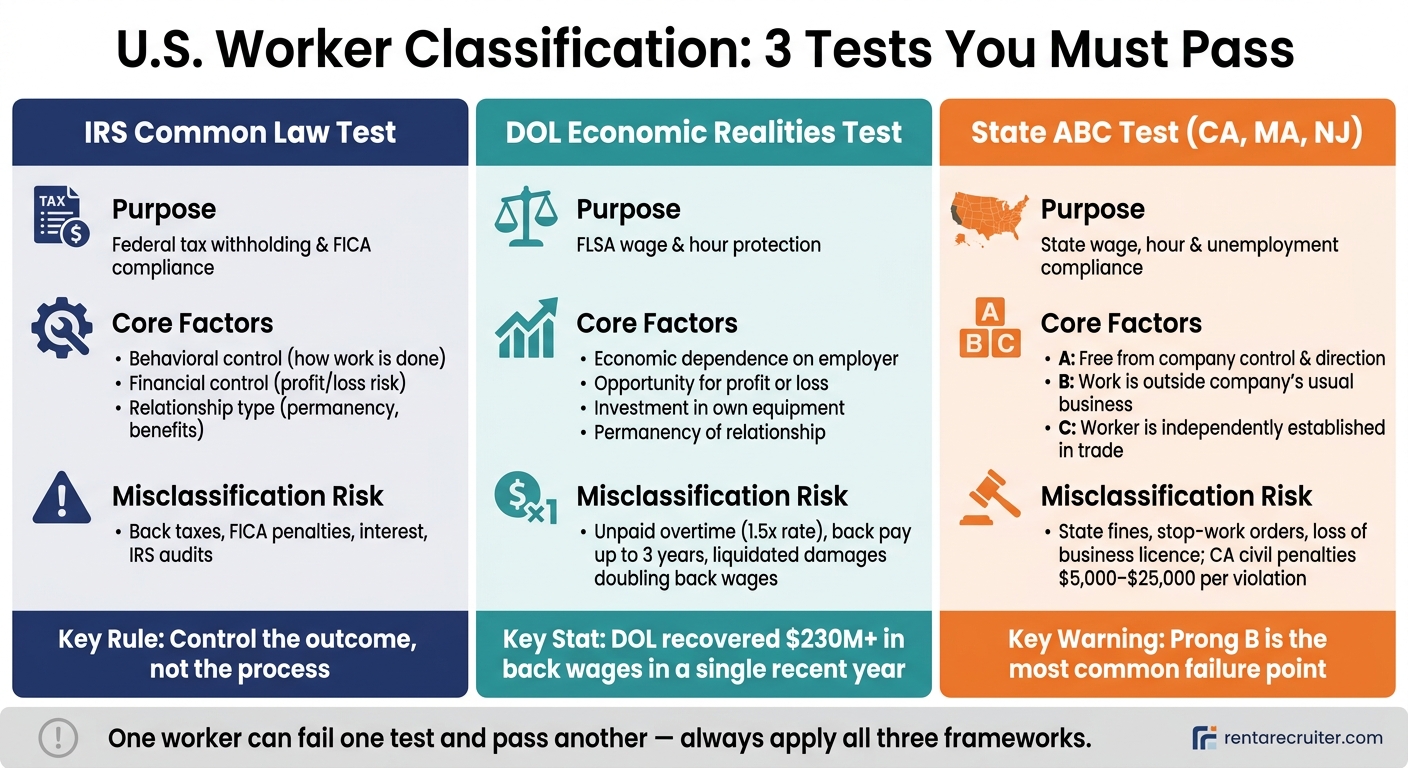
IRS vs DOL vs State ABC: Worker Classification Tests Compared
There isn’t one federal test that settles every worker classification issue.
That’s where many SMEs get caught out. Tax, wage and hour, and state labor rules can all use different tests. So the same worker might clear one test and fail another. That creates risk across payroll tax, overtime, benefits, and state enforcement.
How the IRS common law test evaluates control and independence
The IRS starts with one main point: who controls the work? It looks at that through three categories: behavioral, financial, and relationship type [3][4].
Behavioral control looks at whether your company directs how the work is done, not just what needs to be delivered. If you’re telling someone when to log on, what tools to use, or the order they should follow, that leans toward employee status [4].
Financial control looks at whether the worker has money at risk in their own business, whether they can make a profit or take a loss, and whether they offer services to the market more broadly [4].
Relationship type looks at how permanent the arrangement is and whether benefits are part of the deal. PTO and health insurance point toward employee status [4].
A simple rule helps here: control the outcome, not the process. If you’re giving a 1099 worker a laptop, software licences, or office space, that’s a red flag [3][4].
If the right classification is still unclear for federal tax purposes, an SME can file IRS Form SS-8 and ask for a formal determination [3][4].
How the DOL economic realities test and state ABC tests change the analysis
Tax treatment is only one part of the picture. Wage and hour law uses a different lens.
The DOL economic realities test applies under the Fair Labor Standards Act (FLSA). It asks whether the worker depends on your business for work, or whether they’re running a business of their own. Key factors include the worker’s chance to make a profit or take a loss, their investment in equipment, and how permanent the relationship is [2][4]. If the worker is economically dependent on your company, that points toward employee status under the FLSA [3].
State ABC tests are stricter still. States like California (AB5), New Jersey, and Massachusetts start from the position that the worker is an employee unless the company can prove all three prongs:
- A: the worker is free from the company’s control and direction
- B: the work is outside the company’s usual course of business
- C: the worker is independently established in that trade or occupation [2][4]
For many scaling companies, prong B is the problem. If the worker is doing work inside your core business, the test often fails there.
The table below shows how these three frameworks differ:
| Test | Primary Purpose | Core Factors | Misclassification Risk |
|---|---|---|---|
| IRS Common Law | Federal tax withholding and FICA compliance | Behavioral control, financial control, relationship type | Back taxes, FICA penalties, and interest |
| DOL Economic Realities | FLSA wage and hour protection | Economic dependence, opportunity for profit or loss, permanency | Overtime and minimum wage claims, back pay |
| State ABC Test | State wage, hour, and unemployment compliance | Freedom from control (A), outside usual business (B), independent trade (C) | State fines, stop-work orders, and loss of business licence |
Before the first payment, collect Form W-9 so the worker’s TIN is on file [3]. That step won’t fix a bad classification, but it does help you stay in line on the tax side while these rules shape the tax, wage, and benefit exposure covered next.
Misclassification risk: taxes, wage and hour exposure, and benefits issues
Misclassification happens when you pay someone as a 1099 contractor but manage them like an employee. The risk starts when the label on paper doesn’t match what happens day to day. If a worker fails even one of those tests, the fallout can spread across tax, wage, and benefits systems.
That matters because the same classification mistake can hit your business in more than one place at once. One worker can create tax exposure, wage claims, and benefit liability at the same time.
| Risk Category | Typical Triggers | Typical Exposure | Consequences |
|---|---|---|---|
| Tax Risk | Missing FICA withholding; incorrect W-2 or 1099-NEC filings | Employer FICA of 7.65%, potential liability for the worker’s share, up to $330 per unfiled or incorrect Form W-2 [4][5] | IRS audits, back taxes, interest, tax liens, personal liability for owners |
| Wage & Hour Risk | Set schedules; fixed location; contractor doing core business work | Unpaid overtime at 1.5x the regular rate, back pay up to 2 to 3 years for willful violations, liquidated damages can double back wages [1][6] | DOL investigations, private litigation, back pay orders |
| Benefits & Compliance | Company equipment; exclusivity; long-term tenure | Retroactive health premiums, 401(k) matching, PTO, workers’ compensation; in California, civil penalties between $5,000 and $25,000 per violation [6] | ERISA claims, reclassification work, reputational damage |
The DOL recovered over $230 million in back wages for workers in a single recent year, with FLSA violations making up most of those claims [1].
Where SMEs typically get classification wrong
Most issues don’t start with deliberate abuse. They start with ordinary management habits.
The most common one is role drift. A contractor begins as a short-term project resource, then slowly starts working like a member of staff. You see the signs early if you know where to look: company equipment, exclusivity, fixed schedules, and day-to-day supervision.
Another common mistake is when a manager starts directing a contractor’s daily output. That can mean setting deadlines, checking work in progress, or telling the person which tools to use. That’s the kind of behavioural control the IRS common law test looks for. Your contract wording won’t save you if your managers are treating the worker like an employee.
State ABC tests can also create trouble even when a federal review looks defendable. So what seems fine at one level can still turn into state-level exposure.
What remediation requires after a problem is found
Once a misclassification issue comes to light, whether through an audit, a worker complaint, or an internal review, you need a joined-up response.
Start with the numbers. Work out back pay owed, including unpaid overtime and any minimum wage shortfalls. Then review payroll, tax filings, and retroactive benefit exposure, including health coverage, retirement matching, PTO, and workers’ compensation. After that, account for the employer’s share of FICA, plus any penalties and interest.
The IRS Voluntary Classification Settlement Program, or VCSP, is one route worth knowing. Eligible employers can use it to reclassify workers for future periods and get partial relief from past federal employment tax liability [5][6]. It doesn’t wipe out past exposure, but it can cut the penalty load. Eligibility usually depends on a reasonable basis for the original classification and steady 1099 filing.
That’s the financial cleanup. But cleanup on its own isn’t enough. If you don’t fix your intake process, documentation, and review steps, the same issue can come back and cost you again.
How to build a worker classification compliance program
A classification compliance program should be simple, consistent, and built to catch risk early. The aim is prevention, not damage control once an audit is already under way. If you want classification review to work, it needs to become a repeatable hiring control, not a one-off legal exercise.
Start with a worker inventory. Pull together your payroll register and vendor list, then map every active worker into one view: W-2 employees, 1099 contractors, consultants, and temps. When HR, finance, and procurement each hold part of the picture, misclassification can slip through the cracks. Review every role in this order: IRS first, then DOL, then any state test that applies.
The table below lays out the process, owner, timing, and required documents.
| Step | Action | Owner | Timeline | Required Artifacts |
|---|---|---|---|---|
| 1. Inventory | List all active W-2 and 1099 roles | HR / Finance | Days 1–5 | Payroll register, vendor list |
| 2. IRS Test | Apply behavioral, financial, and relationship criteria | HR / Legal | Days 6–10 | Written classification analysis; Form SS-8 if status is unclear |
| 3. DOL / State Test | Apply economic realities and state ABC tests | HR / Legal | Days 11–15 | State-specific checklists |
| 4. Documentation | Draft rationale for each classification decision | HR / Legal | Days 16–20 | Role intake form, analysis memo |
| 5. Contracting | Issue agreement and collect tax forms | HR / Payroll | Pre-hire | IC agreement, W-9 (contractor) or W-4 (employee) |
| 6. Reporting | File quarterly and annual tax documents | Payroll | Ongoing | Form W-2, Form 1099-NEC, Form 941 |
You also need reclassification triggers. Without them, reviews tend to stop after the first pass. Certain changes should force an immediate re-check:
- a shift in job duties or reporting line
- a worker moving to another state
- the company supplying equipment or setting fixed hours
- a contractor engagement lasting 12 months or more
- a rule change that affects reporting thresholds or filing requirements [3][2]
Once you make the call, your paperwork needs to support it.
Documentation standards that hold up under audit
Documentation is what protects you when a worker files for unemployment or an IRS examiner starts digging into the file [2].
For every contractor engagement, keep a written classification analysis that explains why the role meets the IRS and DOL tests based on the way the work is actually done, not just the title in the contract. A contract helps, but it does not settle classification on its own. The file should also include a signed independent contractor agreement that matches day-to-day working conditions, including scope, deliverables, payment terms, and the lack of behavioral control.
For employees, collect Form W-4 before the first payroll run. For contractors, collect Form W-9 before the first payment so you do not run into backup withholding issues [2][3]. If status is still unclear after you apply all the tests, file Form SS-8 and get a formal IRS view instead of making a bad call.
Retention matters too. Under the FLSA, payroll records must be kept for at least three years, and time cards for two years. The IRS requires employment tax records for at least four years from the date the tax was due or paid [1]. Build those timelines into your document process now, while things are calm, not when an audit lands.
With the recordkeeping standard in place, the next pressure point is intake.
How to train recruitment teams to flag classification risks early
Most misclassification starts at intake, not in legal review. Recruiters and hiring managers shape the role before an offer is sent. They decide scope, control, reporting lines, and day-to-day expectations. If that setup looks like an employee role, calling it a contractor role on paper will not fix the problem.
Training should focus on the intake stage. Recruiters and hiring managers need to spot the warning signs early. Is the company supplying equipment? Is there a fixed schedule? Will the person report into a manager every day? Will the work be closely supervised? Those details can point toward W-2 status. A standard intake checklist gives you a clear checkpoint and cuts down on inconsistent judgment.
Cross-team coordination needs to happen early as well. HR should own the classification analysis. Finance should track total contractor spend across the year so 1099-NEC filing duties are not missed. Payroll should confirm that the right tax forms are in place before payment starts. That kind of handoff saves time and cuts the odds of cleanup work later.
How Rent a Recruiter can support structured, scalable hiring workflows

When hiring picks up fast, after a funding round, a product launch, or a sharp jump in demand, process discipline often takes a hit.
Rent a Recruiter places experienced recruiters directly into your team, often within days, to manage hiring from intake through to offer with a consistent process. For high-growth SMEs in technology, SaaS, fintech, engineering, and professional services, that support helps keep intake steps steady and team coordination tighter as hiring volume grows.
The business upside is straightforward: more control, less drift, and faster internal review cycles. When your intake process stays consistent, quarterly audits take less time and are far easier to repeat as headcount grows.
Monitoring, audits, and next steps for ongoing compliance
Once you’ve put intake controls, documentation, and recruiter training in place, the next job is keeping those decisions on track. A one-time review is not a compliance program. Classification can drift over time as roles shift, contractors move to another state, and filing thresholds change. A light quarterly review helps you keep pace without adding a lot of admin.
Quarterly audits catch classification drift before penalties pile up.
What to audit each quarter in rapid hiring
Four areas need a close look every quarter.
First, flag any contractor engagement that has passed the 12-month mark. Duration and exclusivity are major triggers for IRS and DOL scrutiny, and a long-running engagement that now looks like employment is exactly what examiners look for [2][6].
Second, check for state residency changes. If a contractor moves to California, Massachusetts, or New Jersey, you’re now dealing with strict ABC test rules, where your business must prove that worker meets the test [2][6].
Third, review contractor-heavy teams to see whether any contractor is now doing a core business function. For example, a developer sitting inside a software company’s product team needs an immediate re-check under prong B of the ABC test [6].
Fourth, compare a sample of time records against invoices. The aim is simple: make sure managers are not controlling how and when the work gets done [1].
The quarterly audit should test whether the original classification still fits the current setup. That means checking control, independence, and ABC prong B. Use this dashboard to track triggers, owners, and review timing.
| Key Indicator | Internal Owner | Review Cadence | Legal Framework Monitored |
|---|---|---|---|
| Engagement duration (flag >12 months) | HR / Hiring Manager | Quarterly | DOL Economic Realities Test |
| State residency changes | Payroll / Finance | Quarterly | State ABC Tests (CA, MA, NJ) |
| 1099-NEC spend (threshold: $2,000) | Finance | Monthly | IRS 1099-NEC reporting threshold |
| Behavioral control (methods, tools, training) | Department Head | Quarterly | IRS Common Law Test |
| Tax form on file (W-9 for U.S. contractors) | Finance / Admin | Monthly | IRS W-9 compliance |
| Core-function test (ABC prong B) | HR / Legal | Quarterly | DOL / State ABC Tests |
Track total annual spend per contractor. The 1099-NEC reporting threshold is $2,000 for 2026 payments, with inflation adjustments starting in 2027 [3].
How to turn compliance into a repeatable hiring control
This only works if ownership is clear. Assign one owner to each dashboard indicator, run the review on a fixed schedule, and treat any flagged issue as a hold before payment or renewal.
That matters even more when hiring volume jumps. This is usually when teams cut corners, not because they want to, but because speed takes over. That’s where structure saves money.
Embedding experienced recruiters directly into your team, as Rent a Recruiter does for high-growth SMEs, can help keep hiring workflows structured and consistent when internal capacity is stretched. For CEOs, CFOs, and HR leaders, that means fewer year-end surprises, less compliance cleanup, and a hiring process that’s easier to control.
The next step is to assign owners to each trigger and review every contractor before renewal.
FAQs
Which worker classification test matters most?
No single test settles worker classification. It depends on the legal setting and the agency reviewing the relationship.
For federal tax purposes, the IRS generally applies the common law test. For FLSA compliance, the Department of Labor applies the economic realities test. States and other agencies may use different criteria, so each worker relationship needs its own review.
That matters for your business because the same worker can be judged under different rules depending on the issue at hand. If you treat classification as a one-size-fits-all decision, you can run into tax risk, wage and hour exposure, and costly compliance problems.
When should a contractor be reclassified as an employee?
Reclassify a contractor as an employee when the relationship moves from output-based work to one where you control how the work gets done.
If you set their hours, assign day-to-day tasks, dictate methods, or require them to work from a set location, that’s a strong sign the role now looks like employment. The same applies if the person becomes a permanent part of your core team, receives training, or gets employee-style benefits.
From a risk point of view, this matters. Once you control the work in a way that fits Department of Labor and IRS tests, keeping that person on a contractor setup can create tax, compliance, and worker classification issues.
What records should I keep for classification compliance?
Keep records that back up your worker classification decision. Focus on the three areas the IRS looks at: behavioral control, financial control, and the relationship between the parties.
In practice, that means keeping the right paperwork on file before work starts and before you make a first payment. For U.S.-based contractors, get a signed Form W-9. For foreign contractors, collect Form W-8BEN or W-8BEN-E, depending on the entity type.
You should also have a written contract in place. It needs to cover:
- scope of work
- fees
- payment schedule
- intellectual property ownership
- termination terms
This is not just admin. Good documentation helps protect your business if a classification decision is ever questioned, and it gives your finance and hiring teams a clear paper trail from day one.