
Poor hiring process costs money fast. If you are scaling in SaaS, IT, fintech, engineering, security, insurance, or professional services, recruitment risk training helps you cut hiring errors, reduce legal exposure, and keep hiring on track.
Here’s the short version:
- Bad hires are expensive, often costing 30% to 200% of salary
- Loose hiring process creates risk, from weak documentation to poor interview discipline
- Manager-led hiring needs structure, or costs climb through delays, rework, and agency spend
- Training should focus on actions, not theory: structured interviews, documentation, data handling, and checks
- Results should be tracked, using time-to-hire, process adoption, compliance issues, and admin time
For many scaling companies, the issue is not just hiring more people. It is keeping control as hiring volume grows.
That usually means three things:
- Clear hiring steps
- Better manager discipline
- Tools that make the process easier to follow
If your team is stretched, embedded recruitment can help put those controls into day-to-day hiring. Providers such as Rent a Recruiter place recruiters inside your team, which can cut hiring costs by up to 70% compared with agency fees and save 80+ hours per month in hiring admin.
Below, I break down what recruitment risk training should cover, where the main risks sit, and how to turn training into lower cost, less admin, and better hiring control.
The Recruitment Risk Landscape: What Can Go Wrong and What It Costs
Recruitment risk usually shows up in four areas: legal and compliance, process and documentation, data and privacy, and fraud and verification. You do not need a giant risk register to act on this. What matters is knowing which controls your training needs to lock in.
In simple terms, these are the risks your training programme must cut.
Legal, process, data, and fraud risks
Legal risk often starts with everyday hiring habits that feel harmless until they are not. A job ad drifts into discriminatory language. Screening changes from one manager to the next. Background checks are handled badly. I-9 paperwork is incomplete or wrong.
The cost can be steep. FCRA-related class actions have led to settlements ranging from about $420,000 to more than $4 million for individual employers.[6][7][8][9][10][11] I-9 errors can trigger fines of up to $2,861 per form, while knowingly hiring unauthorised workers can cost up to $28,619 per worker for repeat offences.[19][20][21][22]
Process risk is less dramatic on the surface, but it causes damage fast. Missing scorecards, changing interview questions, and informal sign-off leave you with no audit trail. If a candidate challenges the decision, you have little to point to. That gap creates liability and makes a weak hiring process even harder to defend.
Data risk is just as direct. Candidate details sitting in unprotected spreadsheets or moving around by email can expose sensitive personal data. If that happens, remediation and notification costs can reach $25,000 to $100,000, depending on how many candidates are affected.[4]
Fraud and verification risk tends to hit twice. First, you hire the wrong person. Then you pay to replace them. False credentials, made-up work history, and weak right-to-work checks all sit in this bucket.
Bias and reputational risks in manager-led hiring
Manager-led hiring without structure is where bias slips in. Unstructured interviews are weak predictors of performance and are highly open to halo effect, similarity bias, and first-impression bias.[12][13][14][15][16][17][18]
That matters because once managers start hiring on gut feel or vague culture fit, decisions move away from job-related criteria. They drift towards protected characteristics, whether anyone means for that to happen or not.
The business cost builds over time. Homogeneous hiring can shrink the strength of your candidate pool. Poor candidate experiences spread through review sites and social media. In tight markets, that makes hiring harder and slower.
For high-growth SMEs, this often leads to:
- Longer time-to-fill
- More spend on external agencies instead of using structured talent acquisition services
- More pressure on internal leaders to fix avoidable hiring issues
This is where training pays for itself. Better interviewer discipline means lower risk, stronger hiring decisions, and less wasted spend.
How to rate likelihood and impact
Not every risk needs the same level of attention. A simple likelihood × impact matrix helps you sort what needs action first. Rate each risk by how often it happens and what it costs when it does.
| Risk Category | Description | Common SME Scenario | Impact | Urgency |
|---|---|---|---|---|
| Legal / EEOC discrimination | Discriminatory ads, biased screening, disparate impact in selection | Manager relies on word-of-mouth recruiting; interview questions drift into protected areas | Legal fees and settlements from $50,000 to $250,000 or more.[4][3] | Critical |
| Process / documentation | Inconsistent interviews, missing scorecards, ad-hoc approvals | Contested hiring decision with no written evaluation record | $5,000 to $15,000 in re-hiring or bad-hire costs.[1][2][5] | High |
| Data / privacy | Unsecured candidate PII, uncontrolled spreadsheet access, no retention policy | Candidate data shared on an unprotected email thread | $25,000 to $100,000 in remediation and notification costs.[4] | High |
| Fraud / verification | Falsified credentials, misrepresented work history, I-9 errors | Candidate fabricates a degree; role must be backfilled | $5,000 to $15,000 in bad-hire costs, plus up to $28,619 per worker in I-9 fines for repeat violations.[1][2][5][19][21][22] | High |
| Bias / reputational | Unstructured interviews, vague criteria, similarity bias | Manager selects based on culture fit without defined competencies | Indirect costs through turnover, longer time-to-fill, and agency dependence. | High |
Use these rankings to decide which controls and skills your training programme should cover first. Then turn each risk area into practical capability: better interviews, cleaner documentation, and tighter verification checks.
sbb-itb-a23bd6a
What to Train: The Core Skills That Reduce Recruitment Risk
If you want lower hiring risk, train for the points where decisions break down.
Not broad awareness. Not one-off workshops. Practical skills tied to clear actions and controls.
The table below gives you a working blueprint.
| Training Module | Primary Risks Addressed | Key Practices Taught | Target Outcome |
|---|---|---|---|
| Compliance Basics | Legal / unlawful discrimination | Lawful vs. unlawful interview questions, EEO and Uniform Guidelines on Employee Selection Procedures principles, pay transparency obligations, ADA accommodation notices | Reduced legal exposure; consistent, defensible screening |
| Structured Interviews | Bias, process inconsistency | Job-related competency questions, standardized rating scales, same question order for all candidates | Stronger hiring decisions; improved candidate fairness |
| Documentation Discipline | Process / audit risk | Scorecards, decision summaries, rejection rationales, centralized record storage | Audit-ready records; faster dispute resolution |
| Bias Reduction & Fair Decisions | Bias / reputational risk | Independent scoring before group discussion, calibrated panels, evidence-based evaluation | Lower adverse impact risk; more consistent hiring |
| Data Handling & Security | Data / privacy | Role-based access controls, approved storage systems, retention schedules | Reduced breach risk; regulatory compliance |
| Verification & Fraud Prevention | Fraud / credential risk | Structured reference checks, credential verification, background checks that follow FCRA rules, escalation steps | Fewer bad hires; stronger hiring integrity |
Use this map to train by role, not by general awareness.
Compliance basics, structured interviews, and documentation discipline
The aim of compliance training is simple: make lawful hiring habits routine.
That means teaching managers which questions are off-limits, how to write job ads around core job functions, and where salary ranges must be posted. When those basics are clear, you cut legal risk early, before it turns into a complaint or a stalled hire.
Structured interviews bring discipline into decision-making. Every candidate gets the same job-related questions, the same scoring rubric, and the same sequence. Train hiring managers to choose questions linked to specific competencies before the role opens, score each answer against a standard scale, and stick to the same order across the process.
Why does that matter? Because consistency cuts risk. It also gives you a cleaner basis for comparing candidates and defending decisions if someone challenges the outcome later.
Documentation discipline is what holds the whole process together. Train every hiring manager to set selection criteria before the role opens, record interview notes against specific competencies, and store records in one central system, not a personal inbox or a local spreadsheet.
Federal guidance recommends retaining recruitment records, including applications, interview notes, and rejection reasons, for up to four years in some contexts.[25][23][24]
That kind of recordkeeping does more than support compliance. It also saves time when issues come up. If your team needs to explain a decision six months later, good records turn a scramble into a straightforward review.
Bias reduction, fair decision-making, and data handling
Bias training only works when it changes how decisions get made.
Awareness on its own won’t do much. Process change will. That includes independent scoring before group discussion, calibrated panels, standard evaluation criteria, blind resume review, and decisions tied to job-related evidence instead of gut feel.
This is where many hiring teams slip. They think bias shows up as obvious bad behavior. More often, it appears in loose processes, uneven scoring, and panel discussions where the loudest voice sets the direction. Tightening the process lowers that risk.
You can measure whether the training is working by tracking:
- Pass-through rates by gender or ethnicity, where collected
- Interview score distributions
- Offer acceptance rates
- Candidate satisfaction scores
Those signals show whether behavior is changing, or whether the team just got better at talking about bias.
For data handling, train your team on role-based access. Interviewers should only see the information they need to assess competencies. Sensitive material, such as background check results, should stay with HR or a designated recruiter.
You also need clear rules for where candidate data is stored, how long it stays there, and what triggers a purge. Loose data handling creates avoidable risk. Clear controls cut privacy exposure and support compliance.
Verification and fraud prevention controls
Verification should not depend on how careful an individual manager happens to be.
Train your team to run structured reference checks with standard question sets tied to job performance and reliability. That is far safer than open-ended calls that shift from one manager to the next.
Credential checks should also be a defined step, not an optional one. In regulated sectors, a fabricated degree or an invalid license creates direct business risk. In any sector, it can lead to a bad hire that costs time, money, and internal trust.
Where background checks are used, FCRA compliance is non-negotiable. That means proper consent, correct adverse-action procedures, and documented handling at each step.
Define escalation steps for issues like mismatched dates, conflicting references, or unverifiable credentials. If those cases are left to ad hoc judgment, risk creeps back into the process.
These controls work best when they are built into a repeatable hiring system, not left to memory or manager preference.
Next, turn these skills into a role-based rollout plan managers can follow consistently.
How to Build and Roll Out a Recruitment Risk Training Program
Once the core skills are in place, you need a rollout plan that works in the day-to-day. The goal is simple: make training practical, role-specific, and built into how hiring already happens.
Start with a hiring risk audit and role-based training plan
Start by pinpointing where your hiring process slips. Review each stage, intake, sourcing, screening, interviews, offers, and recordkeeping. Look for decisions that happen informally, go undocumented, or vary from one manager to another. Check recent interview notes. Confirm approvals were logged. Look for missing scorecards or uneven selection criteria across teams. Those gaps should shape your training priorities.[26][27]
Once you have a short list of the highest-risk issues, build training around roles, not broad theory. Each group needs to know what it owns, where risk shows up, and what good looks like in practice.
| Hiring Stage | Main Risk | Required Control | Training Applied |
|---|---|---|---|
| Job scoping & approval | Vague criteria, unapproved headcount | Approved job description template, headcount approval | Leadership training on hiring governance |
| Sourcing | Inconsistent outreach, poor recordkeeping | Standardized sourcing checklist | Recruiter training on documentation and data handling |
| Screening | Bias in resume review, inconsistent criteria | Approved screening criteria, standardized review checklist | Hiring manager training on fair evaluation |
| Interviewing | Bias, weak questioning, undocumented decisions | Structured interview guide, scorecard | Structured interview and bias reduction training |
| Verification & references | Credential fraud, inconsistent checks | Verification checklist, clear escalation path | Fraud prevention and verification training |
| Offer approval | Unauthorized terms, inconsistent approvals | Offer approval workflow, standard template | HR and leadership training on offer controls |
| Records retention | Missing files, privacy failures | Centralized storage, defined retention schedule | Data handling and documentation discipline training |
Training should match responsibility. Recruiters own compliance and data handling. Hiring managers own structured interviews and fair evaluation. HR owns policy and escalation. Leadership owns oversight.[27][28]
That split matters. If everyone owns everything, no one owns anything.
Use repeatable tools that support scale
Training alone won’t fix inconsistency. People are busy. Managers take shortcuts. That’s why the process itself needs to make the right action easier.
Scorecards keep evaluation tied to the same competencies. Interview kits pull the role brief, approved questions, scoring criteria, and process reminders into one package. Approval workflows make sure headcount, salary, and offer terms are reviewed before anyone moves ahead. Documentation checklists cut down on missing records. Hiring dashboards give leaders a clear view of pipeline health, approval delays, and compliance completion, so issues show up early instead of after a bad hire.[27][29][30]
Put simply, these tools cut manager-to-manager variation. They turn training from a one-off session into a repeatable hiring system.
Where embedded recruitment support fits
If your internal team is stretched, outside support can help keep the process steady in practice, not just on paper. Rent a Recruiter places experienced recruiters inside your team to manage hiring end-to-end. They apply structured processes in real time and coach hiring managers as work happens, which helps training stick in day-to-day hiring.
For scaling SMEs, this model can cut hiring costs by up to 70% compared with commission-based models and save over 80 hours per month in internal hiring and admin time. The commercial upside is clear: lower spend, less admin drag, and a more consistent process as headcount grows.
How to Measure Results and Keep Training Effective
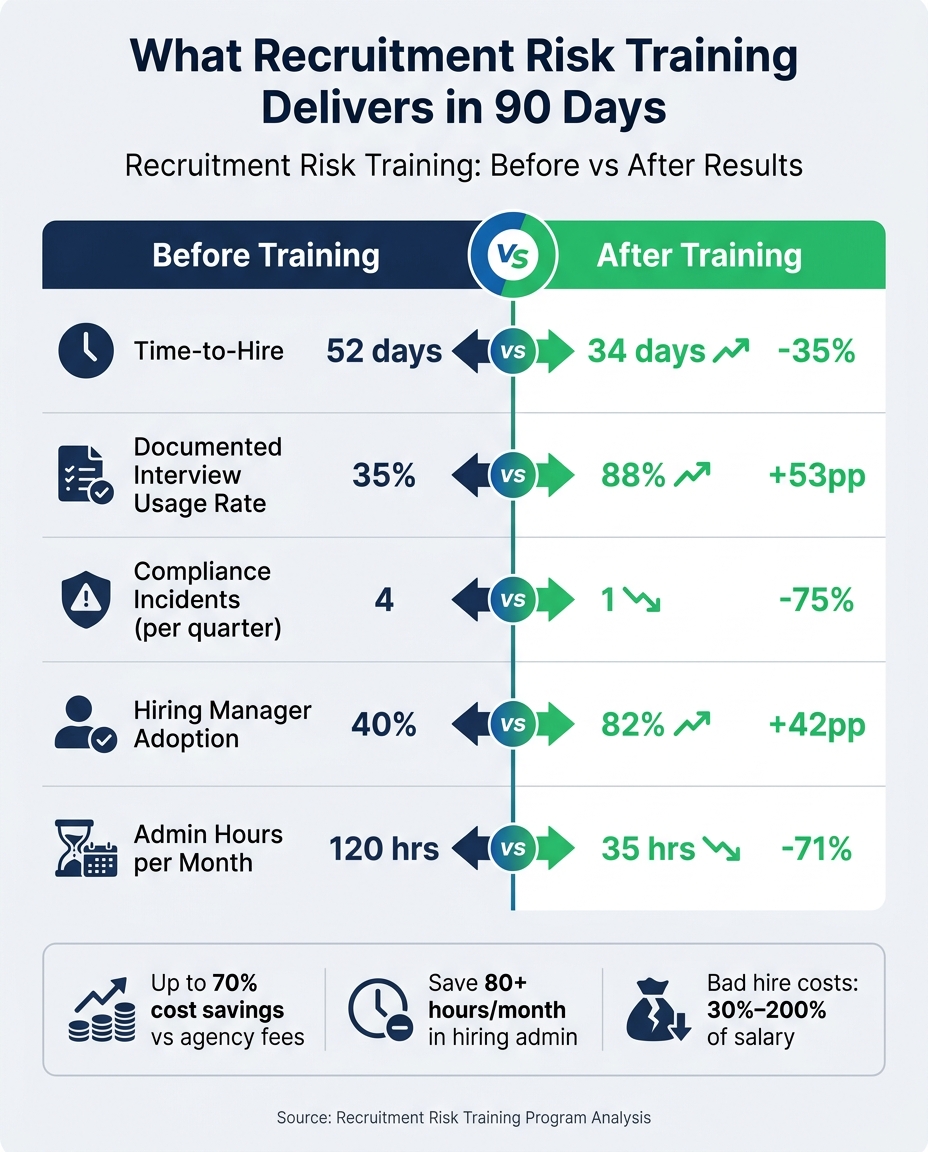
Recruitment Risk Training: Before vs After Key Metrics
The metrics that matter to leadership
Once the tools are in place, you need to see if they’re changing hiring behaviour. It’s not enough to launch training and hope it sticks. You need proof that managers are using the process, and that the process is cutting risk.
Use the controls from the previous section to measure whether training is changing outcomes. Once hiring controls are in place, track whether they are being used and whether they are reducing risk.
Focus on five metrics:
- Time-to-hire in days, from approved requisition to accepted offer
- Documented interview usage rate, the share of roles using a standardised template and completed scorecard
- Documented compliance incidents per quarter
- Hiring manager adoption, the percentage of managers actively following the standard process
- Admin hours saved per month versus baseline
These five metrics link straight to what leadership cares about most: cost control, hiring speed, and the ability to scale without chaos.
Compare a 3-month baseline before training against the same metrics 3 months after rollout:
| Metric | Before Training (3-month avg) | After Training (3-month avg) |
|---|---|---|
| Time-to-hire (days) | 52 | 34 |
| Documented interview usage rate (%) | 35 | 88 |
| Compliance incidents (per quarter) | 4 | 1 |
| Hiring manager adoption (%) | 40 | 82 |
| Admin hours per month (approx.) | 120 | 35 |
The pattern is easy to read. Faster hiring, fewer compliance issues, higher process adoption, and less admin time. That’s the kind of reporting a CEO, CFO, or HR leader can act on.
Define each metric once and keep the method the same every quarter. For time-to-hire, use the requisition approval date as your start point and the accepted offer date as your end point. For cost tracking, report in USD and split internal costs from external agency spend, so finance can see exactly where savings are coming from.
Audit, refresh, and improve the program each quarter
Metrics tell you if hiring is getting better. Audits show where the process is slipping.
Each quarter, audit 10% to 20% of filled roles for scorecards, decision notes, and approvals. Use the dashboard to decide which parts of the process to sample that quarter. That keeps the review focused and stops the audit from turning into a box-ticking exercise.
Legal review matters too. Check state-level rules on pay transparency, background checks, and record retention with legal counsel each quarter. Rules change, and if your process doesn’t keep up, risk creeps back in.
Then run 45- to 60-minute refreshers based on the gaps shown in your dashboard. Keep the training tied to the quarterly dashboard, so leadership can see adoption next to process results, not parked off as a separate HR metric. That gives you a much clearer view of whether training is doing its job.
Key takeaways and next steps
Start with five steps: identify risk, train roles, standardise tools, track KPIs, and audit quarterly.
A 90-day plan is a practical place to begin. Collect baseline data in month one. Roll out training in month two. Run your first before-and-after comparison in month three. Keep one clear owner in place, usually HR or a lead recruiter, who is responsible for quarterly audits, dashboard reporting, and keeping training materials current with state-level requirements.
If your team can’t sustain this process internally, Rent a Recruiter embeds experienced recruiters directly into your team to manage hiring end-to-end. Book a call to see how embedded recruiters can keep your hiring controls consistent at scale.
FAQs
Who should own recruitment risk training?
Recruitment risk training needs clear individual ownership.
When nobody owns a task, gaps creep in. Files go missing, training slips, and audit trails become messy. The cleanest way to keep control is simple: assign one person to own each record, audit, and training activity. That keeps compliance tight and your process consistent.
In most teams, HR managers oversee compliance and final file control. Hiring managers usually own interviewing and selection. That split works well because each person knows where their responsibility starts and ends.
If you use embedded recruitment support, such as Rent a Recruiter, they should work within your internal templates and logging rules. That way, your records stay in one place, your process stays aligned, and your team is always audit-ready.
How often should hiring teams be retrained?
Retraining should be ongoing, not a one-time event.
Give managers initial training before they run their first interview. After that, require refreshers annually, or any time your process or legal requirements change.
To keep interview quality steady and cut drift over time, add a simple rhythm around that training:
- Quarterly calibration sessions for active interview panels
- Data-triggered retraining when an interviewer’s calibration gap goes above 1.0 point
- Feedback reviews 3–6 months after initial training
This matters because interview quality slips when training is treated as a box-ticking exercise. A steady retraining cycle helps you protect hiring quality, reduce inconsistency, and avoid costly mis-hires.
What tools make recruitment risk training stick?
Make recruitment risk training part of day-to-day hiring, not a one-off workshop that people forget a week later.
A simple way to do that is to use standardised interview guides with 4 to 6 role-specific questions for each role. Pair that with competency-based scorecards using a 1 to 5 rating scale and evidence-based notes. That gives you a clearer record of why decisions were made, cuts down on inconsistency, and makes hiring decisions easier to defend.
You should also add mock interviews and calibration sessions to keep interviewers aligned on what good looks like. If one manager scores harshly and another scores loosely, your process starts drifting fast. Calibration helps you catch that before it turns into poor hires, slow decisions, or risk in the process.
Track calibration gaps over time and audit scorecard quality to see where standards are slipping. That shows you when retraining is needed, before weak interview practice starts costing you time, money, or hiring confidence.