
Poor candidate experience costs you hires, slows growth, and pushes up hiring spend.
If you are scaling in SaaS, Technology, IT, Fintech, Engineering, Security, Insurance, or Professional Services, the fix is simple: map the hiring journey, cut delay at each stage, give every step a named owner, and track a small set of metrics every month. Done well, that means fewer drop-offs, faster time-to-hire, stronger offer acceptance, and less wasted manager time.
This article breaks the job down into four parts:
- Map where candidates drop off
- Set clear response times and interview standards
- Assign ownership so nobody gets ghosted
- Track cNPS, drop-off, time-to-hire, and offer acceptance
You will also see where extra support makes sense. If your team is stretched, embedded recruitment can give you added hiring capacity without the stop-start handoffs that often come with traditional recruitment agencies. That can mean up to 70% lower hiring costs and 80+ hours saved per month in hiring admin.
If your hiring process feels slow, messy, or hard to control, this is where to start.
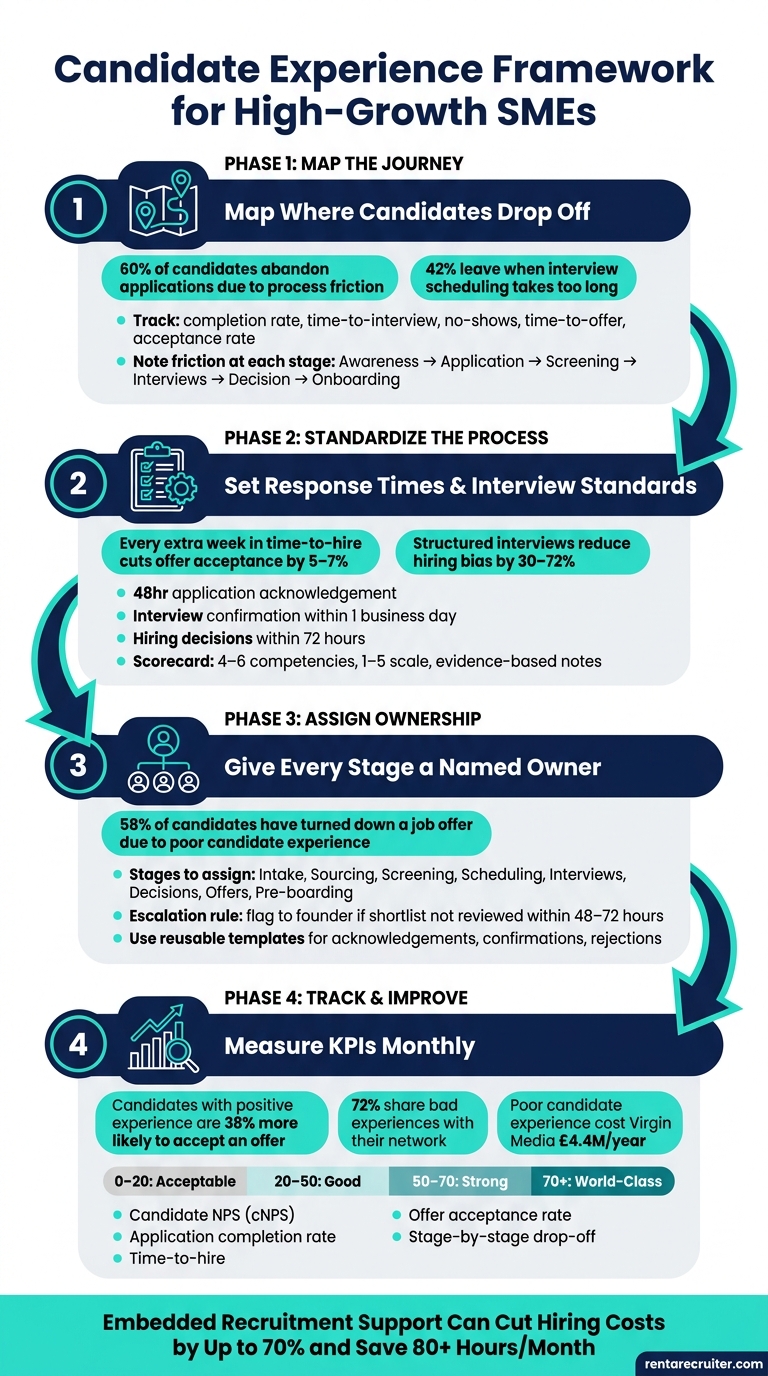
Candidate Experience Framework for High-Growth SMEs
Hiring Excellence Series: Operationalizing Great Candidate Experiences
sbb-itb-a23bd6a
Map the Candidate Journey and Find the Biggest Points of Friction
Map the candidate journey first so you can see exactly where drop-off begins.
The steps will vary by role. Engineering often includes technical assessments. Sales may include role plays. Leadership hiring tends to involve stakeholder panels.
For each stage, note four things: what the candidate is doing, what they expect, who owns the step internally, and where timing or communication starts to slip. That makes handoff issues much easier to spot, especially when ownership moves from recruiter to hiring manager, or from hiring manager to operations.
The table below maps the journey for common high-growth SME roles:
| Stage | Candidate Actions | Internal Owner | Common Friction | Fix |
|---|---|---|---|---|
| Awareness | Job boards, careers page, LinkedIn, referrals | Recruiter / Talent Acquisition | Generic job ads, missing salary range, unclear remote/hybrid policy | Rewrite job descriptions with real responsibilities, U.S. salary bands, and location expectations |
| Consideration | Job description, company website, LinkedIn or Glassdoor research | Recruiter / Talent Acquisition | Vague role scope, missing context about the team or location | Make the role easy to evaluate with clear scope and location expectations |
| Application | Resume upload, screening questions, ATS portal | Recruiter / Operations | Long forms, no mobile optimization, no confirmation email | Remove duplicate fields, limit applications to essentials, automate acknowledgment within 24 hours |
| Screening | Recruiter call, qualification review | Recruiter | Applications sit unreviewed for days, unstructured calls | Set a 3-business-day SLA for first contact and use one screening script |
| Interviews | Technical assessment, panel interviews, case studies | Hiring Manager | Slow scheduling, inconsistent questions, 5–7 interview rounds | Standardize 2–4 rounds per role type; use shared question banks; introduce scheduling tools |
| Decision | Offer, rejection, negotiation, background check | Hiring Manager / Operations | Silence after final interview, vague rejections | Collect feedback within 48 hours and send decisions within 3 business days |
| Pre-boarding & Onboarding | Paperwork, equipment, orientation, first 30–90 days | HR / People Ops / IT | Last-minute logistics, unclear start-day expectations | Build a pre-boarding checklist; send the first-week schedule before day one |
Where SMEs Lose Strong Candidates
The biggest drop-off points are usually easy to predict.
Up to 60% of candidates abandon job applications due to process friction alone, especially when forms are too long, questions repeat, or the ATS is clunky [4]. That makes the application stage one of the fastest ways to lose good people before your team even speaks to them.
Scheduling is another common failure point. Cronofy‘s 2024 Candidate Expectations research, based on 12,000 candidates across seven countries, found that 42% of candidates left recruitment processes when interview scheduling took too long [3]. If you’re hiring into SaaS, Technology, IT, Fintech, Engineering, Security, Insurance, or Professional Services, that delay can get expensive fast. Strong candidates rarely sit still while internal calendars catch up.
The post-interview stage can do just as much damage. When someone gives time to several rounds and then hears nothing, they often feel ghosted. That silence doesn’t just cost you one hire. It can hit referrals, future applications, and employer reputation too.
The best journey maps are measurable, not just descriptive. Track completion rate, time-to-interview, no-shows, time-to-offer, and acceptance rate by stage. Those numbers show you where the process is slowing down, where ownership is weak, and where tighter interview standards could save time and protect offer acceptance.
Build a Candidate Experience Process That Holds Up Under Hiring Pressure
Once you’ve mapped the friction, the next step is simple: turn it into fixed operating standards.
The aim is to remove delays at the exact moments candidates tend to drop off. The answer is not more hustle. It’s fewer exceptions and faster handoffs.
Set Standards for Speed, Communication, and Interview Consistency
Start with the biggest pain points and turn them into clear response standards.
Set target response times for acknowledgment, screening, feedback, and offers, then make sure the team sticks to them. That matters because every extra week in time-to-hire cuts the chance of offer acceptance by roughly 5% to 7% for competitive roles.[1]
Speed matters, but consistency matters just as much.
Structured interviews, where every candidate answers the same predefined, job-related questions, can reduce hiring bias by 30% to 72%.[5][6] You do not need a bloated process to make this work. A simple scorecard with:
- 4 to 6 competencies
- A 1 to 5 rating scale
- Space for evidence-based notes
is often enough to reduce rework, shorten debriefs, and make side-by-side candidate comparison far easier.
The table below shows what strong and weak candidate experience behaviours look like in practice:
| Behavior Area | Strong Candidate Experience | Weak Candidate Experience | Impact |
|---|---|---|---|
| Speed & responsiveness | Same-day acknowledgment; 24 to 48 hour feedback; clear timelines | Delayed responses; no updates; ghosting after interviews | Higher acceptance rates; stronger employer reputation |
| Communication quality | Personalized updates; transparent feedback; mobile-friendly emails | Generic or no updates; vague feedback; last-minute changes | Better engagement; higher candidate trust |
| Interview structure | Standard scorecards; trained interviewers; consistent questions | Unstructured interviews; inconsistent criteria; interviewer no-shows | Faster, fairer decisions; reduced bias |
Assign Ownership at Each Step to Avoid Delays and Ghosting
Standards only work when one person owns each step.
Most hiring delays do not come from lack of effort. They come from unclear ownership.
Give one person clear accountability for each stage: intake, sourcing, screening, scheduling, interviews, decisions, offers, and pre-boarding. In a smaller team, one person may cover several stages. That’s fine. What matters is that responsibility is named, not assumed.
Then back that up with simple controls. For example:
- An intake checklist covering role title, salary band in USD, location, remote policy, and target start date
- Reusable email templates for acknowledgments, interview confirmations, and rejections
- A clear escalation rule, if a hiring manager has not reviewed a shortlist within 48 to 72 hours, the recruiter flags it to the founder
That kind of clarity protects speed and keeps candidates from falling into silence. And the cost of getting it wrong is high. Up to 58% of candidates have turned down a job offer because of poor candidate experience.[7][2][8]
Use Embedded Recruitment Support When Internal Capacity Is Stretched
When internal capacity becomes the bottleneck, bring in embedded support before candidate experience starts to slide.
An embedded recruiter works inside your team and manages hiring end to end. That gives you extra delivery power without the stop-start handoffs you often get from traditional recruitment agencies.
Rent a Recruiter places experienced recruiters into your team within days to run the hiring process from intake through offer. Clients typically cut hiring costs by up to 70% and save more than 80 hours a month.
Measure Candidate Experience and Improve It Month Over Month
Once SLAs and ownership are in place, you need to check that the process still works when hiring volume picks up. Track a small set of KPIs each month, then fix the weakest stage first. If things start to drag, the data will show you where.
Track the Metrics That Show Hiring Speed, Quality, and Cost Impact
Use these metrics to spot where your hiring process is breaking down.
| Metric | What It Signals | Key Lever to Pull |
|---|---|---|
| Candidate NPS (cNPS) | Overall experience quality; employer brand strength | Improve communication, interview structure, and feedback speed |
| Application completion rate | Application friction and form usability | Shorten form, remove unnecessary fields, optimise for mobile |
| Application-to-interview rate | Screening quality and JD fit | Tighten JD alignment; adjust screening criteria |
| Interview-to-offer rate | Interview quality and role fit | Standardise scorecards; run hiring manager calibration sessions |
| Offer acceptance rate | Pay fit and process quality | Pre-align salary bands in USD; speed up approvals to 24 to 48 hours |
| Stage-by-stage drop-off | Where candidates drop off | Fix the highest drop-off stage first |
| Time-to-hire | End-to-end hiring speed | Tighten feedback SLAs; reduce interview rounds |
| Channel performance | Source quality and cost | Shift budget toward high-converting, lower-cost sources |
For cNPS, use the standard bands: 0 to +20 acceptable, +20 to +50 good, +50 to +70 strong, and +70+ world-class.
This matters for more than optics. It affects hiring outcomes and cost. Candidates with a positive experience are 38% more likely to accept an offer. At the same time, 52% have declined because of a poor hiring experience, and 72% share bad experiences with their network.[2]
That means weak candidate experience doesn’t just hurt one hire. It can shrink your pipeline, push up hiring costs, and slow growth.
Turn Feedback and Data Into Process Changes
Run a monthly 60 to 90-minute review with HR, recruiting, and hiring managers. Look at movement by stage. Pick one or two fixes. Test them in the next cycle.
Use short post-process surveys, three to five questions, sent straight after rejection or acceptance. Segment responses by:
- hired
- rejected at application
- rejected after interviews
- withdrew
A simple monthly loop works well.
In month one, shorten the application form and watch completion rates. In month two, set a firm 24-hour acknowledgement SLA and track whether cNPS and drop-off between application and first interview improve. In month three, give hiring managers a short written interview guide and a standard scorecard, then check whether your interview-to-offer rate gets tighter.
The goal is straightforward: use the monthly review to keep candidate experience in step with growth.
Conclusion: Build a Candidate Experience System That Supports Growth
Candidate experience has a direct effect on hiring speed, cost, and growth. For high-growth SMEs, each delay adds up. One analysis of Virgin Media found that poor candidate experience cost the company about £4.4 million a year in lost revenue, after rejected applicants cancelled subscriptions following negative hiring interactions.[11]
Use the same sequence: map the journey, spot friction, standardise the process, assign ownership, and review performance each month.
Start with your last hiring cycle. Audit your last 10 to 20 hires. Look for the biggest delays, handoff issues, and communication gaps. Then set clear service levels:
- 48-hour application acknowledgement
- Interview confirmation within one business day
- Hiring decisions within 72 hours
Give each stage a named owner. Then run a monthly review using the metrics from the previous section, so the process stays consistent as hiring volume grows.
If those fixes still don’t keep pace with demand, the next lever is extra hiring capacity. If demand is outstripping your internal team, or process consistency is starting to slip, it may be time to look at embedded recruitment support. Rent a Recruiter places experienced recruiters inside your team within days to manage hiring end to end, bringing structure, visibility, and consistency.
Book a call to talk through where your hiring process is breaking down.
FAQs
How do I audit our candidate experience quickly?
Start with your ATS data. Look at where candidates drop out of the funnel, because that’s usually where time, money, and hiring momentum start leaking.
Then compare your documented process with what actually happened. Check recent communication logs, email templates, and interview scorecards to see if your team followed a consistent process or if things drifted role by role.
It also helps to add brief post-interview surveys, sent within three days. That gives you fast feedback while the experience is still fresh. Alongside that, review metrics like time-to-first-contact and stage-by-stage conversion rates to pinpoint bottlenecks, delays, and friction points that slow hiring and hurt conversion.
Which hiring stage should we fix first?
Start with a funnel audit using your recruitment data or applicant tracking system. The goal is simple: see where candidates drop off and where the process slows down.
Look first at a few core numbers:
- Application completion rate
- Time to first contact
- Offer acceptance rate
These metrics show you where the biggest bottlenecks sit. If completion rates are low, your application process may be adding friction. If first contact is slow, you’re likely losing good people before a recruiter even speaks to them. If offer acceptance is weak, the issue may be compensation, speed, or how the role is being sold.
Once you can see the problem areas, rank them by impact versus effort. Start with quick wins, changes that can move results without a major rebuild. That gives you a faster path to lower drop-off, less wasted recruiter time, and better hiring outcomes before you commit to a full overhaul.
When should we add embedded recruitment support?
Consider embedded recruitment support when hiring demand starts to outpace your internal team.
That usually shows up as slower hiring, patchy process, and inconsistent delivery. Roles stay open longer. Interview stages drift. Good candidates drop out because no one owns the process closely enough.
Some of the clearest signs are:
- You’re hiring more than 5 to 10 roles per quarter
- You’re trying to fill hard-to-source or niche roles
- Leadership is spending 10 to 20 hours a month on hiring admin
- You’re in a high-growth phase, but your team doesn’t have the capacity or know-how to keep hiring fair and efficient
At that point, the issue isn’t just workload. It’s business drag. Your leaders get pulled into admin, your process loses structure, and hiring outcomes become less predictable.