
Bad interviews cost you money. If your team still hires on gut feel, you are increasing the odds of poor hires, missed talent, and repeat hiring costs that can run from $4,700 to $5,475 per hire before you even count team time or lost output.
I’d sum it up like this: if you want better hiring results, you need a set interview process built around job-based scoring, not personal opinion. This article shows how to cut bias with clear competencies, fixed questions, independent scorecards, tighter debriefs, and simple audit checks. It also shows why that matters in commercial terms, because structured interviews can predict job success far better than unstructured ones, about 0.51 vs 0.19 to 0.20.
What you’ll get from this guide:
- How interview bias shows up in scaling companies
- Which bias patterns lead to false positives and false negatives
- How to build a structured, competency-based interview process
- How to run interviews the same way across teams
- How to audit interview quality as hiring volume grows
- Where embedded recruitment or Rent a Recruiter can help if your internal team lacks time or hiring capacity
If you are scaling across SaaS, Technology, IT, Fintech, Engineering, Security, Insurance, or Professional Services, this is about one thing: making hiring more accurate, less wasteful, and easier to control.
The Advantages of Structured Interviews (over unstructured ones)
sbb-itb-a23bd6a
Understanding Interview Bias in Fast-Growth Hiring
Interview bias is the steady move away from role-based evidence and toward personal impressions, shortcuts, or group opinion.[4] Put simply, feelings start to beat evidence. It shows up most in fast-growth hiring, where speed and weak structure push interviewers to rely on instinct.[1][4] In scaling SMEs, reducing bias starts with a repeatable interview process, not better instinct.
Fast-growth hiring makes this worse. Rushed interviews and inconsistent scoring mean results depend more on who did the interview than on the candidate’s proof.[1][4] That creates a small group of bias patterns that teams can spot and stop.
The Biases That Most Often Distort Interview Decisions
Nine common biases distort scoring. The table below shows each trigger, signal, likely error, and fix.
| Bias type | Typical trigger | Common interview signal | Likely error | Fix |
|---|---|---|---|---|
| Halo effect | Prestigious employer or strong opening answer | High scores across competencies from one strong impression | False positive | Score each competency separately; require evidence for every rating[1][4][8] |
| Horns effect | Nervous opening or one weak early answer | Low scores across the board; limited probing after a misstep | False negative | Use multiple questions per competency; score later answers independently[1][4][9] |
| Affinity bias | Shared background, education, or hobbies | High culture-fit scores without job evidence | False positive or false negative | Define "culture add" over "culture fit"; anchor on job-critical competencies[1][4][6] |
| Attractiveness bias | Polished presentation or charismatic delivery | High ratings on influence or leadership without concrete examples | False positive | Train interviewers that appearance and style are not competencies; require behavioral examples[6][7] |
| Contrast bias | Back-to-back interviews with mismatched candidates | Comments referencing the previous candidate; fluctuating standards | False positive or negative | Score against role requirements, not the previous interviewee[7] |
| Expectation anchoring | Strong referral note or first interviewer’s opinion | Scores cluster around the initial impression; little adjustment despite new evidence | False positive or negative | Prohibit sharing qualitative impressions before scorecards are submitted[2][4][8] |
| Confirmation bias | Early gut judgment or a strong first impression | Leading questions and selective note-taking that support the initial view | False positive or negative | Use a fixed question set; require at least one disconfirming question per competency[1][5][8] |
| Overconfidence bias | Seniority or a strong hiring track record | Sparse notes and rubric bypassing | False positive or negative | Make note-taking and scorecards mandatory; calibrate interviewers against past outcomes[7] |
| Groupthink | A senior voice speaks first in debrief | Fast convergence; no documented disagreements; dissenting scores quietly dropped | False positive or negative | Collect written scores before discussion; explicitly ask for disagreements in debrief[6] |
These biases matter because they change who moves forward and who gets ruled out.
False Positives, False Negatives, and Missed Growth Targets
Bias does not just affect fairness, it hits hiring accuracy at the exact point where accuracy matters most. False positives often come from halo, affinity, attractiveness, and overconfidence bias.[1][4][7] These hires may look strong because of one visible trait, while falling short on the competencies the role needs. The business cost is clear: lower quality of hire, higher turnover, and the expense of reopening roles and running the process again.[3][7]
False negatives are less visible, but they can hurt just as much. The horns effect and confirmation bias can knock out strong candidates early, often before the interview brings out their best evidence.[1][8] In fast-growth hiring, losing a qualified candidate because they started nervously, or because an interviewer locked onto a first impression, is not a soft issue. It costs time, slows delivery, and can put growth plans at risk. Structured interviews have a predictive validity of around 0.51 versus roughly 0.19 for unstructured interviews.[11] That gap is exactly why structure needs to sit inside every interview.
The next step is to build those controls into the interview process itself.
How to Design a Structured, Competency-Based Interview Process
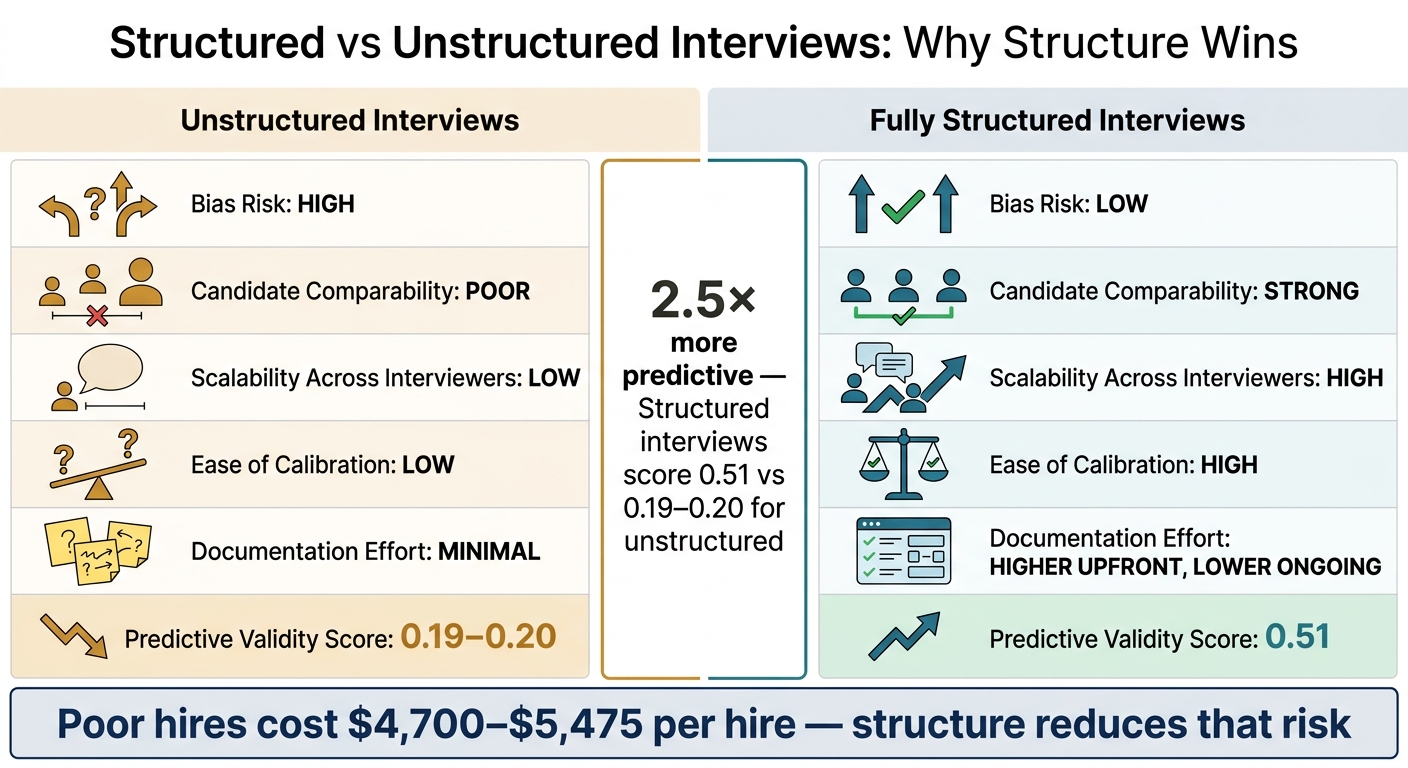
Structured vs Unstructured Interviews: Key Differences & Bias Impact
If you want to cut bias, you need to standardize the interview before the first candidate enters the process. Structured interviewing is the most practical way to reduce bias and compare candidates on the same basis.
The table below shows how the three main interview formats stack up across the areas that matter most for scaling SMEs.
| Dimension | Unstructured | Semi-structured | Fully structured |
|---|---|---|---|
| Bias risk | High | Moderate | Low |
| Comparability across candidates | Poor | Inconsistent | Strong |
| Scalability across interviewers | Low | Moderate | High |
| Ease of calibration | Low | Moderate | High |
| Documentation effort | Minimal | Uneven | Higher upfront, lower ongoing |
Once you build the scorecard, you can reuse it for every candidate applying for that role. That saves time, keeps decisions tighter, and gives hiring teams a shared standard.
Define 4 to 6 Job-Critical Competencies Before the Interview Starts
Start with a brief job analysis. Map the role’s core responsibilities, expected outcomes, key stakeholders, and constraints before you write a single question. From there, narrow it down to 4 to 6 competencies, specific, observable capabilities that predict performance, not vague culture-fit language.[17][19][20]
Keep only the competencies that have a clear link to success in the role. If a gap in that area would hurt performance, it stays. If not, cut it.
For a U.S.-based SaaS Account Executive, that might mean stakeholder communication, commercial judgment, pipeline ownership, prioritization, and resilience in complex sales cycles. For a Senior Software Engineer, it could be technical problem-solving, system design thinking, collaboration, ownership, and risk-aware decision-making. Each competency should connect to a measurable outcome, such as new ARR, deal velocity, pipeline hygiene, project cycle times, customer retention, or error rates. That keeps scoring tied to business results, not gut feel.[17][19]
Build Standard Questions, Rating Rubrics, and Scorecards
Once the competencies are set, write 2 to 3 questions per competency. Use a mix of behavioral questions, such as "Tell me about a time when…", and situational questions, such as "What would you do if…". Tag each question to one primary competency so scoring stays clean. Every candidate for the same role should answer the same core questions in the same order. That’s what makes the scores comparable.[16][17][18]
Then pair each competency with a 1 to 5 rubric based on behavioral anchors, not vague labels. For ownership, a score of 1 might describe someone who avoids responsibility and blames outside factors. A 5 might describe someone who spots problems early, takes end-to-end accountability beyond their formal remit, and has a clear record of delivering key outcomes despite obstacles. Anchors like these make it far more likely that different interviewers will reach the same score when reviewing the same evidence.[13][16][18][19]
With competencies and questions locked in, the scorecard becomes the main reference point for every interviewer. Use one scorecard per role, with:
- Role title
- 4 to 6 competencies with definitions
- Mapped questions
- Anchored rubrics
- Space for evidence-based notes
- An overall recommendation based on competency scores
Interviewers should complete their scorecards independently, straight after each interview, before any group discussion starts.
Assign Interviewer Focus Areas to Cut Overlap and Noise
Next, divide coverage so each interviewer gathers different evidence instead of asking the same things again and again. Assign each interviewer one focus area to reduce overlap and improve evidence quality.[17][19]
This cuts repetition, shortens interviews, and gives you better signal. It also makes debriefs far sharper. Instead of everyone sharing broad impressions, each interviewer brings specific scores and examples from their own area. You get a fuller picture of the candidate, backed by evidence rather than instinct.[17]
For SMEs scaling fast, this also makes interviewer onboarding much easier. If you need to put this structure in place without building it all alone, Rent a Recruiter can support your team with interview standardization and competency frameworks.
How to Run Bias-Free Interviews Day to Day
A structured process only works when every interviewer uses it the same way, every time. That means tight execution in prep, live questioning, scoring, and the debrief.
Use the Same Interview Structure for Every Candidate
Ask every candidate the same questions, in the same order, with the same time allocation. When that slips, bias creeps in fast. Interviewers go off-script, dig deeper into topics they like, change the level of difficulty based on a candidate’s résumé, or let casual chat run too long. Once that happens, scores stop being comparable.[12][15]
Keep small talk to under 2 to 3 minutes. Stick to the same neutral topics for everyone. Avoid alma mater, family status, or shared hobbies, since those are common triggers for affinity bias.[25][27] Set a fixed number of minutes for each competency block and watch the clock so no candidate gets extra depth in one area over another.
That discipline matters for another reason too. If the questions are standardised but the notes and scoring are loose, you still end up with poor hiring data.
Take Evidence-Based Notes and Score Before the Debrief
The gap between good notes and biased notes is simple: specific evidence.
"Strong communicator" is a label, not evidence. Explained a system migration in three steps, clarified risks, and checked understanding with the stakeholder before proposing a solution is evidence.[23][10] One can be scored against a rubric. The other can’t.
Write down verbatim evidence for each competency, along with any numbers or outcomes the candidate shares, team size, budget, impact, such as reduced incident volume by about 30% in 6 months.[21][14] Then score while the detail is still fresh, and submit scores before any group discussion starts.[21][26] That step helps block anchoring, halo effects, and groupthink.[21][22][24]
If you want debriefs that lead to better hiring calls, this is one of the simplest habits to lock in. Independent scoring keeps the conversation tied to proof, not memory.
Run Debriefs Against the Scorecard, Not Personal Preference
Without structure, the loudest voice tends to take over. A better way is to start with a round-robin. Each interviewer shares their overall recommendation and top evidence points before hearing anyone else’s view.[23][24] That brings out real disagreement instead of smoothing it over too early.
Then spend discussion time on the biggest scoring gaps, not the averages. If one interviewer gave execution a 2 and another gave it a 4, that’s usually a signal. Maybe they asked different questions. Maybe they read the anchor in different ways. Maybe one of them missed a key example.
When someone brings up a vague "fit" concern without job-related evidence, the facilitator should challenge it. What exact behaviour or answer led to that view? If there isn’t a clear example, set that opinion aside.[25][27] Where possible, hold back other interviewers’ scores until the debrief starts. Even that small blind step can cut anchoring and seniority bias.[21][24] Record the final decision against the scorecard so the process stays steady across roles and interviewers.
To make this work at scale, you need the same discipline across every interviewer and every role.
How to Embed Bias Reduction into Your Hiring Process
Once interviews are structured, the next job is to make that structure hold across every role and every interviewer.
Standardize, Train, and Audit for Consistency at Scale
One strong interview is a tactic. Consistent interviews across teams are an operating model.
Keep a single source of truth for every scorecard, question bank, and competency definition. Use the same scorecards and rubrics from the interview design stage, and make sure every interviewer checks that same source before each interview.
Run short calibration sessions when a role opens or a new interviewer joins. That keeps scoring standards lined up from the start. Calibrate sample answers at each score level so "meets expectations" means the same thing to everyone, not just the person in the room.
Training helps, but audits stop standards from slipping as your team grows. Review intake-to-screen pass rates, stage conversion rates, and scorecard completion rates by role and hiring manager. Use intake-to-screen pass rates as a drift signal, not a target on its own.
Audit score drift and pass-rate gaps to catch bias before it turns into a pattern. Look for drift by role, interviewer, and hiring manager, then reset scorecards when ratings split without evidence. Update your competency frameworks after a funding round, product shift, or restructure so your interview criteria still match the job as it exists now.
This is where many scaling teams get stuck. The process looks fine on paper, but day to day it starts to wobble. One manager scores hard, another scores soft, and before long your hiring data tells two different stories. That inconsistency costs time, weakens decision-making, and makes hiring harder to trust.
Use Embedded Recruitment Support to Build Structure Faster
When hiring volume grows faster than your internal team can handle, outside embedded support can help you apply the same process every time.
Lean HR teams often know what good looks like, but they don’t have the bandwidth to build it while live hiring is in motion. Rent a Recruiter places experienced recruiters inside your team within days to run hiring end to end. That gives you more structure, better visibility, and tighter consistency across the process.
The commercial upside is hard to ignore. Companies often cut hiring costs by up to 70% compared with commission-based agency models, while saving more than 80 hours per month in internal hiring and admin time.
If you’re growing across SaaS, Technology, IT, Fintech, Engineering, Security, Insurance, or Professional Services, that kind of support can take pressure off leaders fast. You keep control of the process, while getting the delivery capacity to make it stick.
Conclusion: Build a Fairer, Faster Interview System
Bias-free interviewing works when the process is repeatable, visible, and reviewed. It comes from job-related competencies, consistent questions, evidence-based scoring, disciplined debriefs, and regular audits. Structured interviews beat unstructured ones because they turn judgment into evidence.
If you’re ready to move from ad hoc hiring to a more structured model, book a call with Rent a Recruiter to talk through a process that fits your team size and growth stage.
FAQs
What makes an interview structured?
A structured interview follows a standardised, evidence-based process instead of gut feel. Every candidate gets the same prearranged, job-related questions, asked in the same order.
Interviewers assess each person against clear, role-specific competencies using standard scoring rubrics. Each interviewer then submits scores and supporting evidence on their own before any group discussion, which helps cut bias and gives you a fairer, more consistent hiring decision.
How do we score candidates fairly?
Use a standardized interview framework so every candidate is measured against the same job-related criteria. Set 4 to 6 core competencies before interviews start, then score each one with Behaviorally Anchored Rating Scales on a 1 to 4 or 1 to 5 scale.
This gives you a cleaner way to compare candidates. It also cuts down on gut-feel hiring, which often leads to slower decisions and costly mis-hires.
Ask each interviewer to submit their scores and supporting evidence independently before any group discussion. That helps reduce anchoring bias, where the first strong opinion shifts everyone else’s view.
It also pays to run periodic calibration sessions. These sessions help interviewers stay aligned on what each score means, so your hiring decisions stay fair, consistent, and easier to defend.
How often should we audit interviews?
Audit interviews regularly, at least quarterly, to catch issues like interviewer drift, vague rubrics, or adverse impact signals early. That helps you keep scoring consistent over time and reduces the risk of poor hiring calls creeping into the process.
It also pays to review the areas where interviewers disagree most often. If scoring varies too much, your rubric may be too loose. Tightening the language can improve consistency, save time in debriefs, and give you a clearer basis for hiring decisions.