Bias training does not fix hiring on its own. Process control does.
If you are scaling hiring across SaaS, Technology, IT, Fintech, Engineering, Security, Insurance, or Professional Services, the cost of inconsistent interviews adds up fast. You lose time, rework roles, slow delivery, and make weaker decisions. The article’s core point is simple: bias awareness only helps when you build it into scorecards, interview kits, feedback rules, and debrief discipline.
Here’s the short version:
- One-off workshops are not enough. They may shift awareness for a few days, but they rarely change live hiring behaviour.
- The first step is an audit. Check where subjective decisions enter the funnel, from job design to panel debriefs.
- Different hiring groups need different training. New managers, senior leaders, recruiters, and high-risk hiring teams should not all get the same session.
- Structured interviews work better than unstructured ones. The article cites 0.51 validity for structured interviews vs 0.20 for unstructured interviews.
- Measure usage first, results second. Track scorecard completion, feedback within 24 hours, interview kit use, and recruiter escalations before judging hiring outcomes.
- For scaling teams, structure saves money and time. The article links this back to fewer hiring reruns, lower admin load, and stronger control across the process.
If you want bias awareness to change hiring results, you need a hiring system that holds up under volume. That is the lens the rest of the article uses.
Unconscious Bias at Work – Making the Unconscious Conscious
sbb-itb-a23bd6a
Plan Bias Awareness Training Around Real Hiring Risks
Before you book training, map where bias can change hiring decisions. Training should fix known risk points, not tick a box.
Audit the Hiring Funnel for Subjective Decision Points
Start by reviewing each stage where someone makes a judgement call: job descriptions, interview questions, candidate documentation, and panel debriefs. At every step, ask: Is this decision based on written criteria, or is it open to personal interpretation?
That distinction matters. If managers are making calls without clear standards, bias can slip in fast.
One of the clearest warning signs is vague language. Review a sample of interview notes, scorecards, and debrief records. Look for phrases like "not a culture fit" that don’t point to job-related evidence. That’s not a hiring standard. It’s an impression.
Your aim is simple: find the moments where personal judgement starts to override role criteria.
You should also check for process drift. This shows up when managers skip the interview kit, ask different questions for the same role, or submit feedback days after the interview. Delayed feedback is less accurate, and it makes hiring decisions harder to defend.
| Audit Area | What to Look For |
|---|---|
| Feedback Quality | Specific evidence and observable signals rather than vague impressions |
| Turnaround Time | Feedback submitted within 24 hours to limit memory drift [1] |
| Question Discipline | Alignment to approved criteria and structured interview questions |
| Decision Rationale | Clear, defensible explanation for the "advance" or "reject" decision |
Decide Who Needs Training and What Each Role Must Learn
Not every hiring stakeholder needs the same training. Different roles carry different bias risks. If you put everyone through one generic workshop, you waste time and miss the real issue.
A better approach is to segment training by role and risk level, then tie each module to the decisions that group actually makes.
| Segment | Primary Risk | Training Emphasis |
|---|---|---|
| New People Managers | Inexperience and gut-based decisions | Interview basics, scorecards, legal boundaries |
| Frequent Hiring Managers | Inconsistent execution under pressure | Calibration, speed, documentation quality |
| Senior Functional Leaders | Overconfidence and panel inconsistency | Decision discipline, debrief rigor |
| High-Risk Roles | Compliance exposure | Disclosures, consent handling, required workflow steps |
Map each group to the decisions they own, not just the title on their org chart.
Recruiters need extra focus here. They are often the first line of control when managers go off-script. They spot vague scorecard language, flag weak documentation, and coach managers in the moment. That work needs its own training track, not a shared session with everyone else.
Set Governance, Ownership, and Success Measures Before Launch
Training with no owner fades fast. Before launch, set clear accountability from day one: who owns the programme, who signs off on materials, who tracks completion, and who deals with escalations when a manager ignores the process.
Give ownership to the person who can enforce the workflow, not just run the session.
You should also require certification before managers lead live interviews, including a knowledge check and a mock interview simulation [1]. That sets a clear standard. It also avoids the common mistake of assuming a workshop someone attended months ago is enough.
Then measure adoption, not just attendance. Completion rates don’t tell you if behaviour changed. Process data does.
Track:
- Scorecard completion rates
- Interview kit adoption
- Recruiter escalations caused by manager errors [1]
These are leading indicators. They show whether new habits are taking hold long before that appears in hiring outcomes. They should shape the training content, the controls you put in place, and the measures you track next.
Build a Training Program That Improves Hiring Decisions
Turn audit findings into training that fixes the highest-risk hiring decisions, not a generic bias session that sounds good but changes nothing.
Start with the bias patterns and decision criteria tied to the moments where hiring goes wrong most often. That keeps training practical and tied to business impact, not theory.
Teach Common Bias Patterns in a Hiring Context
Abstract definitions of bias rarely change behaviour. What does work is linking each bias pattern to a specific point in your hiring process.
Affinity bias shows up when a manager leans towards a candidate who shares their confidence, accent, background, or school brand, because it feels familiar, not because it predicts performance. Confirmation bias shows up when an interviewer forms an opinion in the first 30 seconds, then spends the rest of the interview looking for proof that backs it up instead of testing it. The halo effect lifts scores across every competency because a candidate did well in one area, such as confident delivery.
The aim is simple: connect each pattern to a hiring mistake, then define the correction required. If you don’t do that, managers may recognise the term but still repeat the same decision error.
Replace Vague Judgments With Job-Related Criteria and Rubrics
Before reviews begin, managers need to define what strong evidence looks like for each competency. Without that, scoring slips back into gut feel.
Training should show managers how to turn job descriptions into observable signals. Terms like "polish", "executive presence", or "sharp" sound neat, but they leave far too much room for personal interpretation. They need to be replaced with behaviours your team can actually observe and document. For example, "executive presence" might translate to: Can explain complex technical concepts clearly to non-experts. That can be scored. "Polish" can’t.
Translate each competency into observable evidence before interviews start.
| Vague Term | Job-Related Replacement | Observable Evidence to Seek |
|---|---|---|
| "Culture fit" | Values alignment | Specific examples of past decisions that reflect company core values |
| "Executive presence" | Communication impact | Ability to explain complex topics clearly to non-expert audiences |
| "Lack of polish" | Role-appropriate communication and documentation | Adherence to role-specific communication or documentation standards |
| "Not sharp" | Problem-solving ability | Performance on a standardised work sample or structured logic assessment |
It’s just as important to separate required qualifications from preferred qualifications before the role goes live. When that line stays blurry, interviewers end up using different standards for different candidates, often without noticing. That creates drift, slows decisions, and makes hiring harder to defend.
Use Structured Interviews and Bias Interruption Techniques
Structured interviewing is one of the strongest changes most hiring teams can make. Structured interviews score about 0.51 in validity, versus 0.20 for unstructured interviews [2].
That gap matters. Better structure usually means better signal, cleaner debriefs, and fewer reruns of the hiring process.
Use the same core questions, behaviour-based prompts, anchored rubrics, and independent ratings before group discussion. Bias prompts then help the panel stay tied to those rules during debriefs.
Train your teams to use prompts like these:
- "What specific evidence supports that score?"
- "Would we apply the same standard to every candidate for this role?"
- "Is this observation job-related, or is it a personal preference?"
These prompts make debriefs sharper and give hiring panels a shared language. That’s a big deal when hiring as you scale and bringing new managers into live interview loops.
Deliver training through live calibration sessions, async basics, and just-in-time reminders, such as a pre-interview checklist sent before the interview starts.
Apply Bias Controls Across the Hiring Workflow and Measure Results
Training only works when it shows up in the day-to-day hiring process. The point is to move past awareness and into consistent execution, where each hiring stage has a clear control that pushes decision-making through a structured filter.
Embed Controls From Job Design Through Offer Approval
Every stage in your hiring workflow carries a bias risk. Each one needs its own guardrail. The table below links those stages to practical controls your team can put in place right away.
| Workflow Stage | Bias Control | Recommended Control |
|---|---|---|
| Job Design | Converting requirements to evidence | Approved intake template with knockout criteria and "must-haves" vs. preferences |
| Sourcing/Screening | Interpreting screening data responsibly | Structured screening rubrics; treat screening outputs as input for live interviews, not the final decision |
| Interviewing | Gathering evidence, not impressions | Assigned competencies, approved question sets, and evidence-only note-taking |
| Debriefing | Separating signal from preference | Independent scoring submitted before any group discussion; structured debrief template |
| Selection/Offer | Documenting defensible decisions | Written selection rationale mapped directly back to the original job-related criteria |
Each control should create a measurable signal, not just a process that looks better on paper.
Two rules are worth putting in place now:
- Require managers to submit evidence-based feedback within 24 hours of an interview.
- Restrict live interviews to certified managers.
That’s how you channel human judgment through a disciplined process, and that matters when you want better hiring outcomes, lower rework, and fewer avoidable mistakes.
Track Adoption Metrics and Hiring Outcomes Separately
A lot of teams judge training success by completion rates alone. That only tells you who attended the session, not whether anything changed.
Once controls are live, first measure whether teams are using them. Then look at outcomes. Keep those two layers separate: process adoption as your leading indicators, and hiring outcomes as your lagging indicators.
Leading indicators tell you whether behaviour is changing now. Lagging indicators show whether that shift is leading to better hiring over time.
| Metric Category | What to Track | Why It Matters |
|---|---|---|
| Process Adoption | Scorecard completion rate, feedback turnaround (<24 hours), interview kit usage, calibration reviews, certification rates | Shows whether structured behavior is happening in real time |
| Hiring Outcomes | Quality of hire, early retention, time-to-fill, candidate experience ratings, interviewer score alignment | Shows the long-term business impact of better hiring discipline |
| Risk & Compliance | Audit failure rates, policy exceptions, recruiter escalations for process errors | Tracks reduction in legal and operational exposure |
Be careful with small sample sizes on outcome metrics. Start with adoption metrics first. Give outcome trends a few quarters before you make big calls.
That approach saves time and avoids bad decisions based on thin data. If usage is weak, the issue is process discipline. If usage is strong but results stay flat, the controls may need work.
Review Quarterly and Recalibrate When Patterns Drift
Use the metrics to spot drift early, then adjust the controls. For most growing companies, a quarterly review cycle works well. Review your process data each quarter. Look at scorecard quality, feedback turnaround times, and whether interviewers are sticking to approved question sets.
If you see vague feedback, phrases like "not a culture fit" with no supporting evidence, deal with it straight away, not at the next annual training.
Three situations should trigger an immediate recalibration outside the regular cycle:
- A new screening or assessment tool is introduced
- A role’s requirements change in a major way
- A funnel stage shows inconsistent scoring patterns across interviewers
Catching drift early is far cheaper than rerunning a search because the panel used different standards for different candidates.
Operationalize Bias Awareness in a Scaling Recruitment Function
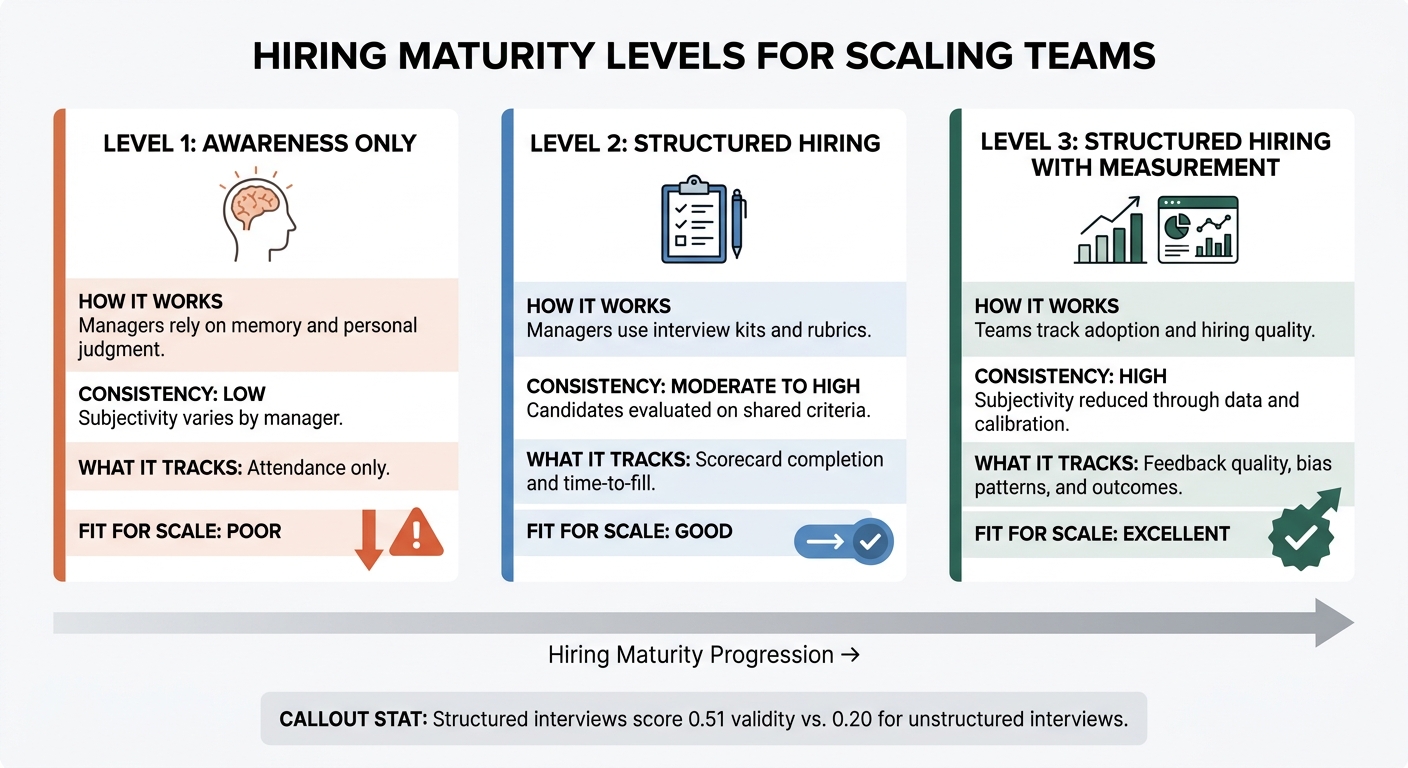
3 Hiring Maturity Levels: From Bias Awareness to Structured Hiring With Measurement
Bias awareness only works when it’s built into your hiring system. A one-off workshop might spark discussion, but it rarely changes day-to-day hiring. What scales is a repeatable hiring process.
In high-growth SMEs, inconsistency is the main risk. One manager interviews one way, another manager does something else, and suddenly hiring quality depends on who runs the process. That leads to a simple business question: how you rate your recruitment process and maturity today?
3 Maturity Levels: Awareness Only vs. Structured Hiring vs. Structured Hiring With Measurement
The table below shows the three operating levels most scaling teams move through.
| Maturity Level | How It Works | How Consistent It Is | What It Tracks | Fit for Scale |
|---|---|---|---|---|
| 1. Awareness Only | Managers rely on memory and personal judgment | Low; subjectivity varies by manager | Attendance only | Poor |
| 2. Structured Hiring | Managers use interview kits and rubrics | Moderate to high; candidates evaluated on shared criteria | Scorecard completion and time-to-fill | Good |
| 3. Structured Hiring With Measurement | Teams track adoption and hiring quality | High; subjectivity reduced through data and calibration | Feedback quality, bias patterns, and outcomes | Excellent |
The right level depends on your hiring volume, your exposure to risk, and how much oversight you need.
If you’re hiring a handful of people each year, light structure may be enough for now. If you’re scaling across SaaS, Technology, IT, Fintech, Engineering, Security, Insurance, or Professional Services, that usually changes fast. More roles mean more interviewers, more decisions, and more room for drift.
Teams that need faster standardization usually don’t need more one-off training. They need outside operating support that helps put the process into practice.
How Rent a Recruiter Can Help Standardize Hiring at Scale
Rent a Recruiter helps growing companies move from awareness to a repeatable hiring system by placing experienced recruiters directly into your team within days.
That matters because structure isn’t just a policy document sitting in a shared folder. It has to show up in the work itself. Embedded recruiters help make that happen across intake, interviews, and decision records. They put in place:
- structured intake
- interviewer calibration
- scorecards
- decision records
In plain terms, they help your team hire the same way, role after role, manager after manager.
The commercial case is hard to ignore. Companies working with Rent a Recruiter typically reduce hiring costs by up to 70% compared to commission-based models, while saving over 80 hours per month in internal hiring and admin time.
Conclusion: Build Awareness Into a Repeatable Hiring System
The point is not more training content. It’s a hiring process that still works when hiring volume goes up.
Bias awareness lasts when structure, measurement, and accountability work together. That’s what gives you a repeatable hiring system that stays consistent as headcount grows.
Start by auditing where your team sits across the three maturity levels. Then build from there. If you want to speed that up, explore how Rent a Recruiter can embed structure into your hiring function from the ground up.
FAQs
How do I audit our hiring process for bias?
Review your recruitment data to spot where candidates drop out of the funnel. Then apply the four-fifths rule to check for adverse impact. In plain terms, the selection rate for any protected group should be at least 80% of the highest-performing group.
That gives you a simple way to catch issues before they turn into bigger hiring problems, legal risk, or lost talent.
Audit interview scorecards every quarter. Look for feedback tied to specific, observable evidence, not vague comments like culture fit. If a score can’t be backed up by what the interviewer saw or heard, it shouldn’t shape the hiring decision.
From there, analyse pass-through rates by demographic and role. Pair that with candidate surveys to find the root causes. You’re not just looking for a gap, you’re looking for why that gap exists, so you can fix the part of the process that’s costing you good hires.
Who should get bias awareness training first?
Start with managers handling high-volume hiring, those who’ve just stepped into leadership, and anyone overseeing roles with more compliance risk.
Then split training by experience level. First-time managers need the basics: how to run interviews well, what good evidence looks like, and where the legal lines are. More experienced leaders usually need something different. Focus them on decision discipline, tighter calibration, and how to avoid drifting back to gut feel.
Your recruiting data should guide where you spend time first. Look for teams with:
- Inconsistent hiring results
- High turnover
- Heavy reliance on instinct over evidence
That’s usually where better manager training has the biggest business payoff, through better hiring decisions, less churn, and less time lost fixing poor hires.
What metrics show the training is working?
Track both leading and lagging indicators.
Leading indicators tell you if managers are actually using the training in day-to-day hiring. Look at scorecard completion rates, feedback note quality, use of structured interview kits, feedback turnaround times, and use of standardised evaluation criteria.
Lagging indicators show the effect on hiring outcomes. Track selection rates by demographic using the EEOC’s four-fifths rule, quality of hire, new-hire retention, and candidate experience scores.
For a cleaner read on impact, compare trained versus untrained groups, or pre-training versus post-training cohorts.