
Hiring the wrong way can cost you – big time. Between payroll taxes, benefits, and penalties for misclassification, choosing between temporary and contract hiring isn’t just a preference – it’s a financial decision that impacts your bottom line.
Here’s what you need to know:
- Temporary hiring works for short-term needs through on-demand recruitment or staffing agencies. You pay an hourly rate plus a markup (20%–60%) that covers payroll taxes, benefits, and admin costs. Agencies handle compliance, making this a lower-risk option.
- Contract hiring is project-based, ideal for specialized skills. Contractors charge 25%–100% more than employee rates to cover their own taxes and insurance. Misclassification risks can lead to fines of $15,000+ per worker.
Key takeaway: For roles under 1,500 hours annually, contractors or temps can save costs. Beyond 1,800 hours, permanent employees are often cheaper. Missteps in classification can derail budgets – get it wrong, and you could face six-figure penalties.
Let’s break it down further.
Temporary Hiring: Cost Breakdown
What Is Temporary Hiring?
Temporary hiring brings in workers through an agency to address short-term needs like seasonal demand, employee absences, or project-specific workloads. In this model, the agency serves as the employer of record, managing recruitment, screening, and payroll. This setup is perfect for situations where quick support is needed without the long-term obligations of permanent employment. Common scenarios include administrative roles, warehouse operations, retail staffing, and specialized IT projects.
Let’s break down the direct costs involved in temporary staffing to understand its financial impact.
Direct Costs: Pay Rates and Agency Fees
With temporary staffing, you pay a bill rate that combines the worker’s hourly wage and the agency’s markup. Markups typically range from 20% to 60% of the base pay, though they can climb as high as 100% in specialized fields. For example:
- A $15/hour admin role with a 50% markup costs $22.50/hour.
- Mid-level professionals earning $35/hour may cost between $42 and $49/hour after markup.
- Specialized IT or engineering temps, whose base rates range from $75 to $150/hour, can push bill rates to $90–$240/hour.
"If you have an increase in production, extended shift hours, or a short-term temporary need, the most cost-effective solution is to use temporary personnel."
– TPI Staffing
Additional Costs and Responsibilities
Beyond the hourly wage and markup, agency fees cover expenses like Social Security (6.2%), Medicare (1.45%), workers’ compensation, and unemployment taxes. Additionally, managing temporary staff may require 5 to 10 hours of internal oversight each month. However, onboarding for temporary workers is faster – typically 2–4 days compared to the 2–4 weeks often needed for permanent hires – minimizing productivity losses.
Another financial benefit? Most temporary workers use their own equipment or work remotely, which eliminates setup costs for computers, software, or office space – expenses that typically range from $1,500 to $3,000 per employee.
"The markup rate covers the costs of insurance, taxes and administrative fees. Even though you pay a markup, you are not paying payroll taxes and expenses, including workers’ compensation and benefits."
– TPI Staffing
The average cost of hiring a permanent employee in the U.S. is roughly $4,700, a cost avoided with agency temps. Additionally, temporary workers don’t require benefits, which usually account for 30% to 35% of a full-time salary. For short-term needs under 1,500–1,800 hours annually, the agency markup often proves more economical than the long-term costs of a permanent hire.
Breaking down these costs helps clarify how temporary hiring compares to other staffing models in terms of overall value.
sbb-itb-a23bd6a
Contract Hiring: Cost Breakdown
What Is Contract Hiring?
Contract hiring involves bringing in independent specialists to handle specific, short-term projects. Unlike temps hired through agencies, contractors work as independent entities, taking care of their own taxes, insurance, and operational expenses while delivering targeted results. This approach is ideal for specialized tasks like software development, compliance audits, cybersecurity reviews, or creative projects where you need expertise without committing to hiring as you scale. Let’s break down how these professionals structure their rates.
Direct Costs: Fixed and Project-Based Rates
Contractors often charge 25% to 100% more than the hourly rates of equivalent full-time employees. These higher rates cover their self-employment taxes (15.3%), insurance, and the absence of employee benefits. Here’s how it translates:
- A role with a $50,000 annual salary equates to $60–$75/hour for a contractor.
- A $75,000 salary equivalent would cost $90–$112/hour.
- Software engineers, who might earn $125,000 as employees, typically charge $75–$150/hour as contractors.
The benefit? You only pay for the work delivered – no idle hours, paid leave, or onboarding periods that permanent employees require.
Additional Costs and Compliance Factors
While contractors save you from payroll taxes, benefits, and equipment expenses, there are other costs to consider. For example, you’ll need to budget for legal reviews ($500–$2,000) and intellectual property (IP) agreements ($500–$1,500).
The most significant financial risk comes from worker misclassification. If the IRS or Department of Labor finds your contractor should have been classified as an employee, you could face back taxes, unpaid benefits, and penalties ranging from $15,000 to over $100,000 per worker. Proper classification is critical to managing your overall costs. To stay compliant:
- Use detailed Statements of Work (SOW).
- Avoid providing company equipment or dictating schedules.
- Allow contractors to control their own methods and hours.
Additionally, for U.S.-based contractors, you must issue Form 1099-NEC annually.
"Worker misclassification could cost your business as much as $1,000 per employee."
– Michael Warne, Tarmack
If you hire contractors through staffing agencies, expect a 25% to 50% markup on the worker’s pay rate. While this increases hourly costs, the agency handles compliance, payroll, and legal documentation – offering peace of mind and reducing the risk of misclassification.
These considerations show how contract hiring costs differ from temporary staffing, underscoring the unique budgetary factors involved.
The Difference Between Contract Worker & Temporary Worker 👩🏫💪🧑💻
Temporary vs. Contract Hiring: Cost Comparison
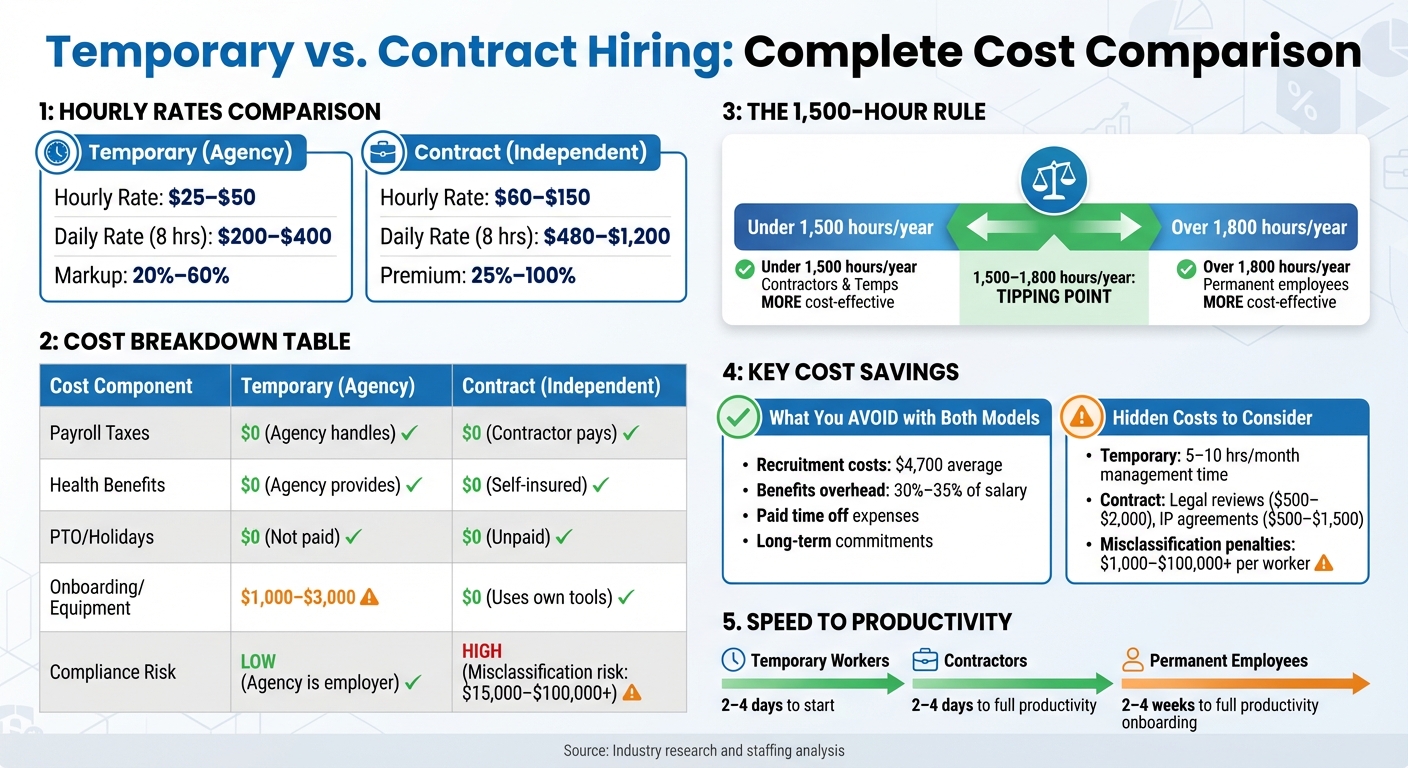
Temporary vs Contract Hiring Cost Comparison Chart
Direct Pay Comparison
Hourly rates are just one piece of the puzzle when comparing costs. Temporary workers hired through agencies typically charge $25 to $50 per hour for general or mid-level roles, while independent contractors command $60 to $150+ per hour for specialized work. On a daily basis, this translates to $200–$400 for temporary hires versus $480–$1,200 for contractors.
Agencies apply a 20% to 60% markup to cover payroll taxes, workers’ compensation, and administrative costs. Independent contractors, on the other hand, bake a 25% to 100% premium into their rates to account for self-employment taxes (15.3%), insurance, and the absence of benefits.
| Hiring Model | Typical Hourly Rate | Daily Rate (8 hrs) | Markup / Premium |
|---|---|---|---|
| Temporary (Agency) | $25 – $50 | $200 – $400 | 20% – 60% markup |
| Contract (Independent) | $60 – $150 | $480 – $1,200 | 25% – 100% premium |
But beyond these numbers, there are deeper cost factors to consider.
Hidden Costs: Taxes, Benefits, and Compliance
The real cost differences become clear when you factor in additional expenses. For temporary hires through an agency, you avoid extra costs like payroll taxes, health benefits, or paid time off – these are already included in the agency’s markup. You also sidestep the average recruitment cost of a permanent hire of $4,700, along with $1,500 to $3,000 in onboarding expenses.
Independent contractors eliminate many overhead expenses as well. You’re not responsible for Social Security (6.2%), Medicare (1.45%), or unemployment taxes – contractors handle these themselves. They also self-insure for health coverage, saving you $7,000 to $10,000 annually in employer contributions, and provide their own equipment. However, this model comes with a risk: if the IRS determines a contractor should have been classified as an employee, you could face fines of $1,000 per worker, plus back taxes and potential legal fees ranging from $15,000 to over $100,000.
| Cost Component | Temporary (Agency) | Contract (Independent) |
|---|---|---|
| Payroll Taxes | $0 (Handled by agency) | $0 (Contractor pays) |
| Health Benefits | $0 (Provided by agency) | $0 (Self-insured) |
| PTO / Holidays | $0 (Not paid by client) | $0 (Unpaid) |
| Onboarding/Equipment | $1,000 – $3,000 | $0 (Uses own tools) |
| Compliance Risk | Low (Agency is employer) | High (Misclassification risk) |
These hidden costs and risks are critical when deciding between temporary and contract hires.
Cost Over Time: Short-Term vs. Long-Term Value
When weighing short-term versus long-term needs, usage hours play a key role in determining cost efficiency. For projects requiring fewer than 1,500 hours annually, both temporary and contract hires are often more cost-effective than a permanent employee. Permanent employees carry an additional 30% to 55% in overhead for benefits, taxes, and paid time off. While a full-time employee works 2,080 hours per year, only about 1,840 of those are productive after accounting for holidays and leave. With temporary or contract workers, you pay only for productive hours.
The tipping point lies between 1,500 and 1,800 hours. Beyond this, the higher hourly rates of contractors and agency markups for temporary workers can surpass the total cost of a permanent employee with full benefits. For example, a 12-week project requiring specialized skills might cost $48,000 with a contractor charging $100 per hour. This could be more economical than hiring a permanent employee when factoring in recruitment, onboarding costs ($7,500 to $28,000), and potential separation expenses. However, for ongoing, year-round roles, the premium costs of temporary or contract hires may become unsustainable.
"A $50,000 employee costs $67,000–$78,000 when you add payroll taxes, benefits, and PTO – that’s 33–55% above base salary."
– Michael Warne, Tarmack
Productivity and ROI Considerations
Temporary Hiring: Flexibility and Speed
Temporary workers are a quick solution to immediate staffing needs. Pre-screened by agencies, they can step in within days, making them perfect for handling seasonal peaks in industries like retail or logistics, filling short-term administrative gaps, or supporting IT sprints. Unlike permanent employees, who typically take around 12 weeks to reach full productivity, temporary staff start contributing almost immediately.
That said, there’s a downside: the need to repeatedly train new hires. Each temporary worker requires onboarding to learn your systems and processes, which can briefly pull focus from your existing team. While they might not be the best fit for roles requiring deep institutional knowledge, temporary hires thrive in high-volume, task-oriented roles and can maintain strong efficiency levels.
"Temporary workers are known to result in increased productivity within the workplace while helping to control staff costs." – TPI Staffing
Ultimately, temporary hires excel when you need quick, scalable support through flexible hiring models. For more specialized or strategic needs, contractors are often the better choice.
Contract Hiring: Specialized Skills and Continuity
Contract hiring focuses on bringing in expertise for specific projects. Contractors are ideal for roles requiring specialized skills, such as setting up cybersecurity systems, conducting compliance audits, or running design sprints. They typically integrate within 2–4 days, delivering immediate results.
However, contractors come with their own risks. If a contractor leaves mid-project, you could lose critical expertise, potentially causing delays and forcing your team to regroup. For projects exceeding 1,500–1,800 hours annually, the risk of losing continuity grows. Additionally, contractors may not fully blend into your team, which can impact collaboration during longer engagements.
To maximize ROI, contractors are best utilized for short-term, specialized projects rather than ongoing core functions. This approach ensures that the cost of hiring aligns with the value delivered, without compromising project timelines or team dynamics.
Choosing the Right Model for Your Business
When Temporary Hiring Makes Sense
Temporary hiring offers quick and flexible solutions for short-term needs. Whether you’re managing seasonal spikes in retail or logistics, supporting brief IT projects, or dealing with a headcount freeze that limits permanent hires, temporary workers can step in to handle tasks like administrative work, warehouse operations, or customer service surges – all without requiring specialized expertise.
The biggest advantage? Speed and scalability. Temporary staff can often be onboarded within days, providing the immediate capacity you need and scaling down just as quickly when demand decreases. This approach can also be cost-efficient. While agencies typically charge a markup of 20% to 60% on wages, you avoid the additional overhead costs (30% to 55%) tied to permanent employees.
That said, when your needs demand specialized skills, a different hiring model might deliver better value.
When Contract Hiring Delivers Better ROI
Contract hiring focuses on securing specialized skills for specific projects. If you’re tackling compliance audits, implementing cybersecurity measures, testing new markets, or running design sprints, contractors bring the expertise you need with minimal onboarding time. They typically become fully productive within 2 to 4 days and work toward clearly defined milestones.
However, contractors can lose their cost advantage when workloads exceed 1,500 to 1,800 hours annually – around 30 to 35 hours per week. At that point, their hourly rates, which are often 25% to 100% higher than employee wages, may surpass the costs associated with hiring a full-time employee. For example, a role with a $50,000 annual salary might cost significantly more if filled by a contractor.
For growing businesses, a mix of hiring models often works best. A lean core of permanent employees ensures continuity and institutional knowledge, while contractors handle specialized projects and temporary workers address seasonal or short-term needs. This combination keeps fixed costs manageable while giving you the flexibility to access the right skills at the right time.
Ultimately, your choice between these hiring models should hinge on whether your priority is rapid scalability or achieving specific project goals.
Rent a Recruiter: Cost-Effective Contract Staffing Solutions

When it comes to temporary and contract hiring, costs can quickly spiral out of control. That’s where Rent a Recruiter stands out – a simple, fixed-cost solution that eliminates the guesswork.
Cost Savings and Efficiency
Comparing different recruitment models, traditional agencies often charge between 15% and 25% of a new hire’s first-year salary. For a $75,000 role, that’s over $11,000 in fees. Temporary staffing comes with even steeper markups, ranging from 20% to 60%. These costs only grow as your hiring needs increase.
Rent a Recruiter flips the script. Instead of paying per hire, you get experienced recruiters embedded directly into your team at a fixed monthly cost. This approach not only avoids hefty commissions but also cuts hiring expenses by up to 70% compared to traditional models. On top of that, businesses save over 80 hours per month in administrative work. With predictable pricing, you can say goodbye to surprise invoices – especially when hiring for senior roles.
This streamlined model is ideal for businesses looking to control costs while scaling effectively.
Scalable and Flexible Support
Whether you’re ramping up for a product launch or building a long-term recruitment function, Rent a Recruiter adjusts to your needs. High-growth companies in sectors like technology, SaaS, fintech, engineering, and professional services rely on this model to handle hiring surges without committing to a larger permanent HR team.
This flexibility is key during critical growth phases, such as post-funding expansions or seasonal hiring spikes. You get the capacity you need when it matters most, without carrying extra costs during quieter periods. Some businesses use Rent a Recruiter for short-term hiring goals, while others establish ongoing partnerships to build a consistent recruitment function that scales with their growth.
Predictable Hiring Outcomes
The combination of cost efficiency and scalability leads to one more major advantage: predictable results. Embedded recruiters work as part of your team, aligning with your company’s culture and managing the entire hiring process from start to finish. This reduces administrative tasks – saving 10 to 15 hours per hire – and ensures a structured, repeatable process.
By integrating seamlessly into your operations, these recruiters help you make faster hires, improve candidate quality, and reduce your dependence on external agencies. They also handle critical details like proper classification, which minimizes financial risks.
For high-growth companies, this approach delivers the precise, cost-effective hiring solutions needed to scale efficiently and confidently.
Conclusion
Key Takeaways
When deciding between temporary and contract hiring, it’s crucial to look beyond hourly rates and focus on the total cost and how each model fits your business needs. This includes everything from hourly wages to hidden fees, helping you choose the right approach for your situation.
Temporary hires through agencies often come with wage markups, while contractors charge higher rates but eliminate costs like benefits and payroll taxes. A helpful benchmark is the 1,500-hour rule: for roles requiring fewer than 1,500 hours annually, contractors often provide better value. For positions exceeding 1,800 hours annually, permanent employees generally become the more economical choice.
You’ll also need to weigh cost against flexibility. Contractors can bring specialized skills onboard in just 2 to 4 days, compared to the 2 to 4 weeks it often takes to hire permanent staff. Temporary workers, on the other hand, allow for quick scaling to meet short-term demands thanks to pre-screened talent pools.
These insights provide a roadmap to refining your hiring strategy based on both cost and operational needs.
Next Steps: Explore Cost-Saving Opportunities
If you’re aiming to cut hiring costs by up to 70% without compromising on quality or speed, Rent a Recruiter offers a fixed-cost alternative to traditional commission-based recruitment. Our embedded recruiters integrate seamlessly into your team, handling the entire hiring process while saving over 80 hours of administrative work each month.
Whether you need short-term hiring support or a scalable recruitment solution, we partner with high-growth companies in technology, SaaS, fintech, and professional services to deliver predictable, efficient hiring. See how Rent a Recruiter can transform your hiring strategy and start making smarter, more cost-effective decisions today.
FAQs
How do I calculate the true hourly cost of a temp vs a contractor?
To figure out the true hourly cost of a temporary worker versus a contractor, you need to account for much more than just the hourly rate. Look at the total costs involved, including:
- Benefits: Health insurance, paid time off, or other perks for temporary workers.
- Overhead: Administrative expenses tied to payroll and management.
- Recruitment and onboarding: Fees for hiring, training, and integrating the worker into your team.
- Hidden costs: Items like equipment, software access, or additional training.
For temporary workers, recruitment fees and onboarding costs can significantly add up, along with potentially higher hourly rates. Combine all these expenses with the direct wages, then divide the total by the number of billable hours. This gives you a clear picture of the true hourly cost for both options.
What are the biggest contractor misclassification red flags?
Key warning signs of contractor misclassification revolve around control over how work is performed, the worker’s ability to realize a profit or incur a loss, and whether the worker is essential to the company’s operations. Misclassifying workers can lead to hefty penalties – ranging from $15,000 to over $100,000 per worker – stemming from violations tied to the IRS, Department of Labor, or state-specific rules.
When does it become cheaper to hire a full-time employee instead?
Hiring a full-time employee makes financial sense when their total compensation – covering salary, benefits, taxes, and overhead – comes in lower than what you’d pay a contractor for the same hours. Take a role with a $50,000 salary, for instance. Once you factor in additional costs, the total annual expense usually ranges between $67,000 and $78,000. While contractors work well for short-term projects, full-time employees often become the more budget-friendly choice for steady, long-term workloads, especially when contractor costs surpass what you’d spend on an employee.