
If you wait until a role opens to start hiring, you are already losing time and money.
I see the same pattern across scaling firms in SaaS, Technology, IT, Fintech, Engineering, Security, Insurance, and Professional Services: reactive hiring slows delivery, pushes up spend, and leaves hiring teams stuck in repeat search cycles. The fix is simple in principle. Build live talent pools, link them to workforce planning, and review them against demand every 90 days.
Here is the commercial case in plain terms:
- Technical roles can take 42 to 60 days to fill
- Each vacancy can cost $1,700 to $5,000 per day
- Poor senior hires can cost up to 200% of salary
- Structured talent planning can cut cost-per-hire by 25% to 40% over time
- Pre-qualified pipelines can shorten hiring windows to 2 to 4 weeks for repeat or priority roles
For me, the main takeaway is this: talent pools only work when they are live, segmented, and tied to forecasted hiring demand. A static ATS list will not help you when headcount pressure hits. A managed pool will.
If you need extra delivery capacity to keep those pools current, an embedded recruiter or support from Rent a Recruiter can help your team stay ahead of hiring demand instead of reacting to it.
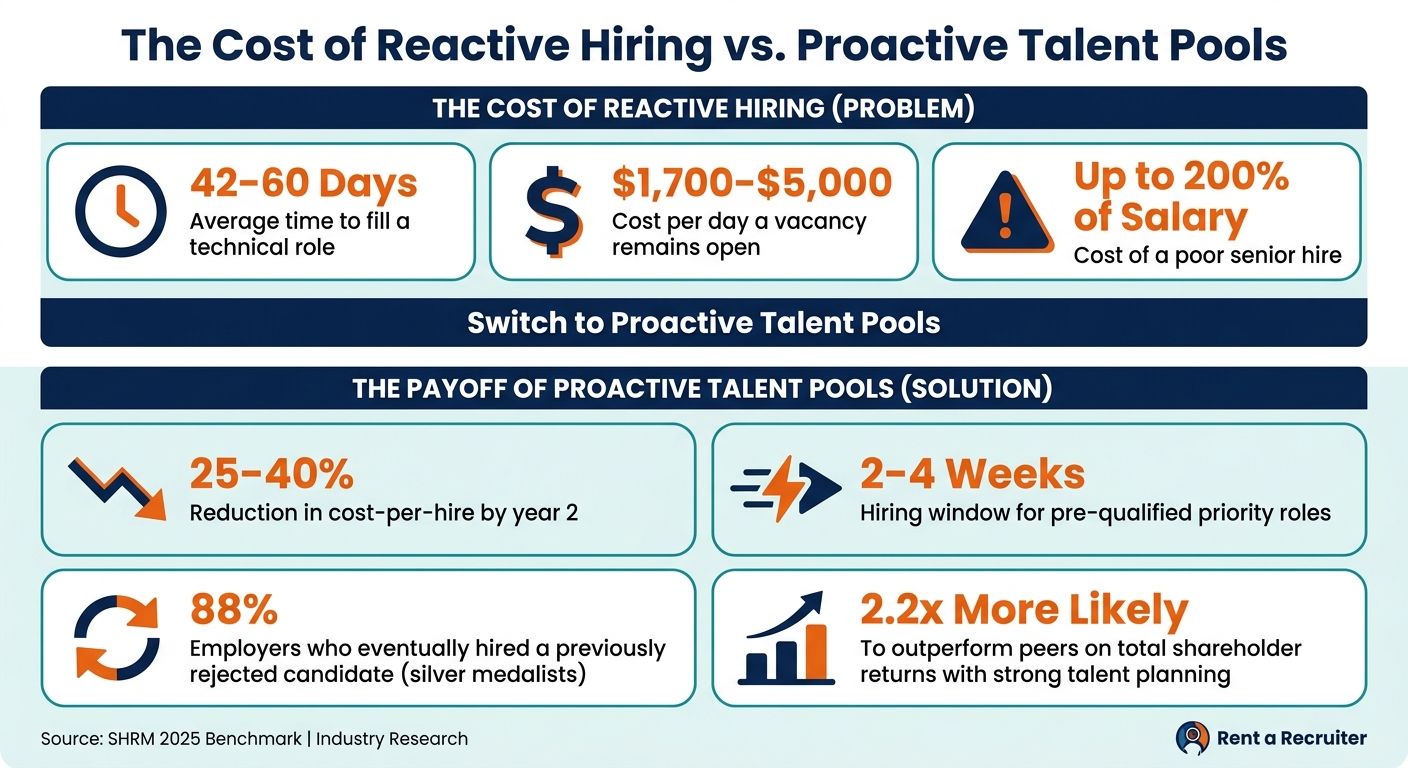
The Cost of Reactive Hiring vs. Proactive Talent Pools
The Talent Pool in a Nutshell | AIHR Learning Bite
sbb-itb-a23bd6a
What research says about talent pools and workforce planning
Research defines a talent pool as a structured, always-on system for tracking skills, potential, and motivation across both internal and external talent [4]. In plain terms, it gives your hiring team a view of who is available before you need to hire, not after the pressure starts.
That changes the game. Instead of running hiring as a last-minute scramble, you make it repeatable, measurable, and easier to plan.
Workforce planning does the other half of the job. It maps current capacity, forecasts future hiring needs, and spots gaps before they turn into urgent vacancies [2]. When you connect talent pools to that forecast, you start matching talent supply to business demand before a role even opens. For scaling companies, that can mean less delay, less agency spend, and fewer rushed decisions.
That matters because not every role takes the same level of sourcing effort. Some hires can move fast. Others need months of planning.
Internal and external talent pools serve different planning needs
Internal pools support succession, internal mobility, and leadership development. They help you see who could step into bigger roles, move across teams, or fill gaps without starting from scratch.
External pools do a different job. They give you a bench of pre-engaged candidates for forecasted demand and hard-to-fill roles. If you’re scaling in SaaS, Technology, Fintech, Engineering, or Security, that kind of bench can save serious time when hiring demand spikes.
Used together, internal and external pools support:
- succession planning
- niche hiring
- future capacity planning
But there’s a catch. A pool only works if it stays current and links back to actual hiring demand. If it’s just a list sitting in your ATS or CRM, it won’t help when the business needs headcount fast.
Role segmentation by business impact strengthens workforce planning
Not every role should get the same sourcing investment. That’s where segmentation helps.
Research suggests grouping roles into critical, planned, and pipeline hires to match sourcing effort to business impact [5][1]. It’s a simple idea, but it has a big commercial effect. Your team spends more time on the roles that matter most, and less time treating every vacancy like a fire drill.
For example, a revenue-critical leadership hire or a hard-to-fill engineering role may need early mapping and regular market outreach. A more predictable hire may only need light pipeline activity. That keeps workforce planning tied to business strategy, not just incoming headcount requests.
Talent pools require active management, not passive databases
A talent pool that isn’t maintained turns into dead weight.
Research shows talent pool data loses accuracy by 20% to 30% each year [3]. People change jobs. Contact details expire. Skill profiles drift out of date. What looked usable six months ago can become noise fast.
That’s why passive databases don’t deliver much. Without quarterly review and regular outreach, the pool loses value quickly [5][2][1]. If you want hiring teams to rely on it, the data has to stay live.
A good talent pool isn’t just stored. It’s worked.
That means checking data, refreshing profiles, and keeping contact warm enough that your team can act when demand appears. Otherwise, you’re not planning ahead, you’re just storing old information.
The next step is turning that structure into a live hiring plan.
How to integrate talent pools into a scalable hiring plan
Forecast hiring demand by role, timing, and skill gaps
Map hiring demand by role, timing, and skill gap across the next 2 to 4 quarters. Tie that plan directly to revenue targets, product launches, expansion, and M&A activity. If hiring sits outside the business plan, it slips fast.
A simple way to frame gaps is across four areas:
- Quantity: too few people
- Skills: missing capabilities
- Quality: the team lacks the experience needed for the next stage
- Pipeline: no successor for critical roles
Each gap needs a different pool plan. If the issue is quantity, you may need a larger ready-to-engage pool. If it’s quality or pipeline, you need a tighter group with stronger screening and longer-term nurturing.
Use those gaps to decide which roles need live pools first. Start with the roles that create the most business risk if left open.
Build segmented pools for priority roles
For priority roles, segment by readiness, not just skill. That sounds simple, but it changes how you act on the pool. A person who is a strong fit but unavailable for 6 months should not sit in the same bucket as someone who can interview this week.
A three-tier structure keeps priority roles under control [3]:
- Ready Now , vetted candidates who can move at once
- Nurture , strong prospects who are not yet available
- Silver Medalists , past finalists who already met your hiring bar
That last group often gets ignored, which is a mistake. Nearly 88% of employers have eventually hired a candidate they previously rejected [3]. That’s not a small signal. It tells you many hiring teams are sitting on people who could fill later roles with less time, less sourcing effort, and less risk.
Use scorecards during live searches so you can tag silver medalists for later roles. If you skip that step, those candidates vanish into the ATS and the work has to start again from scratch.
Pool inputs should come from more than one place. Pull from previous strong applicants, employee referrals, alumni, passive candidates found through market mapping, and internal high-potential employees flagged in performance reviews.
Use data to keep pools aligned with hiring reality
Review each pool every 90 days against current hiring demand. That review matters because hiring plans change. Budgets get cut. Teams grow faster than expected. Turnover shows up out of nowhere.
The metrics worth watching are time-to-fill, internal fill rate, source yield, and quality-of-hire. These numbers show whether a pool still matches what the business needs. They also show where you’re wasting effort.
When priorities shift because of turnover, budget changes, or market conditions, use those metrics to decide which pools to pause and which to move faster.
If internal capacity is thin, outside support can keep the plan moving. When internal sourcing capacity is limited, Rent a Recruiter embeds recruiters into your team to keep pools current and hiring moving.
Commercial outcomes: speed, cost control, and hiring capacity
When talent pools are live, you see the payoff where it matters most: speed, cost, and hiring capacity.
Reduced time-to-fill for critical and repeat hires
When key roles sit open for 60 to 90 days, the impact spreads fast. Teams pick up extra work, delivery slows, and attrition risk climbs [2].
Pre-qualified talent pools can shrink that gap in a big way. Companies with active, prequalified pipelines can bring hiring into a 2-to-4-week window, compared with the U.S. average of 54 days [2]. That kind of speed matters. It helps you protect delivery timelines, keep teams stable, and avoid the drag that comes with long vacancy periods.
Better cost efficiency and internal time savings
The average cost-per-hire for non-executive roles in the U.S. hit $5,475 in 2025 [1]. That adds up fast, especially when hiring ramps across several teams.
Companies that move to a structured, proactive talent acquisition model can cut cost-per-hire by 25% to 40% by their second year [1]. Talent pools help drive that drop because they turn future hiring demand into ready supply. In plain terms, that means:
- fewer cold searches
- less spend with traditional recruitment agencies
- shorter hiring cycles for repeat roles
You also save internal time. Hiring managers spend less time restarting searches from scratch, and talent teams spend less time chasing the same profiles over and over.
Embedded recruitment support for execution
Planning helps, but execution is what gets roles filled.
Embedded recruiters work inside your business, managing sourcing, coordinating interviews, tracking pipeline data, and keeping stakeholders aligned. For high-growth SMEs in technology, SaaS, fintech, and engineering, Rent a Recruiter provides that hiring capacity fast, without the overhead of building a full internal team.
Companies with strong talent planning are 2.2 times more likely to outperform their peers on total shareholder returns [2]. That tends to show up in ways leadership teams care about straight away: fewer open roles, lower hiring costs, and steadier growth.
Those gains only hold when the process has clear ownership, a set rhythm, and metrics that people actually track.
Governance, measurement, and next steps
Once your pools are live, governance is what keeps them accurate and tied to hiring demand. Without it, even a strong pool goes stale. The issue is simple: if no one owns it, no one updates it.
Set clear ownership and review cadence
Talent pools need named owners and a fixed review rhythm. That ownership should sit across HR, talent acquisition, business leaders, and Finance. Each group brings a different lens, from hiring demand and budget to delivery risk and pipeline gaps.
Use that ownership to review the plan at three levels:
| Review Level | Frequency | Focus |
|---|---|---|
| Tactical | Weekly | KPI dashboards, immediate pipeline health, active requisitions |
| Operational | Monthly | Hiring plan updates, backfills, budget allocation |
| Strategic | Quarterly | Pool health, demand forecasting, scenario modeling, business alignment |
This cadence matters because hiring plans shift. Roles get approved, budgets change, and backfills appear out of nowhere. A weekly view helps you spot short-term issues early. Monthly reviews keep hiring plans and spend in line. Quarterly reviews give leadership a clearer view of future demand and whether the pool strategy still matches the business.
That rhythm only works if you track the right numbers.
Track the metrics that show planning is working
You need metrics that show whether the plan is improving speed, cost, and hiring quality. If a pool looks busy but doesn’t help you hire faster or lower spend, it’s just admin.
Time-to-fill shows whether your pools are warm enough to cut vacancy drag. If this number isn’t moving, your pipeline may be too thin or not close enough to the roles you need.
Cost-per-hire shows whether proactive sourcing is lowering spend. Compared with the 2025 SHRM benchmark of $5,475 for non-executive roles, it gives you a clean way to judge whether the model is paying off [1].
Internal fill rate shows how well your internal pool is working. If you keep going to the external market for roles that could have been filled from within, that’s a warning sign. It often points to weak internal mobility, poor visibility, or a pool that hasn’t been kept up to date.
Pipeline coverage measures whether you have pre-qualified people ready for your top-priority roles before those roles open. This is one of the clearest signs that planning is doing its job. When coverage is weak, hiring teams end up back in reactive mode. This shift often stems from the biggest challenges in recruitment that HR leaders face today.
Quality of hire, tracked through 90-day performance reviews, checks whether people coming through the pool are the right fit [2]. Fast hiring means little if early performance is poor or new joiners don’t stick.
These five metrics show whether workforce planning is improving speed, cost, and quality.
Conclusion: turn research into a repeatable hiring system
The pattern is clear. Talent pools work when they are segmented by role priority, actively managed, tied to hiring forecasts, and measured against hiring outcomes. That’s where many scaling companies still fall short—often revealed by a recruitment health check—and it’s also where the upside sits.
A repeatable hiring system doesn’t need a huge team or heavy software. It needs the right structure, steady execution, and enough hiring capacity when demand spikes. That’s what turns planning into results.
When internal capacity is thin, an embedded recruiter can run the process and keep pools current. If you need extra hiring capacity fast, Rent a Recruiter can support your team with pool management, hiring delivery, and reporting. Book a call to talk through embedded recruitment support.
FAQs
How do I start building a live talent pool?
Start by lining up your talent pool with headcount plans and growth milestones, not by stockpiling resumes. If the pool does not map to the roles you expect to open, it will not help you hire faster or cut recruiting spend.
Give one person clear ownership, usually a recruiter or hiring manager. That person should keep the data clean, update records, and run outreach so the pool stays usable instead of turning into a messy database.
Start with past silver medalists. They already know your process, and you already know they were close. From there, tag candidates by job family, seniority, location, and readiness so you can find the right people fast when hiring demand changes.
Review the pool every quarter. Keep in touch through regular, personalised check-ins so warm contacts do not go cold between hiring cycles.
Which roles should be prioritized first?
Map your hiring needs for the next 12 months, then rank each role by business impact and hiring risk. Put the focus on roles tied straight to revenue, project delivery, or the output of your core team.
A simple place to start is with the three to five roles you’ve hired most often in the past 24 months. That gives you a clear view of repeat demand and where hiring gaps are most likely to slow the business down.
Prioritise revenue-protecting roles before expansion hires or extra layers of management. In plain terms, focus on the capabilities the business needs to perform, not just the job titles on the org chart.
How often should talent pools be reviewed?
Review talent pools quarterly so your data stays clean and your candidates stay relevant and engaged. Give this work a clear owner. That’s what keeps it on track, instead of turning into one more task that slips.
It also helps to line up workforce planning and quality reviews with the rhythm your business already follows, like monthly operating metrics and annual planning. When hiring reviews sit inside the cadence you already use, they’re far more likely to happen, and far more likely to improve hiring outcomes.