Structured interviews are the most effective way to reduce bias in hiring. By standardizing questions, scoring systems, and evaluation criteria, they cut unconscious bias by over 50%, improve hiring accuracy, and save companies from costly mistakes. For scaling businesses, this approach ensures consistent hiring decisions while building stronger, more diverse teams.
Key Insights:
- Unstructured interviews are unreliable: They rely on gut instinct, leading to biased decisions. Predictive validity is low (r = 0.20–0.38).
- Structured interviews are data-driven: Predictive validity is nearly double (r = 0.44–0.63), focusing on job-relevant skills, not personal impressions.
- Bias reduction: Structured interviews reduce bias effect size from d = 0.59 to d = 0.23, ensuring fairer evaluations.
- Business impact: A bad hire can cost up to $240,000. Structured interviews minimize these risks by improving decision-making.
By adopting structured interviews, you ensure every candidate is evaluated objectively, saving time and money while improving hiring outcomes. If you’re scaling fast and need help implementing this approach, Rent a Recruiter can embed skilled recruiters into your team to design and manage structured processes tailored to your needs.
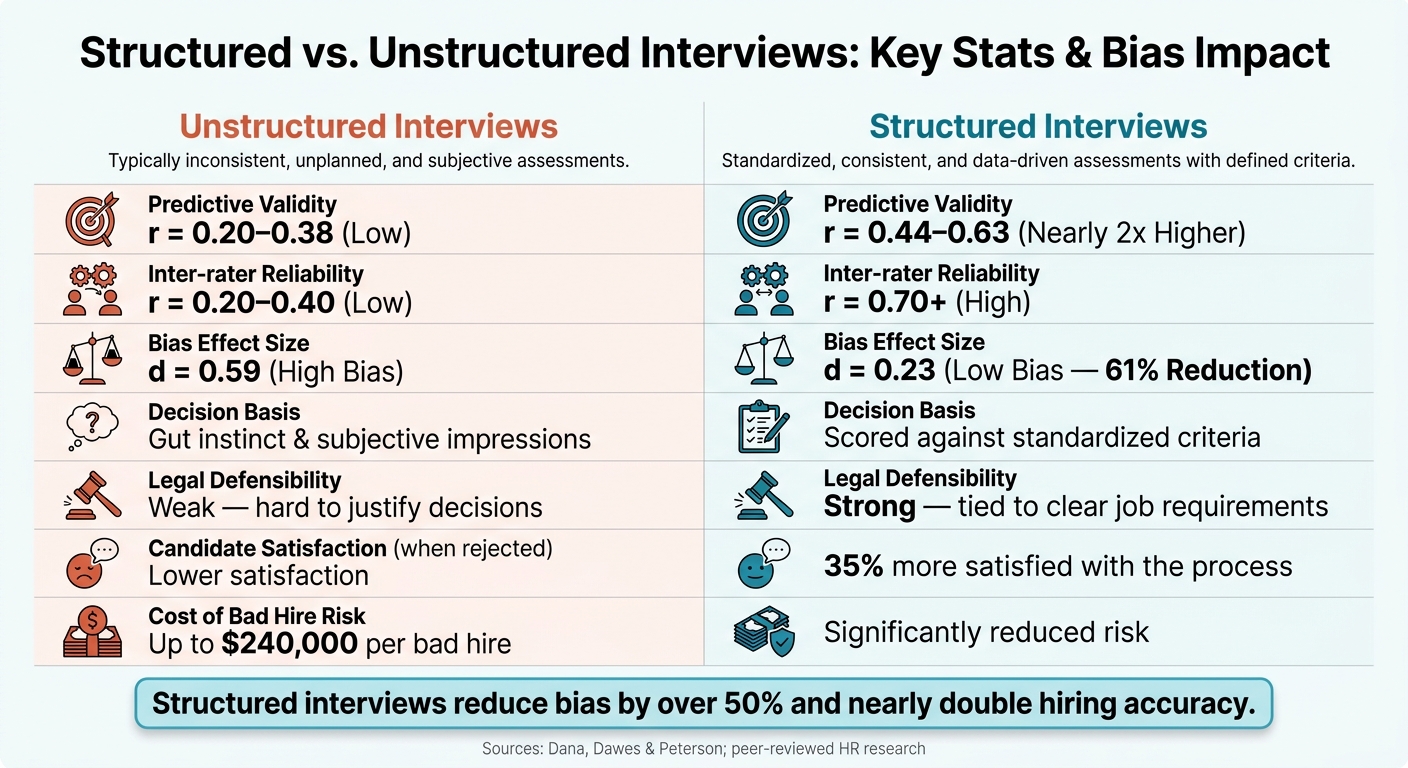
Structured vs. Unstructured Interviews: Key Stats & Bias Impact
The Problem with Unstructured Interviews
What Are Unstructured Interviews?
Unstructured interviews are essentially unscripted conversations where interviewers rely on instinct rather than a formal process. There’s no set list of questions, no scoring system, and no consistent way to compare candidates. While this informal approach might feel natural, it sacrifices fairness and consistency.
The issue with this method lies in its subjectivity. Decisions are often driven by personal impressions instead of measurable criteria. Research by Dana, Dawes & Peterson highlights this flaw:
"Interviewers who conduct unstructured interviews are more confident in their predictions than those who rely on structured data – despite making worse predictions." [3]
This lack of structure opens the door to biases, which can distort judgment and undermine the hiring process. Let’s dive deeper into how unstructured interviews allow bias to creep in.
How Bias Shows Up in Unstructured Interviews
The danger of unstructured interviews is how quickly biases can take over. Studies show that most interviewers form an opinion within the first 90 seconds. From there, confirmation bias kicks in, where interviewers unconsciously seek evidence to support their initial impression [4]. This not only skews fairness but also leads to costly hiring mistakes. Understanding what works in modern recruitment is essential for avoiding these pitfalls.
Without a standard framework, other biases fill the gap:
- Affinity bias: Favoring candidates who share similar interests, backgrounds, or communication styles.
- Attribution bias: Excusing nervousness or mistakes for candidates they relate to, while penalizing others for the same behaviors.
These biases have measurable consequences. For example, 30% of the racial gap in technical interview pass rates stems from such asymmetries [4].
Another major issue is the vague idea of "culture fit." In unstructured interviews, it often becomes shorthand for personal similarity – shared hobbies, education, or demographics – rather than job-relevant traits. Research underscores how damaging this can be: candidates with stereotypically white-sounding names are 50% more likely to receive callbacks, even when qualifications are identical [4].
Structured vs. Unstructured Interviews: A Comparison
To see the risks of unstructured interviews more clearly, compare them with structured interviews:
| Feature | Unstructured Interviews | Structured Interviews |
|---|---|---|
| Format | Informal, improvised | Standardized for all candidates |
| Questions | Vary by interviewer and candidate | Same questions asked in the same order |
| Decision Basis | Gut instinct and subjective impressions | Scored against clear criteria |
| Predictive Validity | Low (r = 0.20–0.38) [3] | High (r = 0.44–0.63) [3] |
| Inter-rater Reliability | Low (r = 0.20–0.40) [3] | High (r = 0.70+) [3] |
| Bias Susceptibility | High (d = 0.59) [6] | Low (d = 0.23) [6] |
| Candidate Experience | Often feels inconsistent or unfair [6] | Perceived as more fair and relevant [3] |
| Legal Defensibility | Weak; decisions are harder to justify | Strong; tied to clear job requirements [6] |
One striking statistic: candidates rejected after a structured interview were 35% more satisfied with the process than those who went through an unstructured one [1]. Even when the answer is "no", a structured approach feels more transparent and respectful, leaving a better impression overall.
sbb-itb-a23bd6a
The Advantages of Structured Interviews (over unstructured ones)
How Structured Interviews Reduce Bias
Structured interviews offer a clear solution to the challenges of unstructured interviews by creating a fair and consistent framework for evaluating candidates.
What Are Structured Interviews?
A structured interview follows a set process: every candidate answers the same pre-planned questions in the same order, and their responses are assessed using the same scoring system. This approach removes guesswork and subjective judgments. A tool called Behaviorally Anchored Rating Scales (BARS) is often used to evaluate answers, defining what poor, average, and excellent responses look like for each key skill or competency.
The foundation of structured interviews is a job analysis. This ensures that questions target 4–6 core competencies essential for the role. By focusing on job performance rather than personal impressions, this process avoids irrelevant factors like shared interests or educational backgrounds from influencing decisions.
Research Supporting Structured Interviews
Data strongly backs the effectiveness of structured interviews. Studies show they achieve a predictive validity of r = 0.44–0.63, nearly double the accuracy of unstructured formats, which range from r = 0.20–0.38 [3]. This means structured interviews are far better at predicting on-the-job success.
They also significantly reduce bias. The bias effect size drops from d = 0.59 in unstructured interviews to d = 0.23 in structured ones [6]. For example, a study involving nearly 20,000 managerial applicants found that highly structured interviews made demographic factors like gender and race almost irrelevant in final scores [7].
"Structured interviews are one of the best tools we have to identify the strongest job candidates. Not only that, they avoid the pitfalls of some of the other common methods." – Dr. Melissa Harrell, Former Hiring Effectiveness Expert, Google [1]
These findings highlight how structured interviews not only improve hiring accuracy but also create a fairer process.
How Bias Mitigation Works in Practice
Structured interviews reduce bias by design, not by chance. Here’s how:
- Standardized questions: Every candidate is judged on the same criteria, ensuring fairness. No one gets easier or harder questions based on personal impressions.
- Independent scoring: Each interviewer submits their ratings before group discussions, preventing senior panelists from influencing others [6].
- Delayed holistic judgment: Rather than forming an overall impression upfront, interviewers score each competency individually. This ensures a thorough, evidence-based evaluation across all areas [3].
These mechanisms work together to ensure a fair and unbiased process.
Common Biases and How Structured Interviews Address Them
The table below outlines common interview biases and how structured interviews neutralize them:
| Common Bias | What It Looks Like | Structured Countermeasure |
|---|---|---|
| Confirmation Bias | Forming an early opinion and seeking evidence to justify it | Standardized questions and rubrics ensure all data is evaluated [1][3] |
| Affinity / Similarity Bias | Preferring candidates with shared backgrounds or interests | Job-focused criteria limit the impact of irrelevant similarities [3][7] |
| Halo / Horn Effect | One strong or weak answer influences the entire evaluation | Independent scoring isolates each answer from overall impressions [3] |
| First-Impression Bias | Judging candidates within seconds | Rubric-based scoring reduces the impact of snap judgments [3] |
| Anchoring Bias | Senior panelists sway the group’s opinions | Independent scoring prevents groupthink [3][6] |
| Leniency Bias | Overrating some candidates without justification | BARS create consistent scoring standards across interviewers [3] |
Rather than relying on any single feature, structured interviews combine these elements – standardization, rubrics, independent scoring, and job-relevant questions – to create a process where bias has less influence. By focusing strictly on job-related criteria, structured interviews not only minimize bias but also contribute to building more diverse teams.
How to Design Effective Structured Interviews
Creating structured interviews that minimize bias and promote fairness takes careful planning and execution. Here’s how to get it right.
Building a Competency-Based Framework
Start with a thorough job analysis. Collaborate with hiring managers, top performers, and review performance data to pinpoint what drives success in the role. From this, identify 4–6 core competencies, such as problem-solving, technical expertise, or leadership. Avoid overloading the scorecard with more than 6–7 competencies; research shows that tracking too many dimensions can lead to inconsistent evaluations due to cognitive overload [8].
Replace vague notions like "culture fit" with values translation. Instead of asking if someone "fits the culture", define this in terms of observable behaviors. For example, "comfort with ambiguity" or "collaborative problem-solving" are far more measurable and less prone to bias [4].
Once you’ve outlined the competencies, the next step is creating standardized questions and scoring methods.
Writing Standardized Questions and Scoring Rubrics
With competencies in hand, assign 1–2 specific questions to each. Use a mix of behavioral questions (e.g., "Tell me about a time you…") and situational ones (e.g., "What would you do if…?"). Behavioral questions are ideal for experienced candidates, while situational questions work better for entry-level roles or scenarios candidates haven’t encountered yet [1][6].
For scoring, a 1–5 scale with behavioral anchors is highly effective. Write anchors that focus on observable actions rather than interpretations. For instance, "Candidate proposed three distinct API schema designs" is concrete and measurable, whereas "Good systems thinker" is subjective and open to bias [8]. Involving top performers in crafting the "5" anchor ensures it reflects what excellence truly looks like in practice.
"Standardizing what you ask and how you evaluate answers turns interviews from conversations into data-driven assessments." – Amit G., CEO, NextInHR [10]
Even with a strong framework, effective interviewer training is key to maintaining consistency.
Training Interviewers to Use Structure
The most robust scoring system falls apart without proper training. Calibration exercises are particularly effective: have interviewers independently score the same recorded interview, then compare results and resolve discrepancies. Google cut interviewer inconsistency by 40% after introducing mandatory calibration sessions [11]. Short, 30-minute calibration sessions each quarter are more effective than a single lengthy onboarding session [11].
Encourage interviewers to submit scores before group discussions and reveal them simultaneously during debriefs. Train them to document specific, observable evidence for each score. If an interviewer can’t point to something the candidate explicitly said or did, the score should be questioned.
Scaling Structured Interviews as Your Team Grows
For fast-growing companies, dedicating 4–6 hours per role to develop reusable scorecards is a smart investment. For example, you might create one scorecard for all Customer Success roles and another for Engineering. This approach reduces setup time for future hires and keeps training consistent [9].
As your team expands, assign specific competencies to individual panel members instead of having everyone evaluate everything. This allows for more detailed assessments and reduces redundancy. Research shows that adding a fifth or sixth interviewer provides less than 1% additional predictive value, so keeping panels to four members is usually sufficient [8]. Smaller panels also speed up scheduling, which is crucial when hiring at scale. A structured process not only saves time but also strengthens bias reduction as your team grows.
Rolling Out Structured Interviews in a Growing Company
How to Roll Out Structured Interviews
Introducing structured interviews doesn’t have to mean overhauling your entire hiring process overnight. Instead, take a phased approach. Begin with one job family or a couple of open roles. A 6-week pilot is often enough to gather meaningful data, demonstrate success, and gain buy-in from hiring managers before expanding the process across other teams [1][5]. Once the pilot delivers results, integrate these methods into your broader hiring strategy.
With proven outcomes, the next step is to create a centralized toolkit. This should include a shared library of pre-approved questions, scoring rubrics, and role-specific scorecards. While setting this up may take 4–6 hours initially, the effort pays off by streamlining future hiring for similar roles. It ensures consistency and saves time as your team continues to grow [6][9].
Fitting Structured Interviews into Your Hiring Process
After a successful pilot, structured interviews should be embedded into every stage of your recruitment pipeline. For instance, at the screening stage, asynchronous (one-way) video interviews are an excellent starting point. They ensure all candidates are asked the same questions in the same order, with minimal impact on live schedules [9][12]. From there, structured live interviews can guide downstream steps like work samples and reference checks, creating a cohesive and bias-resistant hiring process from start to finish.
Here’s how structure can be applied at each hiring stage:
| Stage | Action | Why It Matters |
|---|---|---|
| Intake | Define 3–5 must-have criteria with the hiring manager | Ensures alignment among the panel before screening begins [9] |
| Screening | Use async/one-way video with fixed questions | Guarantees consistent questions for every candidate [12] |
| Interview | Score with anchored 1–5 rubrics | Replaces subjective judgments with clear, documented evaluations [6] |
| Debrief | Submit scores independently before discussion | Prevents dominant voices from influencing the group’s decisions [12][6] |
Handling Common Challenges
One frequent concern is that structured interviews can feel rigid or impersonal. Address this by being transparent with candidates. Let them know that every applicant is asked the same set of questions – this builds trust in the process and underscores your commitment to fairness. Interestingly, research shows that candidates who are rejected after a structured process are 35% more satisfied with their experience compared to those who go through unstructured interviews [1].
Another common issue arises when interviewers delay completing scorecards. Memory recall begins to fade within 20 minutes of an interview, so it’s crucial to complete scorecards within 30 minutes of the conversation – well before any group debrief takes place [8][13].
"Evaluation, not interviewing, is where structured hiring breaks down." – Drew Whitehurst, Director of Marketing and Product Strategy, interviewstream [12]
These challenges highlight the need for expert guidance and disciplined execution.
How Rent a Recruiter Can Help
Scaling companies often struggle to maintain structure in their hiring processes as they grow. Managing a busy hiring pipeline while enforcing structured interviews can feel overwhelming. This is where Rent a Recruiter steps in. By embedding skilled recruiters directly into your team, they design and implement structured interview frameworks tailored to your needs – quickly and effectively.
From creating scorecards to running calibration sessions, their recruiters ensure consistency and process discipline across all roles, not just the ones where someone had time to prepare. For fast-growing companies in sectors like technology, SaaS, fintech, and professional services, this embedded recruitment approach ensures that structured hiring becomes a standard, not an exception.
Measuring the Results of Structured Interviews
Key Metrics to Track
Once you’ve implemented structured interviews, it’s important to measure their impact. Focus on metrics like funnel-stage adverse impact, inter-rater reliability, interviewer score variance, and quality of hire to assess how well the process is working.
Funnel-stage adverse impact helps identify where demographic disparities occur in your hiring pipeline – whether during resume reviews, phone screens, assessments, interviews, or offers [4]. Structured interviews often achieve inter-rater reliability scores of r = 0.70 or higher, compared to r = 0.20–0.40 for unstructured methods [3]. Tracking interviewer score variance can highlight patterns tied to candidate demographics, which might signal a need for additional interviewer training [4]. Finally, quality of hire connects interview scores to actual job performance and retention metrics over time [2][1]. If structured interview scores don’t align with on-the-job success, it’s time to refine your rubrics.
Before-and-After Impact Analysis: Demonstrating Value
To show the value of structured interviews, start by establishing baseline metrics like predictive validity, inter-rater reliability, and demographic selection rates. Then, measure these same metrics after completing a full hiring cycle using structured interviews [3][4].
| Dimension | Unstructured Interviews | Structured Interviews |
|---|---|---|
| Predictive Validity | r = 0.20–0.38 | r = 0.44–0.63 [3] |
| Inter-rater Reliability | r = 0.20–0.40 | r = 0.70+ [3] |
| Adverse Impact | Higher | Lower [3] |
| Legal Defensibility | Weak | Strong [3] |
A key tool for this analysis is the four-fifths rule: if the selection rate for any group is less than 80% of the highest-selected group, it may indicate disparate impact that needs further investigation [4].
These improvements provide a clear framework for refining your hiring practices, ensuring structured interviews remain both fair and effective.
Continuous Improvement and Support
Structured interviews require regular maintenance to stay effective. Quarterly audits can help catch issues like interviewer drift, vague rubrics, or the reappearance of adverse impact [3][4]. During these reviews, focus on areas where evaluators frequently disagree. Often, the problem lies in unclear rubric language rather than interviewer errors.
This is where Rent a Recruiter can make a real difference. Their embedded recruiters not only help set up structured interviews but also perform regular recruitment health checks. They analyse your hiring data, refine scoring rubrics, and adjust question banks based on what the metrics reveal. For fast-growing companies dealing with fluctuating hiring demands, this built-in analytical support keeps the system adaptable and continuously improving.
Conclusion: Building a Fair and Scalable Hiring Process
Key Takeaways
Structured interviews are not just a best practice – they’re a game-changer for hiring. By swapping subjective decisions for standardized questions and anchored scoring systems, companies can reduce bias by over 50% and improve the accuracy of hiring decisions. This approach ensures that unconscious bias is minimized, creating a more inclusive process. For scaling teams, where inconsistencies can quickly multiply across multiple hires, structure becomes even more critical.
In competitive talent markets, a structured approach also enhances your employer brand. Candidates – whether hired or not – are more likely to view your company positively when the process feels transparent and fair. That perception can have a lasting impact on how your company is seen in the market.
Call to Action
If you’re looking to build a hiring process that scales with fairness and consistency, structure is the key. Rent a Recruiter places skilled recruiters directly within your team in just days, creating and managing structured interview processes from start to finish. Companies working with us typically cut hiring costs by up to 70% compared to traditional agency fees and reclaim over 80 hours per month in internal admin time. Ready to transform your hiring? Book a call to learn more, or start with a free Recruitment Health Check to assess your current process.
FAQs
What makes an interview “structured”?
A structured interview uses a consistent approach where every candidate answers the same set of prearranged questions. Their responses are evaluated using standardized criteria and scoring rubrics, ensuring a level playing field. Each answer is scored separately before combining them into an overall evaluation, helping to maintain fairness and consistency throughout the hiring process.
How do I build a good interview scorecard?
To build an interview scorecard that works, start by identifying the key competencies that are critical for success in the role. Make sure these competencies are both observable and measurable.
Use a consistent scoring system, like a 1–5 scale, with clear behavioral examples for each score. This helps interviewers understand exactly what each rating represents. Assign specific competencies to individual interviewers to cover all areas thoroughly. After each candidate response, interviewers should score independently and back up their ratings with documented evidence.
Finally, hold calibration sessions to ensure everyone is aligned on scoring standards. During debriefs, focus on the objective data rather than subjective impressions. This approach helps maintain fairness and consistency throughout the process.
What metrics prove structured interviews reduced bias?
Structured interviews demonstrate their fairness through measurable outcomes. For instance, differences in interview scores across demographic groups are minimal, often as small as d = 0.10 to 0.23. Additionally, inter-rater agreement rates surpass 70%, highlighting strong consistency in evaluations, regardless of an applicant’s background. These metrics reflect a process designed to ensure equitable assessments for all candidates.