
If your hiring process changes by manager, role, or week, growth gets more expensive fast.
I’d sum it up like this: standardised hiring cuts waste, shortens time-to-fill, and gives you more control when headcount jumps. In scaling SaaS, fintech, engineering, IT, security, insurance, and professional services firms, that matters because open roles can cost $4,000 to $9,000 per month in lost output, and a bad hire can cost about 30% of first-year salary.
Here’s the core point in plain terms:
- Unstructured hiring slows decisions
- Slow hiring pushes good people out of process
- Mixed interview methods increase mis-hire risk
- Admin-heavy workflows waste manager and recruiter time
- A standard process gives you more speed, clearer ownership, and better reporting
A simple hiring structure usually includes:
- a shared role brief
- fixed interview stages
- scorecards for each interviewer
- named owners for each step
- response deadlines
- pipeline reporting on time-to-fill, stage conversion, and offer acceptance
For me, this is not just an HR fix. It is a cost control and growth control issue. If you want to hire at pace without letting quality slip or leadership time disappear into interview admin, standardisation needs to be in place early.
If internal capacity is tight, embedded recruitment can help you build that structure while delivery keeps moving. Teams working with Rent a Recruiter often cut hiring costs by up to 70% and save 80+ hours per month in internal hiring admin. If you want to measure the cost impact, you can use this ROI calculator.
Below, I break down what goes wrong without a standard process, what to put in place first, and which metrics matter most if you want hiring to keep up with growth.
How to Build a Structured Recruiting Process for Startups
The problem: What breaks when hiring is not standardized
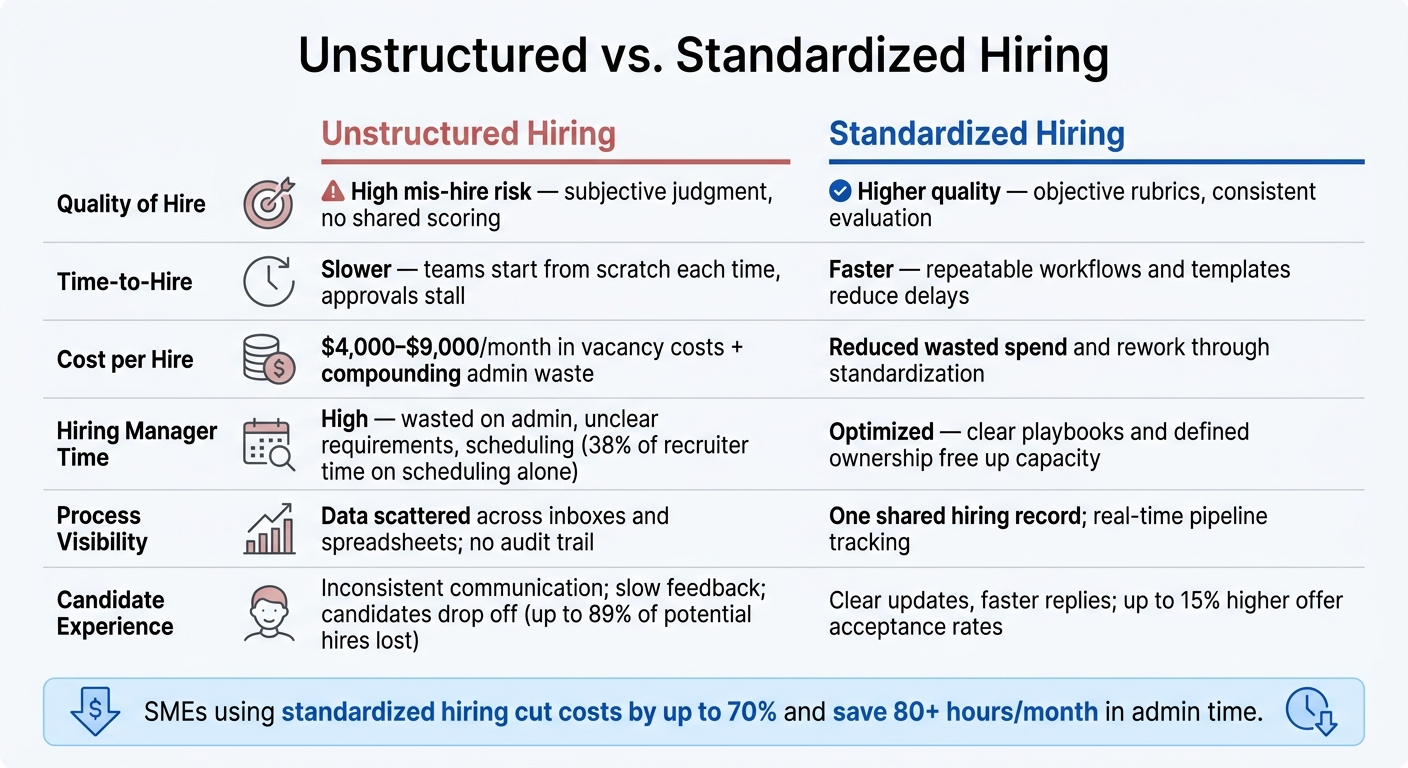
Unstructured vs. Standardized Hiring: Cost, Speed & Quality Impact for SMEs
When your company is scaling, an ad hoc hiring process starts to crack fast.
The same issues show up again and again: no shared brief, no set interview format, and no single person who owns the final decision. Every new role exposes the same process gaps. This is not about one manager having a bad day. It is a system problem that repeats and gets worse as hiring volume climbs.
How unstructured hiring creates quality, speed, and cost risk
The brief is often where things start to go wrong. Managers build it from scratch, expectations shift, and interviewers end up judging different things. Without a shared standard, hiring decisions lean too heavily on personal opinion. Over time, that leads to mixed results across repeated hiring cycles.
That inconsistency costs money.
Every open role can cost a business between $4,000 and $9,000 per month in lost output and delayed projects [4]. As hiring demand grows, the waste grows with it. In unstructured setups, recruiters spend about 38% of their time on scheduling coordination alone [4]. That is time not spent on screening, stakeholder management, or closing hires.
For CEOs, CFOs, and hiring leaders, the commercial impact is plain: slow process, uneven hiring decisions, and admin-heavy teams.
How inconsistency damages candidate experience and employer credibility
A slow or messy process does not just hurt your team internally. It pushes good candidates out of the funnel.
Top candidates are judging your company all the way through the process. If updates slow down or communication goes quiet, they move on. Slow screening can result in losing up to 89% of potential hires [3].
Each dropped candidate means you have to reopen the search, put more team time into the role, and spend more money filling a position that should already be closed. At the same time, your employer credibility takes a hit right when you need strong talent to support the next stage of growth.
Unstructured hiring vs. standardized hiring: a side-by-side comparison
| Hiring Aspect | Unstructured Approach | Standardized Approach |
|---|---|---|
| Quality of hire | High mis-hire risk from subjective judgment and no shared scoring | Higher quality through objective rubrics and consistent evaluation |
| Time-to-hire | Slower; teams start from scratch each time and approvals stall | Faster; repeatable workflows and templates reduce delays |
| Cost per hire | $4,000 to $9,000/month in vacancy costs, plus compounding admin waste [4] | Standardized hiring reduces wasted spend and rework |
| Hiring manager time | High; wasted on admin, unclear requirements, and scheduling [4] | Better use of time; clear playbooks and defined ownership free up capacity |
| Process visibility | Data scattered across inboxes and spreadsheets; no audit trail [4] | One shared hiring record; real-time pipeline tracking [4] |
| Candidate experience | Inconsistent communication and slower feedback; candidates drop off mid-process [2] | Clear updates and faster replies; up to 15% higher offer acceptance rates [3] |
It also hurts applicant flow.
SMEs often attract high application volumes but still post the lowest screen-to-interview conversion rates [2]. That points to a simple issue: qualified people are being lost early because there is no consistent filter in place. On top of that, 43% of recruiters report interviewing more than half of applicants [2]. That is usually a sign that the top of the funnel is not screening tightly enough.
All of these issues point back to the same answer: a repeatable hiring workflow with clear ownership.
The solution: What standardized hiring looks like in a scaling SME
The fix is a repeatable hiring system that cuts guesswork without creating more mess. Standardized hiring means using a set structure for who takes part, what gets assessed, and who signs off at each stage. For scaling SMEs, that usually comes down to a small group of shared tools used the same way on every hire.
Standardize role briefs, interview steps, and scorecards
Before you post a role, get clear on responsibilities, the skills and behaviours needed, and any deal-breakers. That stops the last-minute debates that drag out decisions once candidates are already in process.
From there, every candidate for that role should go through the same interview questions, linked straight to those criteria. Interviewers should use a shared scorecard and mark answers against the same rubric, not gut feel. That makes side-by-side comparison much easier and cuts subjectivity.
TAL Building Centers, a building materials supplier in the Pacific Northwest, used this approach in driver hiring by mapping role-specific licence requirements before the search began. That led to more consistent decision-making across managers who had been using different standards for the same roles [1].
Use one workflow with clear owners, timelines, and data points
A single hiring workflow, from intake through offer and background check, gives everyone a shared view of where each candidate stands. One route for every candidate, one owner for each stage, and one timeline for action. If approval steps are built into the workflow, offers are less likely to sit waiting.
HONK, a roadside assistance platform, built background check screenings directly into its app, giving contractors one place to track status in real time. The result was more candidates moving through the funnel, and hiring turnaround time dropped from two to three weeks to under 24 hours [1].
At this stage, the most useful metrics are time-to-hire, stage conversion, and time spent in each step. Those numbers show you, fast, where the process is slowing down or where candidates are dropping out.
"When expectations are defined upfront and applied consistently, hiring becomes faster, more predictable, and easier to get right – without needing a dedicated HR team." [1]
Core components of standardized hiring
These are the core building blocks most scaling SMEs need to run hiring the same way across roles. They reduce reliance on individual managers and make the process easier to repeat as hiring volume grows.
| Component | Purpose | KPI Supported |
|---|---|---|
| Role Brief | Defines responsibilities, success criteria, and deal-breakers before posting | Decision Speed; Fairness |
| Standardized Workflow | Sets a fixed sequence of steps every candidate follows | Time-to-Hire; Consistency |
| Interview Guide | Uses structured questions tied directly to role requirements | Candidate Comparability; Fairness |
| Scorecard | Shared rubric for evaluating candidates against defined criteria | Decision Confidence; Reduced Bias |
| Communication Templates | Consistent updates at every stage to keep candidates engaged | Candidate Conversion |
| Governance & Approvals | Named owners and sign-off steps at each stage | Process Control; Accountability |
Used the same way every time, these basics give growing teams a faster, clearer hiring process.
sbb-itb-a23bd6a
The business case: Why standardization improves hiring outcomes
Once your hiring workflow is defined, the next step is simple: does it improve the business?
In most scaling companies, the answer shows up fast. When hiring follows a clear process, you usually see lower cost, less management time lost, and better visibility across every open role.
Lower cost per hire and management time lost to admin and rework
Unstructured hiring costs more than most teams think.
It is not just agency spend or job board fees. The hidden cost sits in duplicate interview rounds, messy approval chains, and manual tracking across inboxes and spreadsheets. That time comes straight out of your managers’ day, and away from the work that drives revenue.
Standardization reduces that drag. It cuts rework, shortens decision cycles, and stops too many low-fit candidates moving through the process.
Without early qualification criteria, teams burn time screening weak candidates and miss the window to close strong ones. A standard process fixes that. You get:
- Fewer wasted interview rounds
- Faster decisions
- Better use of recruiting budget
- Less admin for hiring managers
That is the commercial win. You spend less time correcting process issues and more time making hires.
Better forecasting, reporting, and ability to hire at pace during growth spikes
Consistent hiring stages give leadership something many teams do not have in messy hiring setups: clear visibility.
When every role follows the same workflow, you can see where candidates sit in the pipeline, where delays are building, and which roles are close to offer. That makes planning far easier, especially when hiring volume jumps.
This matters most during growth spikes, after funding, after a product launch, or during expansion across several functions at once.
For lean SME teams, hiring delays compound 10x faster than in enterprise environments because there is less internal capacity to flex during growth periods [2]. If your process is already set, the team can keep work moving when demand goes up. It also becomes much easier to add extra recruiting support because the workflow is already in place.
Put bluntly, you cannot scale hiring at pace if every role runs differently.
Metrics leaders should track after standardizing hiring
After standardizing hiring, leaders need proof that the process is removing friction, not just adding more steps.
These metrics tie straight back to speed, cost, and scale.
| Metric | What It Measures | Why It Matters for Growth |
|---|---|---|
| Time to Fill | Speed from job opening to onboarding. | Identifies bottlenecks and improves workforce planning for growth spikes. |
| Cost per Hire | Total spend per hire, including sourcing channel costs. | Provides better control over hiring spend and budget allocation. |
| Source Effectiveness | Effectiveness of different recruitment channels. | Helps teams focus on the most productive sourcing channels. |
| Offer Acceptance Rate | Percentage of candidates who accept a formal offer. | Measures candidate experience and employer brand credibility. |
| Hiring Manager Time | Time spent on manual tasks versus interviews. | Shows how much administrative work standardization removes. |
For teams using embedded recruiting support like Rent a Recruiter, these metrics are much easier to act on.
You are not just looking at numbers in a dashboard. You can spot delays earlier, fix weak points in the process, and make hiring spend easier to control.
Clients typically reduce hiring costs by up to 70% and save more than 80 hours per month in internal hiring and admin time.
How to put standardized hiring in place without slowing growth
Start with priority roles, shared templates, and clear response deadlines
Once you know where hiring is breaking down, start where the pressure is highest.
The biggest mistake is trying to standardize every role at the same time. That usually slows things down and makes it harder for managers to stick with the process.
Instead, focus on two or three roles first, usually the ones with the highest hiring volume or the longest time-to-fill. Put a shared job brief template in place. Set the interview stages. Create a simple scorecard. Then add one clear rule: every hiring manager must respond to candidates within a set deadline. Fast candidate communication can cut total hiring time by 30% [3].
Standardization does not mean every hire follows the exact same script. It means every hire follows the same structure.
That distinction matters. A simple process your team will use beats a complicated one they ignore.
Once those first roles are running well, roll the same structure out across the rest of your hiring funnel.
Use embedded recruitment support to build process and delivery at the same time
If your internal team is already stretched, outside support can help you standardize without slowing active hiring.
In most scaling SMEs, the issue is not knowing what good hiring looks like. The issue is having enough capacity to put it in place while roles still need to be filled. That is where embedded recruitment support changes things. Rent a Recruiter places experienced recruiters directly into your team within days, managing hiring end-to-end while building the structure around it. You get delivery and process improvement at the same time, without adding permanent headcount before you need it.
For SMEs, that means you can keep hiring moving while putting a cleaner system in place. The model runs on fixed monthly pricing, so you get cost control from day one.
Conclusion: Standardized hiring gives scaling SMEs speed, control, and predictability
High-growth SMEs that hire without a consistent process pay for it in real business terms. Managers lose time. candidate experience slips. Roles stay open longer than they should.
Standardization fixes that. It gives your team a repeatable way to hire, one that keeps working when demand picks up.
Scaling companies hire with structure, visibility, and control. They put that foundation in place before the next growth spike lands.
If you are ready to take control of your hiring process, see how much you could save or book a call with Rent a Recruiter to talk through what embedded recruitment could look like for your team.
FAQs
When should we standardize hiring?
Standardize your hiring process as early as you can, ideally before a high-growth push starts. If you wait until hiring volume ramps up, things can get messy fast. Interviews drift. Decisions slow down. Admin piles up. And the risk of inconsistency or compliance issues goes up with it.
Putting formal controls in place early gives you more consistency, less legal risk, and less wasted time. It also makes hiring easier to manage when your team is juggling multiple open roles at once.
This matters most when hiring already feels hard to control, when roles are stacking up, or when delays and mixed practices start showing up across the business. Repeatable workflows protect hiring quality, support compliance, and cut admin time, so your team can focus on making better hires instead of fixing a broken process.
How do we standardize hiring without adding bureaucracy?
Standardizing hiring without adding bureaucracy comes down to one shift: replace gut feel and one-off decisions with a simple framework your team can repeat.
That means using structured interview kits with clear scorecards, and setting 4 to 6 job-related competencies before the role goes live. Everyone assesses against the same criteria. You get cleaner feedback, fewer side debates, and a hiring process that’s easier to manage at scale.
The business upside is straightforward. Less subjectivity means better hiring decisions, less rework, and less time lost chasing alignment after interviews.
Admin is another place where teams get bogged down. Automate tasks like scheduling, screening, and status updates, but don’t automate the decision itself. That’s the line worth holding.
Standard templates and one central place for candidate information help you:
- cut manual coordination
- keep the candidate experience consistent
- save time across hiring managers, HR, and talent teams
Done well, this gives you more control without adding red tape. Your team spends less time on admin and more time making sound hiring calls.
Which hiring metrics matter most for growth?
For high-growth SMEs, the hiring metrics that matter most are the Big Four: cost-per-hire, time-to-fill, offer acceptance rate, and 90-day retention.
These four numbers tell you what’s going on beneath the surface.
Cost-per-hire shows what you’re spending to bring people in. Time-to-fill shows how quickly your team can move. Offer acceptance rate tells you how well your package stacks up in the market. 90-day retention gives you an early read on hire quality and whether your process is setting people up to stay.
Taken together, they give you a clear view of process efficiency, market competitiveness, and hiring quality.
As your company scales, you’ll need more than top-line numbers. That’s where funnel metrics come in. Track source-of-hire and time-in-stage so you can see where things slow down, where candidates drop off, and which channels are driving hires worth making.
It also helps to segment your data by role type. Hiring timelines are not the same across functions. A sales hire, a software engineer, and a finance leader will each move through the market at a different pace. If you lump them together, the data can hide the real issue.