
Hiring fast without breaking the bank is the challenge every scaling SME faces. Manual processes waste time, delay decisions, and drive up costs. Recruitment automation changes the game, cutting hiring times by up to 60% and reducing costs per hire by as much as 70%.
Here’s how automation delivers results for SMEs:
- Saves Time: Automates repetitive tasks like resume screening, interview scheduling, and onboarding admin, freeing up 5–10 hours per hire.
- Cuts Costs: Reduces reliance on expensive agencies and lowers cost-per-hire to as little as $900–$1,500.
- Improves Speed: Shortens time-to-fill from 38+ days to as little as 9–15 days, helping SMEs secure top talent before competitors.
- Boosts Consistency: Creates a structured, transparent hiring process with real-time visibility into pipelines.
Automation doesn’t replace your team, it amplifies their impact. The result? Faster, smarter hiring that scales with your business.
Ready to scale hiring without adding overhead? Rent a Recruiter embeds expert recruiters into your team, combining automation with hands-on support to deliver real results.
The Future of Hiring: AI-Driven Recruitment at Scale
sbb-itb-a23bd6a
How Automation Helps SMEs Scale Hiring
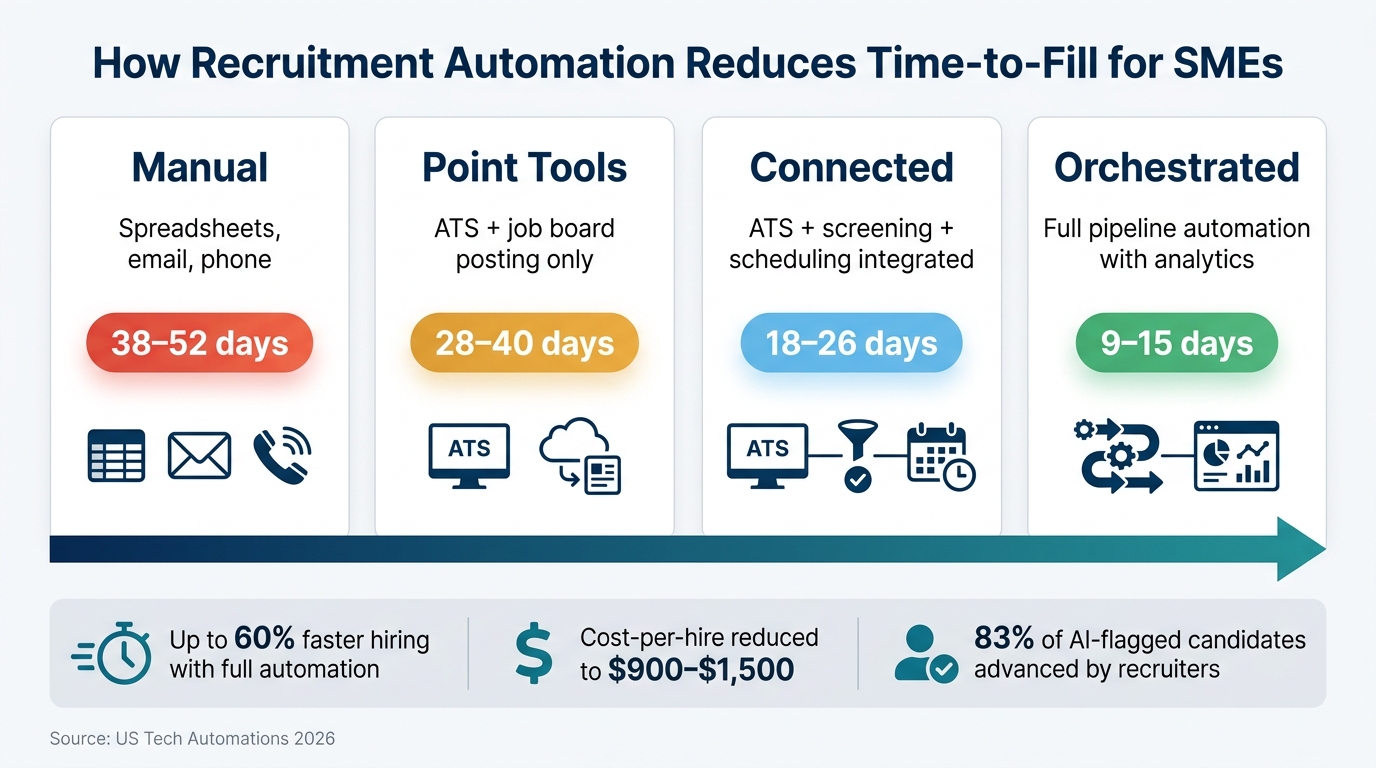
Recruitment Automation Stages: Time-to-Fill & Cost Savings for SMEs
For many SMEs, the hiring process falters not due to lack of effort but because a small team is managing too many tasks at once. Automation doesn’t replace these teams – it removes the bottlenecks that slow them down. By cutting out repetitive tasks, streamlining workflows, and speeding up hiring, automation transforms talent acquisition services for SMEs.
For teams wearing multiple hats, every minute saved translates into better decisions and faster progress.
Cutting Out Repetitive Manual Tasks
The biggest drain on time during hiring isn’t the decision-making – it’s the repetitive tasks. Writing job descriptions, sifting through resumes, and coordinating interviews can take 19–29 hours per hire. With automation, this drops to just 3–5 hours [3].
AI sourcing tools, for example, can scan millions of profiles in minutes, slashing sourcing time by up to 90% [6]. Automated screening tools use knockout questions to filter out 60–75% of unqualified applicants before a recruiter even reviews a resume [9]. Self-serve scheduling tools can save 4–6 hours per hire [3]. Together, these tools create a faster, leaner process.
Take BigGeo, a 40-person data company, as an example. They used an AI agent from Employment Hero to handle a surge in applications. The tool ranked candidates, explained its reasoning, and conducted initial AI-led interviews, narrowing 20 applications down to just 3 finalists.
"The tool will rank candidates, and tell me why it ranked candidates in a particular way. Then these candidates get an e-mail inviting them to an interview conducted by the AI agent, further narrowing down the pool." – Arden Styles, COO, BigGeo [2]
Beyond saving time, automation also ensures that hiring processes are consistent and transparent.
Building Consistency and Visibility Into Hiring
Automation brings order to hiring chaos by creating a unified candidate record. Without it, candidate details can get lost, follow-ups are forgotten, and decisions are often made with incomplete information. Shockingly, only 28% of recruiting teams have real-time visibility into their hiring pipeline, leaving 72% relying on outdated data [9].
Automated workflows solve this by logging every candidate interaction, tracking progress at each stage, and sending alerts when action is needed. This single source of truth is invaluable, particularly for SMEs where hiring responsibilities are often spread across multiple roles.
This clarity not only improves decision-making but also significantly shortens hiring timelines.
Reducing Time-to-Hire
Speed matters. Automating candidate screening alone can reduce the time-to-first-interview by 68% [9]. When screening, scheduling, and onboarding are automated, SMEs can fill roles 40% faster compared to manual methods [3].
The level of automation in a company’s hiring process directly affects how quickly roles are filled:
| Automation Stage | Description | Time-to-Fill |
|---|---|---|
| Manual | Spreadsheets, email, phone | 38–52 days |
| Point Tools | ATS + job board posting only | 28–40 days |
| Connected | ATS + screening + scheduling integrated | 18–26 days |
| Orchestrated | Full pipeline automation with analytics | 9–15 days |
Source: US Tech Automations 2026 [9]
Transitioning from a manual process to a connected system can nearly halve the time it takes to fill a role. For an SME looking to hire six new team members after securing funding, this difference can determine whether a critical project launches on time or falls behind schedule.
What the Research Says About Recruitment Automation for SMEs
Research shows that recruitment automation helps SMEs hire faster, cut costs, and create more reliable hiring processes. Studies and industry benchmarks consistently highlight that SMEs leveraging automation outperform their peers in key recruitment metrics.
Shorter Hiring Timelines
Recruitment automation significantly reduces hiring timelines. AI-powered tools have been shown to cut hiring times by 31% [4], while automated scheduling tools reduce interview confirmation times to a median of 3.7 hours compared to 5 hours – a 26% speed improvement [8]. This is a major efficiency boost, especially given that scheduling alone accounts for 38% of a recruiter’s time – the largest operational bottleneck in hiring [11]. Teams using automated scheduling solutions are also 1.6 times more likely to meet their hiring goals with precision [11]. For small teams juggling multiple roles, these time savings can make an enormous difference.
"The hiring challenge in 2026 isn’t about adding more people or cutting teams. It’s about redesigning how hiring work gets done." – Ahryun Moon, CEO and Co-Founder, GoodTime [11]
Lower Hiring Costs
Automation also delivers significant cost savings. 82% of SMEs using AI report lower recruitment costs, as tasks like manual resume screening – averaging 23 hours per hire – are reduced to mere seconds [4]. For companies making multiple hires, this translates into considerable savings.
The median cost per hire is $1,340, but this figure rises sharply for specialized roles, reaching $2,795 for tech positions and $10,625 for executive hires [10]. Automation helps keep these costs in check by reducing the need for additional HR staff and limiting reliance on costly external agencies. With 30% of organizations prioritizing cost-per-hire reductions by 2026 [10], automation is becoming a go-to solution for SMEs facing budget pressures. These savings go hand in hand with the improved workflows automation enables.
More Consistent Hiring Workflows
While speed and cost savings often dominate the conversation, automation’s ability to create consistent hiring processes is just as impactful. Automated workflows reduce candidate drop-off rates by 47% and cut time-to-fill by an average of 22 days [12]. Companies in the top tier of recruitment automation maturity report an average ROI of 412% within 18 months [12].
Another key benefit is the ability to maintain clean and organised hiring pipelines. Without automated archiving, candidate records can remain unarchived for over 150 days during periods of high activity [8]. Automation ensures that every step of the process stays timely and professional, safeguarding both the employer’s reputation and the integrity of hiring data over time.
Automation Tools and Methods SMEs Are Using
When it comes to automation, success depends on choosing the right tools and applying them effectively. Small and medium-sized enterprises (SMEs) are focusing on three key areas: AI-powered screening, workflow platforms, and data analytics. Each plays a role in improving specific stages of the hiring process.
AI-Powered Candidate Screening and Matching
AI screening tools are transforming how resumes are reviewed. Using advanced models, these tools interpret resume context more accurately, boosting candidate ranking quality by 15.85% compared to outdated keyword filters [13]. By May 2025, 43% of HR tasks were automated with AI and machine learning, a significant jump from 26% the previous year [13]. These tools are achieving impressive results, with 83% of candidates flagged by AI being moved forward by recruiters – four out of five, to be exact [13].
Take the example of BigGeo: AI helped narrow down 20 applications to just three top finalists. This demonstrates how AI tools can save time while delivering better outcomes [2].
Workflow Automation Platforms
Once AI improves candidate matching, the focus shifts to streamlining the rest of the hiring process. For instance, scheduling interviews – a task that typically eats up 35% of a recruiter’s time – can be automated, cutting coordination efforts by 60–80% [4].
Platforms like FirstHR ($98/month) automate administrative tasks such as collecting e-signatures, managing tax forms, and creating 30-60-90 day onboarding plans. This is critical for reducing early turnover, as 20% of new hires leave within their first 45 days, costing SMEs anywhere from $15,000 to $50,000 per departure [1][14]. Other tools, such as JazzHR ($49–$99/month), handle applicant tracking with AI resume parsing, while HiredAI offers a free tier and paid plans up to $95/month for unlimited job postings [1][4].
The trend is clear: all-in-one platforms are becoming the go-to choice for SMEs. These systems integrate sourcing, screening, scheduling, and onboarding into a single workflow. Companies using such platforms have seen tangible results, with mid-market firms achieving an 89.8% offer acceptance rate in 2026, compared to 81.5% for larger enterprises [4].
Using Data to Guide Hiring Decisions
Automation tools are even more powerful when paired with data-driven insights. Modern platforms track metrics like time-to-hire, cost-per-hire, and pipeline conversion rates in real time. This gives smaller teams access to the same level of analytics that larger organisations have relied on for years [4].
AI adoption among SMEs (10 to 100 employees) surged from 47% to 68% in just one year [4]. The payoff? Companies using AI recruitment tools report a 50% improvement in quality-of-hire metrics alongside faster hiring timelines [4]. As PeopleScout predicted in its 2026 recruitment outlook:
"Sophisticated recruitment capabilities will no longer be the exclusive domain of large enterprises, as cloud-based talent technology and AI tools have eliminated the need for massive capital investment." [4]
However, the rise of AI-generated resumes has introduced challenges. 54% of SME leaders say it’s now harder to verify candidate information [5]. While automation can help flag inconsistencies, critical roles still require human oversight – or a skilled embedded recruiter who knows how to spot red flags.
How to Implement Automation Without Getting It Wrong
Automation offers a lot of potential, but getting it right requires careful planning and execution. Here’s how to make sure you implement automation effectively, without losing the benefits it’s meant to deliver.
Getting Your Processes in Order First
One of the biggest mistakes companies make is automating a flawed process. As Vamo explains, "If your hiring process is chaotic, automation can accelerate existing chaos." Before you even think about tools, take a detailed look at your hiring workflow – from the initial job intake all the way to the signed offer letter. Identify where time is wasted and where steps don’t add value.
Start by standardizing your process. Define clear stages, set criteria for moving candidates forward, and assign ownership for each step. Use a single, centralized system to manage applications instead of juggling email, LinkedIn messages, or spreadsheets. Scattered data makes automation harder to implement effectively. Also, establish baseline metrics like time-to-fill, cost-per-hire, and response rates. This will help you measure whether the tools you implement are actually making a difference [6].
Once your process is streamlined, it’s time to figure out which parts of it should remain manual. For many SMEs, this is where fractional recruitment services provide the necessary human oversight without the overhead of a full-time hire.
Knowing Where Not to Automate
Automation is great for repetitive tasks, but it falls short when judgment is required. Before automating any step, ask yourself: Does this task need context that software can’t interpret? Could an automated error create legal problems? Would automation make candidates feel undervalued? If the answer to any of these is yes, keep the task human-led.
For example, automation works well for tasks like sourcing candidates using AI, ranking applications based on qualifications, scheduling interviews through self-booking tools, and sending status updates. But areas like selling your company’s mission, assessing cultural fit, conducting interviews, handling salary discussions, and delivering rejections require a personal touch.
This is backed by research: only 8% of job seekers believe AI makes hiring fair, while 46% report losing trust in the hiring process – and 42% blame AI for this decline [7]. Over-automation can harm your employer brand, so balancing tech with human oversight is essential.
Keeping Control of Automated Processes
Automation isn’t a "set it and forget it" solution. To ensure it works as intended, you need to monitor and adjust regularly. Review outputs weekly, audit candidate quality monthly, and keep detailed audit trails to catch issues early. For example, 19% of companies using hiring automation have reported that their tools missed qualified candidates [6].
"Automation helps you execute a good strategy more efficiently; it does not create the strategy for you." – Mohit Jindal, CTO & Co-Founder, HireZapp [15]
It’s also important to remember that employers are legally responsible for any discriminatory outcomes caused by automated tools. The EEOC has made this clear. To stay compliant, ensure human oversight of AI-generated shortlists and use platforms that provide explainable results. For instance, tools with scorecards can show why a candidate was ranked a certain way.
If you’re new to automation, start small. Choose one high-volume role, run the process for 60–90 days, and measure results at 30-day intervals. Once you’re confident in the outcomes, you can expand [16].
Conclusion: Using Automation to Build a Scalable Hiring Process
Automation has reshaped the way SMEs approach hiring. By moving from manual processes to fully automated recruitment pipelines, companies can dramatically cut time-to-fill from over 38 days to just 9–15 days and reduce cost-per-hire from $4,200–$6,800 to as little as $900–$1,500 [9]. These shifts not only save time and money but also improve the efficiency of small teams.
The best strategy blends automation with human expertise. Use automation to handle repetitive tasks like screening, scheduling, status updates, and onboarding paperwork. Meanwhile, preserve human input for critical decisions, such as final interviews and assessing culture fit. In this way, AI serves as a tool to amplify human decision-making, not replace it [7].
The key to success lies in process discipline. Automation works best when it’s applied to a clean, measurable, and well-structured process. SMEs that succeed in scaling their hiring invest in building this foundation first. This disciplined approach ensures their recruitment efforts are sustainable and effective over the long term.
If your team is ready to scale hiring but lacks the in-house capacity, Rent a Recruiter can help. By embedding experienced recruiters directly into your team, they bring the structure, consistency, and speed that automation thrives on. With this expert support, SMEs can reduce hiring costs by up to 70% compared to traditional agency models and save over 80 hours per month in administrative tasks. It’s a smarter way to scale hiring without adding unnecessary overhead.
FAQs
What should we automate first in our hiring process?
To scale hiring effectively, begin by automating time-consuming, repetitive tasks that don’t need human oversight. Prioritize areas like:
- Candidate sourcing and resume screening: Use AI-powered tools to cut down 60–70% of manual work, freeing up your team for higher-value activities.
- Interview scheduling: Implement self-serve options to minimize back-and-forth emails and speed up the process.
- Pre-boarding and onboarding workflows: Streamline these steps to create a consistent experience, secure new hires, and set the foundation for better retention.
How do we prevent AI screening from rejecting great candidates?
To prevent AI screening from overlooking qualified candidates, think of it as a filtering tool, not the final authority. Let AI handle the initial shortlist by removing clearly unqualified profiles, but ensure a human reviews the final decisions. Use structured scorecards to define and document criteria, making the process clear and consistent. Configure AI tools to focus on relevant skills rather than rigid metrics like keyword frequency. Most importantly, keep human oversight in place for rejections to maintain fairness and accuracy.
How can we measure ROI from recruitment automation?
To gauge ROI from recruitment automation, apply this formula: ROI = (Total Benefits − Total Costs) ÷ Total Costs.
Start by calculating total benefits. This includes gains such as increased recruiter capacity, reduced reliance on agency fees, faster time-to-fill, and lower rates of candidate attrition. Before implementing automation, track internal KPIs like cost-per-hire and time-to-accept over a 4–6 week period. Then, run a 90-day pilot to assess improvements and clearly identify the impact of automation on your hiring process.