
Struggling to keep up with demand spikes? Temporary recruitment helps you scale your team quickly and control costs without long-term commitments. For small and midsize businesses, it’s a game-changer when deadlines loom or workload surges.
Why it works:
- Faster hiring: Fill roles in 24–72 hours instead of waiting weeks.
- Cost flexibility: Pay-as-you-go staffing aligns costs with workload.
- Reduced risk: Trial talent before committing to permanent hires.
Temporary recruitment is ideal for seasonal peaks, unexpected workload increases, or short-term projects. By focusing on clear role definitions and quick onboarding, you can minimize disruptions and maximize productivity.
Want to scale smarter? Rent a Recruiter embeds experienced recruiters into your team to manage hiring end-to-end. No inflated agency fees, just fast, reliable results when you need them most.
Knowing When Temporary Recruitment Is the Right Choice
Temporary recruitment is all about addressing short-term needs without committing to permanent hires. The key is acting quickly before delays start to hurt your business.
Common Business Scenarios for Temporary Recruitment
Small and medium-sized businesses (SMEs) often turn to temporary recruitment in five key situations: seasonal demand spikes, unexpected surges in workload, short-term projects requiring specific expertise, covering employee absences, and testing new markets without adding to permanent payroll.
Each of these scenarios demands a different approach. For instance, a two-week surge in orders requires a faster, more flexible response than a six-month project rollout. Knowing the difference helps you stay agile.
| Scenario | Typical Trigger | Approach |
|---|---|---|
| Seasonal demand | Holidays, tax season, year-end | Plan temp recruitment 4–6 weeks ahead |
| Sudden operational spike | Viral trends, contract wins, recalls | Quick hiring (24–72 hours) |
| Project sprint | Product launches, system updates | Hire contractors or niche freelancers |
| Absence cover | Parental leave, sabbaticals | Use fixed-term contracts or vetted temp staff |
| Market testing | Expanding into new areas | Opt for temp-to-perm solutions |
How to Forecast Hiring Needs Before Peak Periods
Once you’ve identified the scenarios, the next step is accurate forecasting. Waiting too long to hire can be costly, as one staffing team pointed out:
"The most common mistake we see is leaving a temp requirement too late. By the time a business acknowledges it needs resource, the gap is already costing money." – CMD Recruitment Career Team [3]
Instead of guessing how many people you’ll need, focus on the work itself. For instance, if you’re expecting 200 extra orders daily, calculate how long it takes to process each one – from packing to shipping – and add a buffer for training and errors. This gives you a clear hiring target based on actual workload.
To make decisions easier, set automatic hiring thresholds. These could include triggers like “order backlog exceeds 48 hours” or “customer wait times increase for two days in a row.” This removes the guesswork and ensures you act based on clear, measurable signals.
Choosing the Right Roles and Skills for Temporary Coverage
Once your hiring needs are forecasted, focus on roles that can make an immediate impact. Look for positions with clearly defined tasks, minimal training requirements, and measurable daily output. See how other businesses have successfully managed these transitions in our embedded recruitment case studies. Prioritize candidates who meet critical, non-negotiable criteria (like certifications or specific software skills) and leave trainable skills (like internal tools or workflows) for onboarding.
Temporary hiring is common in logistics roles like warehouse picking, packing, and delivery, especially during busy seasons. But it’s also growing in professional services. For example, businesses often hire interim finance controllers for audits, HR specialists for restructuring, or digital marketers for short-term campaigns. Between February and March 2026, temporary placements rose by 9%, with strong demand in light industrial, financial services, and other sectors [4].
Focus on what matters most. Reject candidates only if they lack skills that can’t be taught on day one. Everything else can be addressed with a structured onboarding process.
sbb-itb-a23bd6a
Building a Temporary Workforce Plan
Once you’ve outlined your forecasts and prioritized roles, the next step is creating a clear plan for deploying the temporary workforce you need. A strong plan answers three key questions: How many people do you need? What fractional recruitment or staffing model works best? And what does each role entail?
Calculating Your Temporary Headcount Needs
Avoid guessing – translate workload into labor hours for each function. Use a straightforward four-column approach: incoming workload volume, time per task, a buffer for errors (typically 10–15%), and required shift coverage. For instance, if your fulfillment team needs to handle 400 extra orders daily, and each order takes 8 minutes to process, that equates to about 53 labor hours. To cover this, you’d need around 7 full-time workers per shift, even before accounting for minor fluctuations.
Once you’ve determined the workload, focus on choosing the right staffing model for your needs.
Choosing the Right Temporary Staffing Model
The duration of your workforce need often dictates the best staffing model. Here’s a quick guide:
| Duration | Best-Fit Model |
|---|---|
| Under 2 weeks (<14 days) | Temporary coverage – quick hires with low commitment |
| 30–60 days | Blended model – mix of temp staff and accelerated permanent hiring |
| Multiple quarters | Long-term contracts or temp-to-hire pathways |
A temp-to-hire approach is particularly effective when you’re entering a new market or growing your team. It allows you to assess candidates for permanent roles while meeting immediate needs.
Another tactic is maintaining a "warm bench" – a list of former temporary or seasonal workers who can be quickly reactivated. These rehires are already familiar with your processes, which saves time on training and onboarding.
Writing Clear Role Descriptions and Setting Expectations
Once you’ve selected your staffing model, it’s time to define each role clearly. This speeds up candidate decisions and reduces drop-offs. Research shows candidates need to understand the role within a minute, or they lose interest.
Keep descriptions short and to the point. Highlight the role’s purpose, shift hours, essential requirements, duration, and pay range. Pre-approve offer details, including overtime and shift differentials, so managers can move quickly on offers.
Break down each role into three sections: essential requirements (e.g., work authorization, certifications), trainable skills (e.g., software proficiency or packaging standards), and preferred attributes that aren’t critical. This approach widens your candidate pool without sacrificing quality. Include a simple "what good looks like" guide – like a checklist or photo example – so new hires know exactly what’s expected from day one.
Running a Temporary Recruitment Process
When managing a temporary workforce, speed is crucial, but it shouldn’t come at the expense of quality. A well-structured hiring process ensures you can meet urgent demands while maintaining high standards.
Setting Up a Temporary Hiring Workflow
Temporary recruitment compresses your regular hiring process into six fast-paced stages: Planning, Sourcing, Screening, Interviewing, Offer/Compliance, and Onboarding. By automating repetitive tasks like scheduling and paperwork, managers can focus on critical decisions.
For urgent hiring needs, a 72-hour sprint model can be highly effective:
| Timeline | Phase | Key Actions |
|---|---|---|
| Hour 0–8 | Activate | Confirm workforce needs, assign responsibilities, publish templates, notify your warm bench. |
| Hour 8–24 | Screen & Offer | Conduct two-stage screenings and issue offers immediately using pre-approved templates. |
| Hour 24–72 | Onboard | Complete training, assign mentors, and verify payroll and scheduling setup. |
To avoid bottlenecks, agree on service-level agreements (SLAs) with hiring managers before a surge, or consider an embedded recruitment service for dedicated support. This ensures quick turnaround times for reviewing resumes and providing interview feedback.
Once you’ve established a rapid workflow, the focus shifts to sourcing and screening candidates efficiently.
Sourcing and Screening at High Volume
Concentrate on two or three key channels where your target candidates are most active. For operational or hourly roles, platforms like Indeed Sponsored postings (typically $5–$15 per day) deliver excellent reach with AI-driven matching. For professional or technical roles, LinkedIn Jobs tends to perform better. Don’t overlook employee referrals – offering a referral bonus of $250–$500 can quickly surface pre-vetted candidates.
To maintain quality while working at speed, adopt a two-stage screening process:
- Step 1: A quick 5-minute knock-out screen to confirm basic eligibility, such as availability, work authorization, and pay expectations.
- Step 2: A short, scenario-based test using a relevant work sample to assess skills.
"Faster does not mean less rigorous, it means less wasted time between stages." – FirstHR [5]
Aim for an application-to-interview ratio of 15–25% for high-volume hiring [5]. If your ratio falls below this, your job posting may be too broad. Tools like Calendly can streamline scheduling, saving 10–15 hours for every 15 candidates processed [5]. This approach allows you to scale your team quickly while maintaining quality, often through a Recruitment as a Service model that reduces costs.
Once candidates are selected, a well-designed onboarding process ensures they integrate smoothly and reduces early turnover.
Onboarding and Offboarding Temporary Staff
A structured onboarding process can significantly improve retention. Around 20% of new hires leave within the first 45 days, costing small businesses between $15,000 and $50,000 per departure. However, companies with structured onboarding can see retention improve by up to 82% [5].
To streamline onboarding:
- Use e-signatures to collect compliance documents like I-9s, W-4s, and handbook acknowledgments before Day 1.
- Focus Day 1 on training rather than paperwork.
- If onboarding five or more workers, stagger start dates by one to two days to ensure proper attention for each hire.
- Pair new hires with a shift captain or experienced team member during their first hours to address questions without pulling managers away from other tasks.
For offboarding, follow a checklist to handle final pay, retrieve equipment or credentials, and update records. Don’t forget to flag high performers for future opportunities before they leave. Refining your onboarding and offboarding processes over time will strengthen your temporary recruitment cycle and help you respond even more effectively to future demands.
Measuring the Results of Temporary Recruitment
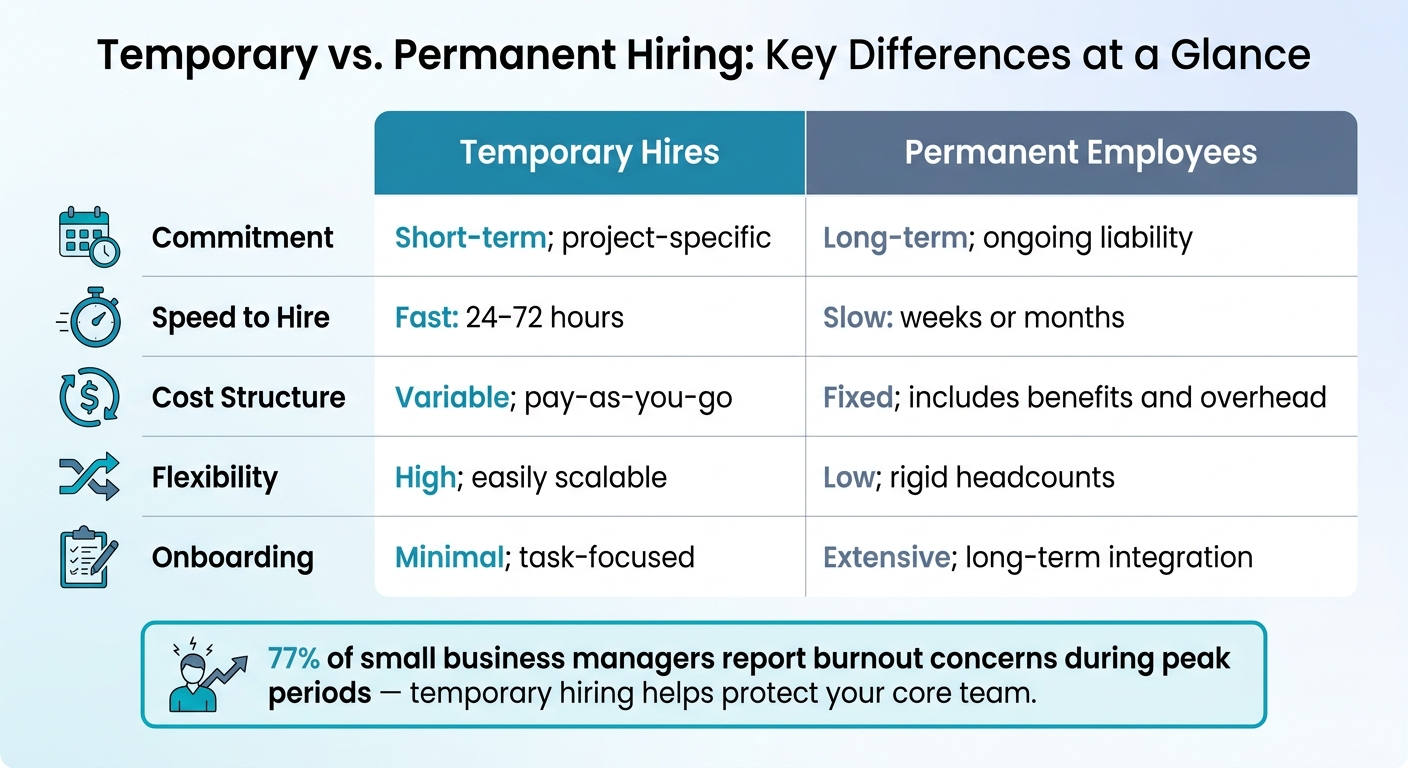
Temporary vs. Permanent Hiring: Key Differences at a Glance
Once your temporary hiring cycle concludes, it’s essential to evaluate the results. By analyzing the data, you can refine your approach and better prepare for future hiring surges.
Key Metrics to Track for Temporary Hiring
When assessing temporary recruitment, focus on three main areas: speed, quality, and operational impact.
Speed is captured through metrics like time-to-fill – how long it takes to fill an open role – and time-to-productivity, which measures how quickly a temporary worker reaches the desired performance level. While a fast time-to-fill is valuable, delays in productivity can lead to hidden costs that traditional metrics might miss [6][2].
Quality revolves around fulfillment rates (the percentage of requested roles successfully filled), attrition and no-show rates, and feedback from hiring managers. These indicators can reveal areas where you can rate your recruitment process to identify areas for improvement [6].
Operational impact looks at how staffing levels influence your business outcomes. For example, did temporary hires help reduce service complaints, improve order fulfillment times, or lower customer churn? For contingent labor, tracking performance at the shift or day level – rather than monthly averages – can provide sharper insights into staffing effectiveness [6][2].
By monitoring these metrics, you can directly compare the benefits and costs of temporary hiring against permanent staffing.
Comparing the Cost and Flexibility of Temporary vs. Permanent Hires
Temporary hiring offers a flexible, demand-driven approach to staffing, contrasting with the fixed costs associated with permanent roles. Permanent employees come with long-term commitments, including benefits, payroll, and potential severance costs. Temporary hires, on the other hand, operate on a pay-as-you-go basis, aligning costs directly with workload [7].
| Feature | Temporary Hires | Permanent Employees |
|---|---|---|
| Commitment | Short-term; project-specific | Long-term; ongoing liability |
| Speed to Hire | Fast (24–72 hours with a clear process) | Slow (weeks or months) |
| Cost Structure | Variable; pay-as-you-go | Fixed; includes benefits and overhead |
| Flexibility | High; easily scalable | Low; rigid headcounts |
| Onboarding | Minimal; task-focused | Extensive; geared for long-term integration |
"Temporary hiring gives you access to skilled professionals pools, that too, only when they’re needed – eliminating the ongoing costs tied to permanent roles." – Randstad Canada [7]
Permanent recruitment often takes weeks or months, leaving teams understaffed and increasing operational costs. Temporary hiring avoids these delays, ensuring staffing aligns with real-time needs. Assigning temporary hires to specific projects or milestones helps keep costs targeted and performance measurable [7].
Building a Cycle of Continuous Improvement
To refine your hiring strategy, conduct a detailed review after each peak period. Evaluate which sourcing channels brought in the best candidates, how quickly team leads provided feedback, and where delays occurred [2]. This post-mortem analysis helps identify and eliminate inefficiencies.
For companies working with staffing partners, using a vendor scorecard can be invaluable. Assess partners on factors like speed, fill rates, credentialing quality, replacement coverage, and invoice transparency [2].
Additionally, maintain a warm bench of high-performing temporary staff. By keeping these workers engaged, you can streamline future hiring efforts, reducing both costs and time-to-fill when the next surge arises [2].
Conclusion and Next Steps
Now that we’ve covered the essentials of forecasting, planning, and executing temporary recruitment, let’s focus on turning these insights into practical actions.
Temporary recruitment offers a smart way for SMEs to expand without overextending. It keeps labor costs flexible, safeguards your core team, and provides the agility needed to adapt when demand shifts unexpectedly.
Why Temporary Recruitment Works
This approach delivers in three critical areas: cost control with pay-as-you-go staffing, speed with hiring possible in just 24 to 72 hours, and flexibility to address specific needs without long-term commitments [2]. It also helps reduce burnout among permanent staff by bringing in extra hands during busy periods – a concern for 77% of small business managers [1].
How Rent a Recruiter Makes It Simple
Rent a Recruiter simplifies temporary hiring by embedding an experienced recruiter directly into your team. They handle everything from sourcing and screening to compliance and onboarding, ensuring fast and reliable results during peak demand – all while keeping costs far lower than traditional recruitment models.
Ready to Scale Your Team?
Temporary recruitment can help you manage demand surges while protecting your core team. If you’re preparing for seasonal peaks or unexpected growth, schedule a call with Rent a Recruiter today and take the first step toward smarter, more flexible hiring.
FAQs
How do I know if I should hire temp, temp-to-hire, or permanent?
When facing short-term projects or seasonal spikes, temporary staffing is a smart option. It offers speed, flexibility, and no long-term obligations. For roles where you want to evaluate a candidate’s performance and cultural fit before making a full commitment, temp-to-hire provides a low-risk solution. On the other hand, if your business requires stability and long-term expertise for critical, ongoing roles, permanent hires are the way to go. Align your hiring strategy with your workload, timeline, and overall business goals to make the right choice.
What’s the fastest way to onboard temps without hurting quality?
The fastest way to bring temporary workers on board without cutting corners is by sticking to a clear, well-organized process. Start by preparing everything ahead of time – training materials, policies, and any necessary documentation. Digital tools can help speed up paperwork and reduce errors, while assigning dedicated coordinators ensures temporary staff have someone to turn to for guidance. Bringing in experienced recruiters, like through an embedded recruitment model, can also help maintain quality and keep the onboarding process running efficiently from day one.
Which metrics best prove temporary hiring improved results?
Key metrics highlight cost reductions, with recruitment expenses slashed by up to 70%, and time efficiency, saving more than 80 hours per month on hiring and administrative tasks. These results showcase the practicality of temporary hiring during periods of increased demand.