
Poor intake adds cost fast. If your hiring manager and recruiter do not lock the role, pay, process, and ownership at the start, you waste sourcing time, slow reviews, and lose people already in process.
I’d keep the intake meeting tight and decision-led. By the end, you should have:
- A clear reason the role exists
- Top must-haves, plus what can be learned on the job
- A locked pay range in US dollars
- Named interview owners and feedback deadlines
- A written hiring plan sent the same day
That matters because interview teams spend about 2.2 hours per candidate, and some hires need outreach to 130+ people before one person joins. Add the fact that 44% of candidates had multiple offers in their last process as of June 2025, and slow, unclear hiring gets expensive fast.
For SaaS, tech, fintech, engineering, security, insurance, and professional services teams, the fix is simple: prepare with market data, run the meeting in a set order, and turn notes into a live hiring plan. The rest of the article shows how to do that without drift, delay, or agency fees vs embedded recruitment costs.
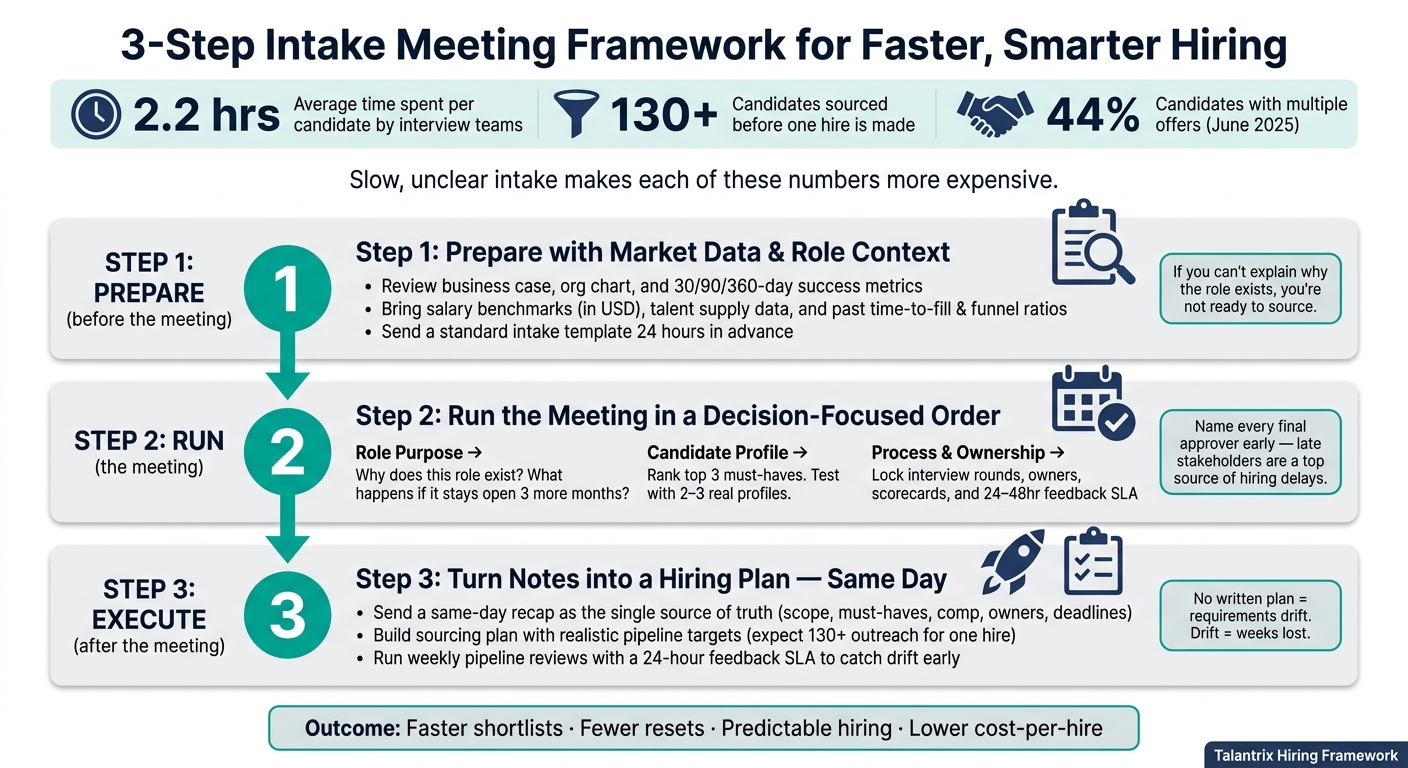
3-Step Intake Meeting Framework for Faster, Smarter Hiring
Optimising Hiring Manager Intake Meetings with Barbara Bruno
sbb-itb-a23bd6a
Step 1: Prepare before the meeting with market data and role context
Once the intake goals are clear, bring the facts that will test the brief. An intake meeting only works when the recruiter walks in prepared. Before the meeting, gather the information that will pressure-test the role.
Review the business case, org chart, and success metrics
Start with the reason the role exists. Is this a backfill after someone left, or new headcount tied to growth? That changes the search straight away. A backfill often has a clearer profile and more urgency. A growth hire usually needs more shape before you go to market.
Then map the reporting line, team size, product or function maturity, and final approver. Get every final approver on the table early. If you miss one, delays tend to show up later when it matters most.
Next, define outcomes. Is this person expected to build, migrate, stabilize, or lead? Clear 30, 90, and 360-day goals give the search a target. They also make shortlisting and interview scoring far more consistent.
"If you cannot explain why this role exists, what the person would own, and why the team needs them now, you are not ready to source." – Talantrix [4]
Once the role context is clear, test it against compensation and talent supply.
Bring salary benchmarks, talent supply data, and past hiring results
Salary and supply data tell you whether the brief stands up before sourcing starts. Bring external salary benchmarks in U.S. dollars alongside internal pay band data, so the compensation conversation stays grounded in what the market is paying.
Add talent supply data for the target location, or the remote market if the role is open beyond one region. This is where many briefs fall apart. A hiring manager may want a narrow mix of skills, fast availability, and a fixed salary. The market may say otherwise.
For technical roles, the stack matters. Python API work and Go development attract different pools of talent [6]. That affects response rates, pipeline size, and time-to-fill.
It also helps to bring hiring history for similar roles:
- Time-to-fill
- Funnel ratios
- Offer acceptance patterns
That gives the hiring manager a clearer view of what it usually takes to make one hire, and what trade-offs may be needed on pay, location, or requirements.
Use that data to shape a standard intake template before the meeting starts.
Use a standard intake template for every search
A repeatable intake template works like a search contract. Once the hiring manager signs off, it becomes the reference point if the brief starts to drift halfway through the search.
A strong template should cover responsibilities, selection criteria, interview stages, ownership, compensation, and timeline. It should also bring hidden constraints into the open, like narrow pay bands, location limits, or internal candidates already in process. Those details often stay buried unless someone asks directly.
Send the template 24 hours in advance so the hiring manager comes ready to make decisions, not spend the meeting defining basics [7].
Step 2: Run the intake meeting in a clear, decision-focused order
Use your template and market data to lock decisions before sourcing starts. The meeting should settle three things in sequence: role purpose, candidate profile, then process.
Start with why the role exists and what success looks like
Start with the business need, not the job description. Ask directly: "Why does this role exist now?" "What cannot move forward without this hire?" and "What happens if this role remains open for another three months?" [4][5]
Then move to outcomes. "What is a win for this role in the first 90 days?" and "How would you know in three months that hiring this person was the right call?" These questions keep the discussion tied to measurable impact, not a long list of ideal traits [4][5].
This matters for one simple reason: if you don’t define success up front, you end up judging candidates against opinions instead of results.
Define the candidate profile without overloading requirements
Once outcomes are clear, ask the hiring manager to rank the top three must-haves. Put everything else in the nice-to-have bucket [4][5]. That keeps the brief realistic and reduces mid-search changes that slow hiring and waste time.
A simple way to pressure-test the profile is to use 2 to 3 real profiles and see whether the brief holds up. Ask which requirements each profile meets and misses [4]. That turns vague ideas into a concrete candidate profile your recruiter can actually search against.
When this step is done well, you get better shortlist quality and fewer resets halfway through the search.
Agree on process, ownership, and response times
Before the meeting ends, lock in the interview process. Agree on the number of interview rounds, who owns each stage, what each interviewer scores, and the feedback deadline after each stage. Set a 24 to 48 hour feedback deadline for resume reviews and scorecards [1][2].
Also name everyone with final approval authority over the hire. If someone can block the offer later, they need to be in the process early [1].
That avoids a common hiring drag: the search moves forward, the team gets aligned, and then a late stakeholder steps in and slows everything down.
A structured intake process cuts rework, speeds feedback, and improves shortlist quality. Once those decisions are fixed, the recruiter can turn the intake into a hiring plan.
Step 3: Turn meeting notes into a hiring plan the team can execute
Once the meeting ends, the next job is simple: turn the decisions into a plan people can actually use.
Intake only works when those decisions become a written hiring plan. If that record doesn’t exist, requirements drift, priorities get fuzzy, and sourcing slips off brief. That’s when teams waste time reviewing the wrong profiles and hiring managers start changing the target halfway through the search.
Send a same-day recap and confirm final decisions
Send the recap the same day. Make it the single source of truth for scope, must-haves, compensation, interviewers, deadlines, and owners.
This matters for one reason: speed with clarity. When everyone works from the same record, you cut down back-and-forth, avoid misalignment, and protect hiring momentum. For scaling teams, that saves hours and keeps the process moving.
Build the sourcing plan, scorecards, and pipeline targets
Turn the recap into a locked role profile, scorecard, and interview plan.
On the sourcing side, set realistic pipeline expectations with the hiring manager from the start. Reaching one hire can require sourcing 130 or more candidates [3], so the team needs to understand the level of review volume and time commitment involved.
That upfront alignment helps you avoid a common problem: a hiring manager expecting a short list in days for a role that needs much more market outreach. When pipeline targets are clear, you can plan recruiter capacity, interviewer time, and reporting with far less friction.
Use recurring pipeline reviews to adjust quickly
Use live pipeline data to test whether the intake brief still matches the market.
Review pipeline quality weekly. Track pass-through rates and market feedback. Use a 24-hour feedback SLA to keep momentum.
If the market isn’t responding, you’ll see it early. That gives you room to adjust title, compensation, must-haves, or search scope before the process burns weeks and budget. For CEOs, CFOs, and talent leaders, that kind of visibility is what turns hiring from a guessing game into an operating process. (You can also audit your talent strategy to identify other process gaps.)
Conclusion: Make intake meetings a repeatable hiring standard
Once the role is live, intake should work like a standard process, not a one-off meeting.
Make it repeatable. Come prepared with data. Run the same structured conversation each time. Record decisions that day. Then review the pipeline against those decisions.
When your team does this every time, hiring gets more predictable. You move faster, spend less, and keep hiring teams aligned, which is exactly what the rest of this guide is built around.
Treat intake as a decision meeting, not a diary filler. Vague intake creates hiring drift. The profile shifts. Recruiters start over. The search loses weeks you do not get back.
If you need help putting this process in place across multiple roles, Rent a Recruiter places experienced recruiters directly into your team within days. That makes intake and structured hiring repeatable across every search, instead of leaving results down to individual effort.
FAQs
Who should attend the intake meeting?
The intake meeting should include the recruiter and every stakeholder who has a real say in the hire.
In most cases, that means the hiring manager, the candidate’s direct supervisor if that’s a different person, plus any department heads, team leads, or senior team members involved in selection.
Bring in anyone with decision-making authority or veto power from the start. That keeps the team aligned, makes the decision chain clear, and helps you avoid mid-search disruption or last-minute objections that slow hiring and waste time.
How long should an intake meeting last?
An intake meeting should usually last 30 to 60 minutes. If you want a more structured kickoff, 45 minutes is a solid minimum. That usually gives you enough time to leave with a locked role profile, clear decision criteria, and an interview plan.
For complex or highly specialised roles, you may need longer.
What if the hiring manager won’t lock the pay range?
Use hard market data to anchor the discussion.
Bring in external research on salary benchmarks, talent supply and demand, and competitor positioning for similar roles. That makes budget limits and market conditions plain to see, not just open to opinion.
If they still won’t commit to a firm range, be direct: the role is not ready to open.
Misalignment on compensation causes the same kind of drag as misalignment on the role itself. You get wasted time, a weak shortlist, and poor hiring outcomes. For CEOs, CFOs, and hiring leads, that usually means more cost, more delay, and less control.