
When choosing a recruitment vendor, the stakes are high. Hiring the wrong partner can inflate costs, delay critical hires, and damage your employer brand. With over 27,000 staffing firms in the U.S., how do you pick the right one? Start by focusing on these seven key criteria:
- Industry Expertise: Specialized recruiters understand your sector, compensation benchmarks, and talent pools. They reduce time-to-hire by up to 55%.
- Track Record: Look for metrics like offer acceptance rates (90%-95%) and repeat business rates (70%-80%). Ask for references and verify claims.
- Pricing Transparency: Understand cost structures (e.g., contingency fees, flat rates) and watch for hidden costs like job ads or psychometric testing.
- Technology & Process: Vendors should integrate with your ATS, provide real-time data, and use tools to streamline hiring.
- Communication & Fit: Strong collaboration and alignment with your team ensure smooth workflows and consistent messaging to candidates.
- Scalability: Flexible contracts and fast deployment (e.g., placing recruiters within 5-7 days) help manage hiring surges without quality loss.
- Legal Compliance: Ensure vendors follow employment laws, classify workers correctly, and provide bias-free recruitment practices.
Why it matters: A structured evaluation process isn’t just about avoiding bad hires. It’s about saving costs, accelerating hiring timelines, and ensuring every hire contributes to your business growth. For example, companies using embedded recruitment models often reduce recruitment costs by up to 70% compared to traditional agencies.
Next steps: Trial a vendor with one role. Evaluate their speed, candidate quality, and collaboration. Need scalable, cost-effective hiring support? Rent a Recruiter embeds experienced recruiters directly into your team, cutting costs and streamlining your process.
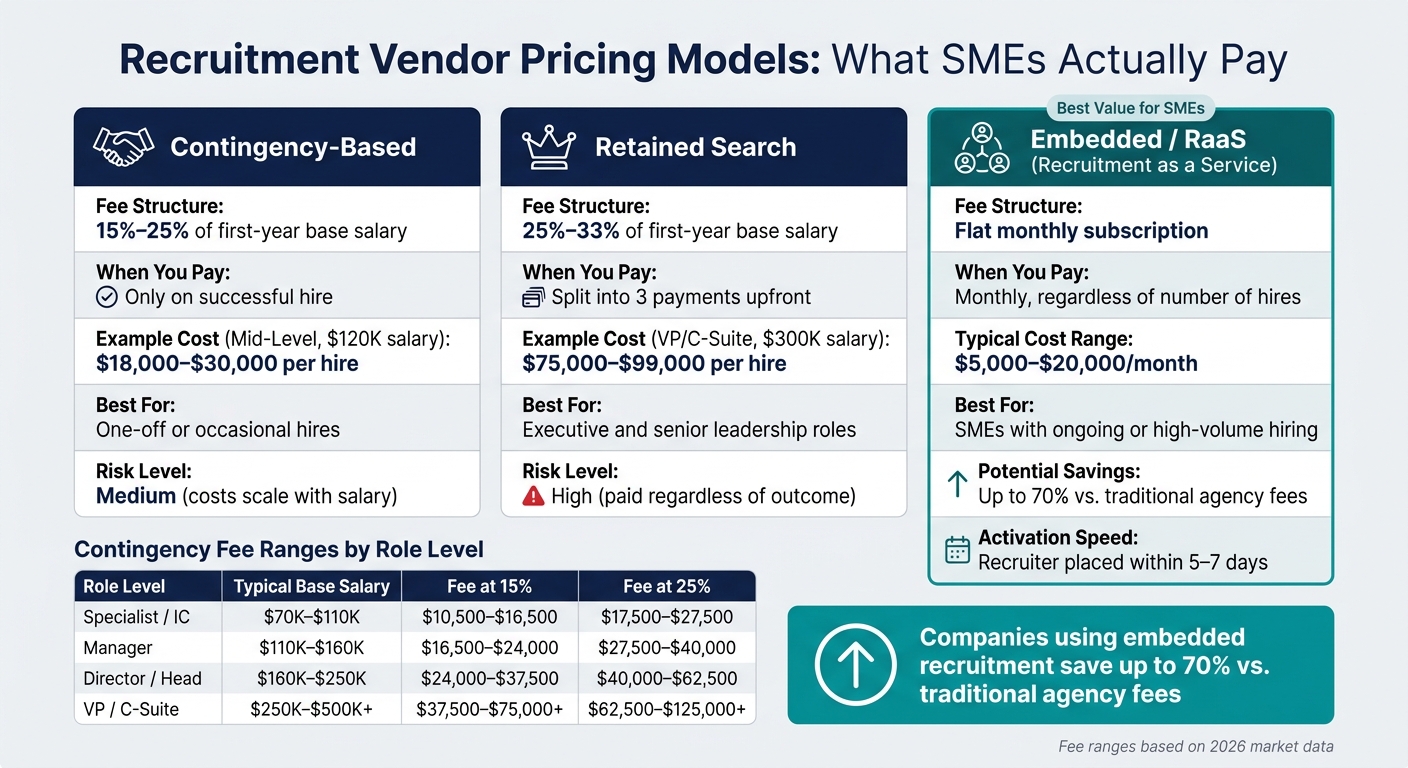
Recruitment Vendor Pricing Models Compared: Contingency vs. Retained vs. Embedded
1. Industry Experience and Specialization
Recruiters aren’t one-size-fits-all. A firm that’s great at hiring retail managers might fall short when sourcing an embedded systems engineer or a fintech compliance lead. The difference between a generalist recruiter and a specialist can make or break your hiring process – impacting both speed and candidate quality.
Specialist recruiters bring more than just resumes; they offer established networks, technical know-how, and a deep understanding of market trends. They already understand your industry’s compensation standards, know where top talent is located, and have strategies to engage passive candidates who aren’t actively job hunting. As RecruitBPM explains:
"Deep domain expertise in a specific vertical, the candidate networks, the compensation benchmarks, the terminology, and the professional community context is significantly harder to find and dramatically more valuable." [1]
This expertise can translate into real results. Specialized recruitment programs often reduce time-to-hire by up to 55%, with the global median sitting at 38 days [3]. For roles that directly impact revenue, that speed can be a game-changer.
When assessing a vendor’s specialization, don’t just rely on their marketing materials. Speak directly with the recruiter who will handle your roles – not the sales team. Ask them to explain their sourcing strategy for a specific technical position in your industry. Request a Talent Mapping Report to see if they can identify actual candidate pools and skill gaps in your market. If they can’t provide salary benchmarks or don’t seem fluent in your industry’s language, it’s a clear warning sign.
| What to Ask | What It Reveals |
|---|---|
| "Walk me through sourcing for [specific role]" | Tests their understanding of technical requirements |
| "Can you provide salary benchmarks for this role?" | Shows their grasp of current market trends |
| "Do you have a talent mapping report for our sector?" | Demonstrates their ability to uncover passive talent pools |
sbb-itb-a23bd6a
2. Track Record, Quality Metrics, and References
A polished vendor pitch can look impressive, but the real proof lies in their track record. To separate true performers from those relying on flashy presentations, compare different recruitment models and ask for hard data – not just a list of high-profile clients. Performance metrics paint a clearer picture of a vendor’s actual capabilities.
The most telling metrics include offer acceptance rate, fill rate, retention rate, and repeat business rate. For example, a recruiter with a 90%–95% offer acceptance rate demonstrates strong candidate matching and effective expectation management [9]. Similarly, a repeat business rate of 70%–80% indicates satisfied clients who trust the vendor enough to return [9]. These numbers are more reliable than any polished case study. However, reviewing embedded recruitment case studies can provide context on how these metrics are achieved in practice.
When vendors boast about retention rates – say, a 98% success rate – dig deeper. Ask how they calculate it. Does it account for resignations? What’s the tracking period? Does "no news" mean success? As Portico Inc. [9] highlights, without proper statistical backing, such claims are meaningless.
Another key factor is the guarantee period. Most reputable vendors offer a free replacement if the hire doesn’t work out within a specified timeframe. The standard is 60 to 90 days [2]. Anything shorter may indicate a lack of confidence in their vetting process.
References are equally critical. Request contacts from your industry and ask detailed questions: What was the CV-to-interview ratio? Were roles filled within the agreed timeframe? Did the recruiter grasp the technical requirements without excessive guidance? Specific, measurable feedback – like a hiring manager sharing exact figures – carries far more weight than generic praise.
To sum up, here are the key performance indicators to evaluate:
| KPI | Target Benchmark | Why It Matters |
|---|---|---|
| Offer Acceptance Rate | 90%–95% [9] | Reflects alignment between candidates and employers, plus negotiation skills |
| Repeat Business Rate | 70%–80% [9] | Indicates consistent client satisfaction and trust |
| Guarantee Period | 60–90 days [2] | Protects you from the cost of a bad hire |
| Fill Rate (Retained) | ~95% [9] | Demonstrates the ability to close challenging roles |
| Turnover Cost (Management) | 50%–200% of salary [2] | Highlights the financial impact of poor-quality placements |
3. Pricing Models, Cost Transparency, and Value
After reviewing a vendor’s track record, the next critical question is: What’s the actual cost? Recruitment pricing comes in many forms, often more complex than SMEs anticipate. The pricing model you choose directly impacts your overall hiring expenses, so understanding these structures is crucial for assessing recruitment value.
The most common model is contingency-based pricing, where you pay only when a hire is successfully made. Fees typically range from 15% to 25% of the candidate’s first-year base salary [10]. For instance, hiring a mid-level employee with a $120,000 salary would cost $18,000–$30,000 per placement. When scaling up to five or more roles in a quarter, these fees can quickly escalate. For executive roles, retained search fees are even higher, usually between 25% and 33% of the first-year base salary, split into three payments [10].
For SMEs with ongoing hiring needs, an embedded recruitment model (also known as Recruitment as a Service) offers a flat monthly fee, typically between $5,000 and $20,000. This approach provides a dedicated recruiter who integrates into your team [10]. At higher hiring volumes, this model can substantially reduce costs compared to percentage-based fees.
Hidden Costs to Watch For
Beyond the standard fees, there are often hidden costs that can inflate your recruitment budget. These include:
- Job board advertisements
- Psychometric testing
- Candidate travel expenses
These are often billed as additional charges [10]. Another potential cost driver is the candidate ownership window – a clause that requires you to pay a fee if you hire a candidate the agency introduced, even months after the initial submission. While a 12-month window is common, aim to negotiate it down to 6 months. Also, ensure "introduction" is clearly defined as a formal written submission [11]. Lastly, confirm whether fees are based solely on the base salary or include total target compensation (bonuses and other perks), as this can significantly alter your final costs [10].
Comparing Contingency Fees Across Role Levels
Here’s a breakdown of contingency fees for various role levels:
| Role Level | Typical Base Salary | Fee at 15% | Fee at 25% |
|---|---|---|---|
| Specialist / IC | $70K–$110K | $10,500–$16,500 | $17,500–$27,500 |
| Manager | $110K–$160K | $16,500–$24,000 | $27,500–$40,000 |
| Director / Head | $160K–$250K | $24,000–$37,500 | $40,000–$62,500 |
| VP / C-Suite | $250K–$500K+ | $37,500–$75,000+ | $62,500–$125,000+ |
| Based on 2026 market ranges [10]. |
The Embedded Recruitment Advantage
Rent a Recruiter eliminates per-placement commissions entirely with a flat monthly subscription model. This gives SMEs predictable recruitment costs and reduces the cost per hire significantly. On average, clients save up to 70% compared to traditional agency fees [5]. For example, Mastertech Group successfully hired 29 employees through this model, saving $123,000 compared to what they would have spent using traditional recruitment agencies [4].
4. Recruitment Process, Technology, and Data Visibility
Transparent pricing and proven results are just part of the equation. A strong, tech-enabled recruitment process ensures real-time insights, fewer delays, and a smoother hiring journey. To evaluate a vendor, focus on their recruitment process and technology stack. These elements are the backbone of process transparency, faster hiring, and fewer mistakes.
What a Well-Structured Process Looks Like
The best recruitment vendors don’t just hand you résumés – they operate with a clear, repeatable process. This typically includes a discovery phase to align on your goals and company culture, followed by sourcing, systematic screening, and structured interviews.
Top vendors also integrate with your existing Applicant Tracking System (ATS) instead of running a separate, disconnected process. This integration keeps all hiring data centralized, giving your team real-time visibility into the candidate pipeline.
"The embedded approach, especially their regular weekly meetings, has streamlined our recruitment efforts and allowed me to become less involved in recruitment and more focused on HR!" – Susan Hogan, Human Resources Manager, Enerpower [8]
Technology That Actually Speeds Things Up
By 2026, 75% of recruiters will consider technology essential [14]. The right tools can significantly impact hiring outcomes:
- Companies using an ATS cut time-to-hire by an average of 40% [14].
- AI-powered screening tools reduce the time spent reviewing candidates by 70% [15].
- AI-driven sourcing tools boost qualified candidate yield by 30% to 45% [12].
However, more tools don’t always mean better results. Recruiters juggling disconnected systems often spend up to 40% of their week on admin tasks [15]. When assessing a vendor, ask how their tools work together. Vendors using a unified recruiting CRM often reduce time-to-hire by 22% and lower vendor costs per hire by 18% [13]. Seamless tech integration not only speeds up hiring but also ensures clear, actionable reporting.
Why Data Visibility Matters for SMEs
Data transparency gives you control over your hiring process. Any vendor you consider should provide regular updates on metrics like time-to-fill, cost-per-hire, and source effectiveness. Vendors embedded into your team and ATS make this easier by logging all activity in your system, giving you a full view of the recruitment pipeline.
Take this example: when Rent a Recruiter partnered with Nitro on a tech recruitment project, they engaged over 3,000 passive candidates, placed 15 hires, and achieved a 2:1 CV-to-interview ratio. The detailed data and reporting throughout the project helped Nitro refine their hiring strategy [16].
"We greatly valued the data and insights they provided, which drove key strategic decisions." – Neil Spellman, Senior Recruiter, Nitro [16]
This level of data visibility not only keeps you informed but also helps shape smarter, more strategic recruitment decisions moving forward.
5. Communication Style, Collaboration, and Fit
A recruitment partner’s communication approach can often determine the success or failure of your hiring engagement – sometimes even more than their technical expertise. In fact, many partnerships fall apart within the first 90 days due to poor communication or fragmented processes that don’t align from the outset [1].
One red flag to watch for? How responsive they are before you even sign a contract. If they’re slow to reply or vague during the sales process, it’s a strong indicator that this behavior will persist once you become a client. As RecruitBPM aptly puts it:
"The best RaaS providers lead with curiosity about how you work, not presentations about how they work." [1]
This curiosity and alignment in communication styles are critical for ensuring their processes integrate smoothly with your team’s workflow.
Avoiding Parallel Workflows
Vendors who insist on separate intake processes often create parallel workflows, forcing your team to juggle their system alongside your own. While technology can help by centralizing data and providing real-time pipeline visibility, it’s good communication that ensures true collaboration and alignment. When both sides are on the same page, the focus stays on achieving the same hiring goals.
To mitigate risks, establish a clear communication cadence before signing any agreements. Whether it’s daily or weekly check-ins, define how and when updates will happen, and set up escalation paths for resolving issues quickly. During the first 30 days, treat this as a calibration period. Schedule a two-week check-in to assess how well communication is working and make adjustments as needed.
Cultural Compatibility Matters
Beyond syncing processes, cultural alignment plays a major role in a recruiter’s effectiveness. The recruiter representing your company to candidates shapes how your brand is perceived. If they don’t understand your tone, values, or what makes someone a high performer in your environment, they could inadvertently send the wrong message – harming your employer brand [5].
For example, clients of Rent a Recruiter have highlighted the importance of this alignment. Noelle Harnett, HR Operations Manager at Silver Stream Healthcare Group, praised her dedicated recruiter for being “personable” and “approachable,” noting they went “above and beyond” in communication. This kind of collaboration turns a recruiter into a true extension of your team [5][6].
| Key Communication and Cultural Integration Criteria | |
|---|---|
| Integration Dimension | Key Evaluation Criteria |
| Workflow | Adherence to your intake, screening, and submission standards [1] |
| Technology | Direct ATS access, real-time pipeline visibility, and data security [1] |
| People | Defined feedback loops, sync frequency, and candidate ownership [1] |
| Culture | Alignment with your company’s tone, values, and employer brand [5] |
6. Scalability and Flexibility for Hiring Surges
Growth doesn’t follow a straight path. A funding round, product launch, or unexpected market opportunity can quickly push hiring needs from two roles a month to 20. The real question is not just whether a vendor can handle the volume, but how quickly they can adapt without slowing you down.
Deployment speed is a clear indicator of a vendor’s ability to flex. Leading embedded models can place an experienced recruiter in your team within 5 to 7 days of signing a contract [5][1]. This kind of responsiveness is essential when scaling rapidly. On the other hand, traditional RPO setups often take weeks – or even months – to get started [17]. When evaluating vendors, ask for their exact "time-to-activation" metric. If they can’t provide a clear answer, consider it a warning sign.
The structure of the contract is just as critical. Long-term agreements, like 12- or 24-month commitments, can be risky for SMEs with fluctuating hiring demands. Instead, look for month-to-month or subscription-based contracts. These allow you to scale hiring up or down as needed, without penalties. This flexibility is the hallmark of a true growth partner, as opposed to a vendor prioritizing their own revenue over your business needs.
The benefits of flexible, embedded models speak for themselves. VicReturn filled 18 senior roles in just four months, screening 1,481 applicants and saving over 600 hours of HR time [16]. Nitro started with a 3-month contract that grew into a 14-month partnership, resulting in 15 successful hires, a 2:1 CV-to-interview ratio, and outreach to over 3,000 passive candidates [16][7]. Neil Spellman, Senior Recruiter at Nitro, summed it up perfectly:
"The flexibility of Rent a Recruiter’s service exceeded our expectations. We greatly valued the data and insights they provided, which drove key strategic decisions." [5]
Maintaining quality during hiring surges is non-negotiable. Scaling too quickly without a structured approach can lead to poor hires, and management turnover alone can cost 50%–200% of a salary [2]. Ensure your vendor uses calibrated role briefs and competency-based evaluations to keep screening consistent, even when demand skyrockets.
7. Legal Compliance, Ethics, and Risk Management
When assessing recruitment vendors, it’s not just about scalability or cost-effectiveness – legal compliance and ethical practices are equally critical. These factors aren’t optional; they’re essential for protecting your business from significant hiring risks. A compliance misstep by your recruitment partner doesn’t just affect them – it can directly impact your company, even if you weren’t involved in the mistake.
Under regulations like the EEOC guidance and the OSHA Temporary Worker Initiative, both the recruitment vendor and the hiring company share responsibility for the fair treatment and safety of workers [18][21]. For instance, if a vendor excludes candidates based on protected characteristics like race, gender, age, or disability, your company could face legal consequences for discrimination. Vendors must comply with laws such as Title VII of the Civil Rights Act, the ADA, and the ADEA, and they cannot act on client requests that conflict with these protections [19][21].
Another area to watch closely is worker classification. Misclassification can lead to costly repercussions. In one case, a staffing agency faced a $9.3 million judgment in July 2025 for wrongly classifying over 1,000 nurses as independent contractors instead of employees. This resulted in retroactive tax and benefit liabilities [21]. Ensuring vendors properly classify workers as W-2 employees or 1099 contractors is essential to safeguarding your finances and reputation.
AI-assisted hiring tools also pose growing risks. While 57% of companies use AI in recruitment, over half are concerned about potential bias or unjust candidate rejections [20]. By 2026, regulations will require vendors using AI tools to conduct bias audits, inform candidates, and document fairness in their algorithms. Non-compliance can lead to fines, with New York City imposing penalties starting at $500 per violation per day [20]. Before partnering with a vendor that uses AI, request their bias audit reports and confirm they include human oversight in their screening process.
Finally, your contracts with vendors must include clear, enforceable protections. These should cover the right to audit I-9 records, robust data security measures, a 48–72 hour breach notification window, and mandatory data deletion once the contract ends [22][23]. Kristen Thomas of ComplyIQ sums it up well:
"Vendor models are like opaque vendors. You can hire them, but you still answer for their work." [22]
If a vendor hesitates to agree to these terms, it’s a red flag that warrants deeper investigation into their compliance practices.
Conclusion
Selecting the right recruitment partner isn’t just about ticking boxes; it’s about ensuring your business avoids costly missteps. The seven criteria – industry expertise, measurable quality, transparent pricing, tech compatibility, communication alignment, scalability, and legal compliance – are essential to creating a hiring process that works seamlessly. Skipping any of these could lead to unnecessary hurdles.
When small and medium-sized businesses move from reactive, one-off hiring to structured partnerships, the results are clear: better candidate quality, faster hiring timelines, and reduced costs. For example, embedded recruitment models can cut hiring expenses by up to 70% compared to commission-based agency fees.
"Time-to-fill acceleration pays for agency fees in scenarios where vacancy cost is meaningful, which is most senior and revenue-generating roles." – RecruitBPM [2]
Start small. Trial a vendor with a single role to gauge their speed, candidate quality, and communication. If you’re ready to create a scalable hiring system, Rent a Recruiter places experienced recruiters directly in your team, offering full-cycle hiring support while cutting recruitment costs by up to 70%.
FAQs
What questions should I ask to confirm a vendor’s industry expertise?
To gauge a vendor’s expertise in your industry, start by requesting specific data. Ask how many placements they’ve made in your industry and for similar roles over the past 12 months. Go a step further and request case studies or references from companies that share similarities with yours.
It’s also important to assess their familiarity with your tools. For instance, ask about their experience with ATS integration or any other systems you rely on. Finally, present a common scenario from your recruitment process and inquire how they would handle it. This will give you a clear sense of their practical knowledge and approach.
Which KPIs best predict recruitment vendor quality?
To assess the quality of recruitment vendors, it’s essential to focus on metrics that reflect speed, effectiveness, and candidate experience. Here are the key indicators to monitor:
- Time-to-Fill: Aim for a benchmark of 36 to 42 days to ensure roles are filled efficiently without compromising quality.
- Submit-to-Interview Ratio: A standard of 3:1 indicates the vendor is submitting well-qualified candidates.
- Quality of Hire: Evaluate through performance scores, 90-day retention rates, and hiring manager satisfaction to gauge long-term success.
- Offer Acceptance Rate: Strive for 80% or higher to confirm alignment between candidates and roles.
- Candidate Net Promoter Score (cNPS): Target a score between 30 and 50 to maintain a positive employer brand and candidate experience.
These metrics provide a clear picture of a vendor’s ability to deliver results while enhancing your company’s reputation in the job market.
What contract terms should I negotiate to avoid hidden recruitment costs?
To steer clear of hidden costs, make sure to negotiate well-defined service-level agreements (SLAs) that outline candidate delivery timelines and feedback expectations. Insist on a solid replacement guarantee, ideally ranging from 90 days to a year. Carefully review any pass-through expenses, such as costs for job advertisements, testing, travel, or relocation, to avoid surprises. Additionally, ensure clarity on candidate ownership windows and exclusivity clauses to prevent unforeseen charges.