
Poor hiring communication costs you money every week a role stays open.
If you lead hiring in a scaling SaaS, fintech, engineering, IT, security, insurance, or professional services firm, the fix is simple in principle: set clear owners, clear response times, and one shared view of the process. When you do that, you cut delay, trim admin, and keep headcount plans tied to business output.
Here’s the short version:
- Time-to-fill now sits around 42 to 44 days in many benchmarks
- Vacancy cost can run at $98 to $500 per day
- For an $80,000 role, lost output can be about $307 per day
- 42% of candidates drop out when interview scheduling takes too long
- Teams with set hiring SLAs can improve time-to-hire by 10% to 30%
What should you do?
- Map every stakeholder before the role opens
- Agree role scope and success measures early
- Set update cadence and decision SLAs
- Use one system of record, usually your ATS plus a simple dashboard
- Review bottlenecks monthly or rate your recruitment process and fix one issue at a time
If internal coordination is slowing hiring, embedded recruitment can give you day-to-day control without the fee model of traditional recruitment agencies. And if you want to talk through your setup, Rent a Recruiter can help.
Below, I break down the communication habits that keep hiring moving, costs tighter, and decisions clear.
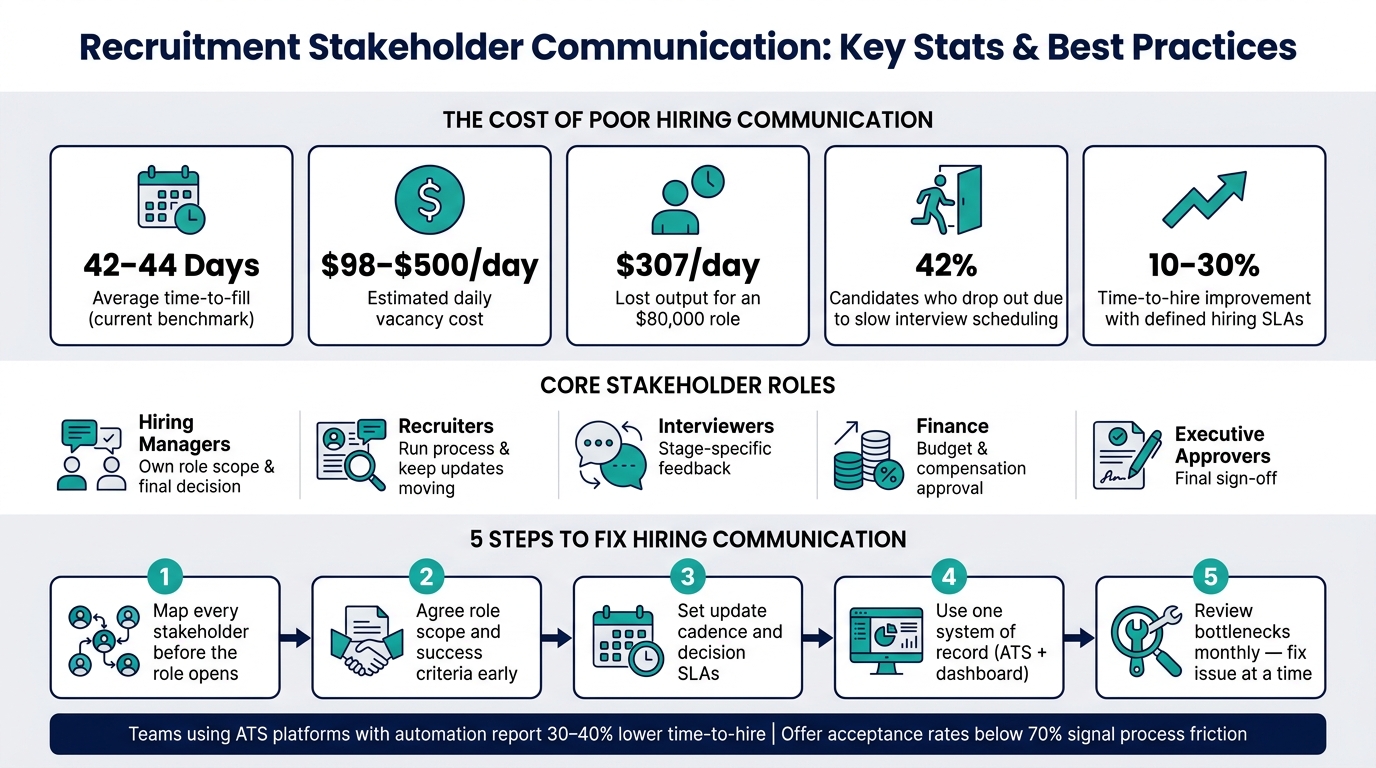
Recruitment Communication: Key Stats & Best Practices at a Glance
Stakeholder mapping and expectation setting
Once you’ve mapped your stakeholders, set roles and expectations before the job goes live. That one step turns hiring communication from messy back-and-forth into a process your team can repeat.
In high-growth SMEs, role overlap is common. A founder might act as both executive sponsor and hiring manager, so responsibilities need to be written down in plain terms [4][7]. Use your stakeholder map to assign each person a clear role in three areas: input, decision-making, and updates.
Who the core recruitment stakeholders are
Most hiring teams involve the same core groups:
| Stakeholder Group | Main Responsibility |
|---|---|
| Hiring managers | Own role scope and final hiring decision |
| Recruiters | Run the process and keep updates moving |
| Interviewers | Give stage-specific feedback |
| HR / people teams | Handle compliance and policy alignment [2] |
| Finance | Approve budget and compensation |
| Executive approvers | Give final sign-off |
If that sounds obvious, here’s the catch: problems usually start when these roles are assumed, not defined—often a sign you need to optimise your talent strategy. One person thinks Finance only needs to review the offer. Finance thinks they need to sign off earlier. Hiring stalls, and your timeline slips.
How to prioritize stakeholders by influence and information needs
Not every stakeholder needs the same update, or the same level of detail.
A simple way to prioritise them is by:
- Decision authority
- Urgency
- Information needs
Hiring managers and executive approvers sit at the top. They need weekly progress updates and fast alerts if anything changes that could affect the hiring timeline. Finance and HR sit in the middle. They should be updated at each key stage, especially when compensation approvals or process rules come into play. Individual interviewers need less day-to-day visibility, but they do need clear briefs before each interview stage.
Match the update style and channel to each group. If you send everyone everything, people tune out. If you send too little, decisions get delayed. Both slow hiring during growth [3][4][5]. For many SMEs, fractional recruitment services provide the expertise needed to manage these complex stakeholder dynamics without the overhead of a full-time hire.
How to align role scope, success criteria, and timelines early
Your kickoff meeting should cover the basics upfront, before sourcing starts. That includes role purpose, 6- and 12-month success criteria, must-have versus flexible requirements, pay range and approval path, interview ownership, target hire date, and response SLAs.
Recruiters should come into that meeting with market data on compensation and talent supply. That makes it easier to push back on unrealistic expectations with facts, not opinion [6]. In scaling companies, that matters. If the brief is off from day one, you waste time screening the wrong profiles and end up reopening the search.
After the meeting, share a written kickoff summary with everyone involved. This becomes the working reference for the role. It keeps decisions tight, reduces confusion, and gives you one source of truth when questions come up later.
Once roles and expectations are fixed, define who sends updates, who approves decisions, and how fast each response is due.
sbb-itb-a23bd6a
Communication cadence, ownership, and decision rules
Once stakeholder roles are set, the next job is to control how communication moves after the search begins. That means setting a clear rhythm, giving each task one owner, and agreeing how fast decisions need to happen.
How often to update stakeholders and through which channels
A predictable cadence does one job well: it removes guesswork. When stakeholders know when they’ll hear from you and what they’ll get, they stop sending ad hoc check-ins that drag the process out.
Use one cadence for each stakeholder group so updates stay predictable and decisions don’t stall.
| Stakeholder | Key information needed | Cadence | Best channel |
|---|---|---|---|
| Hiring manager | Pipeline status, shortlisted profiles, decision deadlines | Twice weekly + after each interview round | ATS dashboard + Slack |
| Executive sponsors | Headcount status, blockers, timeline risks | Weekly or milestone-based for critical roles | Brief email or dashboard summary |
| HR / People Ops | Offers, compensation approvals, risks | Weekly | ATS reports + email |
| Finance | Headcount and budget, offer costs | Monthly or at major offer events | Report + email |
| Interviewers | Interview schedule, scorecard criteria, feedback deadline | Per interview, within 24 hours | ATS reminder + calendar invite |
Some decisions need more than a status note. If you’re reprioritising a role or changing a compensation band, use a short live call or a structured async memo. For executive sponsors, a one-page dashboard or slide works well when it links hiring progress to business metrics like open headcount, time-to-fill, and offer spend.
Who owns updates, approvals, and escalation paths
Give each role one clear owner. If two or three people think someone else is chasing feedback or sending updates, delays creep in fast.
In many strong SME hiring models, that owner is the recruiter or talent partner. The recruiter handles status updates, tracks pipeline movement, and nudges stakeholders when deadlines are slipping. The hiring manager stays accountable for decision speed, including resume screening, interview feedback, finalist selection, and offer approval. [9][10] Embedded recruiters can own coordination end-to-end.
Northwestern‘s HRTA SLA process makes this plain: recruiters connect with hiring managers at least once per week, and if no feedback or status update is received for 14 consecutive days, the search is paused. [12] That kind of rule cuts out confusion. People know the line, and they know what happens if it’s crossed.
How response-time standards reduce hiring delays
Most hiring timelines don’t break at the sourcing stage. They break at decision points.
Cronofy‘s 2024 Candidate Expectations Report found that 42% of candidates leave the recruitment process when scheduling an interview takes too long. [8] That’s a direct hit to hiring outcomes. Delay too long, and your pipeline shrinks before you even get to final interviews.
Set feedback SLAs at same-day to 24 hours for screening, 24 to 48 hours for panel rounds, and 48 to 72 hours for offer approvals. Teams that use these rules can see 10–30% improvements in time-to-hire in structured hiring case studies, along with better forecasting because pipeline stages move at a steady pace instead of in bursts. [11]
To make those SLAs stick, keep them visible in the tools your team already uses. ATS timers, a weekly hiring stand-up, and recruiter-written feedback summaries make it easier for busy stakeholders to respond on time.
Those rules only work when they’re visible in shared tools and documentation.
Shared tools, documentation, and visibility
Shared records and dashboards turn hiring rules into something you can actually manage. Once ownership is clear, the next step is simple: make each hiring decision visible in one place.
What to document at each stage of the hiring process
Documentation should cut repeat conversations, not create extra admin. Each stage needs one standard record. That record becomes the written proof of the roles, rules, and expectations agreed at kickoff.
At intake, document the role purpose, success criteria for the first 6 to 12 months, required skills and experience, compensation range, location or remote rules, reporting lines, decision-makers, hiring timelines, and interview steps. During sourcing and screening, the ATS should hold a candidate pipeline log that tracks who was sourced, where they came from, screening outcomes, and why they were rejected or moved forward. At the assessment stage, standardised scorecards with defined competencies, a 1 to 5 rating scale, and a clear hire or no-hire call should replace scattered feedback across email and chat. At decision and offer stage, record the rationale for the final call, including the chosen candidate, other options considered, compensation decision, expected start date, and any risks or contingencies. Post-hire check-ins against the original success criteria can then sharpen future intake documents and improve alignment over time. For more insights on optimizing your hiring process, visit our recruitment blog. [13]
A simple rule helps keep this clean: no role opens without a completed intake brief, and no candidate moves to offer without at least two scorecards and written hiring manager feedback. [13]
That record should then flow into the ATS and the shared dashboard.
How ATS workflows and shared dashboards improve visibility
An ATS keeps candidate status current and turns day-to-day hiring activity into metrics you can use. Organisations using modern ATS platforms with automated screening, scheduling, and candidate communication report 30% to 40% lower time-to-hire. [14]
Dashboards make that data useful. A pipeline dashboard shows candidate volume and conversion rates by role and stage. A speed and bottlenecks view highlights time-in-stage and feedback turnaround. So if interview feedback is taking five days instead of the expected 24 to 48 hours, leaders can see it fast and deal with it. A process adherence view tracks whether intake briefs and scorecards are being completed at the required rate. [13]
This matters because visibility is not just about reporting. It’s about control.
With the right dashboard view, you can:
- spot delays before they hit offer timelines
- escalate blockers to the right decision-maker
- keep recruiters, hiring managers, and leadership working from the same picture
How embedded recruiter support can strengthen communication
For many scaling SMEs, the gap is usually execution, not tools. An ATS and dashboard only help if someone is updating them every day, chasing feedback, and keeping the process on track.
That’s where embedded recruitment support helps. It gives you the person or function that runs the communication system, keeps records current, and holds the process together as hiring volume grows.
Rent a Recruiter works with high-growth SMEs across technology, SaaS, fintech, engineering, and professional services to provide that support directly inside the team.
Reviewing results and improving communication over time
Which metrics show whether stakeholder communication is working
Use the same structure you set earlier to judge if it’s working. Once your tools and documentation are in place, the next test is simple: is hiring getting faster and more predictable?
Start with the metrics most likely to expose communication issues. You do not need a huge dashboard. A small set of numbers will usually show where things are getting stuck.
Time-to-fill is the clearest signal. SHRM data shows the average U.S. time-to-fill reached 44 days in 2025, up from 33 days in 2021, a 33% increase. [16][17] When time-to-fill drifts up, internal decision-making is often part of the problem.
Interview-to-offer cycle time is another strong measure because it shows how well decisions move after interviews finish. If there’s a long gap between the final interview and the offer, that usually points to slow feedback, unclear ownership, or misalignment on compensation and approvals.
It’s also worth tracking response times across hiring managers, HR, and finance so you can spot approval delays early. Alongside that, keep a close eye on:
- Offer acceptance rate
- Candidate drop-off at key stages
- Recruiter admin hours per hire
Offer acceptance rates below roughly 70% often point to friction somewhere in the process, whether that’s slow updates, mixed messaging, or last-minute surprises. [1][15] Higher candidate drop-off and heavier admin loads usually mean recruiters are spending too much time chasing updates and not enough time moving searches forward.
Once these metrics are visible, use them in short recurring reviews.
How to run simple feedback loops and process reviews
Most hiring teams do not fix communication issues through one big redesign. They fix them through short, regular reviews that catch bottlenecks before they drag out hiring.
A monthly hiring health check is usually enough. Keep it to 30 minutes and have the recruiting lead run it. Review open roles, time-to-fill, response times, and stalled stages. Then pick one fix. Name the bottleneck, assign an owner, and agree what should change before the next review.
Each quarter, bring hiring managers and leadership into a roundtable. Look at offer acceptance trends, candidate experience feedback, and repeat communication issues. Then agree on one test for the next quarter, such as a 48-hour feedback standard for a role family.
Conclusion: Build a communication model that scales with hiring demand
Taken together, these measures make hiring easier to manage as demand grows. The pattern is clear: structured communication improves speed, offer acceptance, and control. Map stakeholders, set scope early, define cadence, assign ownership, use shared tools, and review results on a steady rhythm.
When internal coordination becomes the bottleneck, embedded support can handle the day-to-day process. Rent a Recruiter helps high-growth SMEs place experienced recruiters inside the team to add structure, visibility, and ownership, while keeping hiring costs and admin time under control.
FAQs
How do I set hiring SLAs?
Set hiring SLAs through a shared hiring charter that spells out roles, decision rights, and timelines at each stage of the process.
Be specific with targets. Aim for 24 to 48 hours for post-interview feedback, and 3 business days for interview scheduling and offer approvals. Give each task a clear owner, then record those agreements in a shared workflow or Applicant Tracking System so everyone can see what’s expected and where things stand.
This matters because slow decisions cost you time, slow down offers, and make it easier to lose strong people to other companies. Clear ownership and visible timelines help you hire faster, cut delays, and keep the process under control.
Who owns stakeholder updates?
The recruiter or talent lead should own stakeholder updates as the process owner. They’re closest to the day-to-day work, from hiring activity and candidate flow to communication across the process.
Hiring managers, leadership sponsors, and finance or compensation stakeholders should step in at agreed decision points for input or approval. Keep it simple: assign one decision owner for each stage, then track decisions in a shared log with clear timelines.
That cuts confusion, speeds up sign-off, and gives you a cleaner hiring process with less back-and-forth.
What should a hiring dashboard track?
A strong hiring dashboard should track four areas: efficiency, quality, sentiment, and conversion.
That means watching how work moves through the funnel, where it slows down, and where you lose people. Track stage movement, time-in-stage, candidate drop-off, days open per role, time-to-hire, offer acceptance, candidate satisfaction or Net Promoter Score, and quality-of-hire or new-hire retention.
For leadership teams, less is more. Keep executive dashboards to five to seven key metrics. If a metric sits on the page but doesn’t point to cost, time saved, or hiring results, it’s just noise.
Each metric should make two things clear:
- Why it matters to business outcomes
- What action is needed
That way, your dashboard doesn’t just report on hiring. It helps you spot delays, fix weak points, and make better decisions faster.