
If your hiring dashboard does not show impact on revenue, margin, delivery, or retention, you are tracking the wrong numbers.
I would keep this simple. The article comes down to five steps:
- Turn business goals into hiring targets
- Pick a small KPI set tied to business results
- Set baseline numbers and target dates
- Give each KPI a clear owner and review rhythm
- Use review data to fix bottlenecks
For scaling companies in SaaS, Technology, Fintech, Engineering, Security, Insurance, and Professional Services, this matters because hiring delays hit the business fast. Top candidates can leave the market in 10 days, while many hiring processes still take 40+ days. A bad hire can cost 50% to 200% of annual salary.
The point is not to report more. It is to track the few numbers that help you save time, cut cost, and hit hiring plans with less waste. If you want tighter execution, embedded recruitment can help keep ownership, reporting, and delivery on track when your internal team is stretched.
Below, I break down the five steps in a clear order so you can tie recruitment data back to business results.
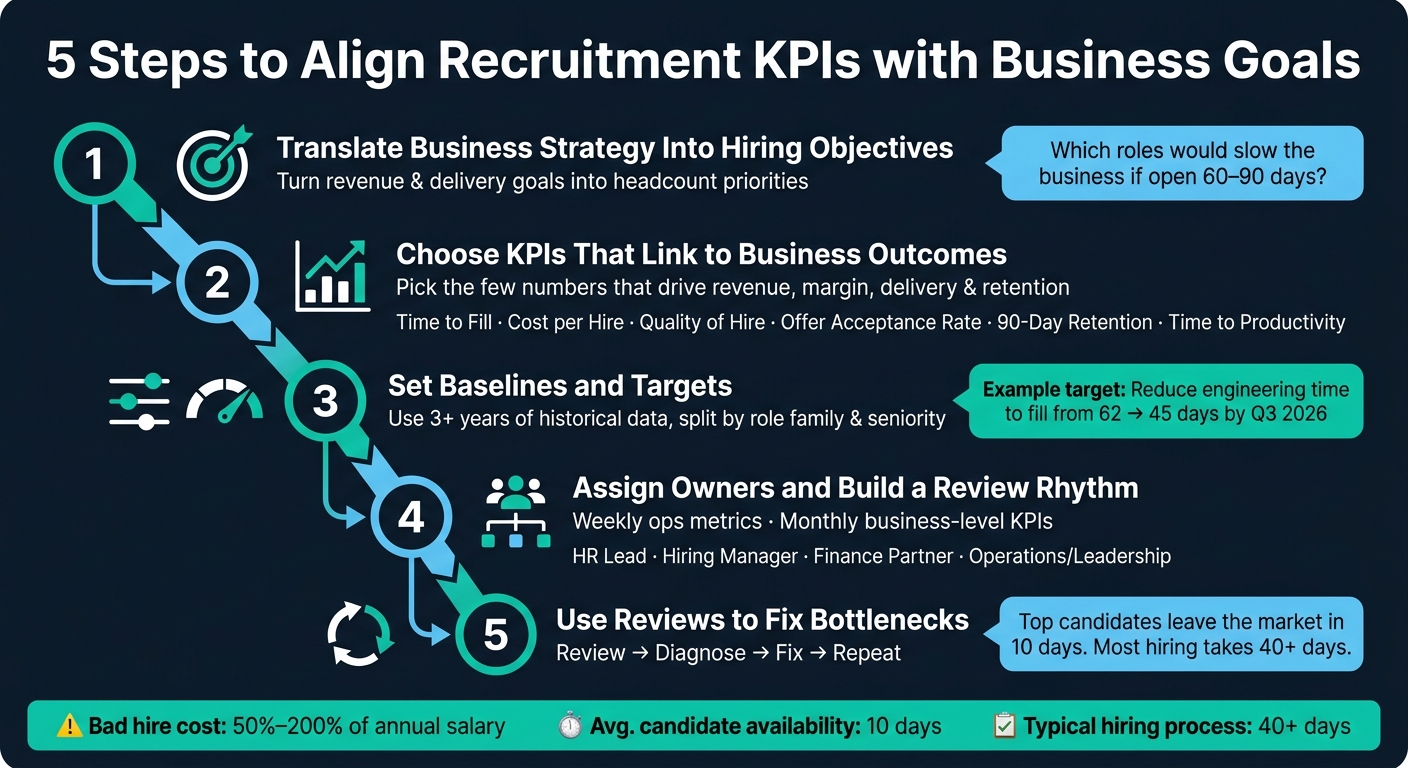
5 Steps to Align Recruitment KPIs with Business Goals
Recruitment KPIs That Drive Results: Measuring Hiring Success, Efficiency & Talent Acquisition Pe…
sbb-itb-a23bd6a
Step 1: Translate Business Strategy Into Hiring Objectives
Start with the business plan. Look at what the company needs to achieve over the next 12 to 18 months, then work back to the hires that make those goals possible.
Turn Revenue and Delivery Goals Into Headcount Priorities
Every business goal creates a hiring need. If you want to grow revenue by 10%, you may need more top-performing sales reps [1]. If a product launch has a fixed deadline, engineers need to be in seat early enough to build, test, and ship on time. If churn is too high, the gap may sit in Customer Success.
One of the most useful conversations you can have with leadership is simple: which roles would slow the business if they stayed open for 60 to 90 days? [2]
That question cuts through noise fast. It helps you sort urgent roles from nice-to-have roles, and it brings Finance, department heads, and HR into the same conversation early. To identify where these gaps exist, you can perform a recruitment health check to audit your current strategy.
| Business Goal | Hiring Objective Example | Linked KPI |
|---|---|---|
| Double ARR | Hire 10 Account Executives by Q3 to support a $2M pipeline target | Time to Productivity |
| Launch product line | Hire 20 engineers with 4 or more years of experience within 6 months | Quality of Hire |
| Enter new market | Build a qualified pipeline of passive candidates in target region | Source of Hire / Pipeline Depth |
| Reduce churn | Increase Customer Success headcount by 15% to reduce churn by 5% | 90-Day Retention |
Each hiring objective should link to one primary KPI and one supporting KPI. That keeps reporting tight and makes it easier to see whether hiring is driving the result the business expects.
Write Hiring Objectives With Numbers, Deadlines, and Owners
Vague goals create vague hiring plans. "Hire more engineers this quarter" doesn’t give your team much to work with.
A stronger objective is specific, time-bound, and owned by one person. For example: "Hire 5 senior backend engineers with 4 or more years of experience within 60 days." Tie each objective back to a business result, and write it with the hiring manager from the start so expectations are clear [3].
This matters because hiring targets are not one-size-fits-all. A senior engineering hire and a mid-level sales hire will have different timelines, costs, and sourcing routes. If you lump them together under company-wide averages, the data gets muddy fast.
Set objectives by:
- Job family
- Seniority
- Geography
Once that’s done, you can map each objective to essential recruitment metrics that measure business impact, not just recruiter activity.
Step 2: Choose Recruitment KPIs That Link to Business Outcomes
Once your hiring objectives are clear, the next step is simple: pick the small set of KPIs that show whether hiring is helping the business move.
This is not about tracking everything your ATS can produce. It is about tracking the few numbers that tell you if hiring is improving revenue, protecting margin, speeding up delivery, or holding onto good people.
Each KPI should support a defined hiring objective. It should not sit on a dashboard just because it is easy to report. In practice, each hiring objective should link to one primary KPI and one supporting KPI.
Match Each KPI to a Business Result
Every KPI should answer a business question, not just a recruiting one.
If a metric does not help you explain business impact, it is probably noise. The best hiring teams connect each KPI to a clear commercial outcome, whether that is revenue, margin, delivery speed, or retention.
Here is how the main recruitment KPIs connect to business results:
- Time to Fill affects project delivery and revenue. When a role stays open too long, delivery dates can slip and revenue targets can come under pressure.
- Cost per Hire links straight to margin and budget control. If hiring spend drifts during a growth phase, your margin gets hit.
- Quality of Hire, measured through performance and retention, is one of the clearest signs of hiring impact. It shows whether new hires are doing the job well and staying long enough to matter.
- Offer Acceptance Rate shows whether late-stage hiring is breaking down, which can throw headcount plans off course.
- 90-Day Retention tracks early stability. It matters because a bad hire is estimated to cost between 50% and 200% of that employee’s annual salary [2].
Use a KPI Mapping Table to Separate Critical Metrics From Noise
A simple mapping table helps you strip out nonessential reporting and keep attention on the KPIs that affect business results.
| KPI | Definition | Linked Business Outcome | Data Source | Owner |
|---|---|---|---|---|
| Quality of Hire | Composite of performance ratings and retention | Revenue growth & team productivity | ATS / HRIS / Manager Surveys | HR Lead |
| Time to Fill | Days from job posting to offer acceptance | Project delivery speed & reduced lost revenue | ATS | Recruiter |
| Cost per Hire | Total internal + external hiring costs divided by hires | Profit margin & budget control | Finance / ATS | TA Lead |
| 90-Day Retention | % of hires still employed after 90 days | Reduced re-hiring costs & workforce stability | HRIS | HR Manager |
| Offer Acceptance Rate | % of extended offers that are accepted | Hiring plan reliability & competitive positioning | ATS | Recruiter |
| Time to Productivity | Time until a new hire hits target output | Faster ROI on headcount & operating efficiency | Performance Data | Hiring Manager |
Keep your dashboard tight. If a metric does not tie back to revenue, margin, delivery, or retention, it does not belong in the core set.
Once those KPIs are locked in, set targets, assign owners, and decide how often each one gets reviewed.
Steps 3 and 4: Set Targets, Build Reporting, and Assign Accountability
Once you know which KPIs matter, the next job is simple to describe and harder to do well: set targets, assign owners, and review them on a rhythm that ties hiring back to business results.
Set Baselines and Targets That Match Actual Performance
Before you set a target, get clear on where you are now. Pull at least three years of historical data from your systems so your baseline reflects your company’s actual path, not a generic market average [1].
That matters more than most teams think. If your baseline is off, your targets will be off too. Then your reporting looks neat, but it won’t help you make better hiring calls.
You also need to split those baselines by role family and seniority level [2]. A single company-wide average for time to fill tells you very little. Engineering and customer support sit in very different hiring markets, with different timelines, pay pressure, and candidate supply. External benchmarks can help as a sense check, but they should come second.
Once your baselines are in place, apply the SMART framework to every target: Specific, Measurable, Achievable, Relevant, and Time-bound [2]. For example, reduce engineering time to fill from 62 to 45 days by Q3 2026 [2].
That kind of target gives you something you can manage. It sets a clear outcome, a clear deadline, and a clear commercial goal, which is less time with roles sitting open and less drag on team output.
Build a Monthly Dashboard With Clear Owners
A good recruitment dashboard should stay simple.
You do not need 20 metrics. You need the right mix of leading and lagging indicators, shown in a way that makes action obvious.
Use a small set of leading indicators, such as pipeline volume and interview-to-offer ratio, alongside lagging indicators like time to fill, cost per hire, and 90-day retention. The leading indicators help you spot issues early. The lagging indicators show whether the hiring process is producing the outcome you want. Use green, yellow, and red status flags against target [4].
Ownership matters just as much as the numbers. If nobody owns a KPI, nobody fixes it. A clean split of responsibility helps avoid finger-pointing and speeds up decisions.
| KPI | Owner | Primary Focus |
|---|---|---|
| Time to Fill, Source of Hire | HR/Recruitment Lead | Data integrity, sourcing efficiency, pipeline volume |
| Interview-to-Offer Ratio, Quality of Hire | Hiring Manager | Candidate assessment, feedback speed, team fit |
| Cost per Hire | Finance Partner | Budget allocation, ROI, financial impact of vacancies |
| 90-Day Retention, Time to Productivity | Operations/Leadership | Strategic growth alignment, retention |
Review operational metrics like time to fill and pipeline health weekly or every two weeks. Review more senior, business-level metrics like cost per hire and retention monthly or quarterly [2].
A shared Service Level Agreement, or SLA, between recruitment and hiring managers also helps. When response times and decision deadlines are clearly defined, accountability is much easier to maintain. It also cuts down slow feedback loops, which often drag out hiring timelines and increase vacancy cost [2].
How Embedded Recruitment Support Can Improve Execution
Setting targets and building dashboards looks straightforward on paper. The harder part is sticking to it when the business is moving fast.
That’s where many scaling companies slip. Reporting discipline fades. ATS data gets stale. KPI reviews get pushed back when hiring volume jumps. And once that happens, you lose visibility fast.
Embedded recruiters can help keep execution, ownership, and reporting steady when your internal team is stretched. Rent a Recruiter provides that embedded support for high-growth SMEs, managing hiring end-to-end while keeping your data clean.
With reporting and ownership in place, the next step is using review data to fix repeat hiring bottlenecks.
Step 5: Use KPI Reviews to Improve Hiring Outcomes Over Time
Once targets, owners, and reporting are in place, the next job is simple: use reviews to improve the hiring process, not just track it. A Review, diagnose, fix, repeat cycle turns recruitment metrics into a practical performance tool [1].
Diagnose Problems by Role, Team, and Hiring Stage
Review KPIs by role, team, seniority, geography, and hiring stage. Then look closely at where candidates or hiring managers are slowing things down inside the process. Aggregate data often hides the actual issue.
A long time-to-fill in engineering, for instance, may not be a sourcing issue at all. It could come from hiring managers taking more than five days to review shortlists, which then slows product delivery [2].
Early attrition in customer success can point to a different problem. If role expectations are unclear during interviews, new hires may leave early, and you end up paying for the same role twice through rehiring costs. Run post-interview candidate surveys to spot process friction and see where strong candidates are dropping out before offer stage [3].
The goal is to move from symptom to cause before you change anything. For more insights on optimizing your hiring strategy, explore our recruitment blog.
Turn KPI Problems Into Specific Process Changes
Once you know where performance is breaking down, tie each issue to a direct process fix. That keeps reviews grounded in action, not theory.
| KPI Problem | Likely Cause | Process Fix | Expected Business Impact |
|---|---|---|---|
| Time to fill rising in engineering | Hiring manager shortlist review taking more than 5 days | Add an SLA: shortlist feedback required within 48 hours | Faster role closure |
| Low candidate satisfaction scores | Interview process creating friction or confusion | Revise interview flow and rubrics; use post-interview surveys | Fewer candidate drop-offs |
| Early attrition in customer success | Role expectations unclear at interview stage | Revise job briefs and interview rubrics; add structured role previews | Better retention and lower rehiring costs |
| High cost per hire across roles | Sourcing mix is not optimized | Expand direct sourcing channels; review sourcing mix quarterly | Lower cost per hire |
| Declining quality of hire scores | Rushed hiring decisions or weak role clarity | Slow down assessment process; add structured scoring to interviews | Fewer bad hires |
Start with the bottleneck that has the biggest business cost. Make one focused change. Then measure the result in the next review cycle.
It also helps to bring in Finance for cost impact and Operations for capacity gaps. That shifts the discussion away from HR reporting and back to what leadership cares about most: cost, time, and hiring output [1].
Conclusion and Next Step
These five steps turn recruitment KPIs into a management tool, not a reporting exercise. You start with business strategy, choose a focused KPI set, set baselines and targets, build reporting with clear ownership, and then improve through structured reviews.
If your internal team is stretched and that review discipline is hard to keep up with, Rent a Recruiter embeds experienced recruiters directly into your team to manage hiring end-to-end. That helps keep your process steady and your reporting clear.
Scaling companies often reduce hiring costs by up to 70% compared with commission-based agency models, while saving over 80 hours per month in internal hiring and admin time.
FAQs
Which recruitment KPIs matter most?
The most important recruitment KPIs are the ones tied directly to your business goals and hiring plans. If a metric does not help you cut hiring costs, save team time, or improve hiring outcomes, it should not be front and centre.
For scaling companies, 5 to 10 KPIs is usually the right range. That gives you enough data to spot problems early, without drowning in reports your team will not use.
A balanced KPI set should be measurable, achievable, and time-bound. In plain terms, you need metrics you can track, act on, and review against a clear deadline.
For most scaling teams, the core metrics often include:
- Time-to-fill, so you can see how long open roles are slowing down growth
- Cost-per-hire, so you can track spend and protect budget
- Offer acceptance rate, so you know whether your value proposition is landing
- 90-day retention, so you can spot hiring or onboarding issues early
- Quality-of-hire, so you measure whether new hires are meeting the bar
- Time-to-productivity, so you know how fast new joiners start delivering value
These are the metrics that give hiring leaders, CFOs, and CEOs a clearer view of whether recruitment is helping the business move or holding it back.
How often should hiring KPIs be reviewed?
Hiring KPIs need regular review if you want them to stay tied to business goals and support better decisions.
Some metrics are worth checking daily, weekly, or monthly, depending on hiring volume and urgency. But your KPI set and recruitment roadmap should be reviewed quarterly.
That quarterly review gives you space to step back and look at the bigger picture. You can spot trends, shift strategy where needed, and keep your team focused on the metrics that drive the strongest business results, lower costs, less wasted time, and better hiring outcomes.
What if our ATS data is incomplete?
If your Applicant Tracking System data is patchy, you can still track hiring metrics with a simple manual setup.
Use a one-row-per-hire spreadsheet to log the key data points for each hire, such as:
- candidate source
- key hiring dates
- total hiring cost
- retention status
It takes about 5 minutes per hire, and that small bit of admin can make your numbers far more dependable.
The bigger point is this: fix the workflow before you fix the tool. If your process is messy or your data entry is inconsistent, your reports will be off no matter what system you use.
Tools help. But they only work as well as the process and data behind them.