
Recruitment feedback loops aren’t just a nice-to-have – they’re the key to building a hiring process that improves over time. For scaling companies, every hire is an opportunity to refine workflows, cut costs, and hire faster. Yet many businesses treat each cycle as standalone, losing valuable insights.
Here’s the bottom line: Feedback loops create a system where you collect input from candidates, hiring managers, and recruiters at every stage – application, interviews, onboarding – and use that data to fix inefficiencies, improve the candidate experience, and make smarter hiring decisions.
Why Feedback Loops Matter:
- Save time and money: Identify bottlenecks like slow interview scheduling or unclear job descriptions by rating your recruitment process.
- Boost hiring outcomes: Metrics like Time to Hire, Cost per Hire, and Candidate Satisfaction improve when feedback is applied.
- Strengthen employer brand: Candidates feel valued, increasing referrals and offer acceptance rates.
How to Build Effective Feedback Loops:
- Set clear objectives: Define what you want to learn at each stage (e.g., application, interview, onboarding).
- Collect feedback at key points: Use surveys, scorecards, and check-ins to gather insights.
- Act on insights: Organize data, spot patterns, and implement changes quickly.
- Measure success: Track metrics like Candidate Satisfaction or Time to Hire to ensure improvements stick.
Scaling companies that implement feedback loops see real results – like cutting hiring time by 20% or increasing offer acceptance rates by 15%. Ready to improve your recruitment process? Start collecting feedback today and turn hiring into a growth engine.
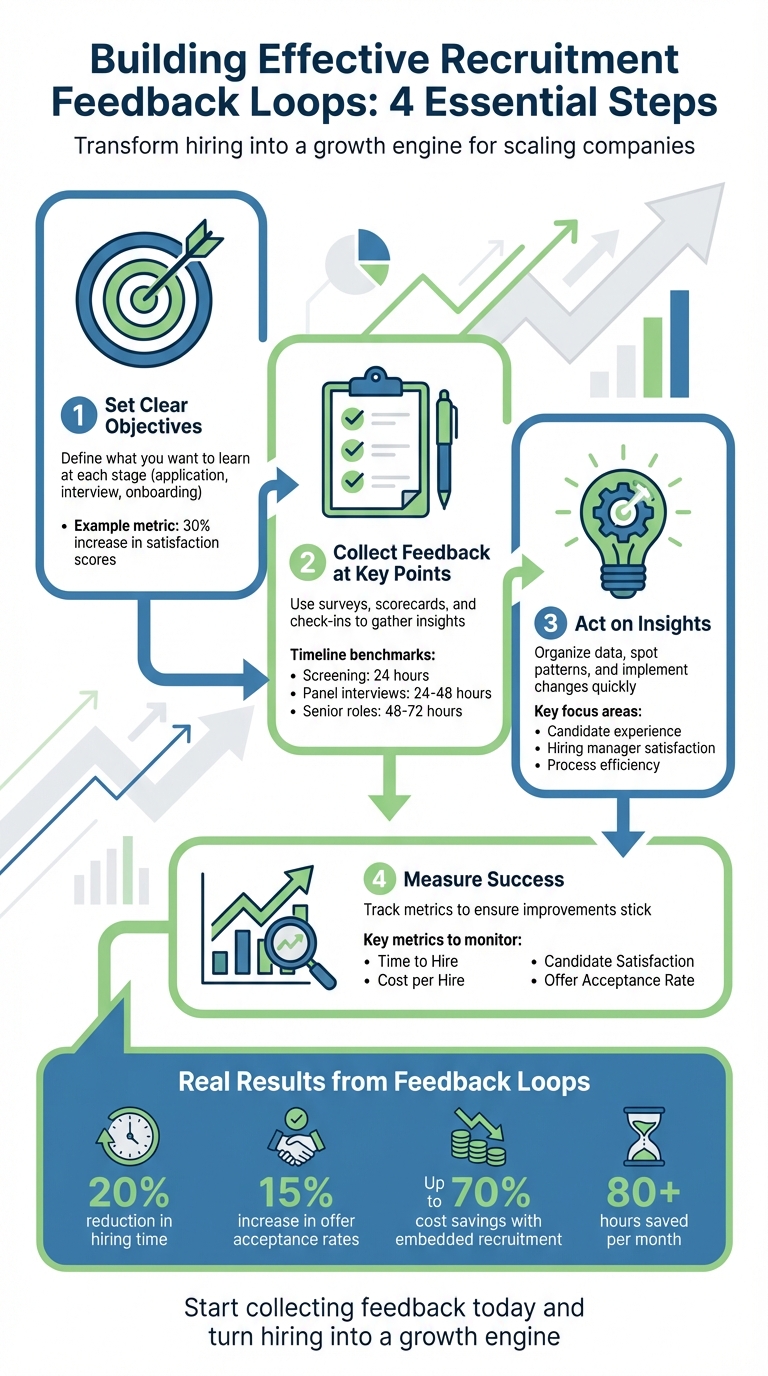
4-Step Process to Build Effective Recruitment Feedback Loops
Measuring Recruiter Feedback to Drive Process Improvement with Will Ducey, Ashby
sbb-itb-a23bd6a
Setting Clear Objectives for Feedback Loops
Before diving into feedback collection, it’s essential to define clear objectives. Without them, you risk gathering unfocused data that doesn’t drive real change. Objectives shape the questions you ask, the metrics you track, and the success criteria you set. For instance, a SaaS startup revamped its application interface using structured feedback and saw satisfaction scores increase by 30% [3]. That kind of outcome isn’t random – it’s the result of targeting a specific problem with purpose.
Defining Goals by Recruitment Stage
Every stage of recruitment presents its own opportunities for improvement. At the application stage, your objective might be to determine if job descriptions accurately represent the role and whether the application process is straightforward [1][2].
In the interview stage, focus on areas like candidate preparedness, understanding of company culture, and the relevance of interview questions [1][2]. A healthcare technology startup, for example, reduced hiring time by 40% by leveraging employee-driven feedback to refine their candidate sourcing process [3].
Post-interview, the focus shifts to candidate sentiment and the likelihood of offer acceptance. Did candidates feel respected and valued, even if they weren’t selected? [1] For onboarding, the goal is to identify gaps in training and support systems that could lead to early turnover. Addressing these gaps ensures new hires are set up for long-term success [1]. Tailoring objectives to each stage ensures that every interaction contributes to a stronger recruitment process.
Focusing on High-Impact Areas
Once you’ve outlined goals for each stage, concentrate on areas with the biggest influence on recruitment outcomes. Feedback should target candidate experience, hiring manager satisfaction, and process efficiency [2]. These three factors determine whether your recruitment strategy runs smoothly or becomes a bottleneck.
Start by evaluating which sourcing channels consistently yield top-quality candidates [2]. This insight helps you allocate your recruitment budget effectively. Set measurable goals, like cutting interview-to-offer time by 20% within a quarter, and implement timely feedback loops – such as a 48-hour feedback window – to keep hiring on schedule [4]. As Carlie Smith, Director of Talent at Circle, explains:
"Feedback is critical to a search. Without it, a search cannot progress; it’s stuck in a holding pattern" [4].
Metrics like Time to Hire, Cost per Hire, and Candidate Satisfaction Scores help you pinpoint inefficiencies. By aligning feedback to these metrics, you turn broad intentions into actionable improvements that drive real results. For more insights on optimizing your hiring strategy, explore our recruitment blog.
Creating Feedback Collection Touchpoints
Once your objectives are in place, the next step is to create structured opportunities for feedback to flow naturally. The idea is to make the process easy and seamless for both candidates and hiring teams. By collecting feedback at the right moments, you ensure that insights remain timely and actionable.
Building Multi-Stage Feedback Opportunities
Feedback works best when gathered at key points throughout the hiring process. Start as early as the application stage by asking candidates about the ease of the process and any technical issues they faced. This helps you identify friction points right at the start [1].
At the screening stage, gather insights from both recruiters and candidates about role alignment and expectations [5]. After interviews, use structured scorecards and evaluation forms immediately – delaying this step can lead to stale or incomplete feedback. For example, companies with hiring cycles exceeding 40 days see a 12% increase in candidate drop-off rates [5]. On the flip side, organizations like Airbnb cut their time-to-hire by 20% in 2024 by refining processes based on candidate feedback [6]. Similarly, Google saw a 25% boost in candidate satisfaction, while IBM improved offer acceptance rates by 15%, all thanks to post-interview surveys [6].
Feedback collection shouldn’t stop once hiring decisions are made. Onboarding check-ins with new hires can reveal gaps in training or support, helping smooth their transition into the company [1]. Internally, debriefs between recruiters and hiring managers can refine job descriptions and sourcing strategies based on the quality of candidates [2][5]. For instance, Hilton Hotels introduced a post-interview survey system in 2024, uncovering that 75% of candidates had highly positive interactions with recruiters, which strengthened their employer brand and reduced time-to-hire [6].
To keep feedback actionable, set strict turnaround times: aim for 24 hours after screening interviews, 24–48 hours for panel interviews, and no more than 48–72 hours for senior-level roles [5]. As Kamila Kashayeva, Talent Acquisition Partner at Tellent Recruitee, highlights:
"I genuinely think that Tellent Recruitee is the best ATS I’ve ever worked with… once your hiring managers get a taste of it as a user, they realize that it’s literally the easiest way to coordinate instead of using email or Slack" [5].
These structured feedback points create a foundation for leveraging advanced tools to streamline the process even further.
Using Tools for Feedback Collection
The right tools can make feedback collection effortless. Modern Applicant Tracking Systems (ATS) like FastHire.io and HROne come with built-in feedback and analytics modules that automate data collection throughout the hiring process [1][2]. These platforms centralize scheduling and feedback, cutting down on coordination headaches [5].
AI-powered chatbots and mobile-first solutions, such as WhatsApp bots, engage candidates and hiring teams in real time to ensure prompt responses [1][6]. Unilever, for example, reduced its time-to-hire by 50% by using AI-driven chatbots to collect immediate feedback from candidates [6]. For busy hiring managers, simple thumbs-up or thumbs-down options offer a quick and effective way to provide input without slowing down the process [5].
Anonymous surveys are another way to encourage honest feedback, as they eliminate concerns about potential repercussions for negative comments [1][2]. Automated triggers can send evaluation requests as candidates progress through the pipeline, with preset deadlines ensuring timely responses [5]. Recruitment software can also integrate with third-party tools for assessments and background checks, capturing performance data at critical stages [2].
To maximize the effectiveness of these tools, train your team with short, 30-minute workshops that showcase best practices for collecting complete feedback. Make feedback submission a required step before advancing candidates to the next stage to ensure accountability and keep the process moving smoothly.
Analyzing and Acting on Feedback
Collecting feedback is just the starting point. The real value lies in turning that feedback into actionable steps that improve your hiring process. Without a clear plan for analysis, it’s easy to get overwhelmed and miss opportunities for meaningful change.
Organizing and Prioritizing Feedback Data
Begin by sorting feedback based on key recruitment stages – application submission, interviews, and onboarding. This makes it easier to identify where specific issues arise and focus your efforts where they’re needed most [1].
Separate numerical data from qualitative insights. Metrics like Net Promoter Scores or satisfaction ratings reveal trends, while open-ended comments provide deeper context behind those numbers [1][2]. Additionally, segment feedback by stakeholder – candidates, hiring managers, and recruiters – to get a complete picture of your hiring process [2].
Look for patterns rather than one-off complaints. For example, if multiple candidates mention unclear job descriptions or a lack of communication, those are areas that need immediate attention. Focus on addressing issues that affect critical metrics like Time to Hire, Cost per Hire, and Quality of Hire [1][2]. As FastHire.io points out:
"Candidate feedback is often a reflection of the entire hiring process, not just the candidate themselves" [1].
Modern Applicant Tracking Systems (ATS) can simplify this process by automating feedback categorization, helping you identify trends without spending hours on manual data entry [1][2]. Once your data is organized, the next step is acting on these insights.
Converting Insights into Action
With feedback organized, the focus shifts to refining your recruitment process through targeted actions. Identify clear steps and assign responsibility for each. For instance, if candidates frequently mention delays in interview scheduling, assign someone to streamline scheduling tools or processes. After implementing changes, measure their impact in the next hiring cycle to ensure continuous improvement [2].
Hold regular review meetings with your team – quarterly reviews work well for most companies – to evaluate feedback trends and plan updates [2]. Keep all stakeholders informed about changes made based on their input. This not only builds trust but also fosters a culture where feedback is seen as a growth tool rather than criticism [2].
HROne highlights the importance of this approach:
"Cycles provide organisations with the ideal pin by revealing what works and what doesn’t, enabling them to adjust their strategies accordingly and continuously improving recruitment" [2].
Ensure that feedback collection remains anonymous to encourage honest responses from both candidates and staff [2]. Experiment with A/B testing for elements like communication styles or interview formats, and track which changes improve satisfaction scores [6]. Finally, share the updates you’ve implemented with future candidates – this demonstrates that your organization values their input and is committed to improvement [6].
Measuring Success and Improving Over Time
In recruitment, tracking the right metrics is the cornerstone of refining your process. Metrics like Time to Hire, Cost per Hire, Quality of Hire, and Offer Acceptance Rates reveal where improvements are working and where adjustments are needed [2][6].
Post-hire metrics matter just as much. Keeping an eye on retention rates and new hire performance ensures your process isn’t just efficient but also effective at finding the right talent [8][6]. Companies that actively gather and act on feedback see real results – like a 14% boost in employee engagement. Additionally, 78% of employers who prioritized candidate feedback reported better hiring outcomes [8]. For example, Google used post-interview surveys to improve candidate satisfaction by 25%, while IBM increased offer acceptance rates by 15% through real-time feedback tools [6].
Key Metrics to Track Feedback Loop Performance
Metrics fall into four main categories:
- Efficiency metrics (e.g., Time to Hire, Cost per Hire) reveal how quickly and cost-effectively you’re hiring.
- Quality metrics (e.g., Quality of Hire, new hire retention) confirm whether you’re hiring the right people.
- Sentiment metrics (e.g., Candidate Satisfaction Scores, Net Promoter Score) gauge the experience of candidates and hiring managers.
- Conversion metrics (e.g., Offer Acceptance Rate) measure how many offers turn into hires [2][6].
It’s also crucial to monitor Feedback Turnaround Time and Time Between Hiring Stages to spot delays or bottlenecks [5]. You can also rate your recruitment strategy to identify other hidden inefficiencies. Keep an eye on the Candidate Drop-off Rate – slow decisions might be costing you top talent [5]. To avoid this, set benchmarks: screening interview feedback should be shared within 24 hours, while panel or final interview feedback should be ready within 48–72 hours [5].
Once metrics are in place, the focus shifts to ensuring your team knows how to turn insights into action.
Training Teams to Use Feedback Effectively
To make feedback actionable, train your team to use it wisely. Short, 30-minute workshops with real-life examples can show what complete, decision-ready feedback looks like [5]. Before interviews, assign specific competencies or skills to each interviewer to prevent redundancy and ensure a thorough evaluation [5].
Structured scorecards and standardized evaluation forms can bring consistency and objectivity to the process, making it easier to analyze data [5]. Teach your team how to use your ATS for recording notes, evaluations, and tagging candidates. Tie feedback submission to workflow progression – for instance, require feedback before advancing a candidate or scheduling debriefs [5].
It’s also important to create a culture where feedback is seen as a tool for growth, not criticism. Involve your team in discussions about the importance of feedback loops to minimize resistance to changes [2]. Regular review meetings, such as quarterly sessions, can help analyze trends and identify areas for improvement [2]. Provide templates with examples of constructive feedback – this not only improves the process but also leaves a positive impression on candidates. In fact, candidates who receive constructive feedback are four times more likely to reapply or refer others, even if they weren’t selected [9].
Using Embedded Recruitment Solutions for Better Feedback Loops
When it comes to improving feedback channels, embedded recruitment solutions bring a level of accountability and efficiency that internal teams often struggle to maintain. Scaling companies, especially those experiencing rapid growth, frequently find their internal resources stretched thin. Embedded recruiters step in to manage the entire feedback process – from coordinating interviews to tracking timelines – ensuring nothing slips through the cracks.
How Embedded Recruitment Strengthens Feedback Loops
Embedded recruiters work closely with hiring managers to define evaluation criteria, design tailored scorecards, and enforce strict feedback timelines [5]. They ensure feedback is submitted before candidates progress, eliminating bottlenecks caused by delayed responses. Instead of juggling scattered emails or Slack messages, they centralize evaluations within your Applicant Tracking System, creating a single, reliable source of truth for the hiring team [5].
To further streamline the process, these recruiters hold mini-workshops to train interviewers on delivering actionable feedback tied to specific competencies. Automated reminders and clear deadlines – such as 24 hours for screening interviews and 24–48 hours for panel interviews – keep the process on track and ensure decisions are made while details are still fresh [5]. This structured approach directly addresses the challenges high-growth companies face in maintaining efficient hiring workflows.
Cost and Efficiency Advantages of Embedded Recruitment
The benefits of this approach go beyond process improvements – they also deliver measurable savings in both time and money. For instance, Rent a Recruiter, a trusted partner for scaling companies in the United States, helps reduce hiring expenses by up to 70% compared to traditional commission-based models. Additionally, companies save over 80 hours per month on internal hiring and administrative tasks, freeing up their teams to focus on strategic priorities.
Embedded recruiters also use data-driven insights to track key metrics like Quality of Hire and Cost per Hire, pinpointing underperforming sourcing channels and cutting unnecessary costs [2]. With 75% of organizations struggling to fill full-time roles [7] and hiring cycles longer than 40 days leading to a 12% increase in candidate drop-off rates [5], having an expert dedicated to analyzing trends and refining search strategies in real time ensures a more efficient hiring process.
Conclusion
Feedback loops transform hiring into a system that constantly evolves and improves. By collecting input from candidates, hiring managers, and interviewers at every stage – from application to onboarding – you create a process that identifies inefficiencies, sharpens workflows, and enhances both productivity and the candidate experience. As HROne puts it:
"Establishing a culture of continuous learning and growth not only helps you to improve your hiring practices and applicant experiences, but it also helps you to optimize your processes." [2]
The results speak for themselves. IBM experienced a 15% jump in offer acceptance rates after introducing post-interview feedback surveys. Unilever, on the other hand, achieved a 92% positive candidate perception by systematically acting on feedback data [6]. These examples underline how structured feedback loops can directly improve metrics like Quality of Hire, Cost per Hire, and Candidate Satisfaction Scores.
Shifting from gut-driven decisions to a feedback-based approach doesn’t mean starting from scratch. Zero in on key stages – application, interviews, and onboarding. Use tools like anonymous surveys, clear performance indicators, and regular debriefs to turn feedback into actionable insights.
Next Steps: Build Your Feedback-Driven Recruitment Process
Ready to take action? Identify gaps in your hiring strategy with Rent a Recruiter‘s free Recruitment Health Check. Their embedded recruiters specialize in creating feedback-driven hiring systems that can cut costs by up to 70% and save over 80 hours a month. Book a consultation today to scale your recruitment process.
FAQs
How do I start a feedback loop if our hiring process is messy?
To improve your hiring process, begin by collecting feedback from both candidates and your hiring team. Use quick surveys, one-on-one interviews, or even casual chats right after interviews or major milestones. This timing ensures the feedback is fresh and accurate. Once you’ve gathered input, look for patterns or recurring challenges. Address these with small, focused adjustments, then track the outcomes to see what works. Repeating this cycle regularly, even if it feels a bit messy at the start, will steadily refine your approach over time.
What’s the best way to get fast interview feedback from busy hiring managers?
Getting quick feedback from managers after interviews can make or break your hiring timeline. To keep things moving, set up a structured process with clear deadlines for managers to share their input.
Tools like applicant tracking systems (ATS) can help by automating feedback collection and sending timely reminders. Another effective approach? Hold brief debrief sessions immediately after interviews. These capture impressions while they’re still fresh and encourage accountability across the team.
Make sure managers understand the stakes. Show them how delayed feedback slows down hiring and impacts overall timelines. When they see the connection, they’re more likely to prioritize this step, keeping your recruitment process on track and maintaining momentum.
Which metrics show if our feedback loop is actually improving hiring?
Key metrics to watch are candidate feedback scores, candidate experience ratings, and the outcomes of any feedback-driven adjustments. Pay attention to results like higher-quality hires and reduced time-to-fill. These metrics provide a clear picture of whether your feedback loop is driving real improvements in your recruitment process.