We judge recruitment ads by qualified hires, not application volume. To improve your return, connect ad spending to your applicant tracking system (ATS), define a qualified applicant, and set spending limits before automating budget decisions. You can also rate your recruitment process to identify other areas for optimization.
Our approach puts three checks first:
- Control costs: Move budget toward sources that produce qualified applicants and hires, not just cheap clicks.
- Count the work: Include platform fees, campaign labour, and screening time when assessing recruitment marketing ROI.
- Test before scaling: Start with a four- to six-week pilot, then allow time to assess hiring results and retention.
<u>Automation controls ad delivery, not hiring decisions.</u> We use reliable tracking and recruiter review to check whether lower ad costs translate into better hiring outcomes.
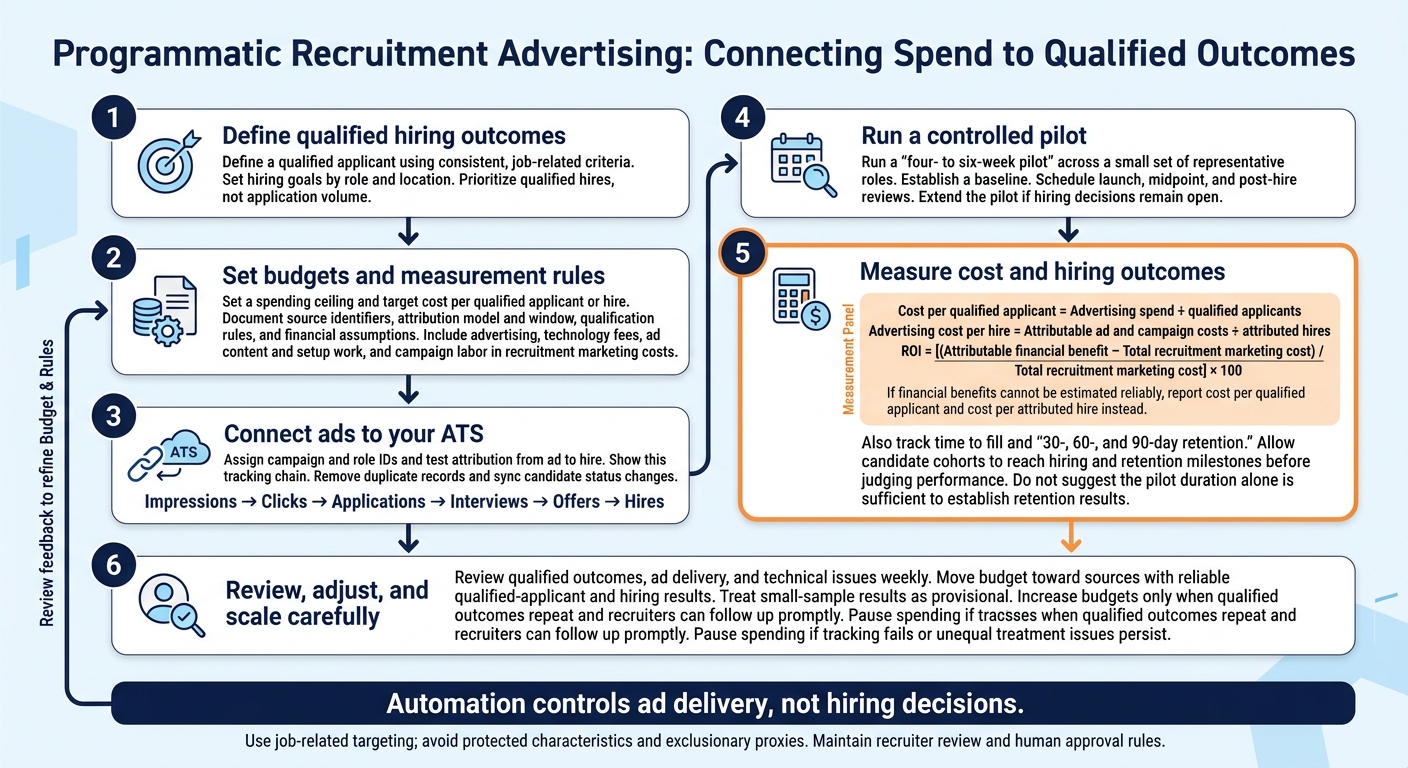
How to Improve Programmatic Recruitment ROI
How Programmatic Recruitment Advertising Works
Once source, job, and ATS data are connected, the system can direct your ad spend automatically. An ATS job feed supplies open roles and updates postings when jobs change or close.
What guides that spending depends on the system. Some track clicks and applications; others use interview and hiring outcomes. Automation controls ad delivery, not hiring decisions.[10][11][12]
Allocate Budgets by Role and Source
The software uses job requirements, location, hiring deadlines, available budget, and past conversions to guide placement and bidding. Within limits you set, it can adjust bids, pace spending, and pause advertising for a role once it reaches its application target.[1][12][13]
For hard-to-fill roles, higher bids can put your ads in front of more people. They cannot fix vague requirements or poor fit. Where supported, live interview and hiring data help direct spending toward sources that produce qualified candidates.[1][12][13]
Where the system supports it, use job-related targeting such as skills, occupation, work location, and shift. Avoid protected characteristics and proxies that could exclude protected groups. Review ad delivery for adverse patterns, and have legal counsel check U.S. employment and privacy rules. Your business remains accountable, even when software controls delivery.[5][6][7][8]
Track Candidates From Click to Hire
A tracking URL or platform identifier links each click to its source, campaign, and role. Your ATS then records each step from application to hire. Check that tracking survives the click-through, remove duplicate records, and sync candidate status changes back to the ad system.[11]
Use later-stage conversion data only when the integration syncs reliably. Otherwise, automated bidding may reflect inconsistent screening rather than source quality.[9][11] Those synced events let automation shift spending toward better hiring outcomes.
sbb-itb-a23bd6a
How Automation Can Improve Recruitment ROI
Once click, application, and ATS data are connected, automation can focus on hiring outcomes, not application volume.
That can mean less wasted spend and less admin. But your data must be reliable enough to guide spending rules, with people reviewing the decisions.[17][18]
| Recruitment challenge | Programmatic response | Requirements |
|---|---|---|
| Wasted spending | Move budget away from sources with weak qualified-applicant or hire results | Reliable spend, source, and conversion data |
| Unqualified applications | Optimize for defined screening or qualification events, not applications alone | Consistent qualification criteria and ATS stage data |
| Limited attribution | Connect impressions, clicks, applications, interviews, offers, and hires | Documented attribution window, tracking rules, and duplicate handling |
| Slow adjustments | Use monitored rules to adjust bids, placements, or budgets as performance changes | Minimum data thresholds, spending limits, and human approval rules |
| Growing campaign workload | Centralize campaign setup, monitoring, and reporting across roles and channels | Platform integration, standardized naming, and clear ownership |
Shift Spending Toward Qualified Hiring Outcomes
Use the last reliable conversion step, not the cheapest click. Direct spending toward sources with stronger qualification rates, interview conversion, and attributed hires.
Compare application starts with completions to find friction in the application process. Then compare completed applications with screening passes to spot possible targeting or messaging mismatches.
Small data samples and tracking errors can skew these signals. Centralized management can reduce manual work, but keep recruiter approval for scarce skills and urgent vacancies.[17][2]
Calculate Recruitment Marketing ROI
ROI = [(Attributable financial benefit − Total recruitment marketing cost) / Total recruitment marketing cost] × 100
Set your measurement period before calculating ROI. Include advertising, technology fees, ad content and setup work, and campaign labor.
Document source identifiers, your attribution model and window, qualification rules, and financial assumptions. Count only attributable benefits. Do not count the same hire twice across sources or benefit types.[18]
Recruitment marketing ROI covers less than total recruitment ROI. The broader measure also includes recruiter labor, applicant-tracking technology, assessments, interview time, agency fees, referral bonuses, travel, and onboarding-related costs.
If you cannot reliably estimate financial benefits, report cost per qualified applicant and cost per attributed hire rather than inventing a dollar return.[14][16][18] Use those figures to move budget, scale a pilot, or stop a weak campaign.
Track Hiring Costs, Quality, and Retention
| Metric | Calculation | Decision supported | Limitation |
|---|---|---|---|
| Cost per click | Advertising spend ÷ clicks | Assess traffic efficiency | Does not measure candidate quality |
| Cost per applicant | Advertising spend ÷ completed applications | Compare application-generation costs | Can reward unqualified volume |
| Cost per qualified applicant | Advertising spend ÷ qualified applicants | Compare quality-adjusted source costs | Requires consistent screening and enough data |
| Advertising cost per hire | Attributable ad and campaign costs ÷ attributed hires | Assess campaign efficiency through hiring | Excludes broader recruiting costs; hiring delays affect results |
Track interview conversion, offer acceptance, time to hire, time to fill, quality of hire, and early retention. Keep the definitions consistent so you can compare results over time.
Use the same attribution rules when comparing ROI by source. Allow time for each candidate cohort to reach hiring and retention milestones before judging performance.[4][15][17][18]
Selection, compensation, manager responsiveness, and onboarding also affect results. Advertising should not get credit for every change.[4][15][17][18]
Before increasing spend, assess your pilot against these metrics. Use that baseline to decide whether the campaign is ready to scale or needs to pause for fixes.
Set Up a Measurable Recruitment Ad Campaign
With measurement rules in place, run a controlled pilot to test whether your campaign produces qualified hires within budget.
Set Hiring Goals and Budget Limits
Create a one-page brief covering roles, headcount, locations, employment type, seniority, U.S. salary ranges, deadlines, and job-related qualification criteria. Keep qualified hires as the priority.
Set a spending ceiling and target cost per qualified applicant or hire for each role or location. Use historical applicant data to inform targets, but first check for missing groups, inconsistent screening, and bias. Federal employment laws still apply when technology guides recruiting and hiring.
Connect Tracking and Run a Pilot
Assign campaign and role IDs, pass them to your ATS through supported integrations, and test attribution from ad to hire. Confirm data access, retention, and consent requirements before launch.
Establish a baseline, then run a four- to six-week pilot across a small set of representative roles. Schedule launch, midpoint, and post-hire reviews. Extend the pilot if hiring decisions remain open.
Review Conversions Before Increasing Spending
Review qualified outcomes, ad delivery, and technical issues weekly, not just traffic. If clicks don’t turn into applications, check mobile usability, broken links, form length, and whether pay and location details are clear.
If applications fail screening, check that targeting and qualification criteria are consistent. Treat small-sample results as provisional.
Increase budgets only when qualified outcomes repeat and recruiters can follow up promptly. Pause spending if tracking fails or unequal treatment issues persist. Use these results to decide whether the campaign is ready to scale.
Add Hiring Support With Rent a Recruiter
Ads can generate applications, but delays in screening, interview coordination, or follow-up can hold back hiring.
If those tasks become the bottleneck, Rent a Recruiter embeds recruiters into your team on a fixed monthly model. It is not a programmatic advertising platform.
The free Recruitment Health Check can identify process gaps. Before engaging, confirm campaign ownership, supported integrations, and who is responsible for reporting and follow-up.
Conclusion: Measure Qualified Hires, Not Just Applications
Tracking source quality and hiring outcomes helps you tie spending to qualified hires, not application volume. That’s what improves ROI. Applications alone don’t prove a return.
Compare each pilot against the same baseline: cost per qualified applicant, cost per hire, time to fill, and 30-, 60-, and 90-day retention.[3] Lower advertising costs mean little if retention drops.
If your hiring team needs more capacity to deliver and measure these results, contact Rent a Recruiter.
FAQs
Can programmatic recruitment ads work with a small hiring budget?
Yes, programmatic recruitment advertising can work well with smaller budgets, with cost-per-hire as low as $850.
These tools automatically distribute job postings across targeted channels and adjust campaigns using real-time performance data. Your budget goes toward the sources that deliver the best results, reducing wasted spend and giving you a more predictable way to scale hiring while keeping costs down.
How can I measure success with only a few hires?
When you’re making just a few hires, candidate quality and hiring progress matter more than application volume. Track qualified applications, conversion rates, your interview-to-offer ratio, and new hires’ long-term performance. These measures help you assess whether your outreach brings in the right talent.
Check your application completion rate too. Remove barriers, such as overly complex forms, that could cause qualified candidates to drop out before your team can assess them.
How do I separate ad performance from hiring process issues?
Track application conversion rates and qualified applications per role as your baseline across the recruitment funnel. If ads get strong engagement but few qualified applications, check your targeting, application form length, and job descriptions before changing the ad itself.
If qualified applicants drop out at the interview stage, the bottleneck may sit in your hiring process. Review recruiter feedback, candidate questions, and drop-offs at each stage before spending time or budget on ad changes.