If you’re struggling to hire the right people, spending too much on recruitment, or losing new hires within months, your recruitment process might be the problem. Inefficient hiring costs companies time, money, and top talent.
Here’s what to watch for:
- Vacancies take too long to fill: Top candidates are off the market in 10 days, but your process drags on for weeks.
- Rising costs per hire: Average cost per hire in the U.S. is $4,800, but inefficiencies can push this much higher.
- Poor-quality candidates: Hundreds of applications but no one fits? Your sourcing strategy might be the issue.
- Early turnover: 38% of new hires quit within the first year, costing companies up to 200% of their salary to replace.
- Inconsistent hiring practices: Different teams, different processes – this creates delays and bias.
The result? Missed growth opportunities, overworked teams, and wasted budgets.
A recruitment health check can pinpoint gaps in your hiring process, from sourcing to onboarding. By addressing these, you can reduce costs, hire faster, and retain top talent.
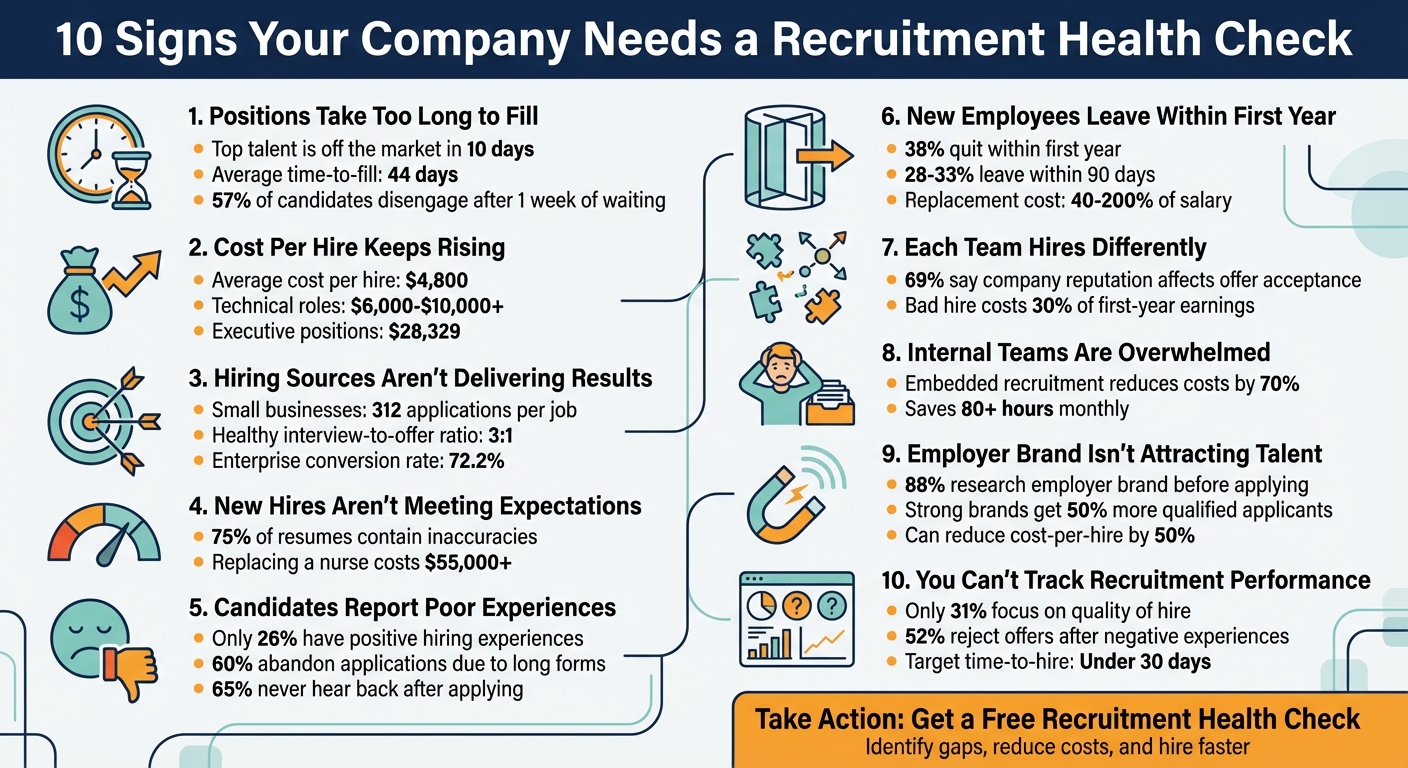
10 Warning Signs Your Recruitment Process Needs a Health Check
1. Positions Take Too Long to Fill
Extended vacancies – averaging 44 days in 2026 compared to just 10 days for top talent [9][4] – aren’t just a revenue drain. They also highlight internal inefficiencies that can ripple across an organization.
Impact on Recruitment Efficiency
Lengthy hiring processes often point to internal hurdles rather than a lack of qualified candidates. In fact, 93% of managers report that hiring now takes longer than it did two years ago [7]. The reasons? Cumbersome approval processes, repetitive interviews, and manual scheduling slow everything down [4][7].
"A sluggish hiring process doesn’t just delay growth – it costs you top talent. Research shows that the best candidates are off the market in just 10 days." – Jessica Miller-Merrell, Founder, Workology [4]
Communication breakdowns only add to the delays. When feedback is slow or sourcing efforts are mismanaged, candidates lose interest fast. Research backs this up: 57% of candidates disengage after a week of waiting, and 25% drop out entirely [9]. These stats make it clear – optimising your hiring strategy is no longer optional.
Alignment with Business Goals
Delays in hiring don’t just affect recruitment; they impact the entire business. Prolonged vacancies lead to overworked employees, stalled projects, and lost revenue opportunities [6][7].
Cost-Effectiveness of Recruitment Strategies
When hiring becomes reactive, costs skyrocket. Small businesses, for example, take nearly 50% longer to screen candidates than larger companies [5][8]. This lag not only drives up expenses but also hurts productivity [6]. Without structured talent acquisition services in place, these challenges compound, making it even harder to fill roles effectively.
sbb-itb-a23bd6a
2. Cost per Hire Keeps Rising
If your recruitment expenses are climbing while your hiring numbers stay the same, it’s a clear sign something’s off. In the U.S., the average cost per hire is around $4,800 as of Q3 2026, but that figure doesn’t tell the whole story [10]. Hiring for technical roles often costs between $6,000 and $10,000+, while executive positions can skyrocket to an average of $28,329 [12][14]. These costs go beyond job board fees or agency invoices – they also include recruiter hours, hiring manager time spent in interviews, and the productivity losses from unfilled roles.
Impact on Recruitment Efficiency
Rising costs often point to inefficiencies, especially in how time is managed. A significant portion of this comes from the hours spent on administrative tasks like scheduling, debriefs, and candidate screening [12][14]. For instance, 67% of recruiters report spending 30 minutes to 2 hours just to schedule a single interview [16]. This inefficiency becomes even more pronounced when job boards adopt "pay-to-play" pricing models, driving up costs regardless of market conditions [11]. Even in industries like tech, where hiring demand has slowed, costs have risen due to the increased screening required for a 5.19% spike in application volumes in 2025 [11].
"Most companies don’t actually know what hiring costs them. They only know what they can see on the invoice." – Sean Griffith, Managing Director, SimpleTexting [14]
Cost-Effectiveness of Recruitment Strategies
The real issue arises when higher costs don’t lead to better hires. Vacant roles can cost anywhere from $500 to $5,000+ per day, depending on the position’s seniority [12][14]. For example, leaving a senior sales role unfilled for 45 days could result in $112,500 in lost revenue [12]. Yet many organizations focus on cutting visible costs, like job board fees, instead of tracking more meaningful metrics such as Management Time Per Hire (MTPH) or sourcing channel efficiency [12][14].
Take one 500-person tech company as an example: in January 2026, they discovered they were spending $120,000 annually on LinkedIn Recruiter, which accounted for only 12% of their hires but consumed 35% of their recruitment budget. By shifting funds to employee referrals and a $3,000/year membership with an industry association, they redirected resources to channels responsible for 60% of their engineering hires [16].
The solution isn’t simply spending less – it’s about spending smarter. Companies with strong employer brands report 43% lower costs per hire compared to those with weaker reputations [13]. Employee referrals, for instance, typically cost about $1,000 less per hire, while referred candidates are hired 55% faster and stay 45% longer [12][14]. If your hiring costs are rising without better results, it’s time to dig into where every dollar – and every hour – is going.
3. Hiring Sources Aren’t Delivering Results
Receiving hundreds of applications but struggling to find qualified candidates? That points to sourcing problems. When screening takes too long and costs keep climbing, poor hiring sources only make things worse. In 2026, small businesses averaged 312 applications per job, while enterprise organizations received 208.1 [8]. But here’s the catch: high application numbers don’t necessarily mean better candidates. If it takes interviewing more than 10 people just to make one offer, your sourcing strategy might be the culprit. A healthy interview-to-offer ratio is around 3:1 – anything higher suggests weak pre-screening [17]. This inefficiency not only eats up your time but also slows down your entire hiring process.
Impact on Recruitment Efficiency
When sourcing falls short, it creates bottlenecks that ripple through the recruitment process. Dr. John Sullivan, a talent management expert, puts it bluntly:
"You can’t hire top candidates who never made it into your applicant pool" [19].
Poor sourcing wastes recruiters’ time, time that could be better spent engaging with strong prospects. On average, enterprise organizations take 5.7 days to screen candidates, while tech companies stretch this to 9 days [8]. The difference often boils down to source quality. Better sources mean better conversion rates: enterprise organizations convert 72.2% of interviewed candidates into offers, while small businesses only manage 7.0% [8]. If you’re conducting dozens of interviews but making few offers, it’s likely your sources are bringing in candidates who don’t meet hiring managers’ actual needs.
Alignment with Business Goals
Weak sourcing doesn’t just slow hiring – it can throw off your entire business strategy. Unfilled roles mean delayed product launches, missed deadlines, and overworked teams. This extra strain can lead to employee burnout [20]. Worse, hiring from poor sources often results in employees who either underperform or leave within their first year. While the average first-year turnover rate in 2026 was 12.1% [8], companies relying on subpar channels see much higher attrition. Ian Cook from Human Resources Today highlights the broader impact:
"The average cost of a poor hiring decision can equal 30% of the individual’s first-year potential earnings – not just from the turnover, but also lower productivity, a damaged employer brand, lower employee engagement, and higher manager time spent on mitigating underperformance" [18].
These challenges underline the importance of aligning sourcing strategies with larger business objectives.
Cost-Effectiveness of Recruitment Strategies
Tracking cost-per-hire is common, but many companies overlook the bigger picture: a top-performing hire can deliver value that’s 20 times greater than the initial sourcing cost [19]. This is why focusing on quality sources is far more effective than chasing high application numbers. If your candidate Net Promoter Score (NPS) is below 50%, it’s a red flag that top talent might be avoiding your channels altogether [17]. Investing in better sourcing isn’t just about saving time – it’s about securing the right people who can drive your business forward.
4. New Hires Aren’t Meeting Expectations
The struggles with recruitment don’t end with sourcing; they extend into how new hires perform. When employees underperform or leave prematurely, it’s often a sign of deeper issues in the hiring process. Overreliance on resumes is a common culprit, with 75% of employers reporting inaccuracies on candidate resumes [21]. The bigger problem? Unstructured interviews and weak vetting processes that allow polished resumes to overshadow actual capability.
Impact on Recruitment Efficiency
A poor hire doesn’t just affect their own role – it ripples across the organization. When underperformers fall short, their teammates are left to pick up the slack, increasing the risk of burnout and turnover [22]. Ryan Nead, a recruiter and business owner at TAL.co, puts it plainly:
"A company is only as strong as its people. When you consistently hire the wrong employees, it slows your company’s ability to innovate, scale, and compete in the market" [22].
If your interview-to-offer rate is lagging – especially compared to benchmarks like the 72.2% conversion rate for enterprise organizations in 2026 [8] – it’s a warning sign. Weak screening processes may be letting unqualified candidates slip through, wasting time on interviews that lead nowhere. This inefficiency doesn’t just hurt day-to-day operations; it also misaligns hiring efforts with long-term goals.
Alignment with Business Goals
Every new hire should directly contribute to a specific business objective, whether that’s driving revenue, improving efficiency, or supporting growth initiatives [22]. When hires fall short, projects stall, deadlines get missed, and the company’s competitive position weakens. Even technically skilled employees can cause problems if they’re not a good cultural fit. For example, in healthcare, replacing a single nurse after a bad hire can cost over $55,000 [21]. To avoid this, start by clearly identifying what the vacancy is preventing your team from achieving, then build your hiring criteria around that need.
Cost-Effectiveness of Recruitment Strategies
The financial toll of a bad hire goes well beyond replacement costs. Underqualified employees slow teams down, disrupt productivity, and can even harm your brand reputation [22]. To combat this, standardize your interviews, incorporate skill assessments, and use behavioral questions to evaluate cultural alignment [21][22]. Companies that implement structured 30-60-90 day plans with regular check-ins often see better results – 95% of new hires rate their onboarding experience positively when they’re given clear goals and early support [8].
5. Candidates Report Poor Hiring Experiences
The way candidates experience your hiring process speaks volumes about your recruitment strategy. It directly impacts not only the quality of applicants but also how your brand is perceived. If your process frustrates or alienates candidates, you risk losing top talent. Here’s a telling statistic: only 26% of North American job seekers report having a positive hiring experience. That means nearly three out of four candidates walk away with a negative impression [23]. This dissatisfaction doesn’t just harm your reputation – it slows down hiring and weakens your ability to attract the best talent.
Candidate Experience and Satisfaction
The numbers don’t lie. A staggering 60% of candidates abandon applications due to forms that are too long or complex, while 58% decline offers because of poor experiences during the hiring process [23]. One of the most common complaints is the infamous "Black Hole" effect – where 65% of applicants never hear back after applying [23]. This lack of communication isn’t just frustrating; it’s costly. Virgin Media famously discovered that negative candidate experiences were costing them $5.4 million annually, as rejected candidates canceled subscriptions and warned others against the company [23][25].
But communication isn’t the only problem. Candidates want transparency. For instance, 74% of applicants prioritize salary information when reviewing job postings, and 38% will abandon an application if the salary isn’t disclosed [23][25]. Mobile accessibility is another critical factor – 83% of candidates expect mobile-friendly applications, yet 70% begin their applications on mobile devices [23]. CareerBuilder research highlights the stakes:
"78% of candidates say the way a company treats them during hiring is a direct indicator of how the company treats its employees" [23].
These gaps in communication, transparency, and usability don’t just frustrate candidates – they prolong hiring timelines and drive up costs.
Impact on Recruitment Efficiency
A poor candidate experience doesn’t just hurt your reputation – it drains your resources. The most qualified candidates, who have plenty of options, are the first to drop out of clunky or slow hiring processes. This leaves you scrambling to fill roles with less competitive talent [23][24]. For example, 48% of candidates decline offers because feedback after final interviews takes too long. When this happens, recruiters often have to restart the search, adding weeks to the time-to-hire [23]. And every week of delay adds $3,500 to hiring costs, with unfilled positions costing an average of $500 per day [23].
Cost-Effectiveness of Recruitment Strategies
The financial toll doesn’t stop at direct hiring costs. Negative candidate experiences ripple outward, making future recruitment even harder. Seventy-seven percent of candidates with a bad experience share their story with their networks, which can deter other potential applicants [23][25]. In North America, 13% of candidates say they’re unlikely to reapply or recommend the company to others [23][25]. And when a candidate declines an offer, the sunk costs can range from $10,000 to $30,000 [23].
So, what can you do? Start by auditing your application process. Aim for an initial application that takes less than 15 minutes to complete and includes fewer than 12 fields. Use automation to send acknowledgment emails with clear timelines, and collect feedback from candidates at two critical points: after rejection and after an offer is accepted or declined [23][25]. A smoother, more transparent process not only improves hiring outcomes but also strengthens your brand as an employer worth working for.
6. New Employees Leave Within the First Year
When new hires leave before completing their first year, it’s a clear red flag for your recruitment process. The numbers are telling: 38% of new hires quit within their first year [26], and 28% to 33% leave within the first 90 days [27][28]. This isn’t just about losing team members – it’s about losing them before you’ve seen any return on your recruitment and onboarding investments. Beyond the loss of talent, these trends drive up operational costs and disrupt business momentum.
The Financial Impact of Early Turnover
First-year turnover comes with a hefty price tag. Replacing an employee can cost between 40% and 200% of their annual salary, depending on the role [27]. For instance, replacing someone earning $50,000 might cost anywhere from $25,000 to $100,000 [28]. And it doesn’t stop there – new hires typically take 8 to 12 months to reach full productivity [28]. When employees leave early, all the training and onboarding resources you’ve poured into them go to waste, creating a ripple effect on both your budget and your strategic hiring efforts.
How It Hurts Recruitment Efficiency
High turnover in the first year creates a vicious cycle. Recruitment teams are forced to focus on replacing departed employees rather than driving long-term growth. This constant churn clogs the hiring pipeline and can even lead to “turnover contagion.” As FirstHR explains:
"When one employee leaves, teammates begin asking themselves the same questions: Should I also be looking? What do they know that I don’t?" [27]
This domino effect not only affects morale but further strains recruitment and retention efforts.
Misaligned Expectations and Business Impact
Early exits don’t just slow down operations – they also hurt overall business performance. A major culprit? Misaligned expectations. Nearly 48% of employees who leave early say the role wasn’t what they were promised [28]. Other reasons include limited career growth, location issues, and rigid remote-work policies – factors cited by 40% and 33% of departing employees, respectively [8]. Even a long commute can be a dealbreaker, with 25% of workers quitting over commutes longer than 30 minutes [26]. Management issues, often stemming from previous roles, also play a role.
To tackle this, focus on transparency and preparation. Honest job previews, structured onboarding programs (like 30-60-90 day plans), and identifying key “stay factors” – such as candidates with a history of long-term roles or genuine interest in your company – can make a huge difference [26][8]. Companies that prioritize these strategies have managed to lower first-year turnover to as little as 12.1% [8]. It’s proof that investing in proper onboarding and expectation-setting pays off.
7. Each Team Hires Differently
When different teams within your company take vastly different approaches to hiring, it creates a ripple effect of inefficiencies. For instance, your sales team might prefer casual, unstructured interviews, while your engineering team opts for multi-stage technical assessments. This lack of alignment makes it harder to evaluate candidates fairly and can unintentionally introduce bias into the process.
Impact on Recruitment Efficiency
Without a consistent process in place, interviews often fail to measure the right skills or provide comparable evaluations. As Kris Leblanc from McQuaig puts it:
"Good hiring needs structure, consistency, and a little science to back it up." [1]
When hiring methods vary by team, it doesn’t just affect how candidates are assessed – it also undermines the recruitment metrics that were highlighted earlier. This can leave you with unreliable data and a hiring process that’s difficult to improve.
Alignment with Business Goals
Disjointed hiring practices make it nearly impossible to track recruitment performance in a meaningful way. Standardizing KPIs across teams ensures hiring efforts align with broader business objectives. This alignment allows for better growth planning, resource allocation, and more accurate predictions about timelines.
Candidate Experience and Satisfaction
A chaotic interview process doesn’t just impact your internal operations – it affects how candidates perceive your company. Poorly organized hiring experiences often find their way onto platforms like Glassdoor and Indeed, where they can harm your reputation. In fact, 69% of candidates say a company’s reputation plays a major role in whether they accept an offer. [29] A negative impression doesn’t just cost you one candidate; it can discourage others from applying altogether.
Cost-Effectiveness of Recruitment Strategies
Inconsistent hiring practices don’t just lead to inefficiencies – they also drive up costs. Poorly structured processes increase the likelihood of bad hires, which can be expensive. A single bad hire can cost your company around 30% of that person’s first-year earnings. [18] Standardized interviews and clear evaluation criteria help ensure every dollar spent on recruitment delivers measurable results, reducing the risk of costly mistakes.
8. Internal Teams Are Overwhelmed with Hiring Tasks
When recruitment teams are stretched too thin, it often hides the internal strain that disrupts hiring efficiency. On the surface, deadlines might be met, but beneath that, the pressure can be immense. Alyson Meister and Nele Dael captured this sentiment through a manager’s experience:
"I was holding it together on the outside, yet inside, I felt like I was screaming. I couldn’t sleep, couldn’t concentrate, and even small tasks felt impossible." [30]
Impact on Recruitment Efficiency
Overloaded teams frequently struggle to handle even routine recruitment tasks [30]. This often forces other employees to step in, creating additional delays and increasing the likelihood of errors [6]. Such bottlenecks disrupt the flow of hiring and make it harder to align recruitment efforts with broader organizational needs.
Alignment with Business Goals
When internal teams are stretched to their limits, recruitment strategies can lose alignment with the company’s objectives. Instead of focusing on how a vacancy impacts business operations, the priority shifts to simply filling the role [2]. This reactive approach can lead to stalled projects, reduced team capacity, and missed growth opportunities [6].
Candidate Experience and Satisfaction
An overstressed hiring team often resorts to rushed and impersonal interview processes. These hurried interactions can leave candidates feeling disengaged. For top talent, such delays or lack of attention can signal instability within the organization, driving them to accept offers elsewhere [6].
Cost-Effectiveness of Recruitment Strategies
Every day a position remains unfilled impacts productivity and increases costs. Restarting recruitment efforts wastes both time and resources [6]. These inefficiencies add up quickly. On the other hand, embedded recruitment models have been shown to reduce hiring costs by up to 70% while saving over 80 hours of administrative work each month. This makes them an attractive option for companies looking to streamline their hiring process and cut unnecessary expenses.
9. Your Employer Brand Isn’t Attracting Talent
Your employer brand plays a critical role in drawing top-tier candidates to your business. Internal inefficiencies and inconsistent hiring practices may create hurdles, but a poor employer brand adds an external layer of difficulty, making it even harder to secure quality talent.
If your job ads are pulling in fewer applications despite steady ad spend, your employer brand might be the issue. A tarnished reputation can turn away skilled candidates. Ryan Nead, Owner of TAL.co, sums it up well:
"Employer reputation is no longer a ‘nice-to-have.’ It is the invisible hand that shapes application volume, offer acceptance rates, and ultimately the strength of your workforce" [32].
Impact on Recruitment Efficiency
A weak employer brand forces recruiters to work harder to convince hesitant candidates instead of focusing on those genuinely excited about the opportunity [32]. Often, qualified candidates drop out mid-process after encountering negative feedback on platforms like Glassdoor, Indeed, or Reddit [32]. For instance, a mid-sized software firm in November 2025 addressed poor Glassdoor reviews by introducing "no-meeting Fridays" and publishing transparent salary bands. The result? Their offer acceptance rate jumped from 68% to 87%, and they slashed agency costs by nearly 33% in just eight months [32].
Alignment with Business Goals
When your employer brand falls short, hiring managers end up interviewing far more candidates just to secure a single hire [32]. On the flip side, companies with a strong employer brand enjoy 50% more qualified applicants and experience 28% lower turnover. This efficiency allows them to redirect resources toward other strategic priorities [34].
### Candidate Experience and Satisfaction
Candidates often come to interviews with preconceived notions shaped by reviews and online discussions. Negative information can lead to immediate skepticism, causing candidates to quietly withdraw from the process [33]. Research shows that 88% of job seekers investigate a company’s employer brand before applying, and 86% check reviews before submitting their application [34]. These perceptions directly influence the success and cost-effectiveness of your recruitment efforts.
Cost-Effectiveness of Recruitment Strategies
A strong employer brand doesn’t just attract more candidates – it saves money. It can cut your cost-per-hire by up to 50% because well-regarded brands naturally attract more organic applicants, reducing reliance on paid ads [32]. Take Accelleron, for example: in October 2024, this ABB spin-off worked with Universum to develop a data-driven Employee Value Proposition. By embedding this EVP into their hiring process and training HR managers, they managed to double global job applications [31]. Ignoring your employer brand, however, will only drive recruitment costs higher.
10. You Can’t Track Recruitment Performance
Failing to track recruitment performance creates a blind spot that makes it hard to identify and resolve issues. Without reliable data, decisions often rely on gut instincts, leaving critical problems like high turnover, selection bias, and poor candidate experiences unnoticed. Focusing on activity-based measures, such as the number of interviews, instead of outcome-based metrics, like quality of hire, further exacerbates these challenges [35][36].
Impact on Recruitment Efficiency
Not monitoring recruitment performance leads to inefficiencies that can derail hiring efforts. Take the case of Tech Innovations: their average time-to-hire of 60 days was delaying projects and increasing costs. The company’s Chief Human Resources Officer revamped the tracking system by introducing a new Applicant Tracking System (ATS), simplifying interview processes, and cutting unnecessary rounds. The result? Time-to-hire dropped to 35 days, project delivery sped up by 20%, and temporary staffing and overtime costs were significantly reduced [15]. Without actionable data, prolonged vacancies can result in losing top candidates and overburdening existing staff [15][36]. Companies should aim for a time-to-hire of 30 days or less – anything over 45 days signals a problem that needs immediate attention [15].
Alignment with Business Goals
Beyond operational delays, poor metrics can create misalignment with broader business objectives. Only 31% of staffing agencies focus on quality of hire over speed and cost [35]. Yet, companies that track quality of hire are four times more likely to see improvements in first-year performance [36]. If recruitment data isn’t integrated with systems like HRIS or performance management tools, key trends can go unnoticed. For instance, a seemingly fast hiring process might lead to employees who leave within six months [35]. Tracking cohorts of hires over time can reveal which sourcing channels or interviewers consistently bring in high-performing, long-term talent [35].
Cost-Effectiveness of Recruitment Strategies
Unchecked recruitment performance can also drive up costs. Without tracking total expenses, hidden costs like ramp-up time, lost productivity, and extra managerial effort remain invisible [35]. Spending on ineffective sourcing channels further inflates budgets unnecessarily [36]. Evaluating the ROI of each sourcing channel is critical to reallocating budgets toward strategies that attract and retain top talent. Consider this: 52% of candidates will reject a job offer if they’ve had a negative experience during the recruitment process [36]. If you’re not measuring candidate satisfaction and dropout rates at every stage, you could be losing top talent and damaging your employer brand without even realizing it. For more insights on optimizing your hiring strategy, explore our recruitment blog.
Conclusion
Prolonged vacancies and inconsistent hiring practices don’t just slow you down – they reveal deeper issues in your recruitment process. Spotting these red flags early can save your business time, money, and unnecessary effort. Overlooking them, on the other hand, often leads to costly turnover, especially when new hires leave within their first 90 days. Meanwhile, competitors with faster, more polished hiring systems snap up the best talent [1].
Top candidates gravitate toward employers with efficient, data-driven recruitment processes. If you’re relying more on gut instinct than on structured methods, you’re likely missing out on standout talent [1]. A slow or disorganized process doesn’t just delay hiring – it risks filling roles with hires who may not drive the growth your business needs [37].
Consider this: research from SHRM shows that 85% of companies have found false or inaccurate information on resumes during recruitment. This highlights the importance of having a structured screening process in place [3].
A recruitment health check can pinpoint the exact areas where your process is falling short – whether it’s outdated job descriptions, interview bottlenecks, or poor data tracking. By identifying these gaps, you can transition to a more structured, efficient approach that reduces unconscious bias and improves hiring outcomes [1]. These insights pave the way for immediate, measurable improvements.
Starting with a free Recruitment Health Check gives you a clear benchmark of your current performance across key areas like employer branding, candidate experience, and diversity. From there, you can make targeted fixes or partner with Rent a Recruiter for expert support. Companies that work with Rent a Recruiter often cut hiring costs by up to 70% and save over 80 hours per month in administrative tasks [38]. For example, VicReturn successfully filled 18 senior roles in just four months, screening 1,481 applicants and saving their HR team over 600 hours [38].
FAQs
What is a recruitment health check?
A recruitment health check takes a close look at your hiring processes to spot inefficiencies or areas that don’t align with your business objectives. It examines critical metrics like candidate quality, time-to-fill, and candidate experience to pinpoint challenges that might be holding you back.
For example, are you dealing with high turnover? Is your hiring process too slow to secure top talent? These are the kinds of problems a health check can uncover, giving you the insights needed for targeted fixes.
The result? A streamlined recruitment strategy that helps you attract the right talent, faster. And in today’s competitive labor market, that can make all the difference.
Which hiring metrics should I track first?
Start by keeping a close eye on Time to Fill, Quality of Hire, and Candidate Experience. These three metrics are critical for understanding how well your recruitment process is performing. They reveal how quickly roles are being filled, the caliber of talent being brought in, and how candidates feel about their journey with your company. Prioritizing these KPIs can help you pinpoint areas that need attention and ensure your hiring strategies are aligned with your overall business objectives.
How do I cut cost per hire without lowering quality?
To bring down your cost per hire while maintaining high standards, focus on making your recruitment process more efficient and informed. Start by identifying and addressing bottlenecks – like overly long interview cycles – that can drain time and resources.
Leverage automation tools to handle repetitive tasks, saving both time and money. For example, automating candidate screening or interview scheduling can free up your team to focus on more strategic efforts.
Keep a close eye on recruitment expenses. By tracking costs and analyzing which efforts yield the best results, you can shift your focus to what truly works. For many companies, this means reducing reliance on high-fee agencies and investing in approaches that deliver better value.
The goal? A streamlined process that minimizes waste while still attracting the talent your business needs to grow.