
If you wait for hiring pain to show up, you usually pay more, fill roles later, and put delivery at risk.
I see the same pattern in scaling SaaS, tech, fintech, engineering, security, insurance, and professional services firms. Predictive analytics helps you spot hiring demand earlier, find funnel slowdowns sooner, and cut avoidable refill work. The business case is simple: lower hiring cost, less time lost, and fewer missed start dates. You can even use an embedded recruitment savings calculator to estimate your potential impact.
A few numbers make the point:
- Average U.S. cost-per-hire is about $4,700
- Average time-to-fill is about 44 days
- Engineering hiring can take about 62 calendar days
- 42% of candidates leave when scheduling drags
- A mis-hire can cost about 30% of first-year salary
- Replacing a professional hire can cost 1.5 to 2 times salary
What matters is not just better reporting. It is using hiring data to answer three business questions:
- When will demand hit?
- Where will the pipeline stall?
- Which hires are more likely to stay and perform?
If you can answer those early, you can plan sourcing sooner, cut agency spend, and compare different recruitment models to give your hiring team more control. If you cannot act on those signals with enough recruiter capacity, the data has limited use. That is where Rent a Recruiter or an embedded recruiter can help turn forecasts into hiring action.
Below, I break down what predictive analytics changes in the hiring pipeline, where the data needs to come from, and what it means for cost, time-to-fill, and hiring outcomes.
AI-Driven Workforce Planning: Predictive Models for Future Talent Needs
sbb-itb-a23bd6a
The Core Pipeline Problems Predictive Analytics Solves
Predictive analytics matters because most pipeline issues don’t blow up all at once. They build in the background. Demand gets spotted too late, hiring stalls at key stages, and poor-fit hires lead to refill costs. These are the points where predictive analytics can flag trouble early, before missed targets hit the business.
Unclear Hiring Demand Leads to Late Hiring Starts
In many high-growth US SMEs, headcount planning still sits in a spreadsheet updated once a year, if that. Hiring starts when a manager asks for help, not when the data says demand is coming.
Take a SaaS company that lands several large enterprise contracts in one quarter. The need for customer success managers, implementation specialists, or engineers can spike fast. By the time that need is obvious, teams are already under pressure and delivery is starting to slip.
Without live demand signals linked to pipeline, ARR, and roadmap data, roles get opened too late. And when hard-to-fill roles can take 30 to 60 days or more to fill, even a two-week delay in opening a req can leave teams stretched and projects off track.
Pipeline Bottlenecks Slow Time-to-Fill for Critical Roles
Once a role opens, delays tend to stack up. Low candidate volume, weak pass-through rates, slow interview scheduling, delayed feedback, and offer declines all drag out time-to-fill. And they tend to hurt the roles you care about most.
This shows up most clearly in hard-to-fill jobs. In the US, the median time-to-fill for engineering roles is about 41 working days, or roughly 62 calendar days, making it the slowest hiring function.[2][3] Only 6.5 of those 41 days are spent assessing candidates. The rest is waiting, scheduling gaps, queue time, and internal review.[3] Panel scheduling alone took a median of 11 working days per hire, more than technical screens and final loops put together.[3]
Candidates won’t sit around forever.
- 42% withdraw from hiring processes because scheduling takes too long.[4][5][6]
- Drop-off goes past 50% by day 23 of a process.[3]
- Each extra week cuts about 19% of the remaining shortlist, and it’s often the strongest people who leave first.[3]
For specialized operations or revenue operations roles, where the talent pool is already tight, that delay gets expensive fast.
Poor Quality-of-Hire and Early Attrition Drive Up Refill Costs
When hiring becomes reactive, hiring quality usually drops with it. People get moved forward on gut feel. Interview criteria shift from one interviewer to the next. Pressure to fill the seat starts to outweigh pressure to fill it well.
That leads to hires who don’t fit the role or the team, and many leave within three to six months.
Replacing a professional-level hire can cost 1.5 to 2 times annual salary once recruiting, onboarding, and ramp time are included. For a scaling company, that’s not just a people issue. It’s a direct hit to cost, time, and team output. Predictive analytics helps spot these patterns earlier, before they turn into another refill cycle.
How Predictive Analytics Improves Pipeline Performance
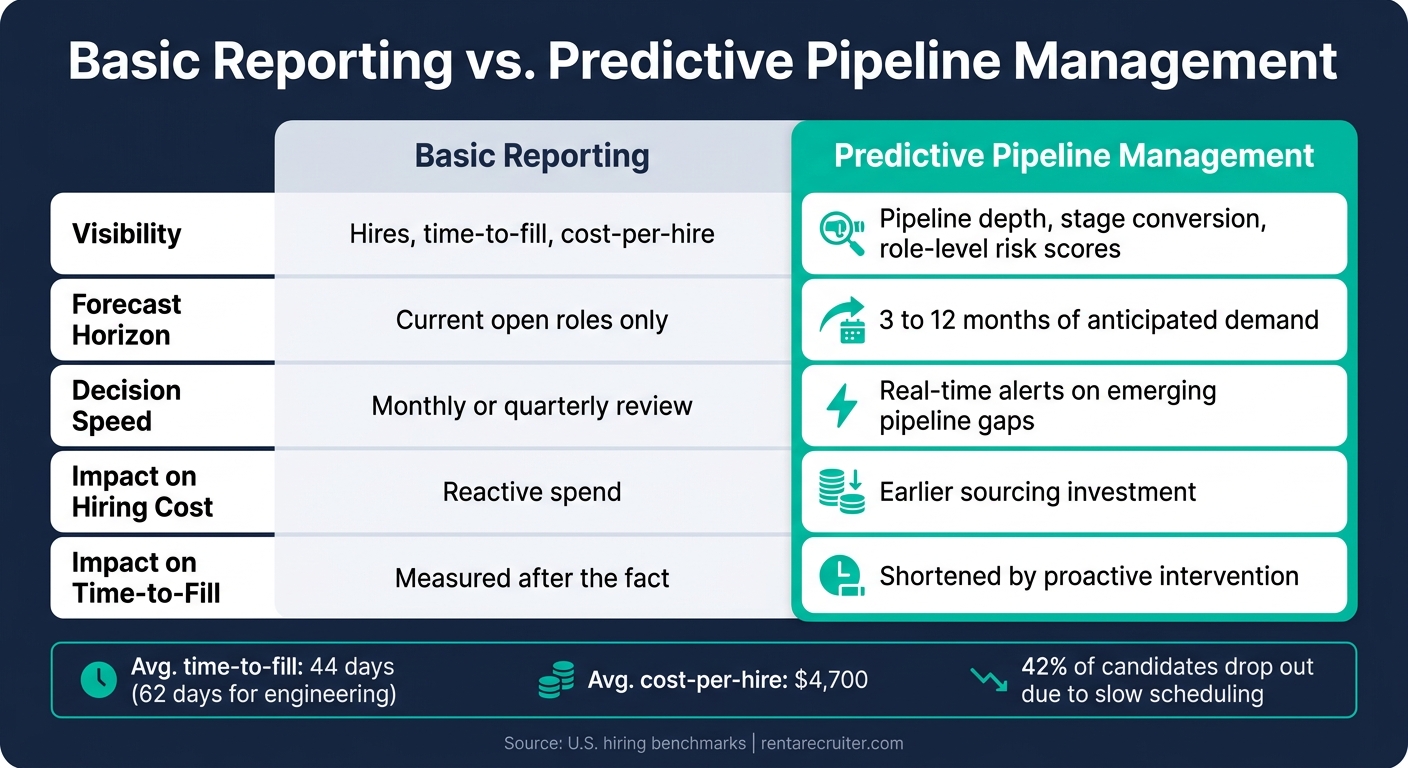
Basic Reporting vs. Predictive Pipeline Management: Key Differences
The value is not the model itself. It is your ability to spot hiring risk before it turns into a vacancy, a delay, or a bad hire.
That is where predictive analytics earns its keep. It turns ATS, HRIS, and performance data into forecasts for hiring demand, pipeline slowdowns, offer outcomes, and retention. For hiring leaders, that means fewer surprises, better planning, and less last-minute hiring pressure.
Forecast Hiring Needs Before Demand Peaks
When you link headcount targets, attrition rates, and time-to-fill by role family, you can build a rolling forecast that shows when hiring demand will spike and when sourcing should begin.
A simple example makes the point. If senior engineering roles take 60 days to fill and annual attrition is 12%, waiting until a vacancy appears puts you behind from day one. You need to start sourcing earlier, not react later.
This does not need to be a heavy data project. A practical forecasting view can start with a clean role taxonomy, such as Engineering-Software, Sales-AE, and Customer Success-Implementation. From there, track hires and attrition by quarter. That gives you a working model you can use to estimate net new hires needed each quarter, 6 to 18 months out, and build a sourcing calendar around it.[9][10]
For scaling teams, the business impact is plain enough:
- Less reactive hiring
- Better recruiter capacity planning
- Lower vacancy cost in hard-to-fill roles
- More time to build pipeline before demand hits
Predict Bottlenecks, Drop-Off, and Offer Outcomes
Once demand is forecast, the next step is to see where the pipeline slows down.
Three models are especially useful here: demand forecasting, attrition modelling, and candidate-fit scoring. Together, they help forecast demand, flag refill risk, and show which candidates are more likely to stay and perform.
Once stage-level ATS data is in place, patterns tend to show up fast. You can also rate your recruitment process to identify specific gaps in your current workflow. You can see where candidates drop out, where interview stages drag, and where approvals create lag. That matters because small delays in the middle of the funnel often become missed hires at the end.
Offer data is one of the clearest examples. Historical patterns can show which roles carry a higher rejection risk based on time from final interview to offer, compensation gaps, and candidate engagement signals. Teams that track this can tighten time-to-offer for competitive roles and line up backup candidates for high-risk offers before a candidate drops out, not after.
That shift saves time, cuts refill work, and protects hiring momentum when the market is tight.
Use Hiring Data to Improve Quality-of-Hire
Pipeline data should not stop at offer acceptance. If you want better hiring outcomes, you need to connect pre-hire data with what happens after the person joins.
Predictive analytics helps here when ATS data is linked to post-hire performance and retention. When you connect candidate source, interview scores, and assessment results to 6-month retention, first-year performance ratings, and manager satisfaction scores, you start to see patterns that instinct alone will miss.
Organizations rating new hires 4.0 or higher on a 5-point performance scale saw average turnover of just 9%, compared with more than 25% for those rated below 3.0.[8] That gap matters. If you can hire more people who perform well and stay longer, you reduce refill demand and take pressure off the pipeline.
Over time, this gives you a much sharper view of what is working. You can track which channels, interviewers, and assessments lead to hires who stay longer and perform better. Then you can refine screening criteria, standardise the interview steps that work, and spend less on channels that generate volume but fall short on retention.
For CEOs, CFOs, and talent leaders, that is the bigger win. Better pipeline performance is not just about speed. It is about hiring people who last, perform, and reduce future hiring load.
What Companies Need to Put Predictive Analytics Into Practice
Once predictive analytics spots risk, the next step is simple in theory and hard in practice: turn the signal into a hiring decision.
For most U.S. SMEs, three challenges in recruitment tend to get in the way. You need clean data. You need a reporting setup that points people toward the right hiring move. And you need enough recruiting capacity to do something with the signal when risk shows up.
Build the Right Data Foundation Across ATS, HRIS, and Reporting
Everything starts with data consistency across systems. That means standardizing stage names, timestamps, source-of-hire tracking, and disposition reasons in your ATS, then connecting those records to HRIS outcomes with one employee ID.[11][14][15][16]
Most SMEs need 12 to 24 months of clean, structured data before models become reliable.[12][13][8] That window matters because it covers seasonal hiring patterns, more than one hiring cycle, and at least one performance and compensation review cycle. It also gives you enough attrition events to separate an actual pattern from a one-off blip.
If your data has gaps today, start fixing them now. Don’t wait for a perfect dataset. Good forecasting depends on clean links between systems. Without that, the output may look smart on a dashboard, but it won’t help you make hiring calls with confidence.
Use a Simple Reporting Framework That Guides Hiring Actions
Basic reports tell you what already happened. Predictive dashboards show where hiring pressure is building before it hits your targets.
| Dimension | Basic Reporting | Predictive Pipeline Management |
|---|---|---|
| Visibility | Hires, time-to-fill, cost-per-hire | Pipeline depth, stage conversion, role-level risk scores |
| Forecast horizon | Current open roles only | 3 to 12 months of anticipated demand |
| Decision speed | Monthly or quarterly review | Real-time alerts on emerging pipeline gaps |
| Impact on hiring cost | Reactive spend | Earlier sourcing investment |
| Impact on time-to-fill | Measured after the fact | Shortened by proactive intervention |
For a scaling SME, an effective dashboard should show three things: pipeline depth by role, role-level risk, and source effectiveness.
Pipeline depth shows how many candidates sit at each stage against what you need. Role-level risk flags which roles are likely to miss their target start date based on current volume and past conversion rates. Source effectiveness shows which channels produce hires who stay and perform.[1][7][17]
That gives hiring managers and leadership a clear view of where action is needed. But data alone won’t move a role forward. The team still needs the capacity to respond.
Act on Insights With Embedded Recruiting Capacity
When a dashboard flags risk, recruiting capacity decides whether the hire stays on track.
A dashboard can tell you that a hard-to-fill position is likely to miss its start date. But if nobody changes sourcing activity, speeds up interviews, or tightens the offer process, the insight doesn’t go anywhere.
This is where many SMEs get stuck. They may have the data. They may even have the dashboard. What they often don’t have is the recruiting capacity to respond fast enough.
That’s where Rent a Recruiter comes in. The team embeds experienced recruiters into your business within days, so you can act on forecasted hiring risk, cut hiring costs, and reduce admin time.
Conclusion: Turn Hiring Data Into a More Predictable Pipeline
Once you’ve flagged demand, bottlenecks, and quality risk, the takeaway is straightforward: predictive analytics makes hiring easier to plan. Reactive hiring is expensive. Roles open too late, searches drag on, and missed hires hit delivery timelines and revenue goals.
Predictive analytics shifts that. It helps U.S. SMEs see when hiring demand is likely to climb, where the pipeline looks weak, and which hires are more likely to stay and perform well.
In practice, that means shorter hiring cycles, lower cost-per-hire, and less early attrition. Over time, hiring stops being a drag on growth and starts supporting it.
You do not need a data science team to get there. What you need is:
- Clean, connected ATS and HRIS data
- A simple dashboard showing pipeline depth, forecasted time-to-fill, and role-level risk
- Enough recruiting capacity to act on what the data is telling you
With those pieces in place, start with your highest-priority roles and build a forecast.
Pull pipeline metrics for your top five critical roles: time-to-fill history, funnel conversion rates, and source-of-hire data. Then map out when each role is needed, how long it usually takes to fill, and where the current pipeline is likely to fall short.
If your team does not have the capacity to act on that data, Rent a Recruiter can help. An embedded recruiter helps you respond to forecasted risk and keep hiring on track.
FAQs
What data do we need to start using predictive hiring analytics?
Start with clean, standardised data from your ATS and HRIS. That should include role details, candidate source, application date, stage progression, stage duration, offer outcome, and start date.
If you want hiring data you can actually trust, this part matters more than most teams think. Messy inputs lead to weak reporting, poor forecasting, and bad hiring calls. Clean data gives you a clearer view of cost, speed, and hiring results.
You should also track post-hire outcomes, including 90-day retention and, where available, 6 to 12 month performance ratings. That’s where hiring data starts to connect with business impact. It helps you see not just who got hired, but whether those hires stayed and performed.
Use at least 2 years of consistent hiring and departure history. Less than that can leave you with gaps, especially if your hiring volume shifts by quarter, market, or role type.
How soon can predictive analytics improve time-to-fill?
Predictive analytics can start improving time-to-fill in roughly 30 to 90 days.
In most teams, that work breaks down like this:
- Days 1 to 30: clean up historical hiring data
- Days 31 to 60: build the model
- Days 61 to 90: compare results against your baseline
That timeline matters because hiring teams rarely have a data problem alone. They have a visibility problem. If your data is messy, your model will point you in the wrong direction. If your baseline is weak, you will not know whether anything is working.
With clean data and a simple model, teams often cut time-to-fill by around 30% to 40%. In some cases, that can reach 60%, but it depends on execution and how clearly hiring bottlenecks show up in the process.
For CEOs, CFOs, and talent leaders, the upside is straightforward: faster hiring, less delay cost, and better use of recruiter time.
Can small teams use predictive analytics without a full data team?
Yes. Small teams can use predictive analytics without a dedicated data team or new software. In most cases, the data you need is already sitting in your ATS and HRIS. The job is to clean it, centralize it, and use it well.
What matters most is not fancy tooling. It’s data consistency and hygiene. If your stage names change from role to role, your reasons for rejection are patchy, or your hiring data lives across spreadsheets and systems, your reporting will be shaky. Fix that first, and you can start spotting patterns that help you plan hiring better, cut delays, and make smarter decisions.
If your team is stretched, Rent a Recruiter can help standardize workflows, clean up hiring data, and turn the information you already have into useful hiring insight.