NLP can cut the time your team spends reviewing candidate feedback and help you spot hiring problems worth fixing. I recommend starting with one source, such as post-interview surveys, and measuring review time and recurring complaints before making changes.
The five benefits for your embedded recruitment team:
- Clearer sentiment: See where communication or interviews cause frustration.
- Recurring themes: Group comments about delays, role clarity, and rejection messages.
- Faster analysis: Review more responses without adding the same amount of manual work.
- Clear actions: Turn repeated issues into process changes with an owner and deadline.
- Consistent tracking: Use shared labels to check whether those changes improve results.
The goal is better hiring processes, not applicant scoring. Keep personal details out of the analysis, have people check the findings, and <u>show response counts alongside percentages</u> so your decisions reflect the evidence.
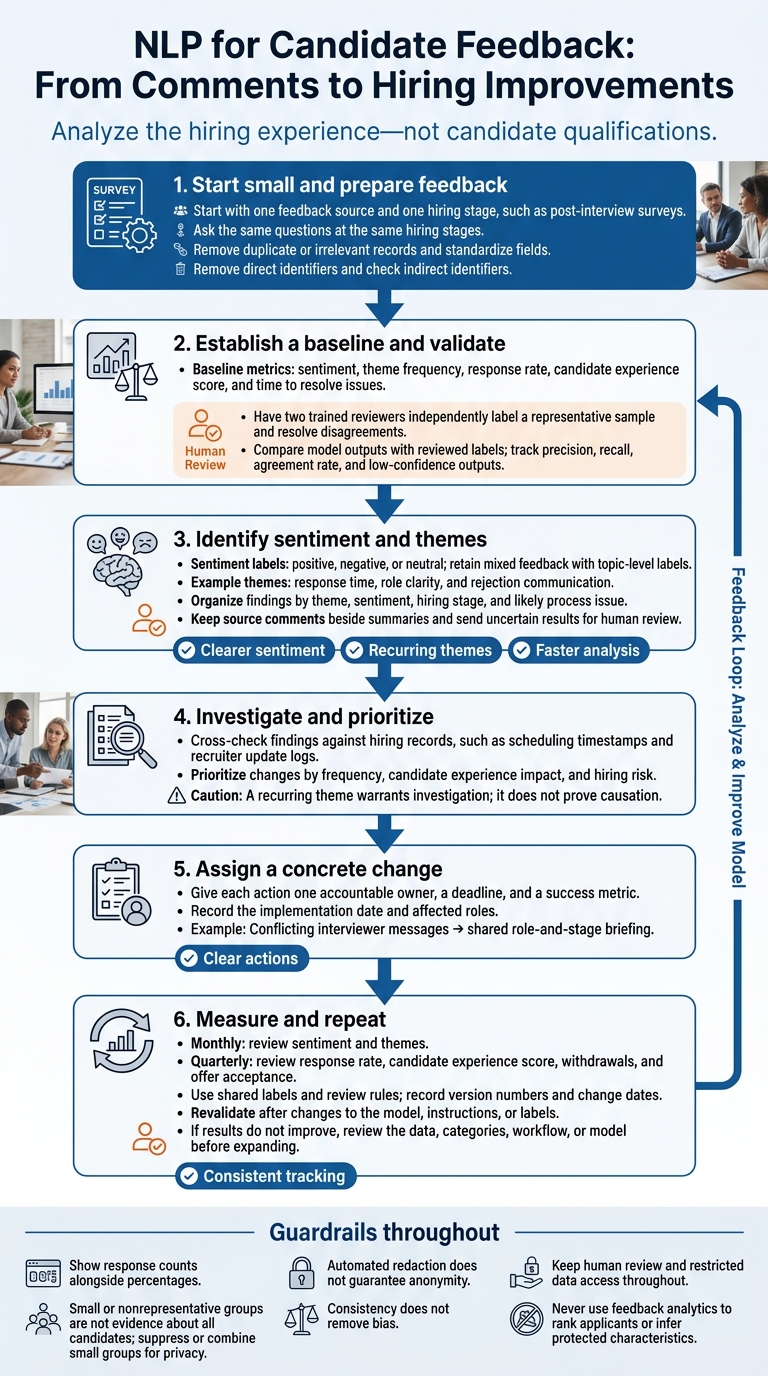
NLP for Candidate Feedback: From Comments to Hiring Improvements
Natural Language Processing (NLP) to analyze Customer Reviews | Sentiment Analysis using VADER
sbb-itb-a23bd6a
What NLP Can Analyze in Candidate Feedback
NLP analyzes the hiring experience, not candidate qualifications. Keep feedback analysis separate from selection decisions. It should not rank applicants or infer protected characteristics.
Use post-interview surveys, candidate-experience questionnaires, and free-text forms. Public comments and recruitment blog feedback-channel submissions can add context, provided you collect and review them in line with applicable law and platform rules. These sources can flag problems with scheduling, accessibility, compensation clarity, and interviewer behavior.
Ask the same questions at the same hiring stages. Pair rating scales with neutral, specific open-text prompts on the same topics. This helps you compare feedback consistently across teams and time periods.
There is no fixed minimum sample size. Collect enough responses for the comparisons you plan to make, and show counts alongside percentages. Small segments should not be treated as representative. If response volume is low, combine feedback over a longer period. Investigate urgent concerns without assuming they reflect everyone’s experience.
Clean, consistent inputs help NLP identify sentiment, recurring themes, and process issues your team can address.
Remove names, email addresses, phone numbers, and application IDs before processing. Check indirect identifiers too, including unusual job titles, specific interview dates, and small offices or locations. Automated redaction does not guarantee anonymity. Context can still identify a person.[2][3] Use human review, limited access, and group-level reporting to support reliable feedback analysis.
These guardrails underpin the five benefits below, starting with clearer sentiment analysis, not applicant selection.
1. Clearer Sentiment Analysis
NLP helps your hiring team read candidate feedback at scale, using AI-powered recruitment tools making it easier to spot problems in your hiring process.
It uses words, phrases, and sentence context to classify feedback as positive, negative, or neutral. It can also flag language that suggests frustration, confidence, or enthusiasm. These are signals in the text, not judgments about someone’s emotions.
Keep mixed feedback visible with topic-level labels, rather than a single overall score. Show the phrases behind each label and flag uncertain results for review.
Sarcasm, negation, and idioms can reverse the apparent meaning. Have trained reviewers check ambiguous or mixed comments before you act. Track their corrections to spot repeated errors.
Compare sentiment across hiring stages, roles, locations, or months only when groups are large enough to protect privacy. Show response counts alongside sentiment percentages.[6][1]
Use sentiment to review your process, not rank candidates. Negative trends should prompt you to investigate communication gaps or hiring process problems, never penalize the people providing feedback.[5][1]
The next step is identifying the themes behind that feedback.
2. Automatic Detection of Recurring Themes
NLP groups comments by meaning, not just exact words. It identifies themes and sorts feedback into defined categories, spotting issues that keyword counts miss.[8][9][10] This turns open comments into patterns your team can review.
Start with a small set of themes you can act on, such as response time, role clarity, and rejection communication. Keep rejection communication separate from general status updates so different problems don’t get buried under one label.[7][9]
Organize findings by theme, sentiment, hiring stage, and likely process issue. Keep the supporting text and use hiring-stage metadata where available. This helps your team connect feedback to specific hiring decisions.
Ask recruiters to review unclear labels, merge duplicates, and check industry terms before accepting a theme. Test proposed causes against scheduling timestamps, response-time records, offer ranges, or stakeholder feedback. A recurring theme warrants investigation; it does not prove causation. You can audit your recruitment process to identify where these themes originate. Grouping themes lets your team review more feedback with less manual reading.
3. Faster Analysis of Large Feedback Volumes
NLP speeds up the first pass through hundreds or thousands of responses. It classifies sentiment, groups similar comments into themes, and creates summaries. You can process feedback in batches or as it arrives without increasing manual work at the same rate.[11][12]
| Factor | Manual analysis | NLP-assisted analysis |
|---|---|---|
| Processing time | People read and code each response individually. | Processes large batches quickly once configured. |
| Scalability | More comments require more reviewer time. | Handles more comments without a matching increase in review time. |
| Consistency | Coding can vary between reviewers. | Applies the same categories repeatedly, but may repeat systematic errors or miss context. |
| Human review | People handle reading, coding, and interpretation. | People validate samples, review low-confidence cases, and check summaries against source comments. |
Before scaling up, remove duplicate or irrelevant records and standardize fields such as interview stage. Prepare a representative labeled sample that covers positive, negative, neutral, ambiguous, and mixed feedback. Validate the results against that sample before processing larger volumes.[13][14]
Keep source comments beside each summary so your team can spot-check results as feedback volumes grow. Measure turnaround time against your manual baseline or rate your recruitment process to track time saved.[11][13]
4. Clear Actions to Improve Hiring
When NLP flags a recurring issue, turn it into one concrete hiring change at the stage where the problem occurs. Recurring complaints can point to fixes such as more interview time slots, confirmed interviewer availability, or clearer role information.
If interviewers give conflicting messages, introduce a shared role-and-stage briefing. If rejection messages are vague, use clearer, more respectful templates that reflect documented evaluations and pass HR/legal review.
Prioritize changes by frequency, candidate experience impact, and hiring risk. Weigh the stages and roles affected, the severity of the issue, and the effort required. Give each approved change an owner and a deadline.
5. More Consistent Feedback Analysis
Use the same labels and review rules each time so you can measure hiring changes and compare feedback trends over time. A shared coding framework gives teams one way to label feedback across roles and hiring periods. Document what each theme means, what it includes and excludes, and how to handle mixed sentiment or comments with multiple themes. Record version numbers and change dates so you can trace each report back to the rules used.[17]
Have two trained reviewers independently label a representative sample, then compare their labels with the model’s output. Track reviewer agreement, false positives, and false negatives for each category, rather than relying on one overall score. Send disputed cases to a reviewer.[17]
After any change to the model, instructions, or labels, rerun a fixed set of previously reviewed comments alongside a new sample. Investigate unexplained shifts before approving the update. This helps your team avoid mistaking a change in the analysis process for a change in candidate experience.[19]
Consistency does not remove bias. Check results across roles, locations, hiring stages, and writing styles. Assign sensitive or unclear feedback to named reviewers, and use NLP to support analysis, not to make hiring decisions automatically.[15][16][18] Stable labels make comparisons across roles, locations, and time periods more reliable, helping you track the impact of hiring changes.
Measure the Impact of Hiring Changes
Set a baseline before making changes: sentiment, theme frequency, response rate, candidate experience score, and time to resolve issues. Once the model is stable, track the same metrics to check whether your changes improved the experience.
Cross-check findings against hiring records. If candidates report slow communication, check whether recruiter update logs show matching gaps. Prioritize issues by frequency, severity, and business impact. Give each action one accountable owner, a deadline, and a success metric. Keep an action log with the implementation date and affected roles. Reviewing embedded recruitment case studies can provide benchmarks for these metrics.
Review sentiment and themes monthly. Every quarter, check broader outcomes: response rate, candidate experience score, withdrawals, and offer acceptance. Report respondent counts alongside percentages so your team can see how much feedback supports each result.
A higher score alone does not prove a change worked. The mix of respondents can affect results. Break down findings by role, stage, location, and candidate outcome. When that mix changes materially, treat comparisons as directional rather than proof of improvement. Before relying on the results, check the model’s outputs and how it handles data.
Check NLP Results and Protect Candidate Data
Validate model outputs before using them to change your hiring process. Have two trained reviewers code a representative sample across engineering roles, stages, languages, and channels, then resolve disagreements. Compare their labels with the model’s sentiment, themes, and summaries. Track precision, recall, agreement rate, and low-confidence outputs. Repeat these checks after major changes to the model, vendor, workflow, or feedback form.[21][22]
Send sarcasm, unclear wording, and recruiting jargon for human review. Maintain a recruiting glossary, and check false positives and false negatives by hiring stage and feedback channel. Qualified reviewers should validate each major language separately, since translation can change tone and meaning. Treat small or nonrepresentative samples as reasons to investigate further, not evidence about all candidates.
After checking accuracy, protect the data behind the analysis. Mask profile links, exact interview dates, rare job titles, health details, and stories that could identify someone. Store any reidentification key separately, encrypt it, and restrict access to authorized personnel. Set a minimum reporting threshold with legal, privacy, and statistical advisers. Suppress or combine smaller groups to reduce identification risk.[21][24]
Use least-privilege, role-based access, multifactor authentication, encryption, and audit logs. Set retention limits for raw comments, model outputs, and exports, while meeting required retention periods and legal holds. Vendor contracts should cover deletion, subprocessors, breach notification, and whether feedback can train the provider’s model.[20][24][25]
Keep feedback analytics separate from candidate evaluation. Have counsel review U.S. privacy requirements, candidate notices, access and deletion procedures, and company policies. If the analysis affects selection, Title VII adverse-impact and selection-procedure rules may apply.[4][23][24][26]
Conclusion: Start With One Feedback Source
NLP helps you interpret, group, and act on candidate feedback. Clean data, privacy safeguards, and recruiter review are needed to make it work.[15]
Start with one feedback source and one hiring stage, such as post-interview surveys. Standardize the fields you collect and set a baseline before changing the process. Ask recruiters to check a sample of the findings against the original comments.
Then link each finding to a measurable process change. Repeat the same survey and track candidate experience scores and how often each theme appears. If results improve, add another feedback source or stage. If they don’t, review the data, categories, workflow, or model before expanding.
FAQs
When is NLP worth using for candidate feedback?
Natural language processing (NLP) can help when high volumes of qualitative feedback slow your hiring team down. It works best when you have a standardized recruitment process, clear hiring criteria, and a consistent feedback loop.
Rent a Recruiter recommends a 30-day pilot on one high-volume role to check whether NLP saves time without compromising hiring decisions.
Use it to summarize feedback, identify themes, and analyze sentiment. Recruiters should review every output and keep final hiring authority.
How can we reduce bias in survey responses?
Keep feedback anonymous so people can respond honestly without worrying about repercussions. For interviews and internal evaluations, use structured scorecards and rubrics to assess every candidate against the same criteria.
Keep interviewer notes and scores hidden until everyone has submitted their own. This helps prevent groupthink and anchoring, so each assessment reflects the interviewer’s judgment.
Hold quarterly calibration reviews to compare scoring patterns, spot inconsistencies, and keep evaluations objective.
How should we handle conflicting feedback trends?
Don’t rush to consensus. Look for patterns by candidate type, hiring stage, or internal stakeholder. Compare comments with hiring metrics to understand where the process gets stuck, rather than reacting to isolated complaints.
In monthly or quarterly reviews, compare documented scores with drop-off rates at each hiring stage. Test process changes under controlled conditions, then measure the results in the next hiring cycle to check whether they address the root cause.